
Iran Claimed a Second F-35 Kill in 12 Hours — But the Wreckage May Expose a U.S. F-15E Strike Eagle Shot Down Over Iran
Crash-site photographs released by Iranian media after claiming a second American F-35 kill instead appear to show debris from a U.S. Air Force F-15E Strike Eagle linked to RAF Lakenheath’s 48th Fighter Wing, raising serious questions about the true scale of American aircraft losses over Iran.
(DEFENCE SECURITY ASIA) — Iran’s claim that its air-defence network destroyed a second American F-35 within twelve hours immediately threatened to transform the air campaign over Iran from a contested battlefield into the first conflict where stealth aircraft could no longer guarantee survivability.
The statement by the Islamic Revolutionary Guard Corps and the Khatam al-Anbiya Air Defense Headquarters carried unusual strategic weight because it asserted that a newly introduced IRGC Aerospace Force surface-to-air system had penetrated the survivability envelope of America’s most advanced combat aircraft.
Iranian media amplified the announcement by declaring that the pilot was unlikely to have survived the crash in Markazi Province, while presenting the incident as evidence that the balance between stealth aircraft and integrated air-defence systems was beginning to shift.

Yet the photographs released within hours created a different and potentially more consequential story because independent aviation analysts quickly concluded that the debris did not belong to an F-35 at all.
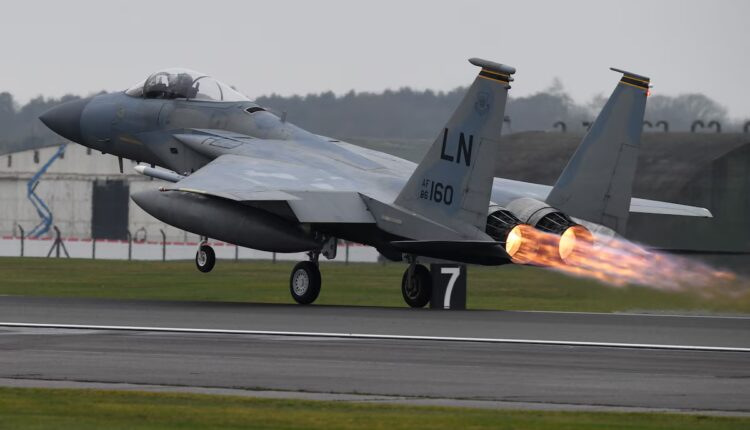
The most identifiable wreckage component was a large vertical stabiliser carrying the “LN” tail code, a red tail flash and markings associated with the United States Air Forces in Europe, none of which appear on any operational F-35.
Those markings instead correspond precisely with aircraft from the 48th Fighter Wing at RAF Lakenheath in the United Kingdom, particularly the 494th and possibly 492nd Fighter Squadron, both of which operate the F-15E Strike Eagle.
If the assessment proves correct, the incident would indicate that Iran did not destroy a stealth fighter over central Iran but instead brought down, or at minimum staged wreckage from, a front-line American strike aircraft deployed from Europe into the Middle East.
READ: US “Friendly Fire” Claim Over Three Downed F-15s Collapses Under Scrutiny — Evidence Points to Iranian Air Defence Breakthrough or Catastrophic US Command Failure
Why The Tail Section Immediately Raised Doubts
The F-35A Lightning II uses canted twin vertical tails with a distinct low-observable geometry, dark radar-absorbent coating and subdued markings designed to minimise both radar and visual detection.
The debris photographed in central Iran instead showed a single vertical stabiliser with conventional metallic structure, exposed rivet lines and a painted tail flash completely inconsistent with the F-35’s design language.
Most importantly, the stabiliser carried the “LN” tail code that has been used for decades by the 48th Fighter Wing at RAF Lakenheath, one of the United States Air Force’s most important forward-deployed fighter formations.
The wing operates both F-35A stealth fighters and F-15E Strike Eagles, but the specific stabiliser shape and painted markings shown in the Iranian photographs match the F-15E rather than the F-35A.
The red flash and “EUROPE” marking visible near the base of the fin correspond directly with aircraft assigned to the 494th Fighter Squadron, known as the “Panthers,” or possibly the 492nd Fighter Squadron.
Comparison photographs of intact RAF Lakenheath F-15E aircraft reveal almost identical layout, colour tone and typography, creating a near-perfect visual alignment between the released debris and known Strike Eagle tail sections.
That discrepancy rapidly shifted the debate from whether Iran had downed an F-35 toward whether Tehran had accidentally revealed evidence of an entirely different American aircraft loss.
The distinction matters strategically because an F-35 destroyed by Iranian air defences would undermine confidence in low-observable technology, whereas an F-15E loss would instead highlight the growing danger facing non-stealth strike aircraft operating over Iran.
The difference also affects political messaging because Iran’s claim of defeating the F-35 generates far greater symbolic impact than acknowledging the destruction of an older, although still highly capable, Strike Eagle.


What An F-15E Loss Would Reveal About The Air War
The F-15E Strike Eagle remains one of the United States Air Force’s principal long-range interdiction platforms because it combines deep-strike capability, heavy weapons load and advanced sensor fusion within a two-seat combat aircraft.
Aircraft from RAF Lakenheath have reportedly been deployed to the Middle East throughout the current conflict, flying from regional bases including Jordan in support of sustained strikes against Iranian military infrastructure.
Unlike the F-35, which relies primarily on stealth to penetrate defended airspace, the F-15E survives through electronic warfare support, standoff weapons, escort fighters and suppression of enemy air-defence operations.
An F-15E flying over central Iran would therefore indicate that the United States had expanded its operational footprint well beyond border regions and into heavily defended interior territory.
Markazi Province occupies a strategically sensitive position near the centre of Iran, meaning any American aircraft operating there was likely supporting strikes against command centres, air-defence nodes or logistics facilities deeper inside the country.
If Iran succeeded in engaging such an aircraft over central Iran, the incident would demonstrate that the country’s surviving air-defence network still retains the ability to contest American airpower despite weeks of sustained bombardment.
Iran described the engagement as the work of a new IRGC Aerospace Force system, although it provided no technical details regarding radar type, missile range or the architecture involved.
That ambiguity leaves open several possibilities, including a newly introduced mobile surface-to-air missile battery, a modified legacy system or an integrated network using multiple radars and launchers.
The claim also emerged after repeated Iranian assertions that American and Israeli aircraft had been forced to operate farther from their targets because Iran’s remaining air-defence systems still imposed operational risk.

The Larger Context Behind America’s Rising Aircraft Losses
The controversy surrounding the photographs emerged during a phase of the conflict in which the United States has already experienced an unusually visible level of aircraft attrition.
American aircraft losses and combat damage have reportedly approached twenty platforms since the beginning of Operation Epic Fury, including drones, helicopters and multiple combat aircraft.
Among the most significant earlier incidents was the March 2 loss of three F-15E Strike Eagles in Kuwaiti airspace after an apparent friendly-fire engagement involving Kuwaiti air defences.
All six crew members from those aircraft survived after ejecting, but the event exposed how difficult it had become for allied air-defence networks to distinguish between friendly and hostile aircraft during high-tempo missile exchanges.
The current controversy is therefore especially important because it involves another aircraft type already associated with recent losses and because the released wreckage appears visually consistent with a Strike Eagle.
A confirmed F-15E shoot-down inside Iran would indicate that attrition is no longer limited to accidental losses or peripheral engagements but is now extending into the most heavily defended sectors of the battlespace.
It would also raise questions regarding whether U.S. commanders have been forced to use F-15Es more aggressively because the available number of stealth aircraft remains insufficient for the scale of the campaign.
Such a development would imply a larger logistics burden because Strike Eagles require tanker support, electronic warfare aircraft, suppression missions and extensive maintenance infrastructure to sustain high operational tempo.
That broader force posture would further expose regional bases in Jordan, Saudi Arabia and the Gulf to retaliatory missile and drone attacks intended to disrupt the coalition’s strike cycle.
Why Tehran May Have Chosen To Call It An F-35
The decision to describe the wreckage as an F-35 appears driven less by the physical evidence than by the strategic value attached to the aircraft’s reputation.
The F-35 is widely marketed as the world’s most advanced fighter and has become a symbol of American technological superiority, stealth warfare and allied airpower.
Claiming to have destroyed one over Iran therefore delivers immediate psychological, political and propaganda value far beyond the significance of downing an F-15E.
For Tehran, the image of an American stealth fighter destroyed by an Iranian missile would reinforce domestic narratives that the country’s air-defence network can resist even the most sophisticated Western platforms.
It would also strengthen deterrence messaging toward neighbouring states hosting American aircraft because it implies that regional bases cannot guarantee protection for U.S. forces.
The use of the phrase “second F-35 in twelve hours” further suggests an effort to create the impression of a systemic breakthrough rather than an isolated incident.
However, the photographs undermined that narrative because the debris presented by Iranian media included visible identifiers impossible to reconcile with any known F-35 airframe.
That contradiction risks damaging the credibility of future Iranian battlefield claims because open-source intelligence communities now examine released images with extraordinary speed and technical precision.
The incident therefore illustrates a wider information-war problem in modern conflicts where governments can shape initial headlines, but visual evidence often determines which version ultimately survives.
What The Incident Means For The Next Phase Of The Conflict
Whether the aircraft was genuinely destroyed over central Iran or whether older wreckage was repurposed for strategic messaging, the episode demonstrates that the information dimension of the conflict has become almost as important as the air war itself.
The United States has not acknowledged the loss of either an F-35 or an F-15E over Markazi Province, leaving a critical gap between Iranian claims and publicly verifiable evidence.
That silence may reflect operational security, uncertainty over the aircraft involved or a deliberate decision to deny Tehran the propaganda victory it seeks.
Yet the visible “LN” tail code creates a problem that cannot easily be ignored because it links the debris to one of the United States Air Force’s most recognisable expeditionary fighter wings.
If further evidence confirms that a RAF Lakenheath Strike Eagle was lost over Iran, the incident would become one of the most serious American combat aircraft losses of the conflict.
Such a development would demonstrate that even heavily supported fourth-generation strike aircraft now face mounting risk when operating inside Iranian airspace.
It would also reinforce the likelihood that the United States will increasingly rely on stealth aircraft, long-range stand-off munitions and unmanned systems rather than direct penetration missions.
At the same time, Tehran’s willingness to present questionable evidence suggests that both sides understand the next decisive battles may be fought not only in the sky above Iran, but also across the global information environment.
For defence planners and military observers, the central question is therefore no longer whether Iran claimed to destroy an F-35, but whether the released wreckage accidentally revealed a far more important truth about America’s escalating air losses.
