
Russia Unveils New AESA Radar for Su-35: Major Upgrade Could Transform R-37M Kill Range and Challenge F-15EX, J-16 Air Superiority
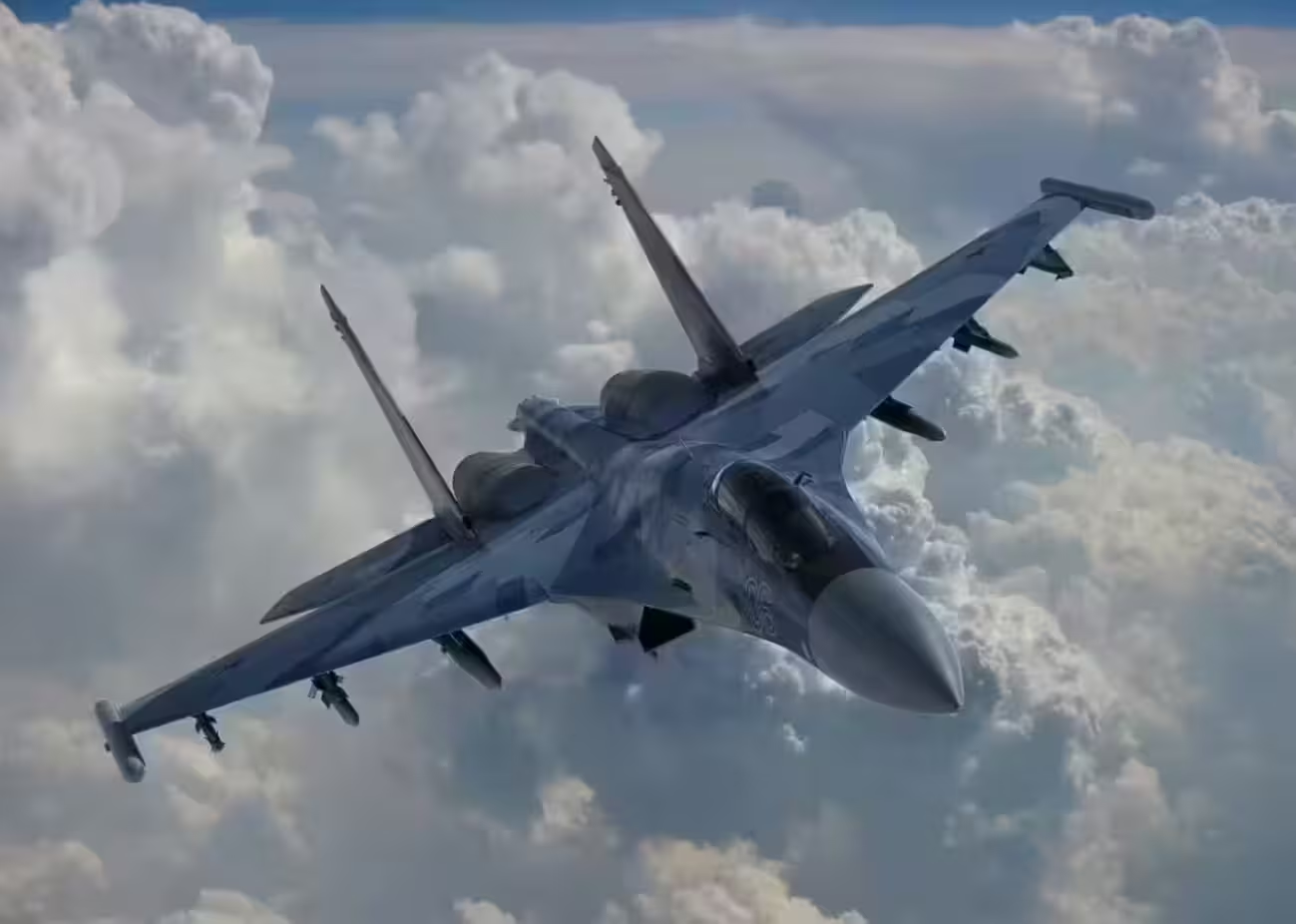
Drawing heavily from the Sukhoi Su-57’s N036 Byelka architecture, Russia’s new X-band AESA radar for the Sukhoi Su-35 could dramatically improve missile guidance, electronic warfare survivability, and long-range air combat capability against the F-15EX Eagle II and Shenyang J-16.

(DEFENCE SECURITY ASIA) — Russia’s decision to finally equip the Su-35 with an active electronically scanned array radar marks the most consequential modernization of the fighter since its introduction into operational service more than a decade ago.
The upgrade arrives at a moment when long-range air combat, electronic warfare resilience, and beyond-visual-range missile guidance have become the decisive variables shaping air superiority competitions from Eastern Europe to the Indo-Pacific.
Russian state media described the new sensor as an X-band AESA radar developed specifically for the Su-35, while secondary reporting suggested that the system draws heavily from the N036 Byelka architecture created for the Su-57 fifth-generation fighter.

The timing of the announcement carries unusual strategic significance because the Su-35’s existing N035 Irbis-E radar has long been regarded as the aircraft’s principal vulnerability against newer Western and Chinese heavy fighters.
Although the Irbis-E remained one of the world’s most powerful fighter radars in raw detection range, the absence of active electronically scanned array technology increasingly placed the Su-35 at a disadvantage against aircraft equipped with more survivable, more flexible, and more electronically resilient sensors.
Russian officials have not publicly disclosed the new radar’s designation, technical specifications, production schedule, or retrofit cost, leaving important questions unresolved regarding how quickly existing Su-35 fleets can be modernized.
If the upgrade enters serial production, however, it could fundamentally reshape the operational value of Russia’s most numerous long-range fighter and potentially revive export interest among foreign operators seeking an alternative to Western or Chinese platforms.
The emergence of the new radar also reflects lessons drawn from combat operations in Ukraine, where Russian fighters increasingly depended on long-range missile engagements conducted far beyond the reach of hostile surface-to-air systems.
By narrowing the technological gap separating the Su-35 from newer competitors such as the F-15EX and J-16, Moscow appears to be attempting to preserve the aircraft’s relevance until larger numbers of Su-57 fighters become operational.
For foreign operators already fielding the Su-35, the AESA upgrade may now become the decisive factor determining whether the aircraft remains a viable frontline platform through the 2030s.
READ: Su-35S ‘Beast Mode’ Loadout Revealed: Russia Signals Long-Range Kill Doctrine as VKS Fighters Claim Air Superiority Over F-16 and Mirage in Ukraine War
The Irbis-E Became the Su-35’s Greatest Competitive Weakness
When the Su-35 entered Russian service in 2014, its N035 Irbis-E passive electronically scanned array radar was promoted as one of the most powerful airborne sensors fielded by any fighter.
The radar’s approximately 1,200 mm antenna and unusually high power output reportedly enabled detection of fighter-sized targets at distances between 350 km and 400 km under favourable conditions.
The Irbis-E could simultaneously track dozens of airborne targets and engage several at once, giving the Su-35 formidable long-range interception capability on paper.
Yet the system remained fundamentally constrained by its passive electronically scanned array architecture, which depends on a single high-power transmitter rather than thousands of individual transmit-receive modules.
That design allowed the Irbis-E to generate immense raw power, but it also created a larger electronic signature and made the radar more vulnerable to hostile jamming, interception, and anti-radiation targeting.
By the early 2020s, the Su-35 increasingly faced rivals such as the F-15EX, the Chinese J-16, and upgraded versions of the F-35 equipped with advanced AESA radars offering superior multi-target tracking and electronic warfare resilience.
F-15EX Eagle II and Shenyang J-16 both field active electronically scanned array systems capable of rapidly steering multiple beams, shifting frequencies instantly, and operating with a much lower probability of intercept.
In practical terms, this meant that the Su-35 could often detect an opponent at considerable distance while simultaneously revealing its own position more clearly through stronger and more predictable radar emissions.
The resulting imbalance became increasingly problematic in contested airspace where electronic warfare aircraft, stand-off jammers, and stealth platforms operated together as an integrated network.
The New AESA Radar Appears Closely Linked to the Su-57’s Byelka System
Russian reporting has not provided an official designation for the new radar, but multiple accounts indicate that it was developed specifically for the Su-35 using technology derived from the Su-57’s N036 Byelka system.
Sukhoi Su-57 became Russia’s first operational fighter equipped with an AESA radar when it entered limited service around 2020, although fully operational regiments only emerged during 2025.
The Byelka radar family represented a major technological departure from earlier Russian fighter sensors because it used large numbers of active transmit-receive modules instead of relying on a central transmitter.
This architecture allowed the Su-57 to perform simultaneous search, tracking, missile guidance, and electronic warfare functions with far greater efficiency than previous Russian fighters.
If the Su-35’s new radar inherits even part of that capability, the aircraft could gain a substantial improvement in sensor flexibility without requiring an entirely new airframe.
The most important advantage of the new AESA radar lies in its ability to generate multiple narrow beams simultaneously rather than sweeping a single beam sequentially across the battlespace.
That capability could allow the Su-35 to track multiple aircraft, guide several long-range missiles, and maintain situational awareness while operating under intense electronic attack.
Because AESA radars can rapidly change frequencies and beam patterns, they are significantly harder for enemy aircraft to detect, classify, or jam effectively.
The lower probability of intercept generated by AESA operation is especially important because the Su-35 frequently performs long-range patrol and interception missions where avoiding early detection can determine whether a missile engagement succeeds.
The radar may also enhance the Su-35’s ability to identify low-observable targets, although there is no public evidence suggesting it would fully overcome the limitations of detecting advanced stealth aircraft.
R-37M Missile Performance May Be the Real Driver Behind the Upgrade
The strongest operational argument for replacing the Irbis-E appears to be the growing importance of the R-37M long-range air-to-air missile in Russian combat doctrine.
Vympel R-37M has been credited with engagement ranges approaching 350 km, making it one of the longest-ranged air-to-air missiles currently in operational service.
Russian forces have reportedly used the missile extensively during the conflict in Ukraine, particularly to threaten support aircraft, airborne early warning platforms, and fighters operating far behind the front line.
Yet the missile’s extreme range created an unexpected limitation because the Irbis-E radar reportedly lacked sufficient precision and guidance performance to exploit the weapon’s full theoretical envelope.
A missile capable of travelling 350 km offers limited practical value if the launching aircraft cannot maintain accurate target tracking and mid-course guidance throughout most of that distance.
An AESA radar with improved beam precision, faster refresh rates, and more stable tracking could therefore unlock significantly greater operational effectiveness for the R-37M.
The new radar may allow the Su-35 to guide missiles deeper into contested airspace while remaining outside the engagement envelope of many opposing fighters.
This could prove especially dangerous for high-value support aircraft such as tankers, intelligence platforms, and airborne early warning aircraft operating near contested regions.
Boeing E-3 Sentry and similar large support aircraft depend heavily on stand-off distance for survival, but a better-guided R-37M would reduce that protective margin considerably.
The implications extend beyond Europe because several Indo-Pacific air forces rely heavily on airborne early warning and tanker fleets to support long-range fighter operations over maritime theatres.
The Eight-Missile Configuration Suggests Russia Is Prioritising Massed Long-Range Engagements
Some reports have linked the new radar to testing of an expanded Su-35 air-to-air weapons configuration carrying up to eight long-range missiles.
If confirmed, that configuration would represent a significant increase in the aircraft’s capacity to conduct massed beyond-visual-range engagements against multiple targets simultaneously.
The combination of eight missiles and a more capable AESA radar would transform the Su-35 from a powerful interceptor into a more effective airborne missile truck designed for networked long-range warfare.
Such a configuration appears consistent with Russia’s evolving doctrine emphasising layered air defence, long-range missile employment, and stand-off attacks against supporting aircraft.
The Su-35’s large airframe, substantial fuel capacity, and powerful engines already allow it to remain on station for extended periods over large distances.
An improved radar and expanded missile loadout would further reinforce that role by enabling the aircraft to patrol broader sectors while threatening multiple targets from greater range.
This concept increasingly resembles Chinese and American approaches that use heavy fighters not merely as dogfighters, but as command-and-control nodes and long-range missile carriers.
Chengdu J-20, the J-16, and the F-15EX have all increasingly been discussed in terms of how many long-range missiles they can carry and how effectively their sensors can coordinate those weapons.
Russia appears to be moving the Su-35 in the same direction because future air combat is likely to depend less on close-range manoeuvring and more on sensor fusion, missile reach, and electronic warfare survivability.
The radar upgrade therefore represents not merely a technical modification, but a broader adaptation to a new model of air combat in which the aircraft with the best information and missile guidance often prevails before visual contact occurs.
The Upgrade Could Revive the Su-35’s Export Prospects but Important Questions Remain
The Su-35 has remained one of Russia’s most prominent fighter exports, yet interest in the aircraft increasingly slowed as rival platforms offered AESA radars as standard equipment.
Potential customers evaluating the Su-35 against aircraft such as the F-15EX, the J-16, or newer European fighters often regarded the continued use of the Irbis-E as evidence that the platform lagged behind technologically.
A credible AESA radar upgrade could therefore improve the fighter’s competitiveness in future export campaigns, particularly among countries already operating Russian combat aircraft.
Several existing operators may also consider retrofitting their current fleets if the new radar can be integrated without extensive structural modification or prohibitively high cost.
Russia has not released pricing data, but an AESA retrofit programme for a large heavy fighter fleet would likely require substantial investment.
If retrofit costs reached US$5 million to US$10 million per aircraft, the modernisation of even a modest fleet could cost between US$120 million and US$240 million, equivalent to approximately RM456 million and RM912 million.
Those figures would still remain significantly lower than the acquisition cost of an entirely new fighter generation, making the upgrade potentially attractive for states seeking to preserve combat capability under financial constraints.
Nevertheless, uncertainty remains over whether Russian industry can manufacture the new radar in sufficient numbers while simultaneously supporting the Su-57 programme and maintaining wartime production demands.
The absence of confirmed technical specifications, production timelines, and independent testing means that the true capability of the new radar cannot yet be verified.
Until those details emerge, the announcement should be viewed as a potentially significant strategic development rather than definitive proof that the Su-35 has fully closed the technological gap separating it from its Western and Chinese competitors.
