
BREAKING: Iran Missile Strike Hits Five U.S. KC-135 Tankers in Saudi Arabia, Exposing Critical Weak Point in American Airpower Logistics Network
Damage to five U.S. aerial refueling aircraft at Prince Sultan Air Base raises alarm over vulnerability of American force sustainment as Middle East war expands.
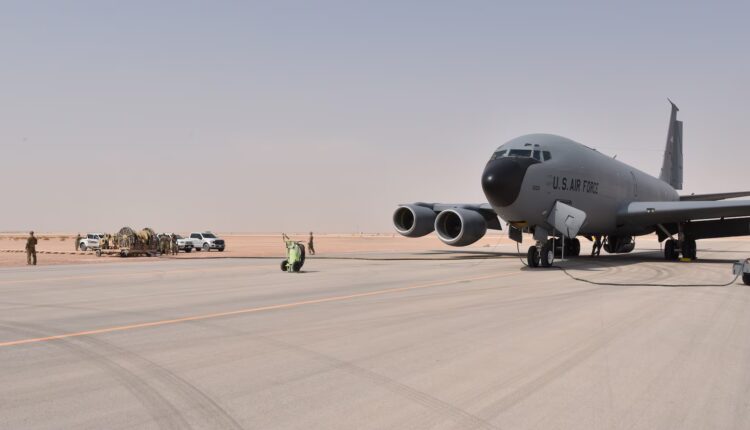
(DEFENCE SECURITY ASIA) — The reported damage to five U.S. Air Force KC-135 Stratotanker refueling aircraft at Prince Sultan Air Base in Saudi Arabia signals a potentially serious disruption to the logistics backbone of American airpower in the Middle East, highlighting how Iranian missile retaliation is increasingly targeting sustainment infrastructure rather than frontline combat platforms.
Information first reported yesterday, citing two unnamed U.S. officials, states that the aircraft were parked on the ground when struck during an Iranian ballistic missile attack in recent days, indicating a deliberate focus on degrading operational readiness rather than causing immediate casualties.
Although the aircraft were not destroyed and no U.S. personnel were killed, the temporary loss of multiple aerial refueling assets introduces strategic consequences for long-range strike capability, coalition air campaign endurance, and the credibility of U.S. force posture across the Gulf during the escalating U.S.–Israel–Iran conflict.

U.S. Central Command has declined public comment, leaving uncertainty about the scale of damage and defensive response, while the strike itself forms part of Iran’s ongoing retaliation campaign involving missile and drone attacks on Israeli targets and on Gulf states hosting American forces, including Saudi Arabia.
The incident increases the total number of U.S. Air Force tanker aircraft damaged or lost in recent days to at least seven, including a separate KC-135 crash in western Iraq earlier in the week that killed all six crew members, along with other minor incidents affecting operational availability.
The strike occurred amid a wider regional escalation in which U.S. forces have conducted intense attacks on Iranian targets, including military sites on Kharg Island, Iran’s main oil export hub, while Iran continues launching missiles and drones across multiple countries where American forces are deployed.
Refueling aircraft such as the KC-135 represent a critical enabling system for long-range air operations, meaning that even limited damage to tanker fleets can produce disproportionate effects on sortie generation, mission endurance, and the ability to sustain high-tempo combat activity across the Middle East theatre.
Targeting the Logistics Backbone of U.S. Airpower
The reported strike on refueling aircraft rather than combat jets suggests a calculated attempt to disrupt the operational logistics that sustain U.S. airpower, since aerial refueling capacity directly determines how far strike aircraft can travel and how long they can remain in contested airspace.
KC-135 Stratotankers support fighters, bombers, surveillance aircraft, and transport missions, meaning that damage to several aircraft at a single base can affect multiple mission types simultaneously and force immediate adjustments to flight planning and tanker allocation.
Because tanker aircraft must operate from fixed airbases with extensive fuel storage and maintenance facilities, they are more exposed to ballistic missile attacks than mobile combat units, increasing their vulnerability during periods of regional escalation.
Forward deployment of refueling aircraft allows rapid response to crises but also places high-value logistics assets within range of adversary missile forces, creating a constant trade-off between operational reach and survivability.
Even when aircraft are only damaged rather than destroyed, the need for repairs can remove them from service for extended periods, reducing the number of available tankers during a time when demand for aerial refueling is rising.
The requirement for specialized maintenance and spare parts means that restoring damaged refueling aircraft may take longer than replacing smaller tactical platforms, further tightening operational margins.
Iran’s use of ballistic missiles against known airbase locations indicates an approach designed to exploit predictable basing patterns, where large support aircraft must remain concentrated for fueling and servicing.
Such targeting places greater emphasis on dispersal procedures, hardened shelters, and missile defense coverage, all of which require additional resources and coordination to implement effectively.
The loss of tanker availability can slow the tempo of air operations without producing dramatic battlefield imagery, making logistics attrition an indirect but effective method of imposing operational costs.
This pattern suggests that the current phase of the conflict includes deliberate attempts to weaken sustainment capacity rather than relying solely on direct engagements between combat forces.
READ: KC-135 Crash During Operation Epic Fury Exposes Risk to U.S. Air Campaign Against Iran as Tanker Loss Hits Strike Logistics Network
Prince Sultan Air Base has served as a key operating location for U.S. Air Force units in Saudi Arabia, making it a logical target for strikes intended to disrupt American air operations across the Gulf region.
The base supports aerial refueling missions that extend the range of U.S. fighters and bombers operating over Iraq, Syria, the Gulf, and other parts of the Middle East, giving it strategic importance beyond its immediate location.
Because tanker operations require large fuel reserves, maintenance infrastructure, and long runways, they cannot be easily relocated, increasing their exposure to missile attacks compared with smaller tactical units.
The strike demonstrates that Iranian forces are willing to target bases inside Saudi Arabia, expanding the geographic scope of the conflict to include partner nations hosting U.S. forces rather than only direct combat zones.
Attacks on Saudi territory carry both operational and political implications, since they place Gulf host nations directly within the missile engagement envelope of the ongoing war.
The absence of fatalities in the reported strike suggests a focus on damaging equipment rather than causing casualties, a pattern that can impose operational costs while limiting immediate escalation.
Repeated strikes on airbases may gradually reduce confidence in defensive systems designed to protect critical infrastructure, especially if high-value aircraft continue to be hit on the ground.
The need to repair damaged aircraft, reposition assets, and maintain alert status can strain personnel and maintenance cycles even without large-scale battles.
Such pressure can influence operational planning by forcing commanders to allocate additional resources to base defense rather than offensive missions.
Prince Sultan Air Base therefore represents not only a tactical target but also a symbol of the broader logistics network supporting U.S. airpower in the region.
Expanding Regional Missile and Drone Campaign
The attack on the Saudi base forms part of a wider pattern in which Iran has launched missiles and drones at multiple locations across the Middle East during the current conflict involving the United States and Israel.
Interceptions and attempted strikes have been reported in Saudi Arabia, the United Arab Emirates, Kuwait, and other countries hosting American forces, indicating that the battlefield now extends across several national territories.
This regionalized threat environment requires coordination between multiple air defense systems, increasing complexity and resource demands for all parties involved.
Each interception consumes defensive missiles and requires radar tracking and command coordination, meaning that even unsuccessful attacks can impose logistical costs.
Iran’s ability to continue launching missiles and drones suggests a strategy based on sustained pressure rather than a single decisive strike.
Continuous attacks force defending forces to remain on high alert, affecting maintenance schedules, crew endurance, and readiness levels.
In this context, damage to refueling aircraft becomes especially significant because tanker availability determines how long combat aircraft can remain airborne.
Reduced refueling capacity limits flexibility in responding to simultaneous threats across different locations.
The cumulative effect of repeated attacks and accidents can gradually reduce operational efficiency without a single large battle.
Such attrition can influence strategic decisions by forcing changes in basing, deployment, and mission tempo.
Tanker Attrition and Air Campaign Endurance
With at least seven KC-135 tankers damaged or lost during the current conflict period, the cumulative impact on aerial refueling capacity becomes a measurable factor in assessing U.S. operational endurance.
KC-135 aircraft are a core component of American air mobility, supporting both combat missions and logistical flights across long distances.
High-intensity operations increase demand for refueling, especially when aircraft must fly from dispersed bases.
Damage to several tankers at once creates immediate scheduling challenges for mission planners.
Unlike fighter fleets, tanker numbers are relatively limited, making each aircraft strategically valuable.
Maintenance requirements further reduce the number of tankers available at any given time.
Damage on the ground highlights the importance of base protection rather than pilot skill.
The crash in western Iraq, which killed all six crew members, adds pressure by reducing both aircraft and trained personnel.
Specialized training makes tanker crews difficult to replace quickly.
Accumulated losses can influence the overall tempo of air operations.
Strategic Signalling and Escalation Control
The strike on Prince Sultan Air Base demonstrates that Iran is willing to target facilities supporting U.S. operations even when those facilities are located in partner countries.
Such strikes can be intended to signal that escalation will affect the entire regional network of American bases.
At the same time, the lack of fatalities suggests a calibrated approach designed to avoid immediate large-scale retaliation.
This balance allows continued operations while attempting to manage escalation thresholds.
For Gulf states hosting U.S. forces, the incident highlights the risks of being part of the operational network.
Damage to equipment on their territory can have economic and security consequences.
For the United States, protecting tanker aircraft may require changes in basing and dispersal.
Additional defensive deployments could affect response speed.
Balancing offensive operations and base defense will remain a central issue.
The damage to five KC-135 tankers therefore reflects a wider shift toward targeting logistics in modern regional warfare.
