
KC-135 Crash During Operation Epic Fury Exposes Risk to U.S. Air Campaign Against Iran as Tanker Loss Hits Strike Logistics Network
Loss of U.S. KC-135 Stratotanker in Iraq raises concern over aerial refueling backbone sustaining U.S.–Israel strike operations during Operation Epic Fury.

(DEFENCE SECURITY ASIA) — The confirmed loss of a U.S. KC-135 Stratotanker during Operation Epic Fury immediately introduces strategic uncertainty into the aerial refueling network sustaining the U.S.-led air campaign against Iran, because tanker aircraft form the critical logistics backbone enabling long-range strike operations, persistent combat air patrols, and extended force projection across the Middle East battlespace.
CENTCOM’s official statement confirming that the incident occurred inside friendly airspace while supporting ongoing combat operations intensifies operational concern among defence planners, since the loss of a refueling aircraft during an active campaign signals stress on the high-tempo air logistics architecture that underpins U.S. airpower in the region.
The fact that two KC-135 aircraft were involved in the same incident, with one crashing in western Iraq while the second declared an in-flight emergency before landing safely in Israel, immediately raises questions about aerial refueling procedures, tanker coordination protocols, and the operational risks associated with sustaining continuous strike support during Operation Epic Fury.
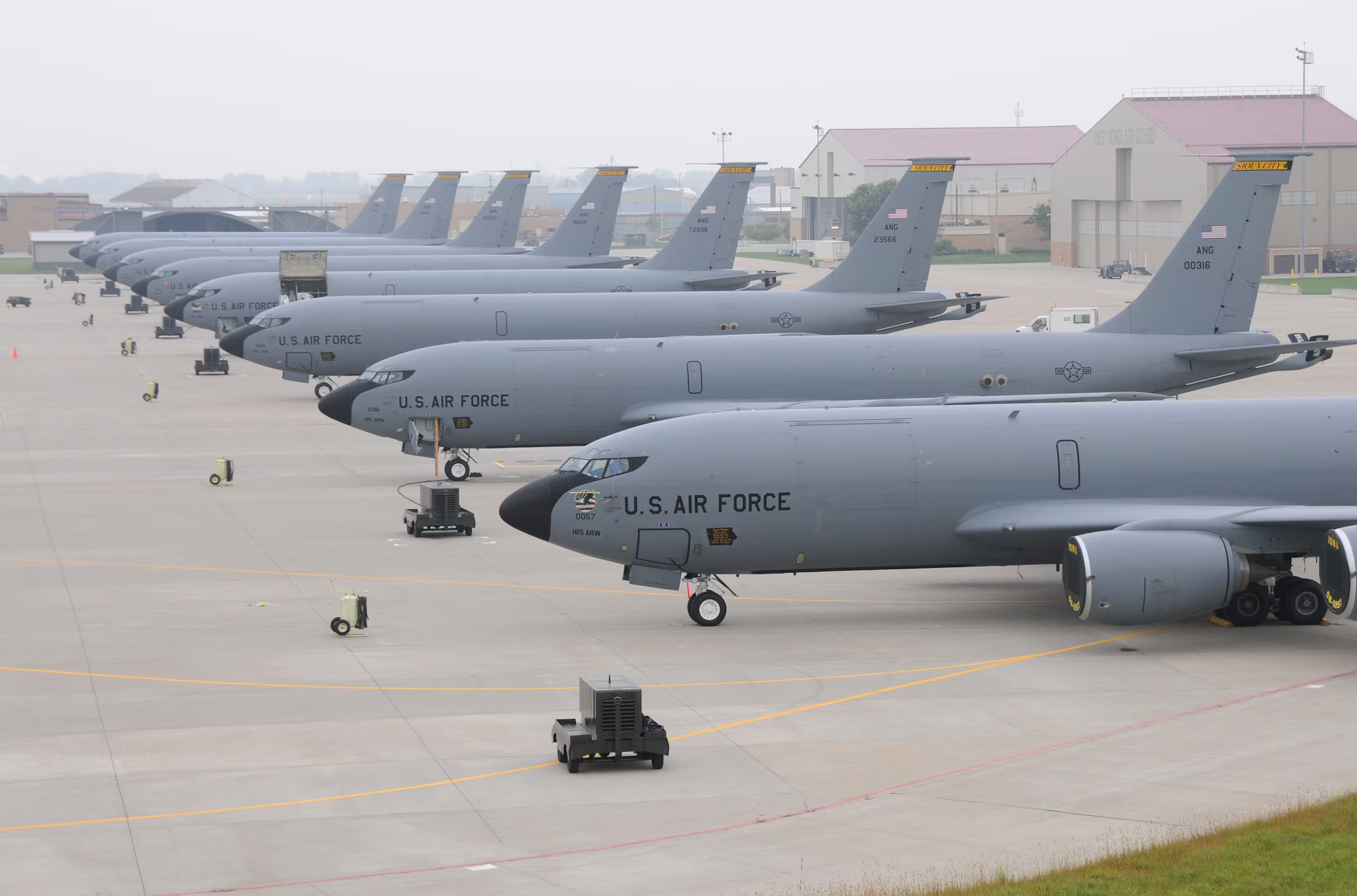
According to the official statement released by U.S. Central Command, the incident occurred during Operation Epic Fury in friendly airspace and was not caused by hostile or friendly fire, while rescue operations remain ongoing and additional information is being withheld pending confirmation of crew status and technical investigation findings.
CENTCOM stated that two aircraft were involved in the incident, that one KC-135 went down in western Iraq, that the second aircraft landed safely, and that authorities are requesting patience as further details are gathered to provide clarity for the families of the service members involved, indicating that the situation remains operationally sensitive.
The aircraft that went down was carrying six U.S. service members, whose status has not been publicly confirmed, creating additional uncertainty for military planners because search-and-rescue operations must now be conducted in a combat-support environment while the broader air campaign continues without interruption.
Reports describing the incident as occurring during an aerial refueling operation suggest that the loss may have resulted from a refueling accident, procedural error, or mid-air coordination failure between two tanker aircraft, which would represent a rare but strategically significant event during high-intensity air operations.
The surviving aircraft has been identified as a KC-135RT variant, a receiver-tanker capable of being refueled in flight itself, and its emergency landing at Ben Gurion Airport in Israel highlights the extended geographic footprint of Operation Epic Fury, where tanker routes span Iraq, Israel, and surrounding operational corridors.
Because KC-135 aircraft were providing refueling support for strike aircraft participating in the campaign against Iran, the incident directly intersects with the operational tempo of the ongoing war effort, where aerial refueling capacity determines the range, persistence, and frequency of combat sorties.
Operation Epic Fury, launched on February 28, 2026, under the direction of President Donald Trump, is a U.S.-led military campaign conducted with Israeli partnership, with declared objectives including the destruction of Iran’s ballistic missile capabilities, the degradation of naval forces, the neutralization of proxy networks, and the prevention of nuclear weapons development.
Tanker Loss Highlights Fragility of Aerial Refueling Network During High-Tempo War Operations
The KC-135 Stratotanker is a core component of U.S. global airpower projection, meaning that any loss during active combat support operations immediately affects the logistics chain required to sustain continuous strike missions across extended distances, particularly in a theater as large and complex as the Middle East.
During Operation Epic Fury, tanker aircraft are required to maintain near-continuous airborne presence to refuel fighters, bombers, surveillance aircraft, and electronic warfare platforms, which increases the number of refueling events conducted each day and consequently raises the probability of procedural or mechanical incidents.
The involvement of two tanker aircraft in the same incident indicates that the accident likely occurred during a coordinated refueling operation, where close-proximity flight and boom-connection procedures require precise communication, strict timing, and stable flight conditions to prevent collision or structural damage.
Because aerial refueling missions often take place at night, at high altitude, and under strict radio discipline, the margin for error can narrow during sustained combat operations, especially when aircraft are repeatedly tasked without extended recovery cycles due to operational demand.
The fact that the surviving aircraft declared an in-flight emergency suggests that both tankers experienced abnormal conditions during the same event, which may indicate a procedural failure, mechanical malfunction, or coordination error rather than an isolated technical issue affecting a single aircraft.
In high-intensity campaigns, tanker crews often operate under compressed schedules, and while there is no confirmation that fatigue or workload played a role, the operational context of continuous strike support during Operation Epic Fury increases the importance of examining tempo-related risk factors.
CENTCOM’s explicit statement that the incident was not caused by hostile or friendly fire narrows the range of possible explanations to accident-related causes, which places focus on flight safety, coordination procedures, and equipment reliability rather than enemy action.
Because the KC-135 fleet is one of the most heavily used aircraft types in any major U.S. air campaign, incidents involving tankers carry disproportionate operational significance compared with losses of other support aircraft, since refueling capacity directly controls how many combat aircraft can remain on mission.
The crash occurring in western Iraq also highlights the wide operational envelope of Operation Epic Fury, where tanker aircraft must operate across multiple national airspaces to sustain strike operations, increasing complexity in navigation, coordination, and mission planning.
Friendly Airspace Incident Underscores Operational Risk Even Without Enemy Fire
The fact that the incident occurred in friendly airspace demonstrates that modern air campaigns carry significant operational risk even when aircraft are not under direct threat from enemy weapons, because the scale and intensity of sustained air operations create inherent hazards.
During Operation Epic Fury, U.S. and partner aircraft are flying frequent sorties to support strike missions, surveillance, refueling, and transport, meaning that the density of military traffic in certain air corridors may be significantly higher than during peacetime operations.
Higher traffic density increases the importance of strict procedural discipline during refueling, where aircraft must fly in close formation while maintaining precise speed and altitude, leaving little margin for unexpected maneuver, turbulence, or equipment malfunction.
Because the KC-135RT variant involved in the incident is capable of receiving fuel itself, the refueling sequence may have involved complex tanker-to-tanker procedures, which are less common than standard tanker-to-fighter refueling operations and therefore require careful coordination.
The emergency landing of the surviving aircraft at Ben Gurion Airport in Israel indicates that the mission profile for the tanker formation extended across a wide regional arc, suggesting that the aircraft were supporting long-range strike packages or persistent combat air patrols.
Operations spanning Iraq and Israel demonstrate the geographic scale of Operation Epic Fury, where refueling aircraft must connect with strike aircraft operating over multiple theaters, including areas close to active conflict zones.
Even without hostile action, the need to maintain continuous refueling support can push tanker crews into demanding mission cycles, especially when multiple strike waves are launched within a short period.
CENTCOM’s decision to confirm the incident while withholding detailed technical findings suggests that the investigation is ongoing and that officials are cautious about releasing preliminary conclusions before rescue operations are completed.
Because the status of the six crew members aboard the downed aircraft has not been confirmed, search-and-rescue operations must proceed while the broader air campaign continues, adding another layer of operational complexity to an already demanding mission environment.
Operation Epic Fury’s Air Campaign Depends on Continuous Tanker Support
Operation Epic Fury relies heavily on aerial refueling because strike aircraft operating against Iranian targets may require extended range, loiter time, or diversion capability, all of which depend on tanker availability.
Without sufficient tanker support, fighters and bombers cannot remain airborne long enough to reach distant targets, conduct patrols, or maintain defensive coverage, making the refueling fleet one of the most critical enablers of the campaign.
The involvement of KC-135 aircraft in the incident confirms that these tankers are actively supporting strike operations rather than remaining in reserve, indicating a sustained operational tempo since the campaign began.
Because the campaign’s stated objectives include degrading ballistic missile capabilities, neutralizing naval forces, and targeting proxy networks, air operations likely require repeated sorties across multiple locations, increasing the burden on refueling assets.
Tanker aircraft must often remain airborne for extended periods, waiting to rendezvous with strike packages, which places additional strain on crews and airframes when missions are conducted daily without long breaks.
The need to support both U.S. and partner aircraft also increases refueling demand, since multinational operations typically involve different aircraft types with varying fuel requirements.
When a tanker is lost, replacement aircraft must be reassigned, which can disrupt planned mission cycles until the refueling schedule is adjusted.
Because aerial refueling is a prerequisite for long-range strike capability, any reduction in tanker availability can temporarily limit operational flexibility, even if the overall campaign continues.
The crash therefore represents not only a safety incident but also a reminder that logistics platforms are as essential to modern warfare as combat aircraft themselves.
Rescue Operations Add Pressure to Ongoing Combat Support Missions
Search-and-rescue operations for the downed KC-135 crew must be conducted while Operation Epic Fury continues, which requires careful coordination so that recovery missions do not interfere with ongoing strike support activities.
Rescue aircraft may need tanker support of their own, meaning that the same aerial refueling network involved in the incident must now also support recovery operations, increasing demand on remaining assets.
Western Iraq, where the aircraft went down, remains an operational environment where military activity is ongoing, which complicates rescue planning even if the airspace is considered friendly.
Because the status of the six crew members has not been confirmed, commanders must prepare for multiple scenarios, including medical evacuation, personnel recovery, or extended search operations.
CENTCOM’s request for patience while more details are gathered suggests that the situation is still developing and that investigators are working to determine the exact sequence of events.
Investigations into refueling incidents typically examine flight data, crew communication, and mechanical performance, but results can take time, especially during active military operations.
Until the cause is confirmed, procedures may be reviewed or temporarily adjusted to reduce risk, which can affect how refueling missions are conducted.
Such adjustments can influence mission timing, tanker routing, and strike scheduling, even if only for a short period.
This means that the consequences of the incident extend beyond the loss of a single aircraft and may affect the broader operational rhythm of the campaign.
Incident Raises Strategic Questions About Sustainability of High-Tempo Air War
Operation Epic Fury was launched with objectives that require sustained airpower over an extended period, meaning that the reliability of support aircraft like the KC-135 is essential for maintaining operational momentum.
Even though CENTCOM confirmed that the crash was not caused by hostile or friendly fire, the incident demonstrates that accidents alone can influence the pace of military operations.
In long campaigns, cumulative stress on aircraft, crews, and logistics systems can increase the probability of non-combat incidents, which planners must factor into operational timelines.
Because tanker aircraft are limited in number compared with fighters, each loss has a measurable effect on available capacity.
The wide geographic scope of the campaign means that tankers must cover long distances, increasing fuel consumption, flight hours, and maintenance requirements.
As the campaign continues, sustaining the balance between operational tempo and safety becomes increasingly important.
CENTCOM’s statement indicates that more information will be released as it becomes available, suggesting that the investigation will continue alongside active combat operations.
Until the cause is confirmed, the incident will remain a point of attention for defence analysts monitoring the progress of Operation Epic Fury.
The crash therefore serves as a reminder that even in technologically advanced air campaigns, logistics and human factors remain critical variables.
How quickly the refueling network returns to full stability may influence the long-term sustainability of the air war against Iran.
