
Iran Counters U.S. Aircraft Carrier Build-Up by Deploying Fateh and Ghadir Submarines into the Strait of Hormuz
Tehran leverages Fateh-class and Ghadir-class submarines to counter U.S. aircraft carrier strike groups and assert asymmetric control over the world’s most critical maritime energy chokepoint.

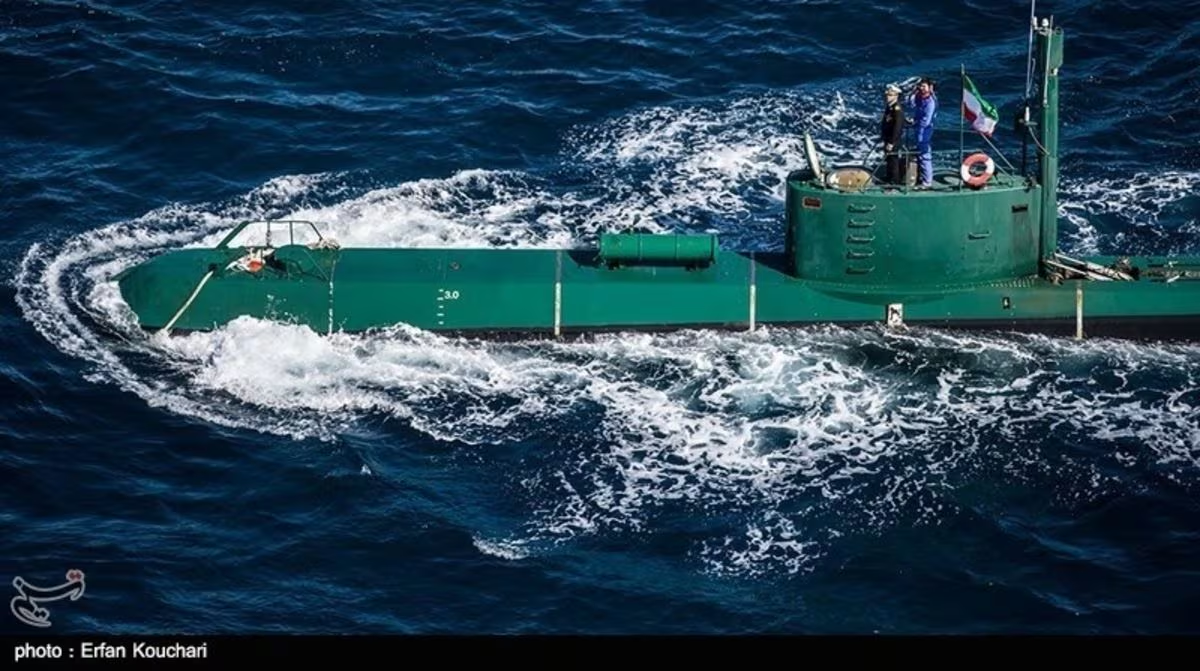
(DEFENCE SECURITY ASIA) – Iran reportedly has deployed a Fateh-class semi-heavy attack submarine alongside a Ghadir-class midget submarine into the Strait of Hormuz at a time when the United States has been pouring additional warships—including aircraft carrier strike groups, guided-missile destroyers, and surveillance assets—into the wider Gulf region.
The deployment represents a calculated escalation of Tehran’s asymmetric maritime doctrine, deliberately leveraging undersea warfare to counterbalance U.S. naval mass and contest a chokepoint through which roughly 20–21 percent of global seaborne oil flows, valued at approximately USD 1.2–1.4 trillion annually (RM 5.6–6.6 trillion), thereby transforming a narrow 21-nautical-mile corridor into a persistent strategic pressure point for global energy security and U.S.-led maritime dominance.
Senior Iranian naval commanders have framed this deployment as proof of Iran’s indigenous maritime surveillance and deterrence capability, with a senior Iranian naval official previously asserting, “This submarine [U.S.], using all its modern-day capacities, was doing its best to pass through the Strait of Hormuz in total silence when it was detected… We issued the necessary warnings,” a claim that—regardless of U.S. denials—illustrates Tehran’s intent to project confidence in its undersea detection and tracking architecture.

Former Islamic Republic of Iran Navy (IRIN) commander Rear Admiral Hossein Khanzadi underscored the disruptive potential of Iran’s midget submarines by stating that the Ghadir-class “can do what the U-boats did during World War II,” directly invoking historical commerce-raiding analogies to signal Iran’s willingness to weaponise geography against technologically superior adversaries.
Western naval assessments have quietly echoed these concerns, with U.S. Navy Captain Tracy A. Vincent acknowledging that Ghadir-class submarines provide Iran with “additional surveillance capability and create a new layer of defense,” while Commander Daniel Dolan described them as “well-designed for the purpose of guerrilla warfare, ambush and anti-access/area denial (A2/AD)… potentially more expendable,” highlighting the cost-exchange dilemma faced by blue-water navies.
Strategic analysts have warned that these submarines are “most difficult to detect particularly when resting on the seabed… given their numbers, these could overwhelm enemy’s technological superiority,” reinforcing the notion that Iran’s naval power is not designed for fleet-on-fleet engagements but for cumulative attrition within constrained maritime spaces.
Defence analysts have further highlighted that Iran could employ these submarines “en masse to launch barrages of the missiles,” suggesting that saturation tactics—rather than precision parity—form the core logic of Iran’s undersea deterrent posture in the Persian Gulf and Gulf of Oman.
The deployment therefore signals not merely a tactical movement of assets, but a strategic reminder that Iran’s maritime calculus hinges on denial, disruption, and escalation control in a theatre where even limited incidents can drive oil prices sharply upward, potentially adding USD 10–20 per barrel (RM 47–94) during crises.
By positioning Fateh-class and Ghadir-class submarines at the gateway between the Persian Gulf and the open Indian Ocean, Iran reinforces its ability to threaten commercial shipping, complicate U.S. Fifth Fleet operations, and impose strategic uncertainty on Gulf Cooperation Council states whose economies remain heavily dependent on uninterrupted maritime energy exports.
In this context, the Strait of Hormuz emerges not as a passive transit route, but as an active battlespace shaped by undersea platforms optimised for stealth, ambush, and deniability, all of which align with Tehran’s broader regional deterrence strategy under sustained economic sanctions.
Iran’s Expanding Submarine Fleet and the Strategic Logic of Asymmetric Undersea Warfare
Iran today operates one of the most diverse and numerically significant submarine fleets in the Middle East, estimated at 28–30 vessels, encompassing Russian-built Kilo-class (Tareq) submarines, indigenously produced Fateh-class semi-heavy submarines, and approximately 20 Ghadir-class midget submarines, reflecting a deliberate force-structure choice prioritising quantity, geographic optimisation, and survivability over blue-water parity.
The absence of nuclear-powered submarines or widespread air-independent propulsion (AIP) across the fleet—despite the unveiling of an AIP-equipped Fateh variant in 2024—has not constrained Iran’s operational effectiveness in the Persian Gulf, where shallow depths, high salinity gradients, dense commercial traffic, and extreme acoustic clutter neutralise many advantages of large, high-end submarines.
Iran’s submarine basing infrastructure, centred on Bandar Abbas near the Strait of Hormuz, enables rapid forward deployment, reducing transit times and maximising on-station endurance within the Gulf’s confined maritime environment, thereby compressing adversary response windows during crises.
While Iran’s Kilo-class submarines remain constrained to deeper channels and the Gulf of Oman, the Fateh-class and Ghadir-class platforms are optimised for littoral dominance, mine warfare, reconnaissance, and ambush operations within waters that frequently fall below 50 metres in depth.
This force composition reflects an explicit rejection of symmetric naval competition with the United States Navy, replacing it with a layered denial architecture designed to exploit geography, numbers, and uncertainty to impose disproportionate operational and economic costs.
Iranian naval planners have increasingly integrated submarine operations with fast-attack craft, unmanned aerial systems, coastal missile batteries, and electronic warfare units, creating a multi-domain A2/AD ecosystem that challenges adversaries across surface, subsurface, and electromagnetic domains.
From a cost-exchange perspective, the loss of a Ghadir-class submarine—estimated to cost a fraction of a modern Western surface combatant—would be strategically acceptable to Tehran if it resulted in damage or disruption to a tanker carrying crude oil worth USD 60–100 million (RM 280–470 million).
The submarine fleet therefore functions not merely as a combat arm, but as an economic weapon embedded within Iran’s deterrence framework, leveraging the global economy’s dependence on energy flows to magnify strategic leverage.
By continuously expanding indigenous submarine production, Iran has also insulated this capability from sanctions pressure, ensuring fleet sustainability even as access to foreign components remains restricted.
In strategic terms, Iran’s submarine force represents a mature asymmetric system tailored specifically for prolonged contestation of the Strait of Hormuz and its surrounding maritime approaches.
Fateh-Class Submarines and Iran’s Semi-Heavy Undersea Strike Capability
The Fateh-class submarine, whose name translates to “Conqueror,” marks a critical evolutionary step in Iran’s indigenous submarine programme, bridging the gap between midget submarines and full-size attack boats while delivering operational flexibility ideally suited to the Strait of Hormuz and Gulf of Oman.
With a submerged displacement of approximately 593 tonnes, a length of 48 metres, and an endurance of up to 35 days, the Fateh-class offers Iran sustained undersea presence without the logistical footprint or acoustic signature associated with larger platforms.
Powered by a diesel-electric propulsion system, the submarine achieves submerged speeds of up to 14 knots and operates at test depths estimated between 200 and 250 metres, providing survivability against shallow-water anti-submarine threats.
Armament includes four—and reportedly up to six—533mm torpedo tubes, capable of launching Valfajr heavy torpedoes against surface combatants and submarines, enabling the Fateh to contest both commercial and military traffic.
More strategically significant is the Fateh-class’s ability to deploy underwater-launched anti-ship cruise missiles, including systems reportedly derived from the Jask and Ghader families, with engagement ranges assessed at 200–300 kilometres, extending Iran’s maritime strike envelope deep into the Gulf of Oman.
The submarine’s capacity to deploy up to eight naval mines, including advanced and potentially smart variants, introduces a persistent and psychologically potent threat to shipping lanes, where even suspected mine presence can halt traffic and drive insurance premiums sharply upward.
Iranian authorities have described the Fateh-class as being “equipped with sonar, electric drive, combined battle management, surface-to-surface guided missile guidance, torpedo guidance, electronic and telecommunication warfare, secure and integrated telecommunication systems and dozens of state-of-the-art modern systems,” underscoring its role as a multi-mission combat platform.
Operational demonstrations, including live torpedo firings during major exercises, have reinforced Iran’s messaging that the Fateh-class is not merely symbolic, but combat-credible within its intended operational envelope.
With only one fully operational hull currently in service and additional units under construction, the Fateh-class represents a scalable capability that can progressively increase Iran’s undersea persistence in contested waters.
In the context of the Strait of Hormuz, the Fateh-class provides Iran with the ability to combine stealth, endurance, and standoff strike power into a single platform optimised for escalation control.
Ghadir-Class Midget Submarines and the Mechanics of Littoral Ambush Warfare
The Ghadir-class midget submarine constitutes the numerical backbone of Iran’s undersea forces, embodying Tehran’s preference for compact, expendable, and stealth-optimised platforms designed specifically for shallow-water operations.
Displacing approximately 117 tonnes surfaced and 125 tonnes submerged, with a length of 29 metres and a crew of just seven, the Ghadir-class is optimised for agility, concealment, and rapid deployment across the Persian Gulf’s constrained littoral zones.
Derived from North Korean Yono-class designs but extensively modified and produced domestically, the Ghadir-class has proliferated into a fleet of roughly 20 operational units, all assigned to Iran’s Southern Fleet.
Armament includes two 533mm torpedo tubes capable of firing Valfajr torpedoes or the supercavitating Hoot, providing lethality against both surface vessels and submarines in close-range engagements.
Critically, the Ghadir-class has demonstrated the ability to launch underwater-fired cruise missiles such as the Jask-2, with Iranian media claiming engagement ranges approaching 200–300 kilometres, thereby blurring the distinction between midget submarines and strategic strike platforms.
The submarine’s mine-laying capability further enhances its value as a lane-denial asset, particularly in narrow approaches where even limited mining can immobilise commercial traffic.
Its ability to deploy special forces, including combat divers and sabotage teams, extends Iran’s reach beyond purely naval targets to ports, offshore infrastructure, and anchored vessels.
Small size enables the Ghadir-class to rest on the seabed, exploit high ambient noise levels, and evade detection by advanced sonar systems optimised for deeper waters.
As Supreme Leader Ali Khamenei noted, “Today, you have been able to design and build many of the military requirements. We have become self-sufficient from other countries,” framing the Ghadir-class as both a military and ideological achievement.
In operational terms, the Ghadir-class transforms the Strait of Hormuz into a contested undersea battlespace where uncertainty itself becomes a weapon.
Operational Doctrine: Coastal Ambush, Mine Warfare, and Rapid Disappearance
Iran’s submarine doctrine is shaped by the geography of the Persian Gulf, prioritising ambush, deception, and rapid disengagement over sustained combat, thereby maximising survivability while amplifying strategic impact.
Submarines are positioned in littoral hideouts to conduct surprise torpedo or missile attacks against high-value targets, exploiting predictable shipping routes and chokepoint congestion.
Mine warfare forms a central pillar of this doctrine, enabling Iran to deny or channel maritime traffic with minimal exposure, while forcing adversaries into prolonged and resource-intensive clearance operations.
The immediate disappearance of submarines into shallow waters, seabed resting zones, or noisy acoustic layers complicates post-attack attribution and response.
Special forces insertion via Ghadir-class submarines adds a hybrid warfare dimension, enabling sabotage operations that blur the line between naval and irregular conflict.
Submarine-based reconnaissance feeds targeting data into an integrated kill chain involving fast-attack craft, drones, and shore-based missile units.
The doctrine emphasises cumulative attrition, where repeated low-intensity actions impose escalating economic and political costs on adversaries.
Layered operations across the Strait of Hormuz, Persian Gulf, and Gulf of Oman allow Iran to stretch defensive resources and create strategic depth.
The objective is not to close the Strait permanently, but to maintain the credible ability to disrupt it at will.
In doing so, Iran positions itself as a decisive actor in any regional escalation scenario.
Strategic and Global Implications for Energy Security and Naval Balance
The deployment of Fateh-class and Ghadir-class submarines into the Strait of Hormuz significantly elevates risk perceptions among energy markets, where even minor incidents can trigger price volatility and supply chain disruptions.
With daily oil flows through the Strait valued at USD 3–4 billion (RM 14–19 billion), Iran’s undersea posture grants it leverage disproportionate to its conventional naval strength.
U.S. and allied navies face persistent challenges conducting anti-submarine warfare in acoustically complex shallow waters, increasing operational risk during crises.
Regional actors such as Saudi Arabia, the UAE, and Israel are compelled to factor undersea threats into their maritime security planning.
While Iran’s submarine fleet has limitations in endurance and sustainment, its integration into a broader A2/AD framework amplifies its deterrent effect.
Sanctions-induced maintenance challenges remain a vulnerability, yet indigenous production mitigates long-term attrition risks.
Naval exercises demonstrate growing integration, though real-world effectiveness under combat conditions remains contested.
Strategically, Iran’s submarine deployment reinforces its ability to influence global energy security calculations without direct confrontation.
In this environment, the Strait of Hormuz remains one of the most consequential flashpoints in modern naval strategy.
— DEFENCE SECURITY ASIA
