
Iran Orders Evacuation at Saudi, UAE, Qatar Energy Sites After South Pars Strike — Gulf Oil Facilities Declared “Legitimate Targets” as War Threatens Global Energy Supply
Iran’s emergency warning after Israeli-US strike on South Pars signals shift toward energy-infrastructure warfare that could destabilise global oil and LNG markets.

(DEFENCE SECURITY ASIA) — Iran has issued an emergency evacuation warning targeting multiple Gulf energy facilities following Israeli-US strikes on the South Pars gas field, signalling a deliberate escalation toward energy-infrastructure warfare designed to expand the conflict’s strategic footprint beyond Iran-Israel exchanges into the core of global hydrocarbon supply chains.
The warning, issued through Iranian state and IRGC-affiliated media on 18 March 2026, explicitly declared several refining, petrochemical, and gas production sites in Saudi Arabia, the United Arab Emirates, and Qatar to be “direct and legitimate targets,” indicating a shift toward coercive targeting of economic nodes rather than purely military objectives.
The statement ordered all workers, residents, and personnel to evacuate immediately from the identified sites, warning that strikes could occur within hours, a formulation consistent with escalation signalling intended to generate market shock, strategic uncertainty, and diplomatic pressure on states aligned with Washington and Tel Aviv.
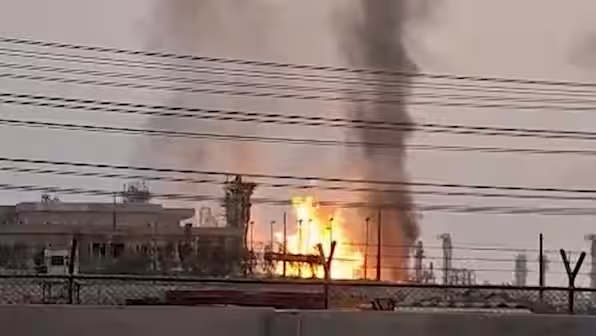
Iranian messaging linked the threat directly to earlier strikes on the South Pars gas field and the Asaluyeh energy hub, attacks reported to have caused fires and temporary production suspension at the world’s largest natural gas field shared between Iran and Qatar, thereby framing retaliation as proportional and strategically justified.
The facilities listed in the warning included the Samref refinery and Jubail petrochemical complex in Saudi Arabia, the Al Hosn gas field in the United Arab Emirates, and the Mesaieed and Ras Laffan industrial zones in Qatar, all of which form critical nodes in global refining, LNG export, and petrochemical supply networks.
Iranian officials described these sites as legitimate targets due to their perceived linkage to Western energy markets and allied security architectures, signalling that economic infrastructure connected to U.S. and Israeli interests would be treated as part of the operational battlespace rather than neutral civilian assets.
Reports circulating on social media also mentioned Israel’s Haifa refinery as a potential target, although this specific site was not included in the confirmed evacuation warning issued through Iranian state channels, highlighting the role of information warfare in amplifying perceived escalation risks.
The warning was released hours after explosions were reported at South Pars, reinforcing the perception that both sides have entered a phase of reciprocal infrastructure targeting intended to impose economic costs and alter the strategic calculus of external actors supporting the conflict.
Financial markets reacted immediately to the announcement, with Brent crude reportedly rising above USD108 per barrel (≈RM410), reflecting trader expectations that even the threat of disruption to Gulf energy facilities could tighten supply and destabilise global energy pricing.
The evacuation warning therefore represents not only a military signalling action but a deliberate attempt to internationalise the conflict by placing the security of global energy flows, maritime logistics routes, and Western-linked industrial assets at the centre of the escalation cycle.
READ: US Deploys E-2D Hawkeye Radar Aircraft to Middle East After Iranian Strikes Cripple THAAD and Early-Warning Network
Targeting Gulf Energy Infrastructure as Strategic Escalation Tool
Iran’s decision to issue an evacuation order before conducting any confirmed strike indicates a calibrated signalling strategy designed to maximise psychological and economic impact while preserving operational flexibility regarding whether attacks will actually be executed.
By naming specific facilities rather than issuing a general threat, Iranian authorities created a direct linkage between Israeli-US strikes on South Pars and potential retaliation against Gulf energy assets, reinforcing the narrative of reciprocal escalation within a defined strategic framework.
The Samref refinery and Jubail petrochemical complex in Saudi Arabia represent key components of the kingdom’s downstream processing and export system, meaning any disruption could affect both refined fuel markets and petrochemical supply chains tied to global manufacturing.
The Al Hosn gas field in the United Arab Emirates is a major sour-gas production facility, making it a critical element of the UAE’s domestic energy balance and industrial feedstock supply, thereby elevating the strategic consequences of any successful strike.
Qatar’s Mesaieed petrochemical complex and Ras Laffan refinery are central to LNG export operations linked to the North Field, meaning even temporary shutdowns could affect long-term supply contracts with Asian and European customers dependent on Gulf gas shipments.
Iran’s framing of these sites as legitimate targets suggests an operational doctrine that treats energy infrastructure as a coercive leverage point rather than purely economic assets, reflecting lessons learned from earlier regional conflicts involving strikes on oil and gas facilities.
The warning also increases pressure on Gulf governments to publicly respond, as silence could be interpreted domestically as vulnerability while strong statements risk further escalation, creating a diplomatic dilemma that Iran may be seeking to exploit.
The absence of confirmed strikes at the time of the warning indicates that the immediate objective may be deterrence and signalling rather than destruction, although the threat alone is sufficient to disrupt normal operations through precautionary evacuations and temporary shutdowns.
Market reactions to the announcement demonstrate that infrastructure threats can achieve strategic effect without kinetic action, as traders and insurers adjust risk assessments based on perceived vulnerability of production and export facilities.
This pattern suggests Iran is attempting to expand the conflict’s economic dimension by targeting the stability of global energy supply rather than focusing solely on battlefield outcomes.

South Pars Strike and the Trigger for Retaliatory Signalling
The escalation was triggered by reported Israeli-US strikes on Iran’s South Pars gas field and the Asaluyeh energy hub, incidents that Iranian media described as attacks on critical national infrastructure rather than purely military targets.
South Pars is the largest natural gas field in the world and is shared with Qatar’s North Field, meaning any disruption has implications not only for Iran but also for global LNG supply and regional energy security.
Reports of fire and partial production suspension at South Pars created the perception that the conflict had crossed into the energy domain, a threshold that historically increases the risk of broader regional escalation.
Iranian officials used the incident to justify threats against Gulf facilities, arguing that states aligned with the United States and Israel could not remain insulated from the consequences of attacks on Iranian energy infrastructure.
The linkage between the strike on South Pars and the evacuation warning suggests a retaliatory logic based on symmetry, in which attacks on energy assets are answered with threats to comparable targets elsewhere in the region.
Such symmetry is intended to signal that escalation will not remain confined to Iranian territory, thereby raising the potential cost for any actor supporting continued strikes against Iranian infrastructure.
By issuing the warning through state and IRGC-affiliated channels, Tehran ensured the message would be interpreted as official policy rather than rhetorical exaggeration, increasing its credibility in the eyes of markets and governments.
The timing of the announcement, coming within hours of the South Pars incident, indicates a rapid decision cycle consistent with a pre-planned escalation ladder prepared in advance of the conflict’s expansion.
This rapid response also suggests that Iran had already identified specific Gulf facilities as potential targets, meaning the warning was not improvised but part of an established contingency framework.
The South Pars strike therefore appears to have served as the trigger for activating a broader strategy aimed at extending the conflict into the global energy domain.

Oil Market Shock and Global Energy Security Implications
The immediate rise in Brent crude above USD108 per barrel (≈RM410) following the evacuation warning demonstrates how threats to Gulf energy infrastructure can generate global economic impact even without confirmed physical damage.
Energy markets reacted to the possibility that strikes on refining, gas, or LNG facilities could reduce supply, increase insurance costs, and disrupt shipping routes, all of which translate directly into higher prices.
The targeting of facilities in Saudi Arabia, the UAE, and Qatar carries particular weight because these states collectively account for a significant share of global oil, gas, and petrochemical exports.
Any disruption at Ras Laffan or Mesaieed would affect LNG shipments to Asia and Europe, meaning the consequences would extend beyond the Middle East into major industrial economies.
Threats to Jubail and Samref raise concerns about refined fuel supply, which is critical for aviation, shipping, and military logistics, thereby linking energy security directly to operational readiness.
Even the possibility of strikes can force companies to suspend operations, evacuate staff, or reduce output, creating real supply constraints without a single missile being launched.
Financial markets therefore treat evacuation warnings as operational signals rather than propaganda, adjusting price expectations based on perceived escalation risk.
The warning also increases volatility in futures markets, as traders attempt to anticipate whether the threat will lead to actual attacks or remain part of psychological warfare.
Such volatility benefits Iran’s stated objective of raising global energy prices to pressure Western governments and their allies, even if physical damage never occurs.
The market reaction therefore confirms that energy infrastructure threats have become a central instrument of strategic leverage in the conflict.
Information Warfare, Social Media Claims, and Verification Gaps
Reports circulating online that the Haifa refinery in Israel was included in the evacuation warning illustrate how information warfare can amplify escalation beyond the scope of official statements.
Confirmed Iranian warnings listed Gulf energy facilities but did not include Haifa, indicating that some claims spreading on social media may represent speculation or deliberate attempts to intensify perceived threat levels.
Such discrepancies complicate strategic assessment because markets and governments must react to the possibility of attacks even when information remains incomplete or unverified.
The use of social media to expand the list of potential targets can increase psychological pressure on multiple actors simultaneously, creating the impression of a wider operational plan than may actually exist.
Iran has previously struck Israeli targets including areas near Haifa, which makes the claim plausible even if not confirmed, thereby increasing uncertainty.
This uncertainty forces defence planners to consider worst-case scenarios, potentially diverting resources to protect sites that may not actually be targeted.
Information ambiguity also benefits the actor issuing the threat, as the lack of clarity increases the deterrent effect without requiring additional military action.
At the same time, governments must balance the need to avoid panic with the need to prepare for possible strikes, creating communication challenges.
The presence of unverified claims highlights the importance of distinguishing confirmed warnings from speculative reporting when assessing escalation risk.
Information warfare therefore becomes an integral component of the broader conflict, shaping perception as much as physical events.
Force Posture, Strategic Signalling, and Conflict Internationalisation
Iran’s evacuation warning indicates a shift toward internationalising the conflict by threatening assets located outside the immediate battlefield but connected to U.S. and Israeli economic networks.
By targeting Gulf energy facilities rather than only Israeli territory, Tehran signals that states hosting Western-linked infrastructure cannot remain neutral if Iranian assets are attacked.
This approach increases pressure on regional governments, which must decide whether to strengthen cooperation with U.S. security architecture or seek de-escalation to protect economic interests.
The warning also forces energy companies and foreign workers to reassess risk, potentially reducing operational capacity even without confirmed strikes.
From a military perspective, threatening infrastructure expands the operational battlespace without requiring large-scale troop deployment, making it an efficient form of strategic signalling.
The fact that the warning preceded any confirmed attack suggests Iran is attempting to achieve deterrence through anticipation rather than destruction.
At the same time, the threat creates conditions in which any accidental incident could be interpreted as deliberate escalation, increasing the risk of rapid conflict expansion.
The involvement of facilities linked to Western companies, including Chevron-affiliated operations, further internationalises the stakes by tying the conflict to global corporate interests.
Such linkage increases the likelihood of diplomatic pressure on all sides, as governments seek to prevent disruption to energy supply chains.
The evacuation warning therefore represents not only a tactical message but a strategic attempt to reshape the conflict into a regional and global energy security crisis.
