
China’s HQ-9B Enters Iran: How Beijing Is Rewriting Tehran’s Air Defence Strategy After the Israel War
The reported deployment of China’s HQ-9B long-range surface-to-air missile system marks a turning point in Iran’s post-war air defence strategy, with far-reaching implications for Israel, the United States, Russia, and the evolving balance of power in the Middle East.

(DEFENCE SECURITY ASIA) — Iran’s reported integration of China’s HQ-9B long-range surface-to-air missile system represents a decisive recalibration of its national air defence posture following the operational shock of the June 2025 Israel-Iran war, with senior Iranian lawmaker Abolfazl Zohrevand, a member of the National Security Committee, stating that “China will soon supply HQ-9 long-range surface-to-air missile systems” to close what he described as “critical operational gaps” against high-altitude threats.
This declaration, coming after a 12-day conflict that systematically degraded Iranian radar nodes, missile production facilities, and command infrastructure, underscores Tehran’s recognition that its existing layered defences failed to deny airspace to halimunan aircraft, standoff munitions, and precision strike packages operated by Israel and potentially the United States.
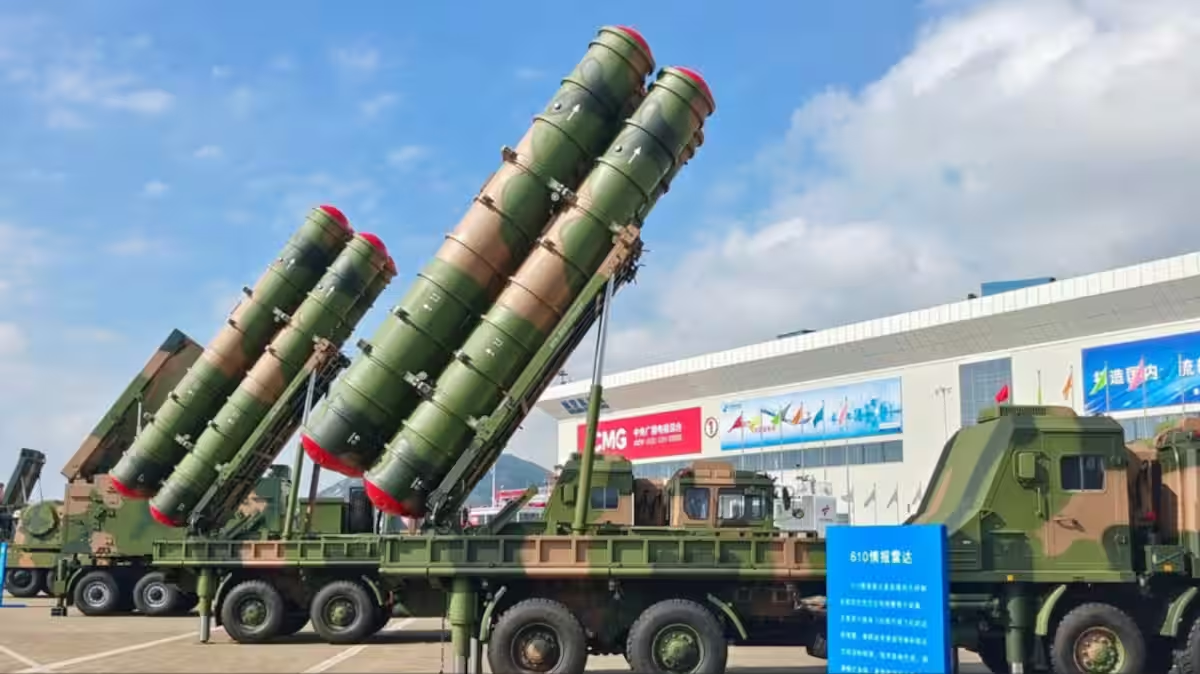
Chinese officials, however, moved quickly to issue a categorical denial through Beijing’s embassy in Tel Aviv on July 8, 2025, calling reports of HQ-9B deliveries “incorrect,” a contradiction that has only amplified strategic ambiguity surrounding the deepening military-industrial relationship between Beijing and Tehran.
Despite this denial, Iranian reformist media and outlets linked to the Armed Forces General Staff asserted that the HQ-9B package also includes long-range surveillance radars and electronic warfare systems, reinforcing perceptions that Iran is pursuing a comprehensive, network-centric air defence rebuild rather than a symbolic procurement.
The HQ-9B, developed by the China Aerospace Science and Industry Corporation, is marketed as China’s most advanced export-grade SAM, with an engagement envelope exceeding 200 kilometres, multi-target tracking, and claimed effectiveness against cruise missiles, ballistic threats, and halimunan aircraft.
Strategically, the system’s arrival would represent a qualitative leap beyond Iran’s mixed inventory of Russian S-300 variants and indigenous systems such as Bavar-373, which together proved insufficient under real combat stress during the June 2025 air campaign.
Economically, the reported barter arrangement—oil exchanged for weapons—illustrates how Iran is leveraging its estimated 150-billion-barrel hydrocarbon reserves to bypass sanctions, while China secures long-term energy flows and a proving ground for its advanced air defence technology.
At the geopolitical level, Iran’s pivot toward Chinese air defence solutions signals eroding confidence in Russian reliability, challenges Moscow’s dominance in the Middle Eastern SAM export market, and introduces a new variable into regional airpower calculations already strained by escalating Israel-Iran-US tensions.
More critically, the prospective deployment of the HQ-9B compels regional air planners to reassess assumptions about penetration corridors, suppression-of-enemy-air-defence timelines, and the survivability of enabling assets such as airborne early warning and refuelling aircraft operating near Iranian airspace.
In this context, the HQ-9B is not merely an incremental hardware upgrade for Tehran but a strategic instrument designed to reshape deterrence dynamics by raising the political and military costs of pre-emptive strikes against Iran’s nuclear, missile, and command infrastructure.
HQ-9B: Technical Capabilities and Strategic Relevance to Iran’s Air Defence Doctrine
The HQ-9B is positioned by Beijing as a long-range, high-altitude interceptor designed to underpin anti-access and area-denial strategies, a concept that aligns closely with Iran’s defensive doctrine along the Persian Gulf, its western borders, and key strategic facilities vulnerable to air and missile attack.
With a reported engagement range surpassing 200 kilometres and the ability to engage multiple targets simultaneously, the HQ-9B provides theoretical coverage deep into contested airspace, forcing adversaries to expend additional resources on suppression, electronic attack, and decoy operations.
The system’s active radar-guided missiles, paired with phased-array sensors such as the JY-26 radar optimized for halimunan detection, are intended to counter low-observable aircraft and complex attack profiles, though export configurations may not include the most sensitive Chinese technologies.
For Iran, the HQ-9B’s appeal lies not only in raw performance metrics but in its potential interoperability with indigenous missiles like the Sayyad-4B, enabling a more resilient, multi-layered engagement architecture across altitude and range bands.
The June 2025 conflict demonstrated that static, siloed SAM deployments are highly vulnerable, making the HQ-9B’s mobile launchers and networked command systems particularly attractive for a country anticipating repeated precision strikes.
Operationally, integrating Chinese electronics, datalinks, and fire-control logic into Iran’s existing command-and-control ecosystem will require extensive localization, testing, and doctrinal adaptation, potentially delaying full operational capability by months or even years.
Nevertheless, even partial deployment could complicate adversary planning by extending defended zones and increasing uncertainty over engagement timelines, particularly for non-halimunan platforms such as tanker aircraft, airborne early warning assets, and cruise-missile carriers.
From an SEO and strategic-analysis perspective, the HQ-9B’s relevance to Iran lies less in its advertised parity with systems like the S-400 and more in how it reshapes regional air defence density, redundancy, and escalation thresholds in a volatile Middle Eastern battlespace.

Lessons from the 12-Day War: Why Iran Is Rebuilding Its Air Defence Network
The 12-day Israel-Iran war in June 2025 served as a brutal stress test for Iran’s air defence architecture, exposing systemic weaknesses in sensor fusion, interceptor responsiveness, and resilience against coordinated halimunan and standoff attacks.
Russian-supplied S-300 systems, which Iran reportedly acquired for approximately USD1 billion—around RM4.6 billion at current exchange rates—after nearly a decade of delays, were unable to prevent the penetration of Israeli strike packages targeting critical infrastructure.
Post-conflict assessments revealed that key radar installations were neutralized early, degrading cueing for both Russian and indigenous SAMs and leaving gaps that were exploited by precision-guided munitions and electronic warfare.
The failure of these high-value assets has intensified domestic scrutiny within Iran’s defence establishment, reinforcing perceptions that reliance on a single foreign supplier carries unacceptable operational and political risks.
Iranian analysts have increasingly contrasted Russian delivery delays and opaque upgrade pathways with China’s perceived willingness to provide complete, rapidly deployable systems under flexible financial arrangements.
This recalibration is not merely technical but doctrinal, reflecting Tehran’s intent to rebuild an air defence network capable of absorbing initial blows while preserving retaliatory and deterrent capabilities.
The HQ-9B, in this context, is viewed as a stopgap and a catalyst, enabling Iran to restore a measure of airspace denial while longer-term indigenous and foreign projects mature.
Ultimately, the war has accelerated Iran’s transition from a patchwork SAM inventory toward a more integrated, networked air defence concept designed to survive sustained, high-intensity air campaigns.
Oil-for-Weapons Barter: Economics, Sanctions, and Strategic Autonomy
Reports of an oil-for-weapons barter underpinning Iran’s HQ-9B acquisition highlight the economic pragmatism driving Tehran’s defence procurement under sanctions pressure.
By exchanging crude oil rather than hard currency, Iran mitigates the impact of financial restrictions while monetizing its vast hydrocarbon reserves to secure advanced military technology.
The overall value of such arrangements, potentially running into several billion US dollars—equivalent to tens of billions of ringgit—illustrates the scale of Iran’s post-war rearmament ambitions.
For China, the arrangement ensures stable energy supplies while opening a pathway to expand its defence export footprint in a region historically dominated by Russian and Western systems.
This barter mechanism also reduces transaction visibility, complicating international monitoring and enforcement efforts aimed at constraining Iran’s military modernization.
From a strategic autonomy perspective, oil-for-weapons deals allow Tehran to bypass diplomatic bottlenecks and accelerate capability regeneration on timelines dictated by threat perception rather than external approval.
However, such arrangements also deepen Iran’s dependence on Chinese political goodwill, potentially constraining Tehran’s strategic flexibility in broader geopolitical negotiations.
In SEO-relevant defence analysis, the oil-for-weapons model underscores how economic statecraft and military modernization are increasingly intertwined in sanctioned environments.
China, Russia, and the Shifting Balance of the Global SAM Market
Iran’s reported turn toward the HQ-9B reflects broader shifts in the global surface-to-air missile market, where China is emerging as a credible competitor to Russia in both performance and political accessibility.
Moscow’s ongoing military commitments elsewhere have strained its production capacity and delivery schedules, eroding confidence among clients reliant on timely upgrades and spare parts.
China, by contrast, has positioned the HQ-9B as a cost-effective alternative with fewer political strings, appealing to states seeking advanced air defence without Western or Russian constraints.
For Iran, this shift represents a calculated diversification rather than a complete rupture, aimed at reducing vulnerability to supplier leverage and strategic surprise.
The HQ-9B’s deployment alongside remaining Russian systems could create a heterogeneous defence environment that complicates adversary intelligence, targeting, and electronic attack planning.
At the same time, China gains valuable feedback, operational data, and potential combat exposure that could refine future iterations of its air defence technology.
This dynamic challenges Russia’s historical dominance in the Middle Eastern SAM market and signals a multipolar evolution in global air defence procurement.
Strategically, Iran’s choices illustrate how middle powers exploit great-power competition to maximize autonomy under pressure.
Regional and Global Implications: Deterrence, Escalation, and Future Conflict
If effectively integrated, the HQ-9B could raise the cost and complexity of future air operations against Iran, extending engagement ranges and increasing the need for suppression and halimunan penetration assets.
For Israel and the United States, this development necessitates recalibrated operational planning, including heavier reliance on electronic warfare, cyber operations, and long-range stand-off munitions.
The system’s presence may also embolden Iran to adopt a more assertive regional posture, believing its critical infrastructure enjoys enhanced protection.
Conversely, overconfidence in unproven export-grade capabilities could invite miscalculation, particularly if adversaries test the system’s limits under combat conditions.
From China’s perspective, any operational success of the HQ-9B would validate its air defence technology against Western threats, strengthening its global export narrative.
Failure, however, would expose limitations and potentially undermine Beijing’s ambitions in high-end defence markets.
The HQ-9B thus becomes more than a weapon system; it is a strategic signal embedded in the evolving balance of power across the Middle East.
In a region already saturated with advanced airpower, Iran’s reported acquisition underscores how contested, technologically dense, and escalation-prone the skies are becoming. — DEFENCE SECURITY ASIA

How’s those HQ-9B air defense systems working out for them??