
CONFIRMED: Iranian Air Defences Hit U.S. F-35 Over Iran — First Strike on Stealth Fighter Signals Airpower Risk in Middle East War
CENTCOM confirms Iranian air-defence fire damaged a U.S. F-35 during combat mission, raising new questions about stealth survivability and U.S. air dominance after weeks of sustained strikes.

(DEFENCE SECURITY ASIA) — US Central Command (CENTCOM) has confirmed that Iranian air-defence fire damaged a U.S. F-35 stealth fighter during a combat mission over Iranian territory, an incident that marks a significant escalation in the ongoing Middle East conflict and signals that Tehran’s integrated air-defence network remains a credible and operationally capable threat despite weeks of sustained U.S. and allied strike operations.
CNN’s report, corroborated by U.S. Central Command, establishes that the incident represents the first confirmed case in the current war of Iran successfully striking an American aircraft, a development that immediately raises questions about force-posture survivability, stealth penetration assumptions, and the operational risk environment facing U.S. airpower in the region.
U.S. Central Command spokesperson Capt. Tim Hawkins confirmed that the fifth-generation stealth jet was “flying a combat mission over Iran” when it was hit and forced to divert to a U.S. air base in the Middle East, where the aircraft landed safely and the pilot remained in stable condition while the incident entered formal investigation.
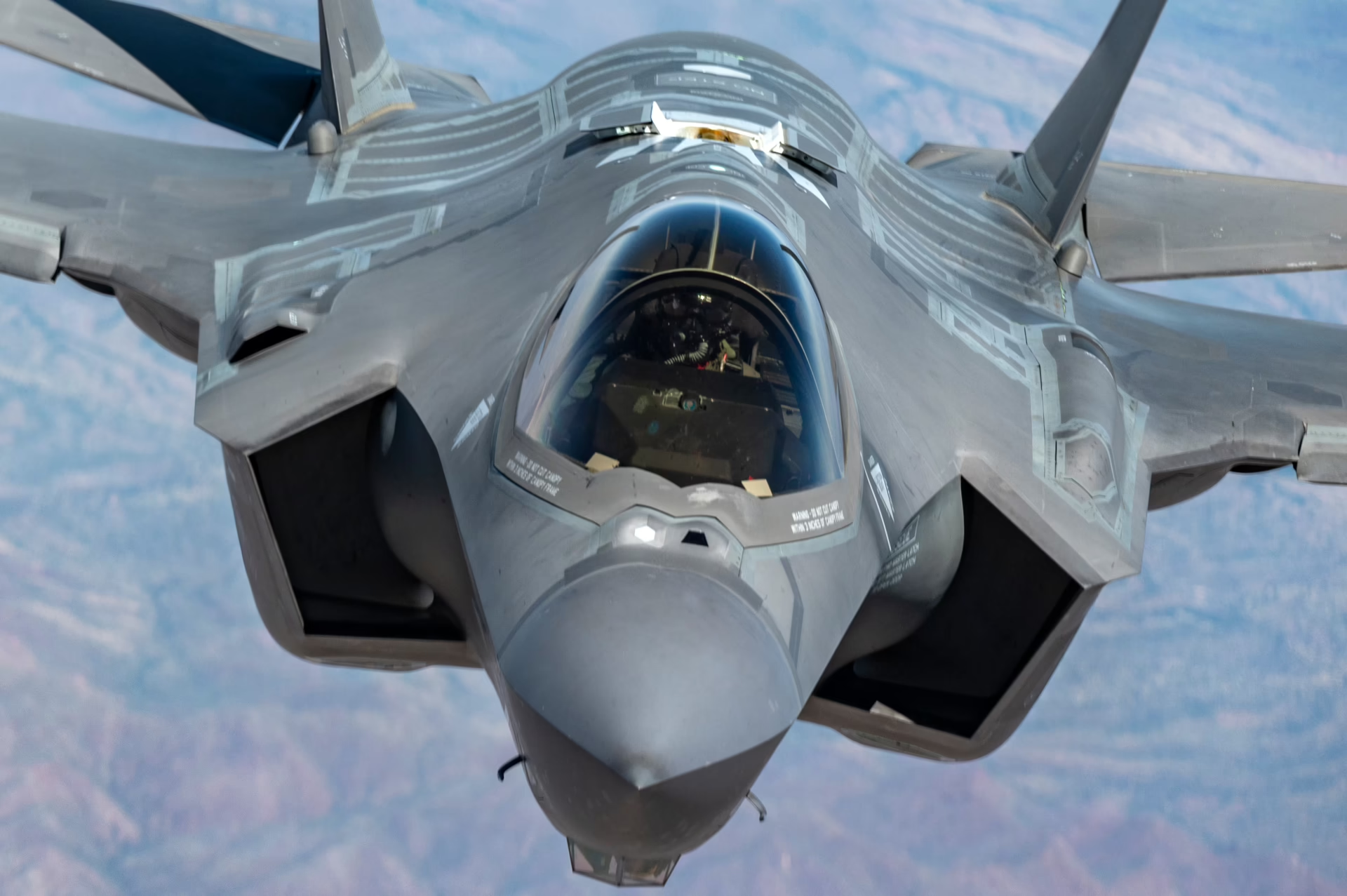
The incident represents the first verified case since the outbreak of the late-February 2026 conflict in which Iranian air-defence forces have successfully engaged a U.S. combat aircraft, signalling a shift from indirect confrontation toward direct engagement of high-value American aerospace assets.
The fact that the aircraft involved was an F-35, a fifth-generation stealth fighter designed specifically to penetrate advanced air-defence networks, elevates the incident from a tactical event to a strategic signal regarding the effectiveness and readiness of Iran’s defensive systems.
CENTCOM confirmed that the aircraft sustained damage while operating over Iranian territory, indicating that the mission profile involved deep penetration into contested airspace rather than stand-off strike operations conducted from outside Iranian radar coverage.
Because the aircraft was able to land safely at a U.S. base in the Middle East, the damage appears to have been limited rather than catastrophic, but even non-critical damage to a stealth platform valued at more than USD100 million (RM380 million) carries significant operational implications.
The absence of confirmed details about the weapon system used leaves open the possibility that the aircraft was engaged by a surface-to-air missile, anti-aircraft artillery, or another air-defence component within Iran’s layered defensive network.
The fact that the engagement occurred during an active combat mission suggests that Iranian air-defence units were operating in a heightened alert posture, likely expecting further U.S. or allied strike activity.
The incident also demonstrates that Iran was prepared to engage rather than merely track stealth aircraft, indicating a willingness to accept escalation risk in order to contest U.S. air superiority.
From a force-protection perspective, the strike highlights the growing vulnerability of even advanced aircraft when operating repeatedly over the same theatre, where adversary air-defence operators can refine detection patterns.
The investigation announced by CENTCOM indicates that U.S. commanders are now assessing whether the event resulted from unexpected radar detection, tactical exposure, or deliberate Iranian targeting decisions.

Combat Mission Over Iran Indicates High-Risk Penetration Operations
CENTCOM’s statement that the aircraft was flying a combat mission over Iran confirms that the United States is conducting direct air operations inside Iranian airspace rather than relying exclusively on stand-off strikes from outside the country’s borders.
Such missions require stealth aircraft like the F-35 to penetrate radar coverage, gather targeting data, or conduct precision strikes, placing them within range of Iranian air-defence systems.
Operating over Iranian territory increases exposure to radar tracking, missile engagement envelopes, and electronic-warfare interference, all of which can reduce the survivability margin even for fifth-generation platforms.
The forced emergency landing suggests that the aircraft suffered enough damage to compromise mission continuation but retained sufficient flight control to reach a U.S. base, indicating partial rather than total loss of capability.
Because the aircraft landed at an American base in the Middle East rather than ejecting or crashing, the event avoided the political consequences that would accompany the loss of a pilot or the capture of sensitive technology.
Nevertheless, the requirement to divert to base during combat operations disrupts sortie generation rates and affects the overall tempo of U.S. air campaigns in the theatre.
Repeated incidents of this type could force commanders to adjust flight routes, altitude profiles, or mission timing, increasing logistical complexity.
The confirmation that the aircraft was hit while flying over Iran suggests that Iranian air-defence coverage remains operational despite ongoing conflict.
This reinforces the possibility that Iranian systems are being preserved through dispersal, mobility, or selective activation rather than continuous operation.
The combat mission context therefore indicates a contested environment rather than uncontested airspace, contradicting assumptions of total U.S. air dominance.
Strategic Implications for Stealth Aircraft Survivability
The engagement of an F-35 by Iranian air defences introduces a significant data point into ongoing debates about the survivability of stealth aircraft against modern integrated air-defence systems.
Fifth-generation fighters are designed to reduce radar detection probability, but they are not immune to engagement, especially when operating repeatedly over defended territory.
Even a single successful hit can influence operational planning because stealth aircraft rely on maintaining low observability rather than absorbing damage.
The cost of the F-35, estimated at more than USD100 million per aircraft (RM380 million), means that every engagement carries not only tactical risk but also strategic financial consequences.
Damage to a stealth aircraft also raises concerns about potential exposure of sensitive materials, sensors, or electronic-warfare components.
Because the aircraft landed safely at a U.S. base, the risk of technology compromise appears limited in this case, but the event still highlights the stakes involved in contested air operations.
The lack of confirmed information about the weapon used suggests that the investigation will focus heavily on radar detection, tracking sequence, and engagement timing.
If the aircraft was detected earlier than expected, the incident could indicate improvements in Iranian air-defence coordination.
If the aircraft was hit during egress rather than ingress, the event may reflect exposure after the mission rather than failure of stealth during penetration.
Either scenario would have implications for future mission planning and force posture.
Iranian Air-Defence Engagement Shows Network Still Operational After Weeks of Sustained Bombardment
The decision by Iranian forces to engage a U.S. stealth aircraft indicates that Tehran’s air-defence network continues to function despite weeks of sustained U.S. and allied bombardment since the conflict began in late February 2026.
Engaging a high-value fifth-generation aircraft under such conditions suggests that Iranian command-and-control structures, radar coverage, and missile batteries have not been fully neutralised by repeated strike operations.
The strike therefore reflects not only a willingness to contest U.S. air operations but also an ability to maintain defensive readiness even after prolonged pressure on Iranian military infrastructure.
Such an engagement signals that American air missions over Iranian territory remain exposed to operational risk, particularly when flying inside the engagement envelopes of surviving air-defence systems.
For the United States, the incident may force a reassessment of sortie patterns, penetration routes, and the frequency of deep-strike missions conducted over heavily defended areas.
For Iran, the ability to damage an F-35 provides evidence that elements of its integrated air-defence network remain intact despite sustained bombardment intended to degrade those capabilities.
The lack of confirmed details about the weapon used also suggests that multiple Iranian systems may still be operational, complicating threat modelling for U.S. planners.
This uncertainty increases the difficulty of predicting engagement zones, forcing commanders to assume a higher level of survivability among Iranian air-defence assets.
The incident therefore carries psychological as well as operational impact, demonstrating that even advanced stealth aircraft cannot assume uncontested access after weeks of continuous air strikes.
Even limited damage to a fifth-generation platform can serve as strategic signalling that Iran retains the capacity to impose costs on U.S. airpower despite sustained bombardment.
Investigation Will Shape Future Force Posture and Air Campaign Planning
CENTCOM confirmed that the incident is under investigation, indicating that operational data is being analysed to determine how the aircraft was detected and hit.
Such investigations typically examine radar logs, mission telemetry, electronic-warfare records, and pilot reports.
The findings will likely influence future mission planning, including route selection and altitude profiles.
If the engagement exposed a vulnerability, corrective measures could include increased stand-off distance or additional support aircraft.
If the event resulted from tactical exposure rather than technical failure, changes may focus on mission procedures.
The investigation may also examine whether Iranian air-defence units coordinated multiple sensors during the engagement.
Layered tracking using several radar types can increase the chance of detecting low-observable aircraft.
Understanding whether the strike was opportunistic or deliberate will be critical for future risk assessments.
The outcome of the investigation could influence how often stealth aircraft are used in the theatre.
Until conclusions are reached, commanders may assume a higher threat level during operations over Iran.
