
Stealth Revolution: Indonesia Shakes Indo-Pacific Power Balance with Landmark Bayraktar KIZILELMA Unmanned Fighter Deal
Jakarta secures 12-aircraft squadron of jet-powered stealth UCAs with options for 60 units and local production, signaling a new era of "Loyal Wingman" doctrine in Southeast Asia.

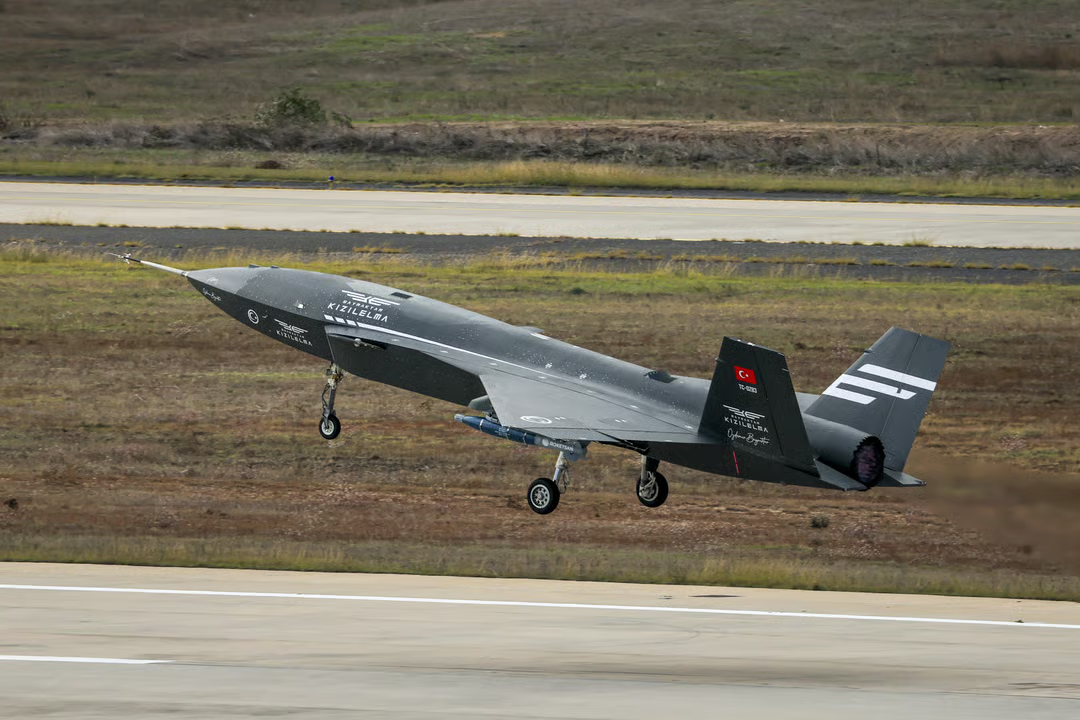
(DEFENCE SECURITY ASIA) — The signing of a definitive export contract between Turkish aerospace giant Baykar and Indonesia’s PT Republik Aero Dirgantara for the Bayraktar KIZILELMA jet-powered unmanned combat aircraft (UCA) marks a seismic shift in Indo-Pacific aerial deterrence and maritime power projection.
This formal agreement, unveiled at the SAHA 2026 International Defence and Aerospace Exhibition in Istanbul, constitutes the first-ever export of the stealth-optimized KIZILELMA platform, positioning Jakarta as the global launch customer for Türkiye’s most advanced indigenous unmanned strike asset.
“We have signed the first export agreement for Bayraktar KIZILELMA with Indonesia, focusing not only on the supply of systems but also the establishment of a local production and maintenance center,” stated Baykar CEO Haluk Bayraktar during the high-stakes signing ceremony.

Republikorp Group Chairman Norman Joesoef expressed strategic urgency regarding the partnership, emphasizing that this deal—valued potentially in the billions of dollars —secures Indonesia’s role as a primary regional aerospace hub.
The firm order encompasses an initial squadron of 12 aircraft scheduled for delivery beginning in 2028, with an integrated framework providing options for 48 additional platforms to eventually field a massive 60-unit fleet across five operational wings.
The acquisition serves as the technological cornerstone of Indonesia’s Minimum Essential Force (MEF) framework, effectively leapfrogging traditional regional rivals by integrating Mach 0.9 stealth drones into a sophisticated, multi-layered unmanned combat ecosystem.
This strategic pivot toward Turkish aerospace technology enables the Indonesian Air Force (TNI-AU) to bypass conventional procurement bottlenecks while gaining sovereign access to critical defense technologies including AESA radar integration and AI-driven autonomous flight control systems.
By establishing domestic manufacturing and MRO (Maintenance, Repair, and Overhaul) facilities through the Republikorp Joint Venture, Jakarta ensures long-term operational sustainability and technological sovereignty in a volatile South China Sea security environment.
Furthermore, this landmark cooperation underscores the deepening bilateral defense ties between Ankara and Jakarta, reflecting a shared vision for strategic autonomy in the face of evolving global security challenges.
The integration of such high-end unmanned capabilities is expected to redefine the tactical landscape of Southeast Asia, compelling neighboring nations to recalibrate their own aerial defense doctrines.
READ: Bayraktar KIZILELMA Makes History: Simulated F-16 Kill Marks Turkey’s Entry Into Next-Generation Unmanned Air Superiority
Generational Shift in Indonesian Airpower and Stealth Doctrine
The induction of the jet-powered KIZILELMA represents a radical departure from the Indonesian Air Force’s current reliance on propeller-driven Medium-Altitude Long-Endurance (MALE) platforms like the Bayraktar TB2 for persistent surveillance.
With a maximum takeoff weight of 8,500 kg and a 1,500 kg payload capacity, the KIZILELMA offers a heavy-strike capability that matches many manned light combat aircraft while significantly reducing pilot risk in high-threat environments.
The platform’s low radar cross-section (RCS) design and internal weapons bays provide Jakarta with a “first-day-of-war” asset capable of penetrating integrated air defense systems (IADS) that currently proliferate across the contested Indo-Pacific maritime theater.
Operating at a service ceiling of 45,000 feet with a combat radius of 500 nautical miles, the KIZILELMA provides the TNI-AU with the requisite reach to patrol remote archipelagic frontiers and disputed economic zones.
The integration of advanced AESA radar systems ensures that Indonesian unmanned pilots can detect and track multiple surface and aerial targets simultaneously, maintaining a decisive informational advantage over regional paramilitary or naval incursions.
Because the KIZILELMA is designed for autonomous takeoff and landing, the Indonesian military can increase sortie generation rates significantly during crisis scenarios without the logistical strain associated with traditional manned fighter wings.
The aircraft’s capability to deploy air-to-air missiles and cruise missiles effectively transforms it into a multi-role interceptor and precision-strike platform, bridging the gap between reconnaissance drones and fifth-generation manned fighters.
This procurement directly addresses the strategic requirement for high-speed, survivable platforms that can respond to supersonic threats or conduct time-sensitive strikes against maritime targets within the North Natuna Sea.
Strategic Significance of Local Production and Technology Transfer
The KIZILELMA deal is intrinsically linked to the 2025 Baykar-Republikorp Joint Venture, which mandates the establishment of an indigenous manufacturing facility in Indonesia to foster long-term defense-industrial self-reliance.
By securing local production rights, Indonesia gains access to proprietary Turkish expertise in advanced aerospace composites and jet propulsion integration, which are critical for the development of future domestic defense projects.
The transfer of Maintenance, Repair, and Overhaul (MRO) capabilities ensures that the TNI can sustain high-tempo operations without relying on lengthy overseas supply chains or foreign technical interventions during active conflicts.
This industrial depth aligns with Indonesia’s 2012 Defence Industry Law, which prioritizes domestic content and technology absorption to shield the nation’s force posture from potential international arms embargoes or sanctions.
Economic spillover from the local production line is expected to create thousands of high-tech jobs within the Indonesian aerospace sector, stimulating the growth of secondary defense suppliers and specialized engineering firms.
The facility will also serve as the regional support hub for the Bayraktar TB3 and AKINCI platforms, potentially allowing Indonesia to export maintenance services to other Southeast Asian operators of Turkish systems.
Integrating Indonesian-made components into the KIZILELMA’s global supply chain provides Jakarta with significant geopolitical leverage and reduces the unit cost of future airframe acquisitions through economies of scale.
This industrial partnership effectively cements a “Strategic Defense Corridor” between Ankara and Jakarta, challenging the traditional dominance of Western and Russian defense contractors in the lucrative Southeast Asian military market.
Manned-Unmanned Teaming and the “Loyal Wingman” Concept
The KIZILELMA is engineered to operate as a “Loyal Wingman,” providing a high-performance autonomous escort for Indonesia’s future fleet of 48 Turkish-made KAAN fifth-generation stealth fighters.
This Manned-Unmanned Teaming (MUM-T) capability allows a single manned fighter pilot to command multiple KIZILELMA drones, using them as forward sensors or weapons carriers to saturate adversary defensive systems.
In contested airspace, the KIZILELMA can be sacrificed to draw enemy fire or suppress air defenses (SEAD), ensuring that Indonesia’s more expensive manned assets and highly trained pilots remain out of the “no-escape” zone.
The synergy between the KIZILELMA and the KAAN fighter provides the TNI-AU with a network-centric warfare capability that few nations in the region currently possess, altering the calculus of any potential aggressor.
Furthermore, the KIZILELMA’s ongoing development for carrier operations suggests future interoperability with Indonesia’s large-deck amphibious ships, potentially granting the Indonesian Navy a rudimentary organic carrier-based strike capability.
The use of AI-driven autonomous cruise and taxi operations minimizes the communication bandwidth required between the drone and its ground control station, making the system highly resilient to electronic warfare and jamming.
Tactical formation flights between manned and unmanned assets will allow Indonesia to conduct complex air superiority missions with a smaller footprint of human personnel, maximizing the efficiency of the Air Force budget.
This evolution in doctrine signifies Jakarta’s transition toward a “smart defense” posture, where technological sophistication is used to compensate for the vast geographic challenges of defending an 18,000-island archipelago.
Bolstering Maritime Domain Awareness and Territorial Deterrence
The archipelagic nature of Indonesia demands a persistent and high-speed aerial presence to counter illegal maritime activities and foreign naval incursions that frequently challenge the nation’s sovereignty.
The KIZILELMA’s ability to loiter at 45,000 feet while equipped with long-range stand-off weapons makes it an ideal platform for maritime interdiction and the protection of critical sea lanes of communication (SLOCs).
By deploying a layered force of TB2, TB3, and KIZILELMA systems, Indonesia can maintain 24/7 surveillance over its Exclusive Economic Zone (EEZ) while retaining the “teeth” to strike intruders instantly if necessary.
The stealth characteristics of the KIZILELMA allow it to monitor sensitive areas without the strategic “noise” of a manned fighter deployment, providing Jakarta with a tool for discreet but potent strategic signaling.
In the event of a maritime standoff, the deployment of a KIZILELMA squadron signals a high level of combat readiness and a willingness to engage in high-intensity kinetic operations without the domestic political cost of pilot casualties.
This capability is particularly relevant in the South China Sea, where the proximity of external powers requires Indonesia to possess a credible and modern deterrent that cannot be easily neutralized by conventional means.
The aircraft’s compatibility with cruise missiles and advanced guided munitions ensures that it can threaten even large surface combatants, forcing potential adversaries to reconsider the risks of violating Indonesian territorial waters.
Ultimately, the KIZILELMA acquisition serves as a force multiplier that enhances the TNI’s ability to enforce its maritime boundaries through a combination of stealth, speed, and persistent autonomous presence.
READ: Bayraktar Kızılelma Makes History: Turkey Becomes First Nation to Conduct BVR Air-to-Air Missile Kill with Autonomous UCAV
Logistics Footprint and Long-Term Geopolitical Implications
The decision to standardize on a Turkish-centric unmanned fleet significantly simplifies the TNI’s logistics footprint, as the KIZILELMA shares technological DNA and ground control infrastructure with the AKINCI and TB3.
This commonality reduces the training burden for technicians and operators, allowing the Indonesian Air Force to rotate personnel across different drone platforms with minimal friction and lower lifecycle costs.
The USD 1 to RM3.8 conversion underscores the massive economic commitment Jakarta is making, emphasizing that defense spending is being redirected toward assets that offer both military utility and domestic industrial growth.
Geopolitically, the deal signals Indonesia’s intent to diversify its defense partnerships away from traditional powers, utilizing Türkiye as a neutral but technologically advanced alternative that does not impose restrictive political conditions.
The KIZILELMA deal also places Indonesia at the forefront of the global “drone revolution,” potentially influencing the procurement decisions of neighboring ASEAN states who must now respond to Jakarta’s new stealth capability.
While the first delivery in 2028 seems distant, the concurrent buildup of local production facilities ensures that by 2030, Indonesia will possess one of the most self-sufficient and advanced aerospace industries in the Southern Hemisphere.
The potential expansion to 60 aircraft would give Indonesia the largest stealth UCAV fleet in Southeast Asia, providing a level of air superiority that could fundamentally redefine regional security architecture for decades.
As the TNI-AU integrates these jet-powered “Red Apples” into its order of battle, the strategic message to the world is clear: Indonesia is no longer just a buyer of defense technology, but a rising aerospace power.
