
India Signs US$7 Billion Tejas Fighter Jet Deal to Replace Aging MiG-21 Fleet
India has signed a landmark US$7 billion contract for 97 Tejas Mk-1A fighter jets, marking one of the largest indigenous defence procurements in its history and signalling the end of the MiG-21 era.
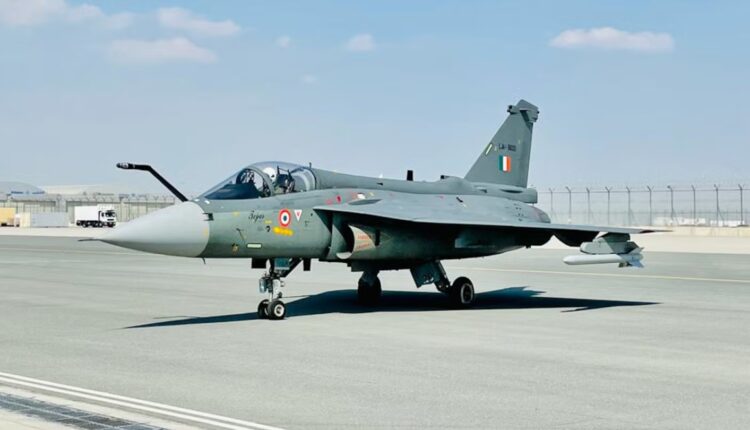
(DEFENCE SECURITY ASIA) — India has formally signed a landmark US$7 billion deal to acquire 97 Tejas Light Combat Aircraft (LCA) Mk-1A fighter jets, marking one of the largest indigenous defence procurements in its modern history.
The contract, concluded recently, with Hindustan Aeronautics Limited (HAL), underscores New Delhi’s accelerating pursuit of self-reliance in military aerospace manufacturing under the “Atmanirbhar Bharat” (Self-Reliant India) vision.

“The supply of these aircraft by HAL would enhance operational capability of the Indian Air Force to continue their unhindered operations and strengthen defence preparedness,” Defence Minister Rajnath Singh said in a post on X.
The announcement came just a day before the Indian Air Force conducted the final flight of its Russian-origin MiG-21 fighters, drawing the curtain on an aircraft that had served as the backbone of India’s combat fleet for decades.
With the retirement of the MiG-21, India’s inventory of primarily Soviet-designed fighter jets will contract to 29 squadrons against an authorised strength of 42 — a shortfall that continues to frustrate military planners, particularly in the aftermath of the bitter aerial clashes with Pakistan in May.
Thursday’s agreement represents a follow-on order for the advanced Tejas Mk-1A variant, powered by General Electric engines, and builds upon the government’s earlier contract signed in 2021 for 83 aircraft of the same type.
However, deliveries from that initial order have yet to commence, with Hindustan Aeronautics Limited (HAL) attributing the delay to GE’s slow pace in supplying the requisite powerplants.
General Electric explained that the delays were the result of challenges in restarting its production line and re-establishing global supply chains for the engines in the aftermath of the COVID-19 pandemic.
The company delivered the first engine for the Tejas Mk-1A in March this year, and Indian defence officials have since expressed confidence that production and deliveries will stabilise within the current fiscal cycle.
With the latest contract, the Indian Air Force’s Tejas fleet will eventually expand to 220 aircraft, representing one of the largest single-engine fighter inventories outside of the United States and China.
Officials have also confirmed that negotiations are underway for a follow-on agreement with GE to secure additional engines in order to sustain long-term production and operational availability of the fleet.
The acquisition of 97 Tejas will serve as both a military and industrial watershed, strengthening the Indian Air Force (IAF) while energising the domestic defence ecosystem through technology transfer, supplier integration, and job creation.
It also demonstrates India’s determination to systematically phase out its aging Soviet-era MiG fleet and replace it with homegrown platforms capable of sustaining prolonged high-intensity operations across South Asia’s contested skies.
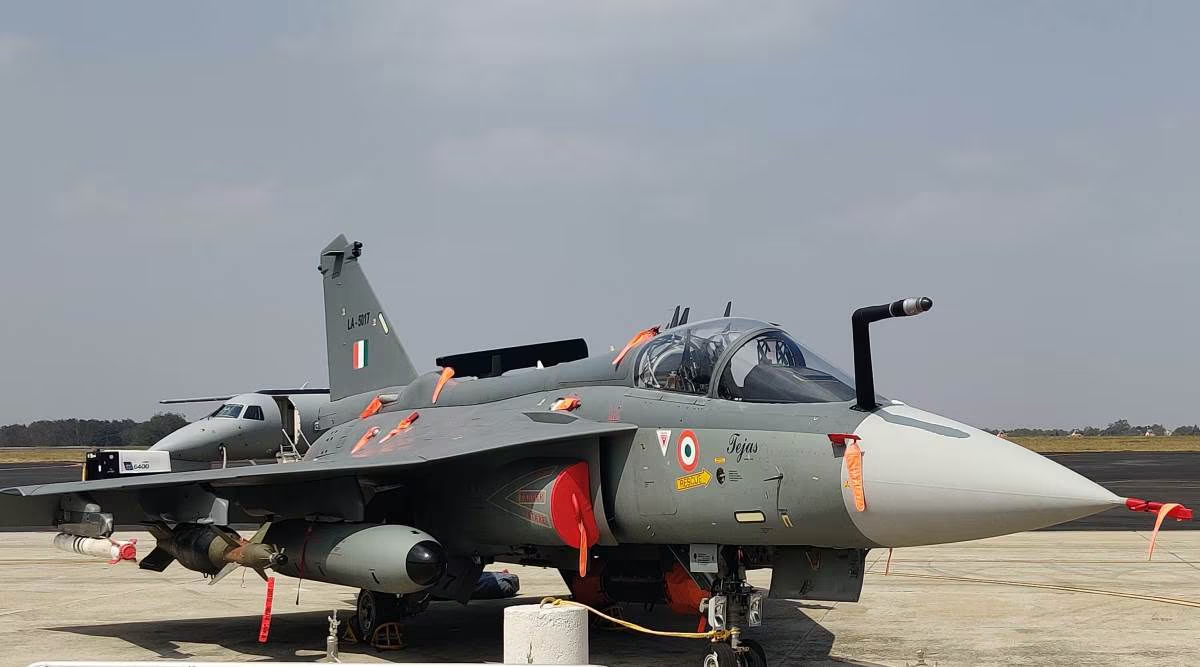
Origins and Evolution of the Tejas Program
The Tejas program was conceived in the 1980s against the backdrop of growing obsolescence of the IAF’s MiG-21 “Fishbed” fleet, which had served as the backbone of Indian air power for decades.
Designed jointly by HAL and the Aeronautical Development Agency (ADA), the Tejas became the first supersonic combat aircraft developed entirely in India.
Despite its long gestation, spanning more than three decades, the Tejas project now represents a critical cornerstone of India’s aerospace sovereignty.
The Tejas Mk-1A variant at the heart of the new deal incorporates modern combat avionics, advanced sensors, and electronic warfare suites, elevating it far beyond the baseline Mk-1 in capability and survivability.
India had previously placed an order in 2021 for 83 Tejas Mk-1A fighters valued at approximately $6 billion, which provided the industrial base and confidence for this larger follow-on order.
With the combined orders, the IAF is projected to field more than 200 Tejas jets, placing it among the largest operators of a single-engine light combat aircraft worldwide.
The $7 Billion Contract and Industrial Impact
The contract, valued at 623.70 billion rupees ($7.03 billion), was signed between India’s Ministry of Defence and HAL in a deal that symbolises the government’s long-term commitment to nurturing domestic aerospace production.
HAL’s facilities in Bengaluru, Nashik, and Coimbatore will be at the forefront of mass production, with a targeted delivery schedule of 97 aircraft spread over six years.
The deal is designed not only to bolster IAF squadron strength but also to catalyse an industrial renaissance across India’s defence supply chain.
Over 105 Indian suppliers — including private-sector small and medium enterprises (SMEs) — are engaged in the Tejas program, with local content exceeding 65 percent.
This ensures that a significant proportion of the economic value remains within India, creating an estimated 11,750 jobs annually during the program’s execution.
By aligning with the government’s “Make in India” initiative, the Tejas program reduces dependency on foreign suppliers and shields India from external sanctions or export restrictions.
Key Features of the Tejas Mk-1A
The Tejas Mk-1A is a fourth-generation multirole combat aircraft, tailored for both air defence and precision strike roles.
Its AESA radar provides enhanced detection and tracking capability against multiple aerial targets, including low-RCS threats such as drones and stealth fighters.
The aircraft is fully compatible with an extensive weapons suite, including Astra beyond-visual-range air-to-air missiles (BVRAAMs), precision-guided bombs, and anti-ship munitions.
With a combat radius exceeding 500 km, supersonic speeds of Mach 1.6, and aerial refuelling capability, the Mk-1A ensures strategic reach across South Asia’s expansive battlefronts.
Its cockpit is equipped with digital multi-function displays, helmet-mounted sights, and HOTAS (hands-on-throttle-and-stick) controls for pilot efficiency.
The platform integrates advanced electronic warfare systems and self-protection jammers, enhancing survivability against modern surface-to-air missile (SAM) systems deployed by both Pakistan and China.
Its relatively low acquisition and lifecycle cost compared to imported fighters like the Rafale F3R or the F-16V makes it a highly cost-effective solution for sustaining numerical squadron strength.
Strategic Implications for India’s Air Power
The timing of this procurement is critical as India faces intensifying airpower competition along both its western and northern frontiers.
Against Pakistan, the Tejas Mk-1A strengthens India’s ability to match the JF-17 Block III fleet, which is now equipped with Chinese PL-15 long-range air-to-air missiles.
While the PL-15’s range is estimated at over 200 km, the integration of India’s indigenous Astra Mk-2 and future Astra Mk-3 missiles will give the Tejas Mk-1A comparable stand-off capability.
Against China, which continues to induct advanced J-20 stealth fighters and J-16 strike aircraft in Tibet and Xinjiang, the Tejas will provide the IAF with volume-based deterrence and high sortie-generation potential.
It also frees up India’s heavyweight Su-30MKI and Rafale fleets for deep-strike and specialised missions while the Tejas secures frontline patrol and quick reaction alert roles.
Analysts note that this layered force structure will increase the IAF’s operational flexibility and sustain deterrence in a potential two-front war scenario.
Boost to India’s Defence Exports
The Tejas deal is also expected to strengthen India’s credibility as an emerging exporter of affordable combat aircraft.
Countries such as Argentina, Egypt, and the Philippines have shown varying degrees of interest in the platform, with Argentina even shortlisting it against rivals such as the JF-17 and FA-50.
While these export campaigns remain in the evaluation stage, India’s commitment to inducting more than 200 Tejas jets demonstrates a strong domestic endorsement, often a prerequisite for export success.
Defence economists predict that export success would not only lower the unit cost for the IAF but also position India alongside South Korea, Turkey, and Brazil as a supplier of next-generation light fighters to the Global South.
READ: Tejas to Get Meteor BVR Missiles: India’s Indigenous Fighter Jet Set for Game-Changing Upgrade
Challenges and Limitations
Despite the Tejas’ successes, challenges remain in scaling production to meet the IAF’s urgent requirements.
HAL’s production capacity has historically been limited, and ramping up to produce 97 fighters in six years will require robust supply chain management and strict adherence to timelines.
Critics also point out that the Tejas, while advanced, is not a fifth-generation platform and lacks stealth features that China and, increasingly, Pakistan are moving toward.
Moreover, sustaining fleet availability will demand consistent investment in maintenance, spares, and pilot training infrastructure, which India must not underestimate.
Yet, the lessons learned from Tejas will feed directly into the development of India’s Tejas Mk-2 and the ambitious Advanced Medium Combat Aircraft (AMCA) program, which aims to deliver a fifth-generation stealth fighter.
Future Outlook
The induction of 97 additional Tejas jets marks a new phase in India’s long-term aerospace strategy.
Combined with the Mk-2 and AMCA projects, India is laying the foundation for a three-tiered fighter ecosystem composed of light, medium, and fifth-generation combat aircraft.
This not only reduces dependence on foreign suppliers but also ensures that India remains strategically autonomous in the face of rapidly evolving global defence dynamics.
For New Delhi, the deal is not merely about modernising the IAF’s fleet but about securing long-term geopolitical leverage through technological sovereignty.
It highlights India’s determination to project itself as both a regional security provider and a global aerospace power capable of shaping the future of combat aviation.
Conclusion
The US$7 billion Tejas contract is a defining milestone for India’s defence sector, embodying both military necessity and industrial ambition.
By inducting 97 Tejas Mk-1A fighters, India is fortifying its air power, energising its defence industry, and reducing reliance on external suppliers in an era of geopolitical uncertainty.
For the IAF, the Tejas will form a critical backbone of its frontline force structure, supporting heavyweights like the Rafale and Su-30MKI in a layered deterrent posture.
For India’s defence industry, the deal is a signal to the world that New Delhi is ready not only to defend itself but also to emerge as a competitive exporter in the global fighter aircraft market.
As these jets roll off HAL’s production lines and enter squadron service, they will stand as both a symbol of national pride and a tool of strategic deterrence in South Asia’s increasingly contested skies. — DEFENCE SECURITY ASIA
