
French Rafale Stuns NATO Exercise: Scores Simulated “Kill” on U.S. F-35 in Trident Atlantic 2025
In a symbolic yet explosive dogfight, France’s Rafale fighter jet locked onto and scored a simulated “kill” against America’s F-35 stealth jet during NATO’s Trident Atlantic 25 exercise in Finland, raising fresh debates on stealth versus agility in modern warfare.

(DEFENCE SECURITY ASIA) — In a dramatic display of air combat training, a French Dassault Rafale fighter jet scored a simulated “kill” against an American F-35A Lightning II during Exercise Trident Atlantic 25, a NATO airpower drill hosted by Finland from June 16 to 27, 2025.
This marked Finland’s first time hosting the trilateral NATO exercise, which brought together air forces from the United States, United Kingdom, France, and Finland to refine interoperability and stress-test Agile Combat Employment (ACE) tactics under high-intensity conflict scenarios.
A 44-second video released on August 20 showcased a Rafale locking onto an F-35 during a Basic Fighter Maneuver (BFM), commonly referred to as a dogfight, within visual range.
At the 15-second mark, the Rafale’s Infrared Search and Track (IRST) system captured the stealth fighter, followed by an audible “take the shot” command—indicating a simulated missile launch.
The footage also depicted the Rafale locking onto a Finnish F/A-18 Hornet twice during the same exercise, underlining its agility and lethality in close-quarters engagements.
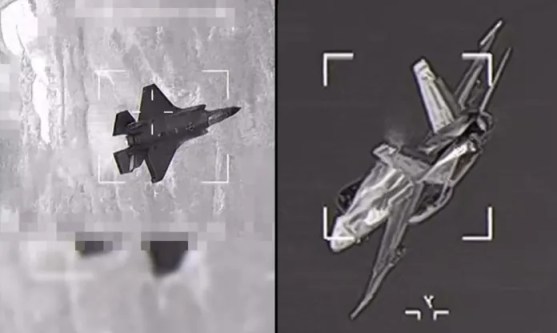
Exercise Trident Atlantic 25 was staged across Finnish air bases at Pirkkala, Rissala, Rovaniemi, and Halli, involving more than 40 aircraft and around 1,000 personnel.
Participating fleets included U.S. F-35A Lightning II and F-15E Strike Eagles, British Eurofighter Typhoons, French Rafales, Finnish F/A-18 Hornets, and support assets such as the French E-3F AWACS and A400M transport aircraft.
The simulated Rafale victory highlighted the strengths and trade-offs between fourth-generation and fifth-generation fighters.
The Rafale, with its delta-wing design, powerful Snecma M88 engines, and advanced SPECTRA electronic warfare suite, thrives in dogfight environments where maneuverability, sensor fusion, and electronic countermeasures dominate.
By contrast, the F-35’s strength lies in beyond-visual-range (BVR) combat, leveraging stealth shaping, sensor fusion, and networked battlespace awareness to strike opponents before being detected.
Analysts stress that while the Rafale’s simulated “kill” demonstrates its formidable close-range combat edge, modern warfare favors long-range engagements where the F-35 maintains an advantage.
This event recalls a 2009 incident when a Rafale secured a simulated kill against an F-22 Raptor during exercises in the Middle East—another episode heavily publicized to reinforce France’s aerospace credibility.
The new footage reignited debate about the Rafale’s competitiveness against U.S. stealth jets, particularly at a time when Paris is actively promoting the Rafale as a cost-effective alternative to the F-35 in the global export market.
“The video underscores the Rafale’s enduring capability to contest even the most advanced Western stealth fighters in certain combat scenarios,” noted defence experts.
While the French Air Force refrained from explicitly confirming the dogfight “kill,” the video’s circulation energized aviation circles, with enthusiasts emphasizing the Rafale’s resilience and adaptability.
Critics caution that simulated kills are highly scenario-dependent, shaped by rules of engagement, altitude parameters, and exercise objectives, rather than reflecting full-scale combat realities.
The F-35’s radar warning receivers likely detected the Rafale lock, but the exercise permitted the engagement to continue to stress-test pilot proficiency and platform agility.
The timing of the release is strategic, aligning with France’s ongoing push to persuade European NATO members to diversify away from U.S. airpower dominance.
Nevertheless, the F-35 program continues to dominate global fighter exports, with Finland, Poland, Switzerland, and several other nations selecting the Lightning II to anchor their next-generation fleets.
Finland, which joined NATO in April 2023, is scheduled to replace its legacy F/A-18 Hornets with 64 F-35As by 2030, citing the aircraft’s advanced stealth, long-range strike capabilities, and resilience in Arctic conditions.
The Rafale’s symbolic “kill” comes at a time of escalating aerial competition in Europe, where NATO air policing missions across the Baltic and Arctic regions are intensifying in response to Russian aggression.
As NATO deepens its air integration, exercises like Trident Atlantic 25 underscore the importance of blending fourth-generation versatility with fifth-generation stealth dominance to create a balanced force structure.
The Rafale’s performance serves as a reminder that agility, electronic warfare resilience, and pilot training remain critical even in an era where stealth and long-range missiles dominate warfighting narratives.
For now, the Rafale has secured a symbolic but politically powerful victory, bolstering its reputation as one of the most combat-proven, exportable multirole fighters in the global market.
French Rafale Scored Simulated Kill Against U.S. F-22 Raptor During 2009 UAE Exercise
In a stunning outcome that shook assumptions about stealth dominance, a French Dassault Rafale fighter jet achieved a simulated “kill” against a U.S. Air Force F-22 Raptor during multinational drills held at Al Dhafra Air Base in the United Arab Emirates (UAE) in November 2009.
The exercise, conducted at Al Dhafra Air Base, was designed to test interoperability among advanced allied air forces while pushing pilots and platforms into both beyond-visual-range (BVR) and within-visual-range (WVR) combat scenarios.
Participants included U.S. F-22 Raptors from the 1st Fighter Wing, French Air Force Rafales, British Royal Air Force Eurofighter Typhoons, and Emirati Mirage 2000s, reflecting a diverse mix of fourth- and fifth-generation fighters.
It was during one of these close-range Basic Fighter Maneuvers (BFM), better known as dogfights, that a Rafale pilot maneuvered into a dominant position and executed a simulated infrared missile strike on the Raptor.
Cockpit video later released captured the Rafale’s Infrared Search and Track (IRST) system locking onto the F-22, with the French pilot sustaining extreme high-G maneuvers—reportedly up to 9Gs—to outmaneuver the stealth jet.
The footage also revealed the pilot’s audible strain under immense G-forces, highlighting the sheer intensity of the engagement and the physical demands imposed on aviators during such combat encounters.
“The video underscores the Rafale’s enduring capability to contest even the most advanced Western stealth fighters in certain combat scenarios,” stressed defence experts observing the footage years later.
The French Ministry of Defence used this video to reinforce claims of the Rafale’s effectiveness, directly countering U.S. assertions that the F-22 remained undefeated in the exercise.
While U.S. pilots insisted the Raptors had downed multiple Rafales in other engagements, they were compelled to concede that at least one Raptor had been “shot down” in training, with another falling victim to a UAE Mirage 2000.
Lt. Col. Dirk Smith admitted that “no matter how advanced a jet is, a pilot can still make mistakes,” a candid recognition that technology alone cannot guarantee invulnerability.
The Rafale’s success lay in its aerodynamic agility, with its delta wing and canard configuration providing extreme maneuverability in tight turning battles.
Coupled with the SPECTRA electronic warfare suite, the Rafale was able to mask signatures, spoof sensors, and position itself for infrared missile engagements against the Raptor.
The F-22, optimized for stealth and first-shot BVR dominance, is designed to neutralize threats at long range using radar stealth and AIM-120 AMRAAMs, but dogfight restrictions in the UAE exercise effectively neutralized its primary advantages.
With external tanks reducing its maneuverability and engagement rules forcing close combat, the Raptor was placed into a rare disadvantageous position where its heavier frame struggled against the Rafale’s agility.
German Air Force pilots who later flew against the F-22 in Alaska echoed similar observations, noting that the Raptor’s size and weight limit its edge in knife-fight scenarios.
For Paris, the Rafale’s simulated victory became a potent marketing tool, positioning Dassault’s 4.5-generation fighter as a credible and cost-effective alternative in the international fighter market.
The timing was critical, as France was struggling to secure export orders against American stealth jets, and the Rafale’s publicized success helped bolster its reputation as a versatile multirole aircraft.
The episode demonstrated that pilot skill, situational awareness, and rules of engagement remain as decisive as technology in determining combat outcomes.
Critics have pointed out that simulated kills in controlled training do not mirror real-world combat, where the F-22’s stealth and sensor fusion would likely prevent such close engagements.
Even so, the Rafale’s achievement chipped away at the narrative of Raptor invincibility and showcased the enduring importance of adaptability and agility.
The incident continues to fuel intense debate in aviation circles, with some emphasizing that exercises are deliberately structured to test limitations and stress aircraft under non-ideal conditions.
The 2009 exercise remains one of the few occasions when the Raptor was publicly acknowledged to have been “killed” in simulated combat, elevating the Rafale’s prestige in military aviation history.
This symbolic victory foreshadowed later developments, including the Rafale’s simulated “kill” against a U.S. F-35A Lightning II during NATO’s Trident Atlantic 25 exercise in Finland in 2025, reinforcing the French jet’s reputation as a formidable opponent even against fifth-generation stealth aircraft.
For France, the Rafale’s combat record in Libya, Mali, Iraq, and Syria, combined with symbolic achievements against stealth rivals in exercises, underlines its status as one of the most combat-proven multirole fighters in service today.
For the United States, the episode served as a reminder that no fighter is invincible, and that even the most advanced platforms must continually adapt tactics, technology, and training to maintain dominance.
As air forces worldwide weigh the trade-offs between stealth and maneuverability, the UAE dogfight remains a compelling case study in the evolving dynamics of aerial warfare.
“Rafale’s Double Kill: How France’s Fighter Exposed the Limits of Stealth Against the F-22 and F-35”
The Rafale’s simulated kills against the F-22 Raptor in 2009 and the F-35 Lightning II in 2025 remain symbolic victories, but their implications extend far beyond the headlines.
These incidents highlight the limits of stealth in modern warfare, showing that even the most advanced fifth-generation aircraft can be neutralized when conditions favor agility, electronic warfare, and passive detection systems.
They also prove that the dogfight has not been rendered obsolete, despite decades of predictions that future aerial combat would be decided entirely at long range.
For NATO and allied air forces, the Rafale’s performance underscores the value of maintaining a balanced fleet that blends stealth fighters with highly maneuverable fourth-generation-plus platforms.
This balance is critical because stealth aircraft like the F-35 and F-22, while unmatched in BVR combat, remain heavily dependent on supporting assets such as AWACS, tankers, and electronic warfare platforms to maximize their effectiveness.
By contrast, the Rafale’s multi-role versatility allows it to operate with greater independence, conducting air superiority, strike, and electronic warfare missions without relying as heavily on a large support architecture.
The fact that a Rafale was able to lock and “kill” both the F-22 and F-35 in different eras also demonstrates how sensor technology is catching up to stealth, with IRST and advanced radar increasingly capable of detecting low-observable aircraft.
This trend raises uncomfortable questions for nations investing heavily in stealth fleets, suggesting that future wars will demand a broader mix of capabilities rather than reliance on a single technological advantage.
It also strengthens France’s hand in the fighter export market, where the Rafale is pitched as a cost-effective alternative to U.S. jets, particularly for countries seeking combat-proven aircraft without political restrictions.
For the U.S., the lesson is clear: stealth dominance cannot be taken for granted, and continuous adaptation in doctrine, tactics, and technology will be essential to preserve its airpower edge against increasingly sophisticated challengers.
Ultimately, the Rafale’s symbolic “kills” demonstrate that the future of air combat lies not in one platform or one doctrine, but in the synergy of stealth, agility, electronic warfare, and human skill — a combination that will define the skies of the 21st century.
— DEFENCE SECURITY ASIA

“With external tanks reducing its maneuverability and engagement rules forcing close combat, the Raptor was placed into a rare disadvantageous position where its heavier frame struggled against the Rafale’s agility.”
How can you still relay the fake news of the F-22 droptanks since not only in the video but also in several shots from Rafale OSF you could CLEARLY SEE there was NO droptank at all? This is quite shameful. Plus not reminding to everyone how bad was the US reaction with as you relayed fake news about the droptanks before being debunked by AAE releasing pictures of the F-22 engaged with no droptank at all, then lying about the results of the duel, USAF official saying it was 5 win for the F-22 and a draw, then being so embarrassed by the “leaked” video of the Rafale kill they conceded a victory to the Rafale.
I encourage you to see this video of the dogfight https://www.youtube.com/watch?v=oGuWadoTgkE and correct your article.
The 2009 UAE exercise also demonstrated an incredible US achievement : invisible drop tanks. They can’t be seen for the duration of the video, that lasts more than a minute and where the F-22 tries to shake the Rafale away by banking as much as it can. These tanks must not have been so effective, as the F-35 wasn’t equipped with them and still got splashed.