
Chinese Satellites Expose US THAAD Deployment in Jordan, Revealing a New Era of Space-Enabled Battlefield Transparency
High-resolution Chinese satellite imagery revealing US THAAD deployment at Muwaffaq Salti Air Base underscores how space-based reconnaissance is transforming missile defence, deterrence, and operational secrecy amid escalating US-Iran tensions.

(DEFENCE SECURITY ASIA) — The exposure of the United States’ Terminal High Altitude Area Defense (THAAD) deployment in Jordan by Chinese commercial satellites underscores the arrival of a new era of space-enabled battlefield transparency.
In this emerging operational environment, orbital reconnaissance has rendered even America’s most sensitive missile-defence deployments openly visible, precisely measurable, and strategically targetable within the global open-source intelligence ecosystem.
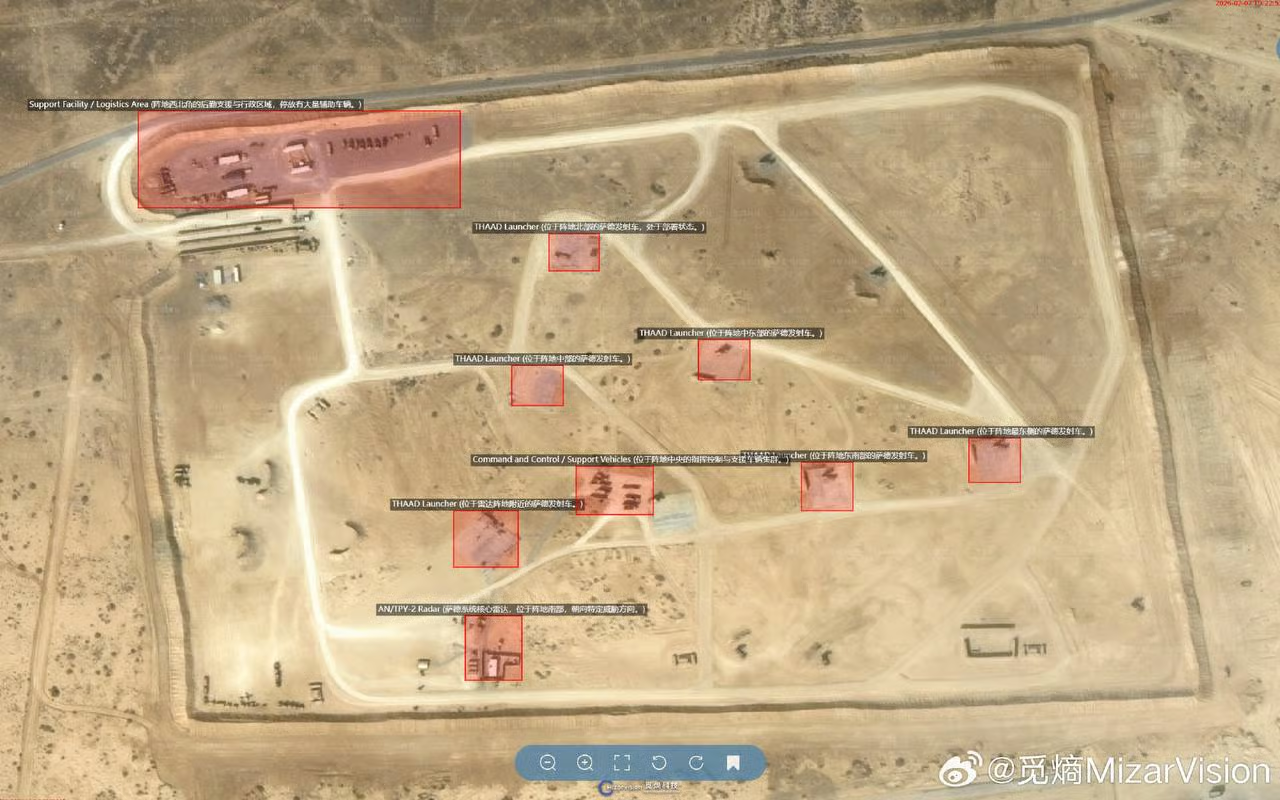
High-resolution imagery released by China’s MizarVision satellite company, dated January 21 and publicly circulated on February 9, 2026, revealed the precise configuration, positioning, and operational status of a full THAAD battery at Muwaffaq Salti Air Base, a critical US forward operating location in eastern Jordan supporting American air and ground operations across the Levant.
This revelation occurred amid sharply escalating tensions between Washington and Tehran, following heightened rhetoric from US President Donald Trump over Iran’s internal unrest, alleged executions of detainees, and persistent warnings of retaliatory missile strikes against US and allied forces throughout the Middle East.
A senior Pentagon source encapsulated the urgency of the deployment when stating, “Before any potential action against Iran, we need to bolster our defenses,” a remark that reflects Washington’s acute awareness of the vulnerability of forward-deployed assets to Iran’s expanding arsenal of precision-guided ballistic and hypersonic weapons.
The exposure of THAAD’s positioning by Chinese satellite platforms underscores a broader strategic reality in which satellite surveillance—once monopolised by state intelligence agencies—has become a commercially accessible instrument capable of reshaping deterrence, escalation control, and operational security across contested regions.
For the United States, the revelation represents more than an intelligence embarrassment; it highlights structural vulnerabilities in the survivability of missile defence systems whose effectiveness increasingly depends not only on interceptor performance, but also on concealment, mobility, and electromagnetic countermeasures against adversarial reconnaissance.
For China, the publication of this imagery constitutes a calibrated geopolitical signal, demonstrating Beijing’s ability to monitor US military posture far beyond the Indo-Pacific while reinforcing its narrative of American militarisation and interventionism across the Middle East.
For Iran and its regional proxies, the open disclosure of THAAD coordinates potentially enhances targeting calculus, even if operational realities complicate any attempt to neutralise such systems, thereby intensifying the already volatile deterrence equation spanning the Gulf, the Levant, and beyond.
Collectively, the incident signals the arrival of a battlespace where space dominance, commercial intelligence, and missile defence intersect, forcing militaries to confront an era in which secrecy is eroding faster than defensive architectures can adapt.
THAAD as the Cornerstone of US Upper-Tier Missile Defence in the Middle East
The THAAD system represents the apex of American upper-tier ballistic missile defence, engineered to intercept and destroy short-, medium-, and intermediate-range ballistic missiles during their terminal phase at altitudes reaching approximately 150 kilometres, thereby extending defensive coverage far beyond conventional air defence envelopes.
Developed by Lockheed Martin and operationally integrated into the US Army since 2008, THAAD complements lower-altitude systems such as Patriot by providing layered defence against increasingly sophisticated missile threats, particularly those employing manoeuvrable re-entry vehicles or depressed trajectories.
Each THAAD battery typically consists of six mobile launchers capable of carrying up to 48 interceptors, a high-power AN/TPY-2 X-band radar with detection ranges exceeding 1,000 kilometres, a fire control and communications unit, and a command post enabling real-time engagement coordination across joint and allied networks.
Unlike traditional surface-to-air missile systems, THAAD employs hit-to-kill kinetic interceptors that rely on direct collision at hypersonic speeds rather than explosive warheads, a design choice that maximises lethality while minimising collateral damage in defended airspace.
The AN/TPY-2 radar’s ability to discriminate between actual warheads and decoys provides critical resilience against countermeasures, making THAAD particularly valuable in scenarios involving complex missile salvos or mixed ballistic threats.
THAAD’s deployment history—from South Korea in 2017 against North Korean missile developments to Guam and Israel—reflects Washington’s reliance on the system as a strategic shield protecting both homeland interests and forward-deployed forces.
However, with only an estimated eight operational THAAD batteries available globally, each costing roughly US$800 million (approximately RM3.76 billion) per unit including interceptors and support infrastructure, the system’s scarcity imposes significant strategic trade-offs in allocation and coverage.
As missile proliferation accelerates across multiple theatres simultaneously, the exposure of a THAAD battery’s precise location magnifies the operational risks associated with concentrating such high-value defensive assets within transparent, surveilled environments.

Jordan’s Strategic Role in the US Missile Defence and Regional Deterrence Architecture
The deployment of a full THAAD battery to Muwaffaq Salti Air Base marks a substantial escalation of Washington’s military footprint in Jordan, a country whose geographic positioning offers a unique balance between operational reach and relative insulation from direct Iranian naval threats.
Satellite imagery confirms that the Jordanian deployment includes the complete THAAD architecture—six launchers loaded with 36 interceptors, the AN/TPY-2 radar, and associated command elements—signalling readiness for immediate operational integration.
Muwaffaq Salti Air Base already hosts advanced US combat and support aircraft, including F-15E Strike Eagles, A-10 Thunderbolt II attack aircraft, and EA-18G Growler electronic warfare platforms, transforming the installation into a pivotal hub for regional power projection and defensive operations.
The decision to position THAAD in Jordan reflects lessons drawn from previous Iranian missile strikes, including the 2025 attack on Al Udeid Air Base in Qatar, which exposed vulnerabilities in even heavily defended US installations.
Jordan’s location places it within effective intercept geometry against Iranian ballistic missile trajectories while reducing exposure to maritime and littoral attack vectors prevalent in the Gulf.
The deployment also echoes historical precedents, such as the 2019 reinforcement of Saudi Arabia following attacks on energy infrastructure, but is now intensified by Iran’s introduction of hypersonic systems like the Fattah-1, designed to complicate interception through extreme manoeuvrability.
Analysts have consistently warned that while THAAD provides formidable upper-tier defence, it remains susceptible to saturation attacks, particularly when paired with lower-cost ballistic missiles or coordinated multi-axis launches.
Seth Jones of the Center for Strategic and International Studies captured the logistical reality succinctly when stating, “It is expensive to move Patriots and THAADs,” underscoring the financial and operational strain inherent in sustaining such deployments across multiple hotspots.
Chinese Commercial Satellites and the Weaponisation of Transparency
The public revelation of the THAAD deployment originated from imagery produced by MizarVision, a Chinese satellite remote-sensing and geospatial analysis firm leveraging China’s rapidly expanding constellation of commercial Earth-observation satellites, including platforms derived from the Jilin-1 series.
The imagery, dated January 21, displayed the radar array, launcher configuration, and support vehicles arranged in a manner consistent with an operationally active THAAD battery, eliminating ambiguity regarding readiness status.
A MizarVision technical analyst described the significance of the imagery by stating, “The satellite imagery shows a large number of F-15E fighter jets and the THAAD deployment, indicating a redeployment to strengthen defenses at key locations.”
Chinese state-aligned media framed the disclosure as evidence of Washington’s aggressive military posture, with commentary suggesting that visible US deployments complicate any attempt to replicate interventionist strategies previously employed elsewhere.
This incident is part of a broader pattern in which Chinese commercial satellites have exposed US military assets across the Middle East, including installations in Qatar and other Gulf states, highlighting Beijing’s sustained monitoring of American force posture.
China’s satellite fleet now exceeds 500 operational platforms, including advanced synthetic aperture radar systems capable of all-weather, day-night imaging, significantly narrowing the window for concealment.
From a strategic perspective, the democratisation of high-resolution satellite imagery erodes the traditional advantages of secrecy, transforming missile defence sites into openly analysable nodes within a transparent battlespace.
As one analyst observed, “Satellite images turn once-hidden bases into open-source targets,” encapsulating the profound shift in how military planners must now conceptualise survivability and deception.
Operational, Regional, and Global Strategic Consequences
The exposure of THAAD’s location introduces complex operational challenges for US forces, potentially necessitating redeployment, enhanced electronic warfare measures, or increased reliance on decoys and mobility to mitigate targeting risks.
Iranian media has rapidly amplified the disclosure, with commentary suggesting that openly available coordinates could inform missile targeting strategies, although experts caution that neutralising THAAD would require large-scale, coordinated salvos.
Regionally, Jordan’s hosting of THAAD reinforces its strategic alignment with Washington while simultaneously increasing its exposure to asymmetric retaliation by Iranian proxies operating across Iraq, Syria, and Yemen.
Across the Gulf, similar reinforcements in Saudi Arabia, Qatar, Bahrain, and Kuwait are collectively forming what analysts describe as a defensive “ring of steel” encircling Iran, altering regional escalation dynamics.
Despite this buildup, assessments describe the posture as “deliberate but incomplete,” raising questions over whether the deployments are primarily deterrent signalling or preparatory steps toward potential conflict.
On the US-China axis, the incident exemplifies intensifying rivalry in space-enabled military intelligence, coinciding with revelations of China’s rapid expansion of missile production facilities and advances in stealth and aerospace capabilities.
A Chinese expert articulated this narrative by stating, “It is difficult for Washington to replicate the ‘Venezuela model’ in Iran,” arguing that visible US deployments expose strategic limitations rather than strength.
The convergence of satellite transparency, missile proliferation, and regional instability underscores a strategic environment where defensive measures themselves become catalysts for escalation.
From Jordan to the Indo-Pacific: The Globalisation of Satellite-Driven Warfare
Beyond the Middle East, the Jordan THAAD exposure reverberates across Asia, where similar debates surround US missile defence deployments and Chinese opposition to radar systems capable of deep surveillance.
The controversy mirrors long-standing tensions over THAAD deployment in South Korea, where Beijing has consistently argued that radar capabilities extend beyond defensive requirements into strategic intelligence collection.
China’s earlier deployment of HQ-9 systems in contested maritime zones was widely interpreted as a counterbalance to US missile defence architectures, reinforcing reciprocal militarisation dynamics.
The Jordan incident reinforces the reality that commercial satellite constellations now enable persistent monitoring of carrier strike groups, air bases, and missile sites across the Taiwan Strait and South China Sea.
For energy markets, any escalation triggered by miscalculation threatens global supply chains, with analysts noting that defensive deployments often precede periods of heightened volatility.
As the US surges heavy airlift assets—over 42 strategic transport sorties—to sustain its Middle Eastern posture, questions of sustainability, cost, and escalation control loom large.
While diplomatic engagement remains a potential off-ramp, the visibility of defensive systems complicates signalling, narrowing the margin for misinterpretation.
Ultimately, the exposure of US THAAD in Jordan by Chinese satellites is not merely an intelligence episode, but a strategic warning that space dominance now dictates terrestrial outcomes, redefining deterrence in an era where concealment is no longer assured. — DEFENCE SECURITY ASIA
