
Chinese Satellites Expose Massive U.S. Air Force Buildup at Prince Sultan Air Base: 13 KC-135 Tankers, E-3G AWACS and C-130 Fleet Signal Extended Strike Readiness Against Iran
High-resolution imagery from China’s MizarVision reveals a concentrated U.S. Air Force deployment in Saudi Arabia, including 13 KC-135 Stratotankers and an E-3G AWACS, intensifying scrutiny over Washington’s operational posture toward Iran during Ramadan.

(DEFENCE SECURITY ASIA) — The disclosure of high-resolution satellite imagery captured by China’s MizarVision revealing a concentrated U.S. Air Force deployment at Prince Sultan Air Base in Saudi Arabia has injected a new layer of transparency into an already combustible U.S.–Iran confrontation, exposing 13 Boeing KC-135 Stratotankers, one Boeing E-3G Sentry AWACS, and five Lockheed C-130 Hercules aircraft poised for extended regional operations.
The imagery, publicly disseminated during the holy month of Ramadan, has intensified scrutiny of Washington’s operational calculus and Riyadh’s strategic positioning, particularly as U.S. President Donald Trump warned on January 28 that a carrier strike group led by USS Abraham Lincoln was moving toward Iran prepared to act “with speed and violence, if necessary,” framing the deployment within an overt deterrence narrative.
President Trump further escalated the rhetorical threshold by declaring, “We could have had a deal instead of sending the B-2s in to knock out their nuclear potential… I don’t think they want the consequences of not making a deal,” linking airborne force posture to coercive nuclear diplomacy in language that blurs deterrence and pre-emption.

White House Press Secretary Karoline Leavitt reinforced that ambiguity, stating there were “many reasons and arguments that one could make for a strike against Iran,” underscoring how political signalling and force concentration have converged into a visible operational architecture.
Iran’s senior adviser Ali Shamkhani responded with a calibrated yet uncompromising warning that “Any military action by America… will be considered the beginning of a war, and the response will be immediate, comprehensive, and unprecedented, targeting the aggressor, the heart of Tel Aviv, and all its supporters,” clarifying Tehran’s declared escalation ladder.
The strategic visibility of the Prince Sultan buildup—augmented by tanker concentration and airborne early warning assets—signals Washington’s intent to sustain prolonged air operations over Iranian airspace rather than conduct a limited demonstrative strike, indicating structural readiness rather than symbolic deterrence.
Simultaneously, the exposure of these aircraft through Chinese satellite capabilities removes the ambiguity traditionally associated with forward-deployed U.S. air power, complicating operational security and amplifying geopolitical signalling across the Middle East theatre.
The convergence of satellite transparency, presidential rhetoric, and visible aerial refuelling infrastructure therefore positions Prince Sultan Air Base as both a logistical nerve centre and a strategic flashpoint in a confrontation that now carries economic, military, and religious sensitivities during Ramadan.
The deliberate configuration of aerial refuelling assets, airborne command-and-control platforms, and tactical airlift aircraft within a single Gulf hub indicates a calibrated force posture designed for endurance-based air operations, suggesting that Washington is prioritising sustained battlespace dominance, sortie regeneration capacity, and flexible strike sequencing over rapid, short-duration punitive action.
At the same time, the public exposure of these deployments by Chinese space-based surveillance systems introduces a new variable into escalation management by narrowing strategic surprise, shaping international perception of offensive intent, and reinforcing a transparency-driven battlespace environment in which force aggregation itself becomes a geopolitical signal rather than merely a military precaution.
The Strategic Architecture at Prince Sultan Air Base
Prince Sultan Air Base, situated approximately 80 kilometres south of Riyadh, has historically functioned as a strategic aviation hub since its establishment in the 1950s and expansion during the Gulf War era, but its 2019 reactivation for U.S. forces following renewed tensions with Iran transformed it into a forward-operating anchor within Washington’s Gulf force posture.
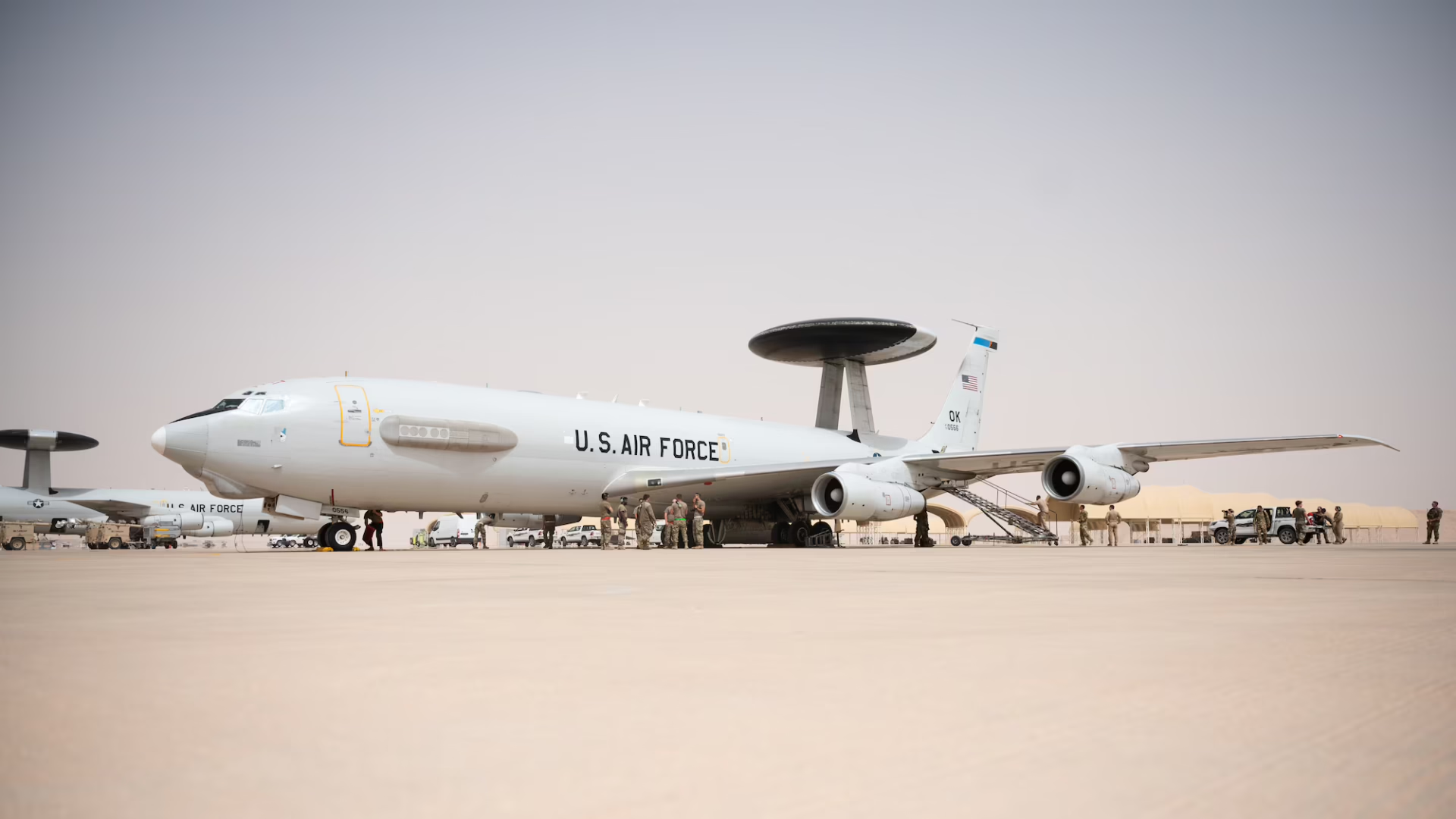
The February 18 imagery depicting one E-3G Sentry, 13 KC-135 Stratotankers, and five C-130 Hercules aircraft illustrates not merely aircraft presence but a deliberate layering of command, endurance, and logistics designed for sustained air dominance operations.
The Boeing E-3G Sentry—equipped with a rotating radar dome and capable of detecting aircraft, missile launches, and ground movements up to 400 kilometres away—forms the airborne command-and-control nucleus required to orchestrate complex multi-wave strike packages.
Such a platform is indispensable in a battlespace where Iran’s ballistic missile inventory and drone capabilities create a dense threat environment demanding real-time airspace coordination and threat cueing.
The concentration of 13 KC-135 Stratotankers—each capable of carrying more than 90,000 kilograms of aviation fuel—indicates preparations for deep-penetration missions requiring extended loiter time, mid-air refuelling cycles, and flexible strike routing.
A tanker fleet of this scale suggests not short-duration deterrent patrols but endurance-based air campaigns capable of sustaining fighters and bombers over target areas for prolonged operational windows.
The presence of five Lockheed C-130 Hercules aircraft—described as “always present” at the base—ensures that tactical airlift, rapid resupply, and force insertion capability remain intact should escalation require ground coordination or rapid dispersal.
Taken collectively, the asset mix reveals a self-sustaining air expeditionary architecture designed to maintain persistent aerial surveillance and strike flexibility without excessive reliance on vulnerable forward bases within immediate missile range.
The imagery therefore substantiates a shift from rotational presence to structured readiness, where refuelling depth and command-and-control resilience underpin the capacity for sustained kinetic operations.
Tanker Concentration and Air Campaign Endurance
The presence of 13 KC-135 Stratotankers at Prince Sultan Air Base constitutes a decisive indicator of operational intent because aerial refuelling capacity determines not only strike reach but sortie frequency and time-on-target persistence.
A tanker cluster of this magnitude enables multiple fighter and bomber packages to operate simultaneously while extending operational arcs deep into Iranian territory without requiring permanent basing inside contested airspace.
Satellite imagery earlier in February also indicated that at Al Udeid Air Base in Qatar, KC-135 numbers doubled from five to 14 between mid-January and late January 2026, suggesting a theatre-wide enhancement of refuelling infrastructure.
Such parallel tanker surges across regional bases imply coordinated logistical scaling rather than isolated repositioning, reinforcing the assessment that Washington seeks sustainable operational tempo rather than reactive signalling.
When viewed alongside the deployment of Patriot air defence systems and the broader regional aggregation of over 500 fighters, bombers, and support aircraft, the tanker footprint becomes the backbone of a potential air campaign architecture.
The deployment of six E-3 Sentry aircraft—nearly 40 percent of the U.S. fleet—to the Middle East further strengthens the analytical conclusion that command-and-control redundancy is being prioritized for high-intensity operations.
As one assessment noted, “The deployment of E-3s to the Middle East is one of the clearest indicators that the final pieces for a major air campaign against Iran are falling into place,” framing airborne early warning as a strategic threshold marker.
Yet the aging E-3 fleet, marked by readiness challenges and delays in replacement platforms, introduces operational risk should maintenance or availability constraints undermine sustained sortie coordination.
The tanker-and-AWACS combination therefore embodies both strength and vulnerability, where endurance capacity is matched by reliance on platforms whose visibility through satellite exposure could alter adversary targeting calculus.
In financial terms, while precise deployment costs remain undisclosed, sustaining a tanker-heavy force posture over months would represent expenditures running into billions of U.S. dollars—equivalent to tens of billions of Malaysian Ringgit at USD 1 = RM3.8—illustrating the economic weight behind extended deterrence.
Chinese Satellite Surveillance and Strategic Transparency
The exposure of Prince Sultan’s aircraft concentration by MizarVision—utilizing high-resolution imagery derived from China’s Earth observation satellite constellation—underscores Beijing’s expanding role in space-based intelligence and global geospatial monitoring.
Sub-meter resolution imagery capable of distinguishing individual aircraft types fundamentally alters the secrecy calculus traditionally associated with pre-strike deployments.
This is not an isolated revelation, as earlier January 2026 imagery similarly highlighted U.S. force concentrations at other regional bases, prompting broader discourse on the accelerating American presence.
Chinese military expert Zhang Junshe emphasized the operational significance of strategic bombers such as the B-2 and B-52, noting Diego Garcia in the Indian Ocean as an “ideal location” for assets positioned beyond Iranian retaliation range.
From an analytical perspective, the public dissemination of such imagery does more than inform—it shapes narrative framing by portraying visible U.S. deployments within the context of escalation.
Sun Degang, director of the Center for Middle East Studies at Fudan University, observed that “Iran is clearly drawing lessons from the conflict last June… the difficulty for the US and Israel to mount another surprise strike has increased significantly,” linking satellite transparency to reduced surprise thresholds.
The strategic effect is twofold: Tehran gains insight into operational posture, and Washington’s ambiguity advantage narrows under persistent surveillance.
For the United States, whose doctrine historically leveraged operational secrecy to achieve shock and awe effects, ubiquitous satellite monitoring introduces friction into pre-emptive planning cycles.
Beijing’s role in releasing the imagery also reinforces its broader diplomatic positioning in the Middle East, particularly following its mediation between Saudi Arabia and Iran in 2023.
The Prince Sultan episode therefore illustrates how space-based reconnaissance has evolved into a geopolitical instrument, amplifying the transparency of military posture while intensifying great-power competition narratives.
U.S.–Iran Escalation Dynamics and Retaliatory Signalling
The Prince Sultan buildup must be interpreted within the continuum of escalating U.S.–Iran hostilities that intensified following 2025 strikes on Iranian nuclear facilities justified by Washington as necessary containment of atomic ambitions.
Iran’s retaliatory missile actions against U.S. bases and proxy operations through regional actors have entrenched a cycle of action and counteraction, eroding confidence in diplomatic off-ramps.
President Trump’s linkage of B-2 bomber deployment to nuclear negotiations signals coercive leverage, while Vice President JD Vance’s reference to weighing talks versus “another option” reflects policy ambiguity.
Iran’s leadership, through Ali Shamkhani’s explicit warning of “immediate, comprehensive, and unprecedented” response, frames any strike as the threshold of declared war rather than limited retaliation.
Concrete fortifications over key Iranian facilities indicate preparation for survivability under potential aerial bombardment, signalling defensive readiness rather than symbolic defiance.
Simultaneously, unnamed U.S. officials have indicated readiness for potential assaults within days, underscoring compressed timelines and heightened alert posture.
The strategic geography of Prince Sultan—offering rapid access to the Persian Gulf—positions U.S. aircraft within range of critical Iranian infrastructure while remaining shielded by Saudi air defence layers.
However, Iran’s asymmetric capabilities, including missile strikes and proxy responses, create credible risks to regional bases, shipping lanes, and allied territory.
The Strait of Hormuz, through which approximately 20 percent of global oil transits, represents a pressure point where escalation could generate immediate global economic reverberations affecting energy-dependent economies.
The interplay of visible U.S. air power, Iranian deterrent rhetoric, and satellite transparency therefore constructs a high-risk environment where miscalculation could cascade into regional conflict.
Saudi Arabia, Ramadan, and Strategic Ambiguity
Saudi Arabia’s hosting of U.S. forces at Prince Sultan during Ramadan, which began on January 29, 2026, introduces religious and political sensitivities into what is already a volatile strategic equation.
The Kingdom’s 2023 diplomatic normalization with Iran—brokered by China—signalled a de-escalatory trajectory, yet the continued presence of American assets implies tacit operational accommodation.
Experts question whether Riyadh would “drag itself into a war during Ramadan,” recognizing the cultural and religious optics associated with military operations during this period.
Chinese satellite imagery reportedly identifying new bunkers in Yanbu suggests infrastructural preparations for potential prolonged operations, reinforcing perceptions of contingency planning.
For Tehran, the use of Saudi territory as a launchpad could be interpreted as complicity, potentially straining fragile diplomatic normalization gains.
From a broader regional stability perspective, escalation risks extend beyond immediate military exchange to energy markets, maritime security, and global economic stability.
Southeast Asian economies—including Malaysia and Indonesia—would be indirectly exposed through oil price volatility should the Strait of Hormuz become contested.
The United Kingdom’s reported blocking of base usage for certain operations underscores allied divergence over escalation thresholds.
The Prince Sultan deployment therefore situates Saudi Arabia at the intersection of alliance obligations, regional diplomacy, and religious observance, complicating strategic messaging.
In this context, the exposure of aircraft by Chinese satellites does not merely reveal hardware; it reveals the delicate balancing act underpinning Middle Eastern geopolitics in 2026.
The Prince Sultan Air Base concentration, captured by Chinese satellite imagery and amplified through global dissemination, thus stands as a defining moment in the evolving U.S.–Iran confrontation, where endurance-focused air power, geopolitical signalling, and space-based transparency converge under the shadow of Ramadan and the scrutiny of great-power competition. — DEFENCE SECURITY ASIA
