
China’s J-35 Enters ‘Beast Mode’: First Images Reveal Stealth Fighter Carrying PL-15 / PL-17 Long-Range Missiles in Major Airpower Shift
New images showing China’s J-35 stealth fighter carrying external PL-15 or PL-17 beyond-visual-range missiles signal a major shift in PLA air combat doctrine, potentially expanding the aircraft’s missile loadout and enabling long-range engagements against multiple airborne targets.

(DEFENCE SECURITY ASIA) — China’s emerging J-35 stealth fighter has entered a new phase of operational experimentation after images captured recently revealed the aircraft flying with externally mounted beyond-visual-range missiles, signalling a doctrinal shift in how the platform could balance stealth survivability with expanded air-to-air firepower during high-intensity combat scenarios.
The sighting represents a significant development milestone for the aircraft because it demonstrates that the J-35 can carry additional long-range air-to-air missiles beyond the constraints of its internal weapon bays, enabling a hybrid operational configuration that sacrifices some stealth performance in exchange for a dramatically increased missile payload.
The imagery suggests the aircraft was equipped with four externally mounted missiles—two on each wing—believed to be either the PL-15 or the larger PL-17 long-range interceptor missile, a configuration that analysts interpret as an experimental “beast mode” loadout designed to maximise engagement capacity against multiple airborne targets simultaneously.
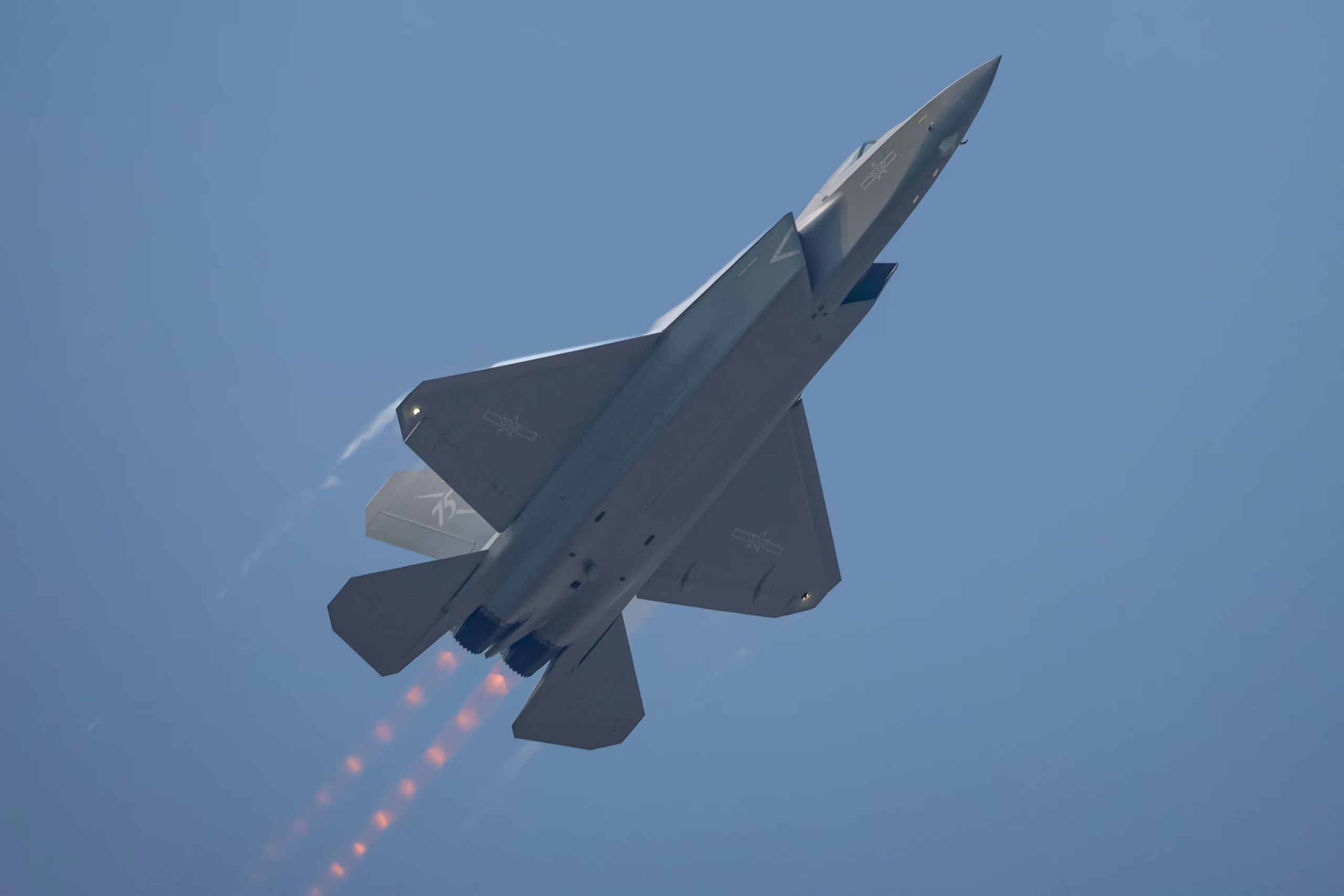
The appearance of external missile carriage on a stealth platform also signals that Chinese aerospace planners are actively exploring mission architectures where survivability derived from low-observable design can be deliberately traded for massed long-range missile salvos once air superiority conditions begin to stabilise in contested airspace.
If validated operationally, the configuration implies that the J-35 could function not only as a stealth penetration fighter but also as a high-capacity long-range missile carrier capable of threatening dispersed aerial formations and high-value airborne assets at extended distances.
External Missile Carriage Signals Doctrinal Flexibility
The aircraft visible in the released imagery appears in flight against a clear blue sky and is photographed from a vantage point below the aircraft, revealing a stealth fighter configuration characterised by sharply angular geometry and canted vertical stabilisers typical of modern low-observable airframe design.
The underwing pylons clearly display four elongated white missiles with pointed noses and stabilising fins consistent with advanced air-to-air missile architecture, reinforcing the assessment that the aircraft was configured for long-range interception testing rather than purely stealth-optimised operational scenarios.
External carriage of these missiles illustrates a doctrinal flexibility that allows the aircraft to transition from low-observable penetration missions toward high-payload aerial combat roles when stealth is no longer the dominant requirement in contested airspace.
Such configurations are often described as “beast mode,” a concept in which stealth fighters prioritise maximum weapons carriage by mounting munitions externally once enemy air-defence networks have been degraded or when overwhelming missile salvos are required to saturate adversary air formations.
For the J-35, this external weapons configuration demonstrates the possibility of engaging a larger number of hostile aircraft or airborne support platforms in a single sortie compared with purely stealth-restricted internal weapon carriage.
Internal weapons bays remain essential to maintaining low radar cross-section during initial penetration phases, but the addition of external pylons expands the aircraft’s engagement flexibility once survivability constraints become less restrictive.
The sighting therefore indicates that Chinese aerospace engineers are exploring operational concepts that allow the J-35 to function not only as a stealth penetration fighter but also as a high-capacity missile carrier capable of projecting long-range aerial lethality.
In such configurations the aircraft could potentially combine stealth-based sensor penetration with high-volume missile release, creating an operational profile where stealth enables targeting while external payload capacity enables mass engagement.
The decision to test external missile carriage also suggests that Chinese developers are evaluating trade-offs between radar signature management and raw combat payload capacity in future aerial warfare scenarios.

PL-15 Long-Range Missile Expands Engagement Envelope
One candidate missile visible in the sighting is the PL-15, a long-range active radar-guided beyond-visual-range air-to-air missile designed specifically for engagements against modern fighter aircraft and high-value airborne support platforms.
The PL-15 measures approximately four metres in length and is capable of speeds exceeding Mach 4, enabling rapid closure rates against distant targets and compressing the reaction time available to adversary aircraft attempting defensive manoeuvres.
Advanced variants of the missile are believed to possess engagement ranges exceeding 300 kilometres, positioning it among the longest-range air-to-air weapons currently fielded in operational service.
The missile’s guidance architecture relies on active radar homing supported by mid-course updates delivered through data-link communication systems that allow the launching aircraft to refine targeting information during flight.
This architecture enables the missile to pursue manoeuvring targets while maintaining situational awareness through sensor fusion provided by the launching platform.
Within the J-35’s internal weapons bays, the aircraft can reportedly carry up to six PL-15 missiles while maintaining a stealth-preserving configuration designed to minimise radar detection.
Specialised variants of the PL-15 feature foldable fins that allow the missile to fit within internal weapon bays without compromising aerodynamic stability during launch.
The integration of such missiles within the internal bays demonstrates that the J-35 is capable of conducting long-range aerial engagements without sacrificing its stealth characteristics during the early stages of combat.
However, the addition of externally mounted missiles potentially multiplies the total missile load carried by the aircraft during missions where stealth considerations become secondary.
PL-17 “AWACS Killer” Missile Alters Airpower Dynamics
Another potential missile visible in the sighting is the significantly larger PL-17, also known as the PL-20, an oversized long-range interceptor missile specifically engineered to neutralise high-value airborne assets rather than manoeuvrable fighter aircraft.
The PL-17 measures approximately six metres in length, making it substantially larger than both the PL-15 and the widely deployed AIM-120 class of Western beyond-visual-range missiles.
Its propulsion system incorporates a dual-pulse rocket motor that sustains thrust during different phases of flight, enabling the missile to maintain energy over extremely long engagement distances.
The missile also features thrust-vectoring control mechanisms that enhance manoeuvrability during terminal engagement phases when intercept geometry becomes increasingly dynamic.
Reported maximum speeds exceed Mach 4, enabling the missile to close large distances quickly against targets operating hundreds of kilometres away.
Range estimates for the missile vary widely but generally fall between 300 and 500 kilometres depending on launch conditions and flight profiles.
The guidance architecture integrates inertial navigation, satellite navigation support, and mid-course data-link updates that allow the missile to adjust trajectory as targeting information evolves.
During the terminal phase of interception the missile reportedly utilises a multimodal seeker incorporating AESA radar guidance, passive anti-radiation homing capabilities, and potentially infrared detection systems.
This combination of guidance modes enables the missile to track large airborne targets that may attempt evasive manoeuvres or electronic countermeasures during the engagement sequence.
Targeting High-Value Airborne Assets
Unlike conventional fighter-interceptor missiles, the PL-17 is believed to prioritise high-value airborne assets such as airborne early warning and control aircraft, aerial refuelling tankers, and airborne command platforms.
These aircraft form the backbone of modern airpower networks because they extend radar coverage, coordinate tactical formations, and enable long-range strike operations by providing aerial refuelling support.
By targeting such assets at extremely long distances, the missile potentially disrupts the entire command-and-control architecture that sustains large-scale air operations.
Neutralising airborne command aircraft or tanker fleets can significantly degrade the operational endurance of fighter formations that rely on aerial refuelling to extend combat patrol durations.
Such capabilities therefore represent a strategic effort to disrupt the operational ecosystem supporting advanced air forces rather than merely engaging individual fighter aircraft.
The missile’s extended range also allows launch platforms to engage these targets while remaining outside the defensive umbrella of escort fighters protecting them.
External carriage of the missile on aircraft such as the J-35 suggests that Chinese aerospace planners are exploring ways to integrate ultra-long-range interception capabilities into stealth fighter operations.
The weapon’s dimensions make it incompatible with the internal weapon bays of certain stealth aircraft designs, requiring external pylons for deployment.
This constraint likely explains why the missile has historically been associated with larger aircraft platforms capable of carrying oversized external munitions.
J-35 “Beast Mode” Expands Missile Saturation Potential
The combination of internal and external missile carriage on the J-35 enables a potential “beast mode” configuration in which the aircraft carries up to twelve air-to-air missiles simultaneously.
Such loadouts combine the aircraft’s internal weapons capacity with additional missiles mounted on external pylons under the wings.
This configuration dramatically increases the number of targets the aircraft could theoretically engage during a single sortie.
The saturation potential created by twelve air-to-air missiles allows the aircraft to prosecute multiple engagements against dispersed airborne targets.
Such configurations could prove particularly relevant in scenarios where the aircraft must confront large formations of enemy aircraft or attempt to overwhelm defensive countermeasures.
However, external carriage inevitably increases the aircraft’s radar cross-section, reducing the stealth advantages normally associated with fifth-generation fighter design.
This trade-off suggests that the configuration is intended for operational environments where stealth penetration has already been achieved or where the tactical requirement prioritises missile volume over radar signature management.
Operational planners may therefore treat “beast mode” as a secondary phase of combat operations rather than the primary configuration used during initial penetration missions.
The appearance of such a configuration during testing indicates that Chinese developers are evaluating how the J-35 might transition between stealth-dominant and payload-dominant mission profiles during future combat operations.
The imagery therefore provides an early glimpse into how the aircraft’s evolving weapons architecture could influence the strategic calculus of long-range aerial warfare in future high-intensity conflicts.
