
“Electronic Attack”: China Uses EW Countermeasures Against Dutch Frigate HNLMS De Ruyter in South China Sea Showdown
Beijing’s unprecedented admission of deploying “warning electronic interference” against Dutch frigate HNLMS De Ruyter signals a dangerous escalation in South China Sea gray-zone warfare involving European naval forces, electronic warfare operations, and freedom-of-navigation missions.

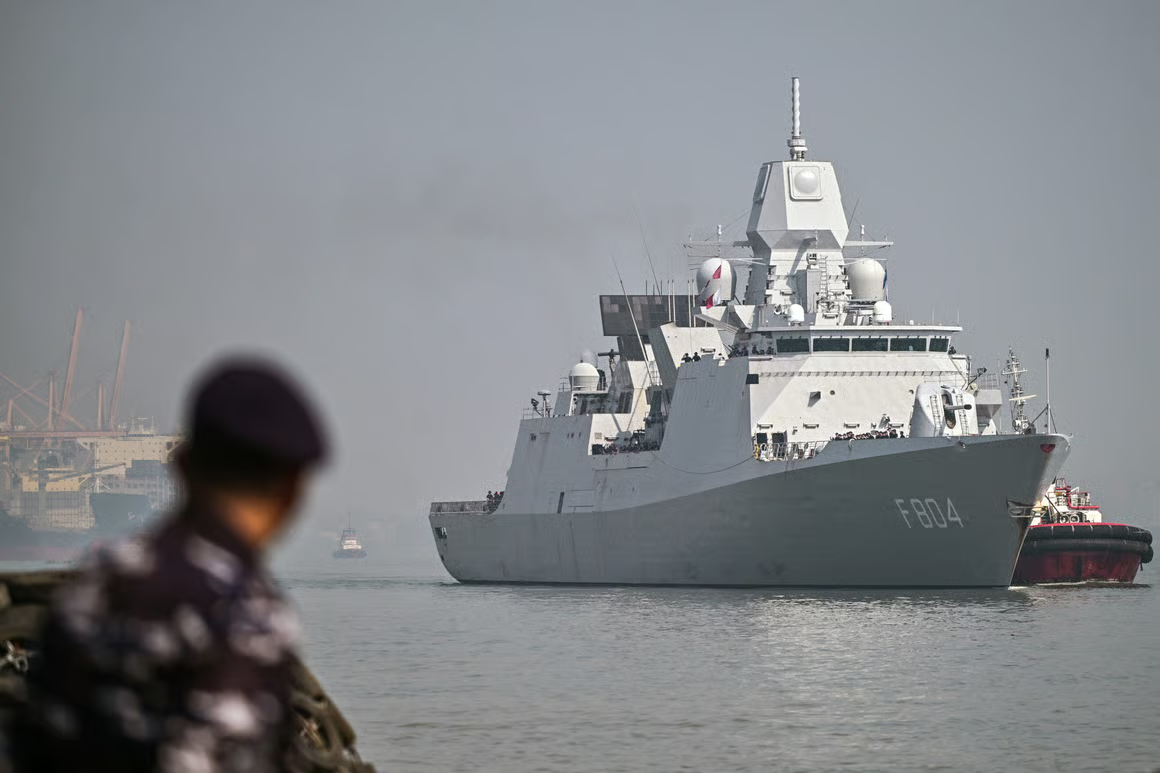
(DEFENCE SECURITY ASIA) — China announced that its forces used verbal warnings and “warning electronic interference” against the Dutch air-defense frigate HNLMS De Ruyter (F804) near the disputed Paracel Islands (Xisha Qundao), marking one of Beijing’s clearest public acknowledgements yet of operational electronic warfare deployment in the South China Sea.
The Chinese military stated that the non-kinetic electronic interference measures were employed after the Dutch frigate and its embarked helicopter allegedly “illegally intruded” into what Beijing described as Chinese territorial waters and airspace near the strategically sensitive Paracel archipelago.
The confrontation immediately elevated strategic concern among Indo-Pacific security planners because it demonstrated how electronic warfare, rather than conventional naval firepower, is increasingly becoming Beijing’s preferred coercive instrument during gray-zone maritime confrontations involving Western naval forces.

Senior Captain Zhai Shichen of the PLA Southern Theater Command accused the Dutch frigate of violating China’s territorial sovereignty, reflecting Beijing’s increasingly aggressive interpretation of maritime jurisdiction throughout disputed South China Sea waters.
Chinese military statements further alleged that the embarked helicopter aboard HNLMS De Ruyter repeatedly entered what Beijing described as “Chinese territorial airspace,” thereby triggering Chinese naval and aerial countermeasures including verbal warnings and electronic interference operations.
The Netherlands Ministry of Defense firmly rejected China’s accusations by insisting the frigate operated fully within international law under UNCLOS provisions permitting freedom of navigation in international waters surrounding disputed maritime regions.
The strategic implications of the encounter extend well beyond a single Dutch warship because European naval deployments into the Indo-Pacific increasingly symbolize a broader Western effort to challenge China’s expanding maritime influence and contested territorial claims.
Military analysts view the public disclosure of electronic interference measures as especially significant because China rarely openly confirms the operational deployment of electronic warfare capabilities during real-time maritime confrontations involving foreign military vessels.
The encounter also underscores how the South China Sea has evolved into a technologically contested battlespace where radar disruption, communications interference, electromagnetic suppression, and information dominance increasingly shape operational deterrence dynamics below the threshold of armed conflict.
HNLMS De Ruyter had recently completed a port visit to Manila before the confrontation, reinforcing the growing alignment between European maritime deployments and regional Southeast Asian states concerned about China’s expanding military footprint across disputed waters.
The Dutch frigate remains scheduled to participate in future Indo-Pacific exercises including RIMPAC, meaning the confrontation may influence future European naval operational planning regarding electromagnetic resilience and contested-environment maneuver operations.
No kinetic escalation, damage, or reported injuries occurred during the incident, yet the deployment of warning electronic warfare measures demonstrates how modern maritime confrontations increasingly revolve around strategic signalling rather than conventional weapons engagement.
Electronic Warfare Signals a New Operational Phase in the South China Sea
China’s reference to “warning electronic interference” strongly indicates the deliberate use of electromagnetic spectrum operations designed to disrupt, intimidate, or complicate foreign naval situational awareness without crossing the threshold into open military conflict.
Such non-kinetic measures potentially include radar jamming, communications interference, navigation disruption, or electronic suppression systems intended to pressure foreign vessels while preserving plausible escalation control during politically sensitive maritime confrontations.
The public acknowledgment of these measures is strategically important because it demonstrates Beijing’s growing confidence in employing electronic warfare capabilities as an overt instrument of maritime sovereignty enforcement rather than maintaining strict operational ambiguity.
Electronic warfare deployments are particularly effective in gray-zone environments because they create operational uncertainty while avoiding the legal and political consequences normally associated with direct kinetic attacks against foreign naval assets.
China’s military modernization programs have heavily prioritized electromagnetic warfare systems across naval, aerial, and island-based platforms throughout the South China Sea over the last decade.
The PLA Southern Theater Command oversees many of China’s most advanced maritime surveillance, anti-access, and electronic warfare assets deployed near disputed areas including the Paracel and Spratly island chains.
Analysts increasingly assess that Beijing views dominance of the electromagnetic spectrum as essential to countering technologically advanced Western naval forces operating close to Chinese-claimed maritime zones.
The encounter involving HNLMS De Ruyter therefore represents more than a diplomatic protest because it illustrates the operationalization of electronic warfare doctrines previously associated primarily with high-intensity wartime scenarios.
The incident may accelerate NATO and European naval investment into hardened communications systems, electronic counter-countermeasures, and electromagnetic resilience training for future Indo-Pacific deployments.
Western defence planners are particularly sensitive to such developments because electronic warfare disruptions during peacetime encounters can rapidly escalate into operational accidents or navigational miscalculations under highly compressed tactical decision timelines.
Dutch Naval Presence Reflects Europe’s Expanding Indo-Pacific Strategy
The deployment of HNLMS De Ruyter into the Pacific reflects a broader European strategic recalibration recognizing that Indo-Pacific security developments increasingly shape global trade stability, supply-chain resilience, and international maritime governance.
European naval deployments by the Netherlands, United Kingdom, France, and Germany have steadily increased as concerns grow regarding China’s military expansion and maritime assertiveness across critical sea lanes.
The Dutch Ministry of Defense emphasized that the frigate’s operations complied fully with international maritime law, reflecting Europe’s continued commitment to UNCLOS-based navigation rights despite escalating regional military tensions.
For European governments, freedom-of-navigation deployments serve both military and diplomatic objectives because they reinforce support for rules-based maritime governance without directly endorsing rival sovereignty claims.
The Netherlands has gradually deepened defence engagement with Indo-Pacific partners including the Philippines, Japan, Australia, and Singapore as part of broader European strategic diversification efforts.
The timing of the confrontation is especially notable because HNLMS De Ruyter had recently concluded a port visit to Manila amid intensifying China-Philippines maritime disputes in the South China Sea.
China likely views expanding European naval activity near contested maritime areas as evidence of growing Western coalition-building efforts designed to constrain Beijing’s regional strategic influence.
European participation in Indo-Pacific exercises including RIMPAC increasingly reinforces military interoperability between NATO-aligned navies and regional partners confronting complex maritime security pressures.
The Dutch frigate itself represents a technologically sophisticated air-defense platform capable of advanced radar surveillance, area air defence, and integrated fleet protection operations during multinational maritime missions.
China’s challenge against such a vessel therefore carried substantial symbolic value because it demonstrated Beijing’s willingness to confront even non-regional Western naval forces operating near disputed waters.
Paracel Islands Remain a Strategic Flashpoint in Regional Power Competition
The confrontation occurred near the Paracel Islands, a strategically critical archipelago controlled by China since its seizure from Vietnam during military clashes in the 1970s.
Vietnam continues to claim sovereignty over the islands, while Taiwan historically maintains parallel territorial claims rooted in earlier Chinese nationalist cartographic positions.
The Paracels occupy enormous strategic importance because they provide forward basing positions enabling China to project surveillance, airpower, missile coverage, and maritime domain awareness deep into the South China Sea.
China has spent years constructing and upgrading military infrastructure across the region, including radar installations, communications nodes, logistics facilities, and electronic warfare systems supporting persistent operational presence.
These outposts significantly extend China’s anti-access and area-denial capabilities across major commercial sea lanes carrying trillions of dollars in annual global maritime trade.
The South China Sea itself remains among the world’s most strategically contested waterways because approximately one-third of global maritime commerce transits through the region annually.
Control over the electromagnetic spectrum within such contested maritime corridors therefore provides substantial operational advantages during both peacetime coercion campaigns and potential military contingencies.
Beijing’s rejection of the 2016 Permanent Court of Arbitration ruling continues to shape regional tensions because China maintains expansive maritime claims despite international legal challenges.
Foreign naval transits near disputed areas are consequently interpreted by Beijing as direct political challenges to Chinese sovereignty narratives and strategic legitimacy.
The Dutch transit thus intersected with one of the world’s most volatile maritime geopolitical fault lines where legal disputes, military modernization, and strategic signalling increasingly overlap.
Gray-Zone Conflict Is Becoming the Dominant South China Sea Battlespace
The encounter highlights how gray-zone conflict tactics now dominate operational interactions across the South China Sea more frequently than conventional military standoffs involving direct kinetic force.
China increasingly employs coast guard vessels, maritime militia fleets, aerial intercepts, laser incidents, and electronic warfare activities to assert territorial claims without provoking full-scale military escalation.
Such tactics are strategically effective because they gradually normalize Chinese operational presence while complicating foreign military responses under ambiguous legal and escalation conditions.
Gray-zone operations also create cumulative psychological pressure on regional states by forcing repeated tactical responses to persistent low-level coercion campaigns.
The use of electronic interference against HNLMS De Ruyter therefore fits a broader operational pattern designed to impose strategic friction on foreign naval deployments entering disputed waters.
Military strategists increasingly warn that repeated non-kinetic confrontations risk normalizing dangerous operational behavior that could eventually trigger unintended escalation during future encounters.
Electronic warfare measures are particularly destabilizing because targeted forces may struggle to immediately determine whether disruptions represent temporary warnings or preparation for broader offensive actions.
The absence of kinetic escalation in this incident should therefore not obscure the broader strategic significance of China openly acknowledging operational electronic interference measures against a European warship.
Regional navies operating in the South China Sea increasingly require advanced electromagnetic-spectrum resilience capabilities comparable to those previously associated primarily with high-intensity NATO operational environments.
The encounter reinforces how modern maritime competition increasingly depends upon technological dominance, information superiority, and escalation management rather than purely conventional naval firepower.
Strategic Consequences Could Reshape Future Western Naval Operations
The confrontation may influence future European operational planning by encouraging more coordinated multinational naval deployments capable of presenting stronger collective deterrence against coercive maritime tactics.
Western military planners are likely studying the encounter carefully because it offers rare insight into how China may operationally employ electronic warfare systems during future maritime crises.
The Netherlands declined to provide detailed operational information regarding the incident, suggesting potential concerns about revealing electromagnetic vulnerabilities or tactical response procedures.
China meanwhile successfully amplified the incident through state media channels, enabling Beijing to frame the encounter domestically as evidence of defending territorial sovereignty against foreign military intrusion.
Information operations therefore became an important parallel battlespace accompanying the physical maritime encounter near the Paracel Islands.
Future Indo-Pacific deployments by European warships may now incorporate expanded electronic warfare readiness protocols, hardened communications procedures, and more robust electromagnetic-spectrum monitoring capabilities.
The strategic signalling dimension is equally important because Beijing’s actions demonstrate confidence that gray-zone coercion can be intensified without necessarily provoking direct Western military retaliation.
European governments may nevertheless interpret such incidents as justification for sustaining or even increasing naval deployments supporting freedom-of-navigation principles in contested maritime regions.
The broader risk is that repeated electronic warfare encounters gradually erode crisis stability by creating unpredictable operational environments involving increasingly sophisticated military technologies.
Although no missiles were fired and no vessels damaged, the confrontation involving HNLMS De Ruyter revealed how the South China Sea is steadily evolving into a frontline laboratory for twenty-first-century gray-zone maritime warfare and electronic spectrum competition.
