
China Arms Iran With Kamikaze Drones, HQ-16 Air Defences and Hypersonic Talks as US Strike Looms Over Persian Gulf Power Balance
Beijing’s delivery of loitering munitions, surface-to-air missile batteries and potential DF-17 hypersonic systems signals a decisive shift in Middle East deterrence architecture amid escalating US force posture adjustments.

(DEFENCE SECURITY ASIA) — The reported delivery of Chinese offensive and defensive weapons systems to Iran unfolds at a moment when United States force posture adjustments in the Middle East suggest credible preparation for potential military action, thereby transforming what might otherwise be a transactional arms transfer into a strategic inflection point with implications for regional deterrence stability and global energy security.
According to an exclusive investigation by a regional news website citing three officials familiar with the matter, including Arab officials and a regional intelligence source, Beijing has already transferred loitering munitions and advanced air defence batteries to Tehran, while discussions are underway for anti-ship cruise missiles and hypersonic glide vehicles, indicating a calibrated escalation in military-technical cooperation.
“One Arab official familiar with the deliveries described the offensive weapons as ‘small’ systems,” while “another regional intelligence official said Beijing had sent loitering munitions, or Kamikaze drones, to the Islamic Republic,” signalling that even ostensibly limited transfers carry asymmetric implications against superior Western airpower in a contested theatre.

These reported transfers follow the June 2025 twelve-day war in which Israel, operating with American warplanes and US participation in strikes on three Iranian nuclear facilities, achieved sustained air dominance that degraded Iranian command structures, destroyed ballistic missile launch infrastructure and crippled layered air defence nodes across multiple operational sectors.
The aftermath of that conflict left Tehran’s integrated air defence network fragmented and exposed, compelling Iran to accelerate procurement from long-standing partners, with Russia reportedly supplying Verba man-portable air defence systems while China appears to have provided a broader and more rapidly scalable package of both offensive and defensive capabilities.
“China supplies around 80 percent of the world’s drone components and is a supplier to both Russia and Ukraine, so it could provide Iran with finished Kamikaze drones quickly,” regional officials told the investigation, underscoring Beijing’s supply-chain dominance in unmanned systems and its ability to compress delivery timelines under sanctions pressure.
The defensive component of these transfers reportedly includes HQ-16 and HQ-17AE surface-to-air missile batteries, medium- and short-range systems capable of engaging aircraft, cruise missiles and certain ballistic threats, thereby contributing to a reconstitution of Iran’s layered air defence architecture following battlefield attrition.
“The regional intelligence official listed the Chinese systems in Iran’s possession as the HQ-16 and HQ-17AE,” the report confirms, indicating that these deliveries have moved beyond exploratory discussions and into operational integration phases within Iran’s restructured air defence command-and-control framework.
Financially, these acquisitions reportedly operate through oil-for-arms arrangements, with nearly 90 percent of Iran’s crude exports flowing to China and payments for surface-to-air missile batteries reportedly conducted in oil shipments, enabling Tehran to circumvent dollar-based sanctions regimes and sustain procurement without conventional banking channels.
In parallel, negotiations over CM-302 anti-ship cruise missiles and potential DF-17 hypersonic glide vehicles introduce a maritime and strategic strike dimension that directly intersects with US naval deployments in the Arabian Sea, Gulf of Oman and Persian Gulf, raising escalation thresholds in any prospective confrontation.
This convergence of air defence regeneration, asymmetric drone replenishment and prospective long-range strike enhancement signals that Beijing’s involvement extends beyond symbolic political backing and into tangible force posture shaping that could recalibrate operational planning assumptions in Washington and allied capitals.
Whether these systems ultimately function as deterrent stabilizers or escalation catalysts will depend on their scale of deployment, integration into Iran’s command networks and the degree to which US planners interpret Chinese signalling as a red line rather than a negotiable variable within a rapidly tightening crisis environment.
Loitering Munitions and Asymmetric Airpower Reconstitution
The transfer of loitering munitions to Iran represents a cost-effective force multiplier that enhances Tehran’s capacity for persistent surveillance-strike cycles against high-value targets, particularly in scenarios where conventional air superiority remains unattainable due to Israeli and American fifth-generation aircraft dominance.
These kamikaze drones, designed to loiter over contested airspace before executing terminal dives onto designated targets, enable Iran to exploit saturation tactics against air bases, radar installations and naval assets, thereby imposing disproportionate defensive burdens on technologically superior adversaries.
Given that Iran pioneered the operationalization of inexpensive loitering munitions to challenge advanced Western air defences, reliance on Chinese finished systems suggests either industrial bottlenecks resulting from wartime damage or strategic diversification to mitigate Russian supply constraints amid Moscow’s Ukraine-focused production priorities.
China’s global dominance in drone components, reportedly supplying around 80 percent of worldwide drone parts, provides Beijing with a unique capacity to rapidly assemble and export complete loitering systems, compressing lead times that would otherwise constrain Iran’s post-conflict force regeneration.
The characterization of these offensive systems as “small” does not negate their strategic impact, because in asymmetric warfare frameworks the cumulative effect of dispersed, networked loitering munitions can degrade high-end platforms through attritional pressure and sensor saturation.
Operationally, the integration of Chinese-supplied loitering munitions into Iran’s command architecture may restore elements of deterrence by denial, complicating adversary targeting cycles and forcing the allocation of scarce interceptor inventories to counter low-cost inbound threats.
This development also intersects with US carrier strike group deployments, as loitering munitions launched from coastal or proxy-controlled territories could extend Iran’s anti-access envelope beyond traditional ballistic missile arcs.
However, the scale, numbers and technical specifications of the transferred drones remain undisclosed, introducing uncertainty regarding their range, payload weight and electronic counter-countermeasure resilience.
Absent verifiable inventory data, strategic assessments must distinguish between confirmed deliveries of loitering munitions and speculative extrapolations about their battlefield effectiveness in high-intensity conflict scenarios.
Rebuilding Layered Air Defence: HQ-16 and HQ-17AE Integration
The reported delivery of HQ-16 medium-range and HQ-17AE short-range surface-to-air missile batteries indicates a deliberate reconstruction of Iran’s layered air defence system following the destruction inflicted during the June 2025 conflict.
The HQ-16, derived from earlier Russian design influences, provides engagement ranges of up to approximately 40 kilometres and is optimized for intercepting aircraft and cruise missiles within a medium-altitude engagement envelope.
The HQ-17AE, analogous in concept to short-range mobile interceptors, offers rapid-reaction capability against low-flying threats such as drones and helicopters, thereby addressing the vulnerability spectrum exposed during Israeli air operations.
By integrating both systems, Iran appears to be rebuilding a tiered defensive grid in which short-range interceptors protect critical nodes while medium-range batteries extend coverage across strategic corridors.
The reported continuation of deliveries since summer 2025 suggests sustained logistical pipelines rather than symbolic one-off transfers, indicating Beijing’s willingness to assume reputational and geopolitical risk in supporting Tehran’s defensive resilience.
Payment reportedly conducted through oil shipments underscores a sanctions-evasive procurement model in which energy exports substitute for financial transfers, reinforcing China’s role as Iran’s primary crude destination.
From a force posture perspective, the reintroduction of mobile air defence assets complicates US or Israeli strike planning by increasing sortie requirements and necessitating electronic warfare suppression packages.
Nevertheless, the survivability of these systems against stealth aircraft and advanced stand-off munitions remains uncertain, particularly if adversaries employ integrated electronic attack and decoy saturation tactics.
Strategically, the HQ-16 and HQ-17AE deliveries may not restore full-spectrum air defence integrity, but they could raise the cost threshold of any follow-on air campaign, thereby recalibrating deterrence dynamics.
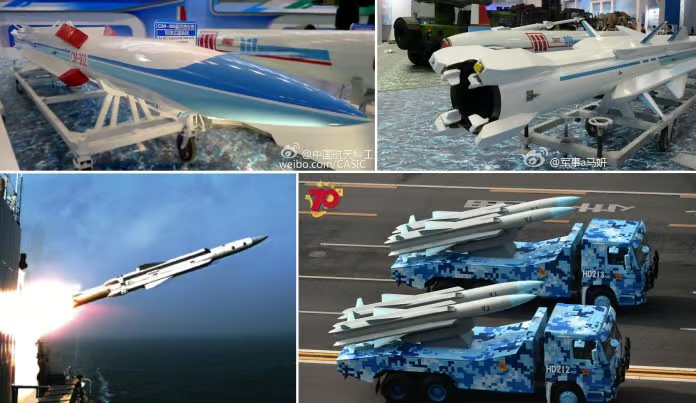
CM-302 Anti-Ship Missiles and Maritime Denial Signalling
Discussions over the CM-302 anti-ship cruise missile introduce a maritime dimension that directly intersects with US naval deployments and freedom-of-navigation operations in the Persian Gulf and adjacent waters.
The CM-302, an export variant of the YJ-12, reportedly possesses a range of approximately 290 kilometres and supersonic terminal speed, characteristics designed to compress reaction times for shipborne air defence systems.
Negotiations reportedly initiated two years ago intensified after the June 2025 strikes, suggesting that perceived vulnerability catalyzed renewed urgency in Tehran’s pursuit of sea-denial capabilities.
If fielded from coastal batteries or naval platforms, the CM-302 would extend Iran’s anti-access/area-denial umbrella across chokepoints critical to global energy transit, including the Strait of Hormuz.
Given that approximately 20 percent of global oil transits this maritime corridor, any enhancement of Iranian anti-ship strike capacity carries systemic economic implications beyond immediate military calculus.
US carrier strike groups operating in the region would need to account for supersonic sea-skimming profiles capable of stressing layered naval air defence systems through speed and manoeuvre.
However, confirmation of finalized contracts, delivery timelines and integration status remains pending, requiring caution in projecting immediate operational readiness.
China’s reported willingness to inform Arab governments in general terms about arms deliveries may function as strategic signalling designed to deter unilateral US action by implying external backing for Tehran.
Such signalling complicates alliance calculations among US partners who must balance regional security dependencies against evolving Sino-Iranian military alignment.
DF-17 Hypersonic Discussions and Strategic Strike Implications
The reported discussions over Iran purchasing China’s DF-17 hypersonic glide missile elevate the strategic stakes, as hypersonic glide vehicles travel at speeds exceeding Mach 5 while executing manoeuvres that challenge traditional interception paradigms.
“Although Iran’s ballistic missiles have similar ranges, the DF-17 has better manoeuvrability, which can help it evade air defence systems,” the regional intelligence source stated, highlighting qualitative distinctions beyond raw range metrics.
The introduction of hypersonic glide technology into Iran’s arsenal would not merely extend strike reach but would alter adversary planning assumptions regarding missile defence effectiveness.
Such capability could theoretically threaten hardened military installations and high-value maritime assets, thereby reshaping escalation ladders in a crisis scenario.
Nevertheless, discussions do not equate to finalized transfer, and significant technical, training and integration hurdles would precede any operational deployment.
Hypersonic systems require sophisticated guidance, secure communications and reliable mobile launch infrastructure, all of which entail extended timelines and vulnerability during transitional phases.
From Beijing’s perspective, even exploratory discussions signal strategic alignment without committing to irreversible technology transfer that might provoke severe sanctions backlash.
For Washington, the mere prospect of hypersonic proliferation in the Middle East intensifies urgency around missile defence investment and forward-deployed sensor networks.
The balance between verifiable deliveries and aspirational negotiations remains a central analytical distinction in assessing the immediacy of the hypersonic threat dimension.
Strategic Signalling, Oil-for-Arms Economics and Regional Deterrence Calculus
China’s reported practice of informing certain Arab governments in general terms about arms deliveries introduces a diplomatic signalling layer designed to shape perceptions before kinetic thresholds are crossed.
By pre-emptively communicating its support for Tehran, Beijing appears to be constructing a deterrence narrative that complicates unilateral US strike calculations without deploying overt military assets.
Oil-for-arms transactions reinforce this signalling by embedding military cooperation within an energy interdependence framework, particularly given that nearly 90 percent of Iran’s crude exports reportedly flow to China.
This economic-military nexus allows Beijing to sustain strategic influence while mitigating exposure to dollar-denominated sanctions regimes.
Simultaneously, Iran’s outreach offering economic incentives to the United States suggests parallel diplomatic hedging even as military procurement accelerates, reflecting a dual-track survival strategy.
US force massing under President Donald Trump, including carrier deployments, elevates escalation risk, as enhanced Iranian air defence and anti-ship capabilities could increase miscalculation probability.
In Southeast Asia, the export of systems such as the CM-302 prompts scrutiny regarding technology diffusion and precedent-setting arms transfers in contested maritime regions.
The broader geopolitical context reflects a shifting multipolar environment in which Russia’s Ukraine-focused industrial commitments create space for China to assume primacy in supplying Iran.
Ultimately, the reported deliveries of loitering munitions, HQ-16 and HQ-17AE air defence batteries, negotiations over CM-302 missiles and exploratory talks on DF-17 hypersonics collectively represent a calibrated Chinese intervention in Middle Eastern deterrence architecture.
Whether this bolstering of Iran’s logistics footprint and force posture deters US action or instead hardens confrontation dynamics will depend on verification of system integration, adversary countermeasures and the political calculus of actors navigating an increasingly volatile Persian Gulf security environment. — DEFENCE SECURITY ASIA

Excuse me does our President Donald J. Trump really understand what is happening? China changing arms and technology to Iran for Oil this is extremely risky business. It is time to end the Iran war that China is supplying arms to. Cutting off China from all kinds of things could also secure the future of Taiwan. The US must bring chip making back to the US along with other things. The people of America should not by from China and they should not allow the visas allowed to China by the US. Stop this Iran without help or funds from oil could end this war!