
Typhon Missiles Confirmed at Japan’s Kanoya Base: US Army’s Tomahawk Arsenal Now Within Strike Range of China’s Coast
Satellite imagery confirms a mobile Tomahawk and SM-6 missile battery now stationed in southern Japan, compressing China's warning time and redrawing the strategic map of the East China Sea.

(DEFENCE SECURITY ASIA) — Newly published satellite imagery has confirmed the presence of the United States Army’s Typhon Mid-Range Capability missile system at Kanoya Air Base in Kagoshima Prefecture, a development that instantly recalibrates the strategic geometry of the East China Sea and the wider First Island Chain.
The imagery, released by Hangzhou-based geospatial intelligence firm MizarVision, depicts launcher vehicles, a battery operations center, and support elements consistent with a fully operational Typhon firing unit positioned deep within southern Kyushu.
Unlike the system’s inaugural Japan deployment at Iwakuni in September 2025, this Kanoya positioning places containerized Tomahawk and SM-6 missiles measurably closer to mainland China, compressing warning timelines for any contested contingency across the Taiwan Strait or the broader western Pacific theatre.

Defence analysts note that the shift from Yamaguchi Prefecture to Kagoshima Prefecture is not merely geographic housekeeping but a calculated repositioning that maximizes penetration depth against coastal air defence networks guarding Shanghai and adjacent industrial provinces.
The deployment, executed under the Hawaii-based 3rd Multi-Domain Task Force, was announced in May 2026 and is now visually corroborated ahead of the Orient Shield exercise scheduled for September, following the completed Valiant Shield drills that ran from June 22 to July 1.
Strategically, the emergence of a persistent rotational Typhon presence signals that Washington and Tokyo are institutionalizing distributed long-range fires rather than treating each deployment as an isolated exercise footnote, a distinction with profound implications for regional deterrence architecture.
U.S. Army force-design planners have consistently framed the Typhon program as a bridge between short-range HIMARS-based fires and emerging hypersonic strike capability, and its Kanoya appearance operationalizes that doctrine inside the most contested air-sea battlespace on earth.
Japanese defence ministry officials have characterized the arrangement as consistent with alliance exercise frameworks rather than permanent basing, yet the described post-exercise storage plan at a Japanese military facility functions as a de facto forward cache enabling rapid future redeployment.
Beijing’s Ministry of National Defence has previously condemned comparable Typhon movements as destabilizing escalations that accelerate a regional arms race, framing the missile’s Tomahawk payload as a direct threat to Chinese coastal population centers and maritime shipping lanes.
Moscow has echoed similar language, describing land-based intermediate-range missile forward-deployment in Asia as a mechanism that erodes strategic stability frameworks inherited from the now-defunct Intermediate-Range Nuclear Forces Treaty architecture.
At an estimated per-battery procurement and sustainment cost exceeding USD 250 million (approximately RM 1 billion), the Typhon system represents a disproportionately asymmetric investment relative to the anti-access disruption it imposes on adversary naval and air planning staffs.
This report separates verifiable satellite-confirmed facts from contested political framing and unverified strategic assumptions, applying equal analytical scrutiny to Washington, Tokyo, Beijing, and Moscow’s competing narratives surrounding the Kanoya deployment.
Anatomy of the Typhon System: How Containerized Naval Missiles Became a Land-Based Strategic Weapon
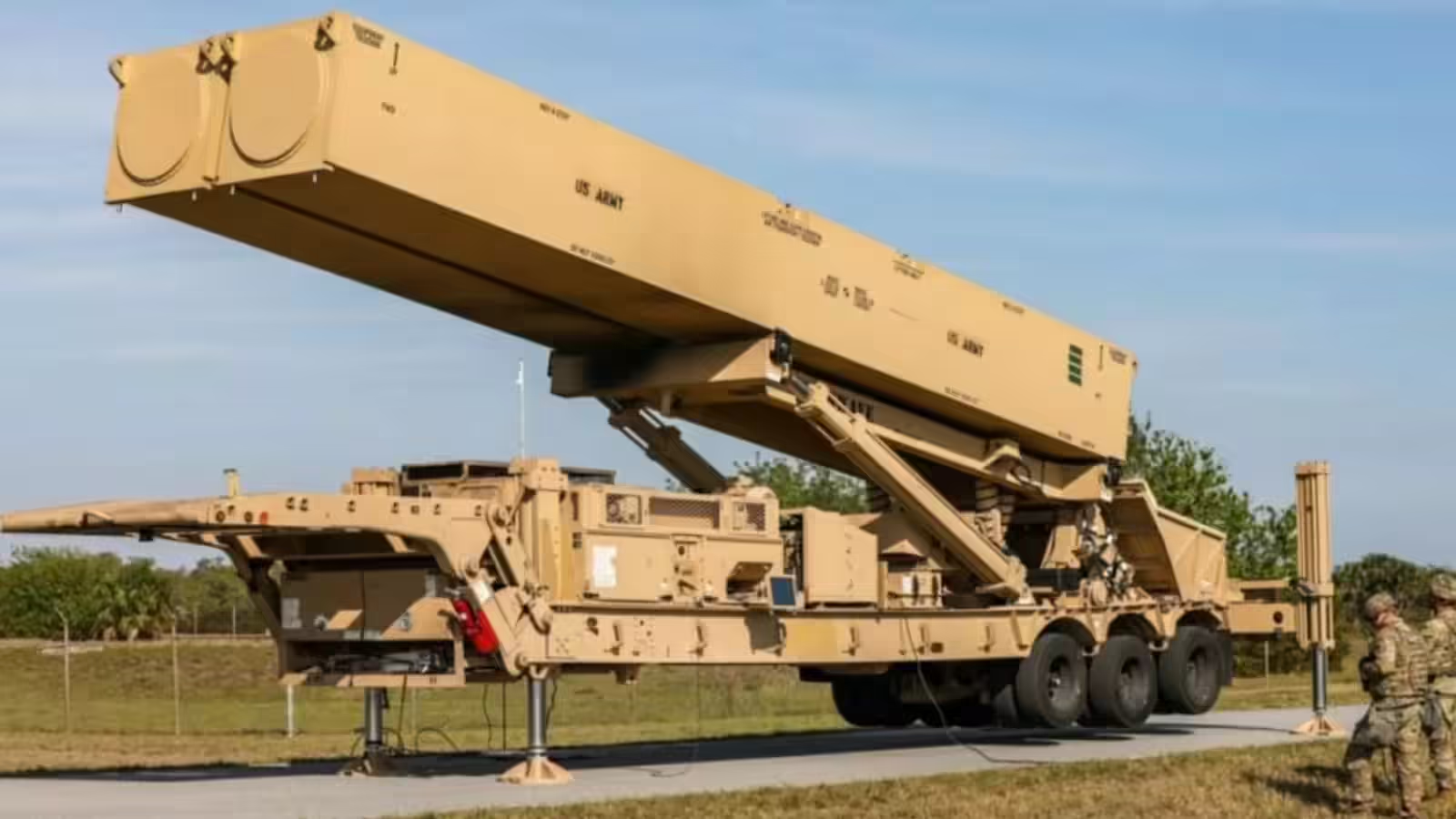
The Typhon Mid-Range Capability, formally designated the Strategic Mid-Range Fires System, repurposes the U.S. Navy’s proven Mk 41 Vertical Launch System into a mobile, trailer-mounted ground configuration unprecedented in modern U.S. Army force structure.
Each launcher integrates four strike-length VLS cells housed within a standard forty-foot ISO container footprint, allowing rapid air transport via C-17 Globemaster aircraft into austere or contested forward operating locations.
A typical Typhon battery combines four launchers, a dedicated Battery Operations Center, prime-mover trucks such as the Heavy Expanded Mobility Tactical Truck, and organic reload and generator support, forming a self-sustaining strike node.
This architecture allows a single battery to fire Tomahawk Block V land-attack and maritime-strike cruise missiles with an operational range approaching 1,600 kilometers, alongside SM-6 multipurpose interceptors capable of anti-ship, anti-air, and terminal land-attack roles beyond 300 kilometers.
Because Tomahawk missiles fly low-altitude penetration profiles designed to defeat layered radar coverage, their land-based employment from Kanoya materially complicates People’s Liberation Army integrated air defence planning across the East China Sea approaches.
The system’s mobility is its defining tactical advantage, since dispersed containerized launchers are considerably harder for adversary intelligence, surveillance, and reconnaissance networks to locate and target than fixed coastal missile batteries.
U.S. Army Long Range Precision Fires modernization documents frame Typhon as deliberately bridging the capability gap between shorter-range Precision Strike Missile-armed HIMARS units and future Dark Eagle hypersonic systems still entering service.
Analysts assess that this layered fires architecture is designed to impose simultaneous multi-axis targeting dilemmas on adversary air defence commanders operating within the contested First Island Chain corridor.
Because the missiles themselves are combat-proven naval munitions rather than experimental designs, the Typhon program carries substantially lower technical risk than comparable emerging hypersonic or directed-energy alternatives under Pentagon development.
This proven-munition approach also allows for accelerated production scaling, since existing Tomahawk and SM-6 supply chains can be redirected toward land-based battery replenishment without requiring entirely new missile manufacturing infrastructure.

From Iwakuni to Kanoya: Reading the Strategic Logic Behind the Southward Shift
The Typhon system’s first Japan appearance occurred in September 2025 at Marine Corps Air Station Iwakuni during the Resolute Dragon exercise, positioning it within range of the Korean Peninsula and northern contested maritime zones.
The subsequent relocation to Kanoya Air Base in Kagoshima Prefecture, announced in May 2026 by Japanese and American defence sources, represents a deliberate southward strategic recalibration rather than a routine exercise rotation.
Kanoya’s geographic position on southern Kyushu places Tomahawk-range coverage over a considerably wider arc of eastern Chinese coastal territory, including approaches toward the Shanghai metropolitan and industrial corridor.
This positioning logic mirrors a broader Pentagon pattern of incrementally pushing land-based fires assets closer to the Taiwan Strait, following earlier Typhon forward-deployments to the Philippines and live-fire testing in Australia during Talisman Sabre 2025.
Military planners assess that southern Kyushu’s proximity to Okinawa and the Ryukyu Island chain allows Kanoya-based batteries to reinforce, rather than duplicate, existing U.S. Marine Corps littoral fires concepts already distributed across Japan’s southwestern islands.
The decision to route this deployment through the Hawaii-based 3rd Multi-Domain Task Force rather than a Japan-permanent unit underscores Washington’s preference for rotational, deniable force posture over politically sensitive permanent basing arrangements.
This posture choice allows Tokyo to publicly frame the deployment as exercise-linked rather than a fixed foreign military installation, reducing domestic political friction while still achieving persistent operational effect.
The planned post-exercise movement of Typhon systems into Japanese-hosted storage facilities by mid-October 2026 effectively converts a temporary exercise deployment into a forward-cached rapid-reconstitution capability.
Such pre-positioned storage arrangements historically compress future redeployment timelines from weeks to days, a logistics-multiplier effect frequently underappreciated in public discourse around “temporary” military exercises.
Regional security observers note that this storage-and-recall model may become the template for future U.S. long-range fires rotations across allied Indo-Pacific territory, avoiding the diplomatic costs of permanent basing while retaining near-permanent strategic effect.
Military-Technical Consequences: How Kanoya Compresses China’s Warning Time and Complicates PLA Targeting
Positioning Tomahawk-capable launchers at Kanoya materially reduces the geographic buffer that People’s Liberation Army planners have historically relied upon when modeling U.S. long-range strike timelines against coastal military and industrial infrastructure.
Because Tomahawk Block V missiles fly low-altitude, terrain-hugging flight profiles specifically engineered to defeat long-range early-warning radar coverage, their employment from a closer southern Japan node meaningfully shortens PLA reaction windows during any escalatory scenario.
The mobile, containerized nature of Typhon launchers forces Chinese intelligence and targeting units to allocate disproportionate reconnaissance-strike resources toward locating dispersed, camouflaged batteries rather than fixed, previously mapped installations.
This dispersal effect directly undermines the cost-efficiency of a first-strike counterforce doctrine, since destroying mobile Typhon units requires real-time targeting cycles that current PLA rocket force reconnaissance architecture may struggle to sustain persistently.
SM-6 missiles integrated into the same launcher family add a multi-domain complication, since their demonstrated anti-ship and terminal ballistic-defence roles force adversary naval commanders to account for both cruise-missile and interceptor threats emanating from a single forward position.
Military-technical assessments suggest that a Kanoya-based Typhon battery, operating alongside existing U.S. Marine Corps and Japan Self-Defense Force littoral assets, creates overlapping fires coverage across the Miyako Strait and Bashi Channel chokepoints critical to PLA Navy surface and submarine transit.
This layered chokepoint coverage directly supports a maritime denial concept intended to slow or disrupt PLA Navy access to open Pacific waters during a Taiwan Strait contingency, a scenario explicitly referenced in unclassified U.S. Indo-Pacific Command planning guidance.
Because Typhon batteries can be air-transported and rapidly reassembled, their strategic value lies less in permanent presence and more in the credible threat of rapid reinforcement, complicating PLA force-posture planning during peacetime intelligence assessments.
Chinese military commentators have specifically flagged this uncertainty factor as strategically destabilizing, arguing that ambiguous forward-deployment patterns erode crisis-stability assumptions previously built around fixed, predictable U.S. force locations.
The cumulative technical effect is a measurable narrowing of China’s anti-access area-denial buffer zone precisely at the moment Beijing has invested heavily in extending that buffer through DF-21D and DF-26 anti-ship ballistic missile development.
Diplomatic Fallout: Beijing, Moscow, and the Widening Indo-Pacific Missile Competition
China’s Ministry of National Defence has consistently characterized U.S. land-based missile deployments across the First Island Chain as provocative actions that accelerate regional arms competition rather than genuine deterrence measures.
Chinese state-affiliated defence commentators have specifically highlighted the Kanoya positioning’s proximity to Shanghai and eastern coastal provinces as evidence of an explicitly offensive rather than defensive strategic orientation.
Russian officials have separately framed the broader pattern of U.S. intermediate-range missile forward-deployment in Asia as directly undermining the strategic stability previously codified under the now-lapsed Intermediate-Range Nuclear Forces Treaty framework.
Moscow’s criticism carries particular weight given Russia’s own Pacific Fleet basing in Vladivostok and Kamchatka, both of which fall within theoretical extended-range consideration for future U.S. land-based fires expansion in Northeast Asia.
Japanese government officials have publicly maintained that the Kanoya deployment operates strictly within pre-announced, exercise-linked frameworks tied to Valiant Shield and the upcoming Orient Shield drills rather than constituting new permanent basing policy.
This official framing, however, sits in tension with the confirmed post-exercise storage arrangement, which independent analysts argue functions as an incremental, deniable step toward normalized persistent rotational presence.
South Korea and the Philippines, both hosts of prior or prospective Typhon-family deployments, are likely to face parallel diplomatic pressure from Beijing urging rejection of similar forward-fires arrangements on their sovereign territory.
Taiwan’s Ministry of National Defence has historically welcomed expanded U.S. regional fires capability as reinforcing extended deterrence, though Taipei has avoided direct public commentary on this specific Kanoya satellite disclosure.
The broader diplomatic pattern suggests an accelerating action-reaction cycle in which each incremental U.S. forward-fires deployment generates proportionally amplified Chinese and Russian rhetorical escalation, regardless of the deployment’s explicitly temporary or exercise-linked character.
This dynamic increasingly resembles a slow-motion missile competition reminiscent of Cold War intermediate-range force posturing across Europe, now relocated to the maritime chokepoints of the Western Pacific.
Logistics Footprint, Cost Structure, and the Rotational Basing Template Reshaping U.S. Indo-Pacific Strategy
Sustaining a forward-deployed Typhon battery requires substantial logistics investment, including prime-mover maintenance, missile reload infrastructure, and secure munitions storage, collectively estimated at several hundred million U.S. dollars in lifecycle sustainment costs per rotational deployment cycle.
At an approximate battery procurement and initial sustainment figure exceeding USD 250 million, equivalent to roughly RM 1 billion at current exchange rates, the program represents a comparatively cost-efficient method of imposing significant anti-access complications on a numerically larger PLA rocket force arsenal.
The planned mid-October 2026 relocation of Kanoya-based systems into Japanese-hosted storage facilities exemplifies a broader U.S. Army logistics innovation sometimes termed “forward-staged reconstitution,” designed to minimize the diplomatic footprint of permanent basing while preserving rapid-response capability.
This storage-based model allows the 3rd Multi-Domain Task Force to redeploy Typhon batteries to Kanoya, Iwakuni, or additional future Japanese sites within compressed timelines measured in days rather than the weeks typically required for trans-Pacific air or sealift from Hawaii.
Such logistics pre-positioning effectively multiplies the strategic value of a comparatively small physical missile inventory, since the same battery can credibly threaten reactivation across multiple Indo-Pacific nodes without requiring duplicate procurement at each location.
Analysts note this rotational-storage template may soon extend to the Philippines and potentially South Korea, creating a distributed network of forward-cached long-range fires capability across the First Island Chain’s most strategically sensitive access points.
The absence of any planned live-fire missile launches during the associated Valiant Shield and Orient Shield exercises suggests Washington is deliberately calibrating visible force posture signaling below the threshold of direct operational provocation.
This calibrated ambiguity allows U.S. and Japanese planners to demonstrate credible forward-fires capability while retaining plausible deniability regarding the system’s precise operational readiness status at any given moment.
The broader strategic effect positions Typhon not merely as a single weapons platform but as a template for how Washington intends to sustain persistent, cost-efficient long-range deterrence across a geographically vast and politically sensitive Indo-Pacific theatre.
As Orient Shield approaches in September 2026, regional observers should expect continued incremental disclosures, further complicating any simple narrative distinction between “temporary exercise asset” and “de facto permanent forward-deployed strike capability.”
