
UAE Eyes India’s BrahMos Supersonic Missile as Gulf Arms Race Intensifies After Iran Attacks
Abu Dhabi’s fast-moving talks with India over the BrahMos cruise missile and Akashteer AI-enabled air defence network could reshape the Middle East military balance and accelerate Gulf military modernisation.

(DEFENCE SECURITY ASIA) — The United Arab Emirates’ preliminary talks with India to acquire the BrahMos supersonic cruise missile and the Akashteer air defence command-and-control network are emerging as one of the most strategically consequential defence developments in the Middle East this year.
Reuters reported that Abu Dhabi and New Delhi are conducting fast-moving early-stage discussions involving the BrahMos missile and the AI-enabled Akashteer C4ISR air defence architecture, according to four Indian government sources familiar with the negotiations.
Although no agreement, pricing structure, quantity framework, or delivery timeline has been publicly finalised, the talks indicate that the UAE is accelerating efforts to harden its military posture following recent Iranian missile and drone attacks during the latest regional conflict.
The renewed Emirati urgency is heavily linked to the strategic vulnerability of the Strait of Hormuz, which remains one of the world’s most critical maritime chokepoints for global energy exports and commercial shipping flows.
By exploring Indian missile and command-and-control technologies, Abu Dhabi is signalling a broader shift toward supplier diversification as Gulf states increasingly seek strategic autonomy beyond traditional Western defence ecosystems.
The UAE already fields advanced American-made THAAD and Patriot air defence systems alongside ATACMS ballistic missiles with an operational range approaching 300 kilometres, yet current regional threat perceptions are driving demand for layered and distributed strike architectures.
The potential BrahMos acquisition would significantly enhance the UAE’s maritime denial and rapid precision-strike capabilities because the missile’s Mach 2.8 to Mach 3.5 flight speed compresses enemy reaction windows to only a few minutes.
Its low-altitude sea-skimming flight profile and terminal manoeuvrability would complicate interception attempts even for modern integrated air defence systems operating advanced radar AESA tracking networks.
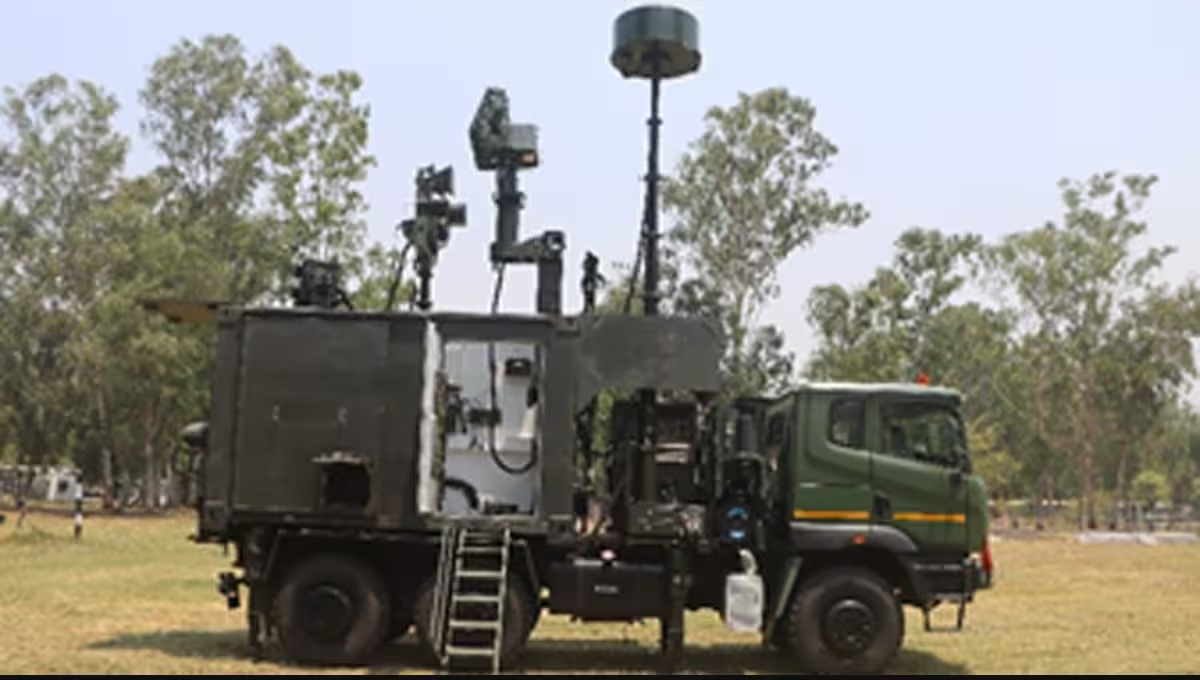
The Akashteer system, meanwhile, represents a different category of strategic value because it integrates radars, sensors, communications, and engagement assets into a real-time AI-enabled command-and-control battlespace management architecture.
That combination could allow the UAE to build a highly responsive system-of-systems warfare framework capable of coordinating responses against drones, cruise missiles, combat aircraft, and saturation attacks simultaneously.
The talks also demonstrate how India’s defence exports are transitioning from regional influence tools into geopolitical instruments capable of reshaping force projection dynamics far beyond the Indo-Pacific theatre.
For New Delhi, a successful UAE deal would represent a strategic breakthrough into the Gulf arms market while validating India’s emergence as a credible high-end military exporter alongside established Western, Russian, and Asian aerospace industry powers.
BrahMos Could Transform UAE Maritime Strike Doctrine
The BrahMos missile is no longer viewed merely as a joint India-Russia weapons programme because its expanding export footprint is increasingly reshaping regional deterrence calculations across multiple theatres.
Developed by BrahMos Aerospace through Indian and Russian collaboration, the missile remains one of the world’s fastest operational cruise missiles currently available on the international export market.
The export variant is restricted to approximately 290 kilometres under Missile Technology Control Regime (MTCR) limitations, yet that range remains strategically sufficient for much of the operational geography surrounding the Strait of Hormuz.
Its two-stage propulsion architecture combines a solid rocket booster with a liquid-fuel ramjet engine, allowing sustained supersonic flight throughout most of the engagement envelope.
Unlike subsonic cruise missiles that provide defenders longer interception timelines, BrahMos dramatically compresses target response cycles because of its sustained Mach 3-class operational speed.
The missile’s sea-skimming and terrain-following flight profiles are specifically designed to reduce radar exposure while increasing survivability against integrated air defence networks.
Its terminal active radar homing seeker also enhances precision-strike capability against high-value naval and land targets including warships, radar sites, command facilities, and strategic infrastructure.
Should the UAE eventually deploy BrahMos batteries along its coastline, the missile could substantially strengthen Emirati anti-access and maritime denial capabilities across critical Gulf shipping lanes.
The system’s mobile Transporter Erector Launcher configuration would additionally improve survivability because launch platforms can rapidly reposition after firing to avoid retaliatory targeting.
The growing international interest in BrahMos following reported operational use during India’s 2025 conflict with Pakistan under “Operation Sindoor” has significantly enhanced the missile’s combat-proven reputation in global defence markets.

UAE Expands Beyond Traditional Western Defence Dependence
The UAE’s interest in Indian military systems reflects a broader transformation in Gulf procurement strategy as regional powers increasingly pursue diversified security relationships rather than exclusive dependence on Western suppliers.
Although Washington remains Abu Dhabi’s principal security partner, Emirati policymakers appear increasingly focused on building strategic flexibility through multi-vector defence acquisition frameworks.
That diversification strategy accelerated earlier this year following the UAE’s defence cooperation initiatives with South Korea, including a memorandum reportedly exceeding US$35 billion (RM133 billion).
The growing UAE-South Korea defence relationship demonstrated Abu Dhabi’s willingness to source advanced military technologies from emerging defence manufacturing powers outside the traditional American-European axis.
India now appears positioned to benefit from the same procurement recalibration because its expanding defence industry offers sophisticated systems without generating the same geopolitical sensitivities associated with Chinese suppliers.
The India-UAE defence relationship also carries less political friction for Washington because both countries maintain strong strategic and economic partnerships with the United States.
Regional strategic competition is simultaneously influencing Emirati procurement calculations because Gulf states increasingly view military acquisitions as geopolitical signalling instruments rather than purely defensive assets.
The recent Saudi Arabia-Pakistan defence pact has intensified regional security competition and likely contributed to Abu Dhabi’s desire to strengthen independent strategic partnerships with alternative military powers.
For the UAE, closer defence cooperation with India provides not only additional military capability but also diplomatic leverage within an increasingly fragmented Middle Eastern security environment.
The result is a Gulf security architecture that is becoming more decentralised, technologically layered, and strategically autonomous compared with the heavily Western-dependent model that dominated previous decades.
Akashteer Could Reshape Gulf Air Defence Operations
The UAE’s reported interest in Akashteer may ultimately prove just as strategically important as BrahMos because modern warfare increasingly depends on sensor fusion and decision-speed dominance rather than missile inventories alone.
Developed by Bharat Electronics Limited in collaboration with DRDO and ISRO, Akashteer functions as an indigenous AI-enabled Air Defence Control and Reporting System integrating multiple battlefield sensors into one operational network.
The system is designed to detect, classify, track, and coordinate engagements against aerial threats including drones, cruise missiles, aircraft, and low-observable attack platforms.
Its architecture focuses heavily on automated coordination and rapid data distribution across the battlespace, thereby reducing delays associated with manual command decision-making chains.
That capability has become increasingly valuable following recent Middle Eastern conflicts where mass drone attacks and saturation missile strikes repeatedly stressed conventional air defence systems.
Akashteer’s mobile vehicle-based deployment structure would additionally allow rapid repositioning to protect energy infrastructure, military bases, command centres, and coastal defence nodes.
The AI-enabled battlespace management component is especially significant because automated threat prioritisation can accelerate response cycles during simultaneous multi-vector attacks.
Indian military sources have previously highlighted Akashteer’s operational performance during the 2025 India-Pakistan conflict where the network reportedly improved interception coordination against inbound threats.
If integrated with existing THAAD and Patriot batteries, Akashteer could provide the UAE with a more unified layered defence ecosystem capable of handling increasingly complex regional missile environments.
Such integration would represent a major evolution in Gulf air defence doctrine because future survivability increasingly depends upon interconnected sensor and command architectures rather than isolated interceptor systems.
India’s Defence Export Surge Gains Strategic Momentum
The UAE negotiations are unfolding during a period of extraordinary expansion in India’s defence export ambitions as New Delhi aggressively pushes its “Atmanirbhar Bharat” self-reliance agenda.
India’s defence exports reportedly exceeded US$4 billion (RM15.2 billion) in the fiscal year ending March 2026, representing dramatic growth from only modest export volumes roughly a decade earlier.
That expansion reflects growing international confidence in Indian military systems, particularly after operational deployments increased visibility for Indian-built missile and air defence technologies.
BrahMos has become the centrepiece of that export strategy because the missile occupies a relatively rare market niche combining high speed, precision strike capability, and mobile deployment flexibility.
The Philippines became BrahMos’ first export customer under a deal valued at approximately US$375 million (RM1.42 billion), establishing the missile’s first operational foothold outside India.
Vietnam subsequently signed a BrahMos-related agreement in May 2026, while Indonesia reportedly remains in advanced or final-stage procurement discussions involving the missile system.
Additional international interest from Thailand, Brazil, Chile, and South Africa further illustrates how India is increasingly being viewed as a viable supplier of sophisticated strategic weapon systems.
A successful UAE acquisition would carry particularly strong symbolic importance because it would establish the first major Gulf customer for BrahMos and expand India’s defence footprint into the Middle East.
The development would simultaneously deepen India-UAE strategic ties beyond trade and energy cooperation into long-term military-industrial alignment and security collaboration.
For New Delhi, the broader geopolitical significance extends beyond immediate financial returns because defence exports are increasingly being used as instruments of strategic influence and diplomatic positioning.
Russian Approval and Regional Escalation Risks Remain Key Variables
Despite accelerating discussions, multiple technical, political, and strategic variables could still delay or complicate any eventual UAE-BrahMos agreement.
Because BrahMos remains a joint India-Russia programme, every third-country export requires formal Russian approval through a No Objection Certificate mechanism before final transfer authorisation.
Current Moscow-Abu Dhabi relations suggest that Russian approval may not represent a major obstacle, although shifting geopolitical calculations could alter Kremlin export considerations over time.
The possible deployment of BrahMos missiles along the southern Gulf coastline would also likely attract close scrutiny from Iran because of the missile’s potential maritime strike implications.
Iranian planners could interpret such deployments as part of a broader regional containment architecture designed to threaten naval operations and strategic infrastructure near the Strait of Hormuz.
The introduction of additional supersonic strike systems into the Gulf environment could therefore intensify ongoing regional missile competition and accelerate military modernisation across neighbouring states.
Questions may also emerge regarding interoperability between Indian-origin systems and existing Western command-and-control architectures already embedded within UAE defence networks.
Regional rivals may subsequently respond by pursuing more advanced air defence systems, electronic warfare capabilities, or competing cruise missile programmes to offset emerging Emirati strike advantages.
At present, however, the negotiations remain preliminary and no official contract terms, quantities, pricing structures, or deployment timelines have been publicly disclosed by either government.
If ultimately finalised, the UAE-BrahMos deal could become one of the most strategically important defence export agreements in India’s history while fundamentally reshaping Gulf military balance calculations for the coming decade.
