Turkey’s KAAN Fighter Jet: The Evolution from First to Second Prototype
Turkey’s KAAN fighter jet enters a decisive new phase with a redesigned second prototype, signaling Ankara’s determination to achieve fifth-generation autonomy, challenge global rivals, and redefine its role in NATO and international arms markets.
(DEFENCE SECURITY ASIA) — Turkey’s fifth-generation KAAN fighter jet program, formerly known as TF-X or Milli Muharip Uçak (MMU), stands as the most ambitious aerospace undertaking in the nation’s modern history.
Developed by Turkish Aerospace Industries (TAI), KAAN is designed to replace the aging F-16 fleet of the Turkish Air Force while establishing Turkey among the elite circle of countries capable of building indigenous stealth combat aircraft.
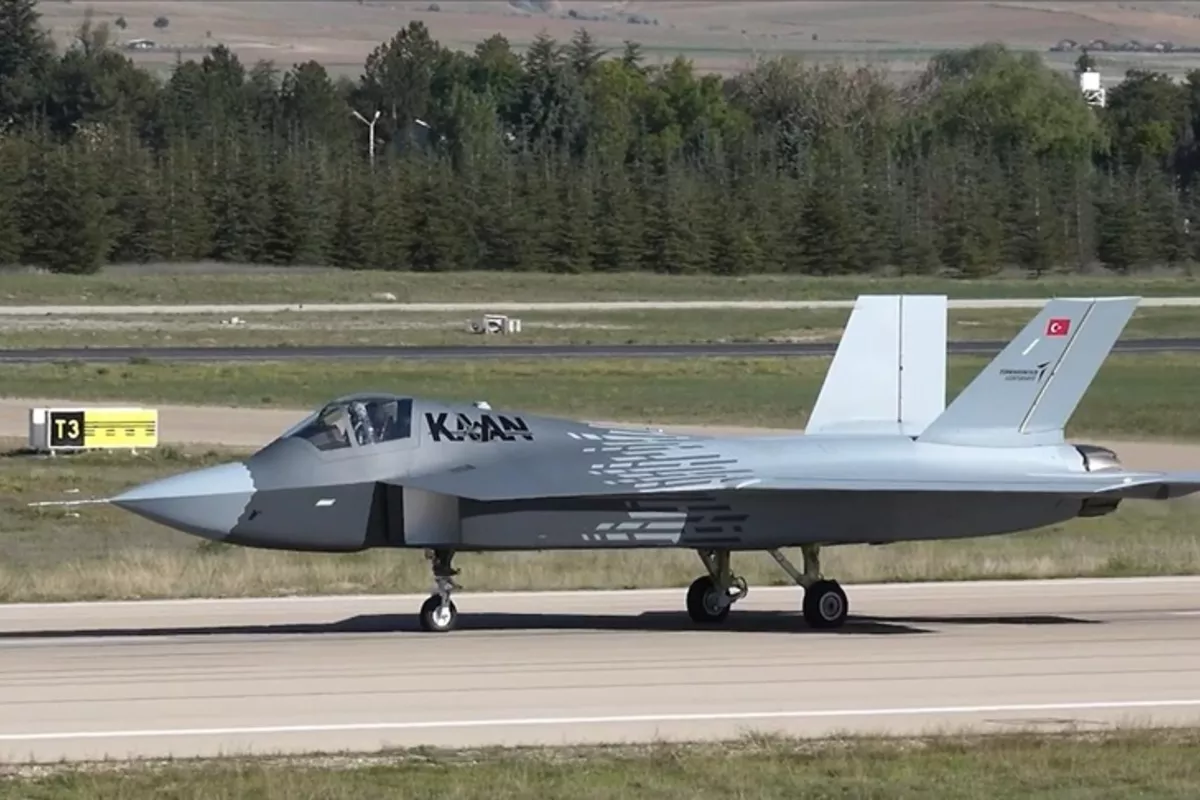
The program, launched officially in 2010, aims to deliver a platform with low observability, advanced avionics, sensor fusion, supercruise capability, internal weapons bays, and next-generation survivability features.
Its projected entry into service between 2028 and 2030 coincides with Ankara’s broader goal of strategic autonomy in defense procurement, following years of strained relations with Western suppliers and export restrictions from Washington.
The prototype phase has been decisive, with the first prototype (P0) achieving flight milestones in 2024, and the second prototype (P1) now undergoing a comprehensive redesign based on early lessons learned.
Turkey’s determination to push KAAN forward is also driven by its expulsion from the U.S.-led F-35 Joint Strike Fighter program in 2019, a decision that forced Ankara to accelerate indigenous alternatives.
By investing heavily in next-generation combat aviation, Ankara seeks to ensure not only a domestic replacement for its F-16 fleet but also a viable competitor to advanced platforms such as the American F-35, the Russian Su-57, and the Chinese J-20 and J-35.
The KAAN program also serves as a critical industrial driver, stimulating Turkey’s domestic defense ecosystem by integrating subsystems from ASELSAN, HAVELSAN, Roketsan, and TEI, thereby reducing reliance on foreign suppliers.
Geopolitically, the fighter jet represents Ankara’s bid to project strategic autonomy, positioning Turkey as a pivotal aerospace player capable of influencing both NATO’s airpower calculus and export markets across the Middle East, Asia, and beyond.
The First Prototype (P0): Establishing a Baseline
The first prototype, designated P0, rolled out publicly in March 2023 to international attention.
On February 21, 2024, P0 completed its maiden flight lasting 13 minutes, climbing to 8,000 feet and reaching speeds of 230 knots.
Powered by twin General Electric F110-GE-129 turbofan engines—similar to those used by F-16 Block 50 fighters—P0 validated Turkey’s capacity to design, manufacture, and fly a fifth-generation configuration.
Its second flight, on May 6, 2024, extended performance envelopes to 10,000 feet, followed by a crucial twin-engine afterburner evaluation in December 2024.
Physically, P0 measured 21 meters in length, with a 14-meter wingspan and 6-meter height, comparable in size to an F-22 Raptor.
The configuration adopted in 2017 had favored a twin-engine design over earlier single-engine studies, giving KAAN greater thrust, survivability, and growth potential.
However, P0 was primarily a demonstrator, tasked with validating aerodynamics, systems integration, ground tests, and initial stealth shaping.
Its achievements confirmed Turkey’s technological leap, but the test campaign exposed challenges in weight distribution, structural robustness, and drag reduction.
For a combat aircraft expected to challenge platforms like the F-35, Su-57, and J-35, refinements were unavoidable.
The Second Prototype (P1): Redesign for Operational Maturity
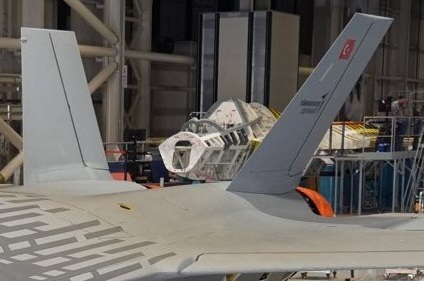
Turkish Aerospace Industries had begun final assembly of the second prototype, P1, at its Ankara facilities.
Unlike P0, P1 has been purpose-built not as a mere proof of concept but as a stepping stone toward operational production.
Its maiden flight, initially expected in late 2025, was rescheduled to April or May 2026 to integrate structural improvements, aerodynamic refinements, and systems architecture.
TAI executives describe P1 as a “more mature” iteration of KAAN, drawing extensively on P0’s flight test data and on technological synergies from other Turkish projects like the Kizilelma unmanned fighter and Anka-3 UCAV.
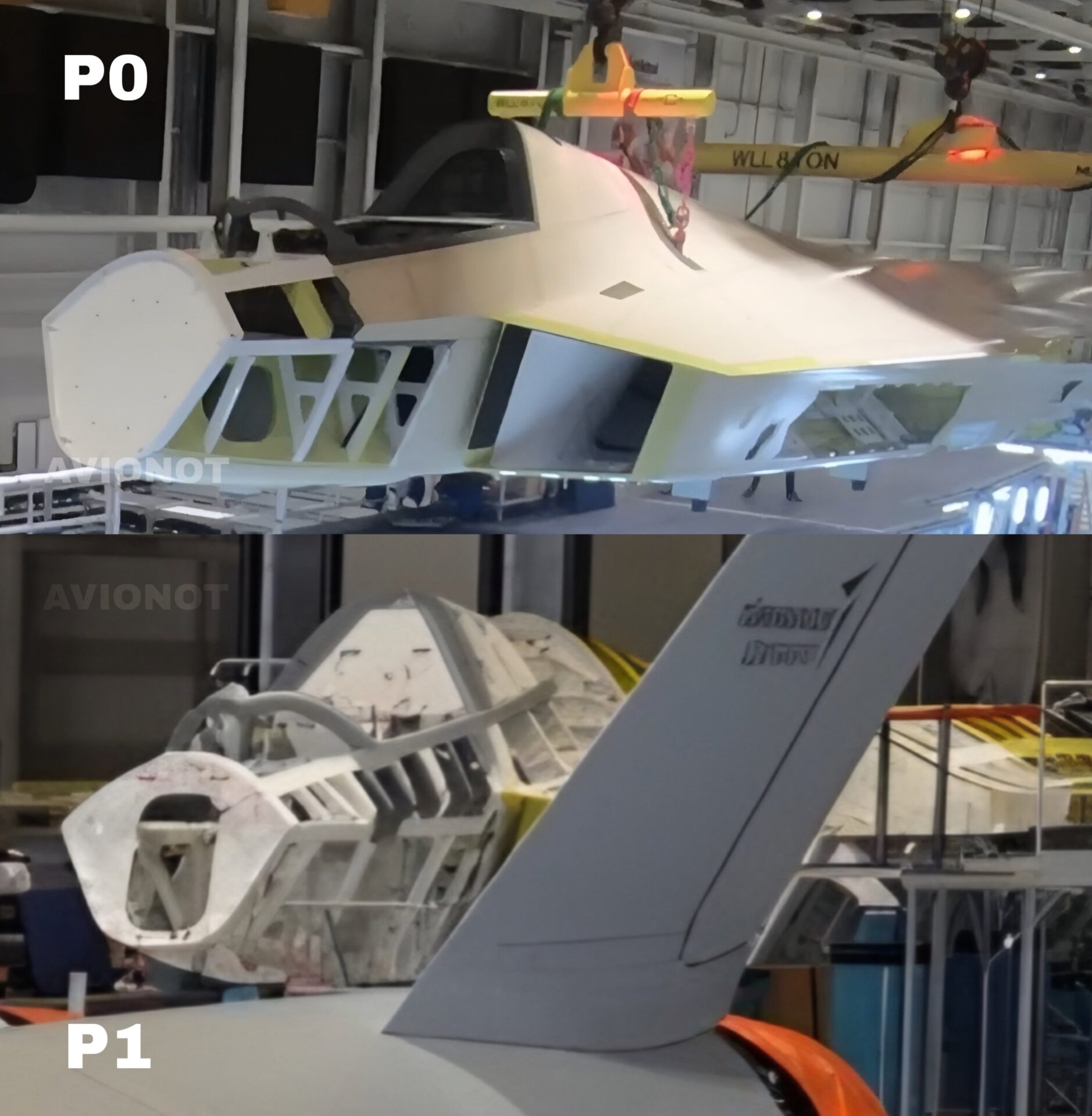
Satellite imagery and leaked photos show visible redesigns, including a wider nose section, taller engine intakes positioned closer to the canopy, and sleeker contours optimized for reduced drag.
Internally, P1 incorporates weight-saving composites and thermoplastics, structural reinforcements, and rebalanced load distribution to improve agility and endurance.
These changes represent more than cosmetic modifications; they mark a fundamental recalibration of KAAN’s path toward operational readiness.
Key Redesign Elements: Structural and Aerodynamic Shifts
The most visible redesign in P1 is the modification of engine air inlets, raised and angled closer to the canopy to optimize airflow and reduce turbulence.
This improves engine efficiency, enhances thrust output, and bolsters KAAN’s potential for sustained supercruise—an essential fifth-generation benchmark.
The airframe has been marginally downsized, with length reduced from 21 meters to around 20.3 meters, wingspan cut from 14 to 13.4 meters, and height lowered to 5 meters.
These dimensional changes improve agility, lower radar cross-section, and reduce overall drag.
The fuselage incorporates more carbon composites and lightweight alloys, trimming empty weight while maintaining structural durability.
P1 also allocates space for future integration of advanced systems including Infrared Search and Track (IRST), an Integrated RF System (BÜRFİS), Directed Infrared Countermeasures (DIRCM), and Manned-Unmanned Teaming (MUM-T) interfaces.
Such forward-planning ensures the KAAN architecture can accommodate iterative upgrades through Block 1, Block 2, and later production runs.
Why the Redesign Was Necessary
The redesign was not merely cosmetic—it was essential.
Flight data from P0 revealed excess drag, weight inefficiencies, and limitations in aerodynamic performance.
Reducing the aircraft’s mass and improving thrust-to-weight ratio became central to unlocking supercruise performance.
Supercruise capability provides a decisive edge in air combat, enabling fighters to travel faster, extend missile ranges, and dictate the tempo of engagements without consuming excessive fuel.
Moreover, Turkey’s strategic need for engine independence factored heavily into the redesign.
As Ankara faces export restrictions on U.S. F110 engines, P1 has been tailored with structural margins to accommodate future indigenous turbofan engines under development, expected around 2032.
By redesigning P1 now, TAI ensures KAAN will remain adaptable as Turkey transitions from dependency on foreign propulsion to homegrown powerplants.
First vs Second Prototype: A Comparative Analysis
| Aspect | First Prototype (P0) | Second Prototype (P1) | Strategic Implication |
|---|---|---|---|
| Length | 21 meters | 20.3 meters | Reduced weight and enhanced agility |
| Wingspan | 14 meters | 13.4 meters | Lower drag, stealthier profile |
| Height | 6 meters | 5 meters | Reduced radar cross-section |
| Nose Section | Narrower | Wider | Allows advanced avionics and IRST |
| Engine Inlets | Standard | Taller, repositioned | Optimized airflow and thrust |
| Structure | Heavier baseline | Reinforced lightweight composites | Greater growth potential |
| Role | Flight validation | Systems integration, expanded testing | Path to operational maturity |
These refinements transform KAAN from a symbolic prototype into a pre-production platform aligned with the performance envelope of global fifth-generation fighters.
Broader Military Impact
KAAN’s redesign sends powerful signals across the Indo-Pacific and NATO defense landscapes.
For the Turkish Air Force, the program promises eventual replacement of over 200 F-16s, securing Ankara’s frontline fighter fleet well into the mid-21st century.
For NATO, KAAN represents a paradox: while Turkey remains an alliance member, its pursuit of independent stealth technology diminishes reliance on U.S. platforms like the F-35.
This independence complicates U.S. defense diplomacy but enhances Ankara’s bargaining power within the alliance.
Regionally, KAAN is poised to compete with Russia’s Su-57, China’s J-20 and J-35, and South Korea’s KF-21 Boramae in export markets.
Turkey has already hinted at potential sales to Azerbaijan, Pakistan, and Central Asian states, creating an arms-export competition that could reshape regional balances.
By redesigning P1 with global markets in mind, Turkey strengthens KAAN’s export credibility, particularly in countries unable to access the F-35 due to political or budgetary constraints.
Industrial and Geo-Strategic Implications
The redesign phase has reinforced Turkey’s defense-industrial ecosystem, stimulating subcontractors in avionics, materials science, and weapons integration.
Domestic companies such as ASELSAN, HAVELSAN, and Roketsan are developing subsystems including AESA radar, electronic warfare suites, and precision-guided weapons for KAAN.
This self-reliant ecosystem reflects Ankara’s strategic lesson from the 2019 U.S. decision to expel Turkey from the F-35 program after its acquisition of Russian S-400 air defenses.
Geo-strategically, KAAN embodies Turkey’s “defense sovereignty” policy, reducing exposure to Western sanctions while opening new avenues for partnerships with nations like Pakistan, Qatar, and even Ukraine.
By 2030, KAAN could become a geopolitical tool, allowing Ankara to leverage fighter exports as part of broader diplomatic and defense-industrial outreach.
Future Roadmap
TAI plans to build at least six prototypes before full-scale production.
The third prototype, P2, is already under construction and will likely join flight tests by 2026, enabling concurrent test campaigns across different configurations.
Block 0 production aircraft may roll out around 2028, followed by Block 1 models incorporating more indigenous subsystems.
By 2032, Turkey expects to transition to fully indigenous engines, a milestone critical for true strategic independence.
KAAN’s final operational configuration envisions Mach 1.8 top speeds, +9/-3.5 g maneuvering limits, and maximum takeoff weights of nearly 35,000 kg.
Weapons integration will include indigenous beyond-visual-range (BVR) missiles, SOM cruise missiles, and precision-guided munitions, with export variants tailored to customer requirements.
READ: Türkiye Confirms No Delay in KAAN Fighter Jet Program Despite US Engine Block
Conclusion: Redesign as a Path to Strategic Autonomy
The redesign of KAAN’s second prototype demonstrates the iterative nature of cutting-edge aerospace engineering.
P0 proved that Turkey could fly a stealth fighter; P1 shows that Ankara is ready to refine, optimize, and compete globally.
By shrinking dimensions, improving aerodynamics, and planning for future systems, Turkey ensures KAAN is not just a national symbol but a competitive fifth-generation fighter.
As KAAN moves toward its next test campaign, its evolution from P0 to P1 represents more than an engineering adjustment—it marks Turkey’s determination to redefine its role in global military aviation.
For the Turkish Air Force, it means a viable successor to the F-16.
For NATO, it signals a complex partner moving toward autonomy.
And for the global arms market, KAAN’s redesign underscores that the next great fighter competition may not be limited to Washington, Moscow, and Beijing—but may now include Ankara.
The ultimate success of KAAN will hinge on Turkey’s ability to integrate indigenous engines by 2032, a milestone that will determine whether Ankara can truly achieve full technological sovereignty in aerospace.
If delivered on schedule, KAAN could emerge as the only non-Western, non-Russian fifth-generation export fighter available to friendly states such as Pakistan, Azerbaijan, and potentially Gulf nations locked out of the F-35 program.
Its success would not only elevate Turkey’s defense industry into the top tier of global aerospace exporters but also challenge the monopoly long held by Western primes like Lockheed Martin and Russian giants such as Sukhoi.
Ultimately, the redesign of P1 reflects more than engineering pragmatism—it is a calculated strategic maneuver by Ankara to position itself as a future powerbroker in the global combat aviation market. — DEFENCE SECURITY ASIA