Thai Air Force Seeks Eight More Gripen E/F Fighters as F-16 Retirement Nears
Thailand’s F-16A/B fighters at Korat are due to retire in 2028, about a year before the first of four Swedish-built Gripen E/Fs already on order is expected to arrive.
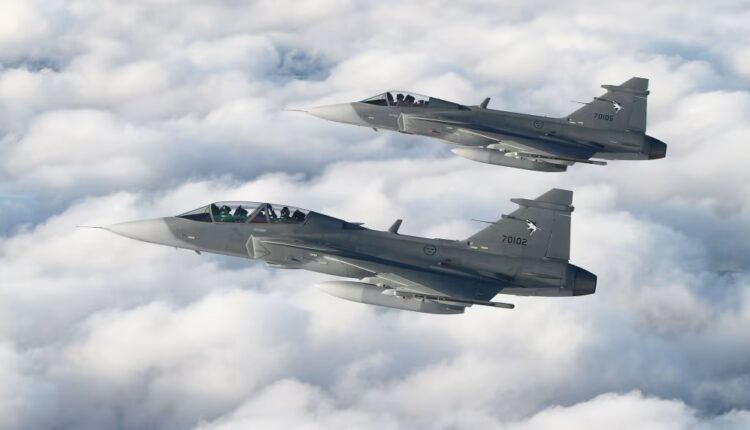
(DEFENCE SECURITY ASIA) — Thailand’s air force chief proposed buying eight more Saab Gripen E/F fighters in a single deal, seeking to complete a 12-aircraft squadron to replace ageing F-16s at Korat.
The F-16A/B fighters are due to retire in 2028, while the first new Gripen is expected around 2029, leaving Bangkok with a transition to manage even if the purchase wins approval.
With four Gripens already on order, Air Chief Marshal Sakesan Kantha wants to combine the two remaining procurement phases so the air force can plan deliveries and crew conversion under one follow-on contract.
Approval would give Sweden a larger role in Thailand’s frontline air fleet, with Korat set to become the country’s second Gripen base alongside Surat Thani, which already operates the earlier C/D variant.
The first new Gripen is expected around 2029, leaving an apparent gap in the published timetable even if Bangkok agrees to consolidate the two remaining procurement phases.

That interval matters beyond the unit changing aircraft because the Royal Thai Air Force intends to maintain three frontline fighter squadrons while deciding how to replace another squadron’s aircraft.
Thailand already operates Gripen C/D fighters at Surat Thani, but converting an F-16 unit at Nakhon Ratchasima would give the Swedish fighter family a second base in the Thai force structure.
“Buying equipment is straightforward,” Sakesan said, identifying the harder test for Thailand’s fighter modernisation as the service’s ability to keep aircraft available for missions throughout their operating lives.
Sakesan also put an economic case to the government, saying ten proposed offsets could generate benefits for Thailand exceeding the value of the programme, a projection still awaiting detailed terms.
In Defence Security Asia’s assessment, the strongest case for a combined order is that it would give planners a firm squadron size around which to organise training, maintenance and deliveries.
The clearest strategic signal is to Sweden, whose government-to-government defence relationship with Thailand could expand from supporting an established Gripen operator to sustaining two Thai squadrons flying different generations of the aircraft.
For Bangkok, the immediate decision concerns how quickly it can commit to that second squadron, while the date on which the unit could assume frontline duties remains open.
(READ) Thailand Confirms Gripen E/F Fighter Jet Purchase Amid Cambodia Border Tensions
One Gripen Order Would Replace Two Separate Buying Decisions
Thailand originally envisaged acquiring 12 Gripen E/F fighters in three phases over roughly a decade, spreading the financial commitment across several decisions while making the final squadron dependent on each succeeding purchase.
Under the contract concluded around August 2025, Thailand ordered four aircraft, generally identified as three single-seat Gripen E fighters and one two-seat Gripen F, establishing the starting point for the conversion.
By May 2026, the first Thai airframe had entered Saab’s production line, giving the initial purchase a tangible manufacturing milestone that the eight proposed aircraft have yet to reach.
Sakesan’s proposal would combine the second and third phases, removing one future purchasing decision between the four aircraft already contracted and the 12 that the air force considers necessary.
For force planners, the practical difference lies in what can be scheduled with confidence when eight additional aircraft share a contract, even if their deliveries extend across several years.
A single agreement could establish the delivery sequence for the balance of the squadron, giving commanders a basis for deciding when to release personnel from their existing F-16 responsibilities.
Buying in stages gives the government opportunities to revisit expenditure, although each additional decision leaves the air force exposed to a change in budget priorities before it secures the full complement.
The 12-aircraft requirement already appears in the air force white paper, giving the proposed purchase a place in published force planning while leaving the government to determine its affordability.
Formal project preparation and budgeting are expected to begin in 2027, when the committee’s figures should clarify how much funding the air force needs and over what period.
Until those figures reach the prime minister, the financial question is how much Thailand must commit to complete the squadron, since the overall programme estimate also encompasses the first phase.
(READ) Thai Gripen, F-16 Fighter Jets Strike Cambodian Military Targets as Border Fighting Escalates

The F-16 Retirement and Gripen Delivery Dates Leave a Readiness Question
The operational pressure comes from two dates set by different processes, with the ageing F-16A/B fighters due for retirement in 2028 and initial Gripen E/F deliveries expected from around 2029.
Those dates establish the order of events, although their precision is insufficient to calculate how many months might separate the last scheduled F-16 retirement from the first Gripen arrival.
Neither date establishes when the replacement squadron can take responsibility for frontline missions, since delivery records the arrival of an aircraft while operational readiness also depends on people and support.
For Wing 1 at Nakhon Ratchasima, also known as Korat, planners must reconcile the loss of aircraft associated with the existing squadron with the pace at which replacement crews qualify.
A faster purchasing decision could narrow the period during which commanders lack a firm delivery schedule, but its effect on the transition depends on the production dates Sweden can offer.
The first four fighters would represent only one-third of the planned squadron, making the pace of subsequent deliveries consequential even after Thailand receives its first aircraft from Saab.
Early aircraft will also have to support conversion training, so their arrival totals alone would give policymakers an incomplete picture of how many fighters commanders could assign to operational duties.
The first phase includes a two-seat Gripen F, giving the initial fleet an aircraft suited to instructional flying, although Thailand has released no timetable for qualifying the squadron’s crews.
The distinction matters for regional assessments of Thai air power because a planned squadron of 12 can appear in force projections years before commanders can routinely draw on that strength.
The most informative milestones after contract approval would therefore be the first delivery, the qualification of personnel at Korat and the point at which the unit assumes its assigned missions.
(READ) Azerbaijan Eyes $6.5 Billion Gripen E/F Fighter Deal as Baku Seeks Air Dominance Over the South Caucasus
Surat Thani’s Gripen Experience Faces a Different Test at Korat
Thailand enters the transition with approximately 11 Gripen C/D fighters remaining from an original fleet of 12, based mainly with Wing 7 at Surat Thani in the country’s south.
That fleet gives the air force personnel familiar with operating Swedish fighters, an institutional advantage whose practical value at Korat depends on which skills transfer to the newer aircraft.
The comparison between the two units begins with their assignments, since Wing 7 operates an established fleet while the prospective Gripen E/F squadron must convert from an American fighter family.
A national inventory combining both Gripen generations would obscure that difference, particularly during the years when one unit sustains existing missions and the other builds experience on recently delivered aircraft.
For the maintenance organisation, the relevant question is how much existing expertise can support the E/F and which tasks require separately qualified technicians, equipment or arrangements with the manufacturer.
Thailand has disclosed no detailed breakdown of common spares, ground equipment or training between the generations, leaving the potential savings from operating two Gripen squadrons difficult to quantify.
Geography also shapes the logistics footprint, since experience concentrated at Surat Thani can assist the conversion but aircraft operating from Korat will need dependable access to support at their own base.
Transferring experienced personnel could help establish the new unit, although commanders would have to weigh that benefit against the continuing demands of maintaining the existing C/D fleet in the south.
Across both bases, the more consequential measure of fleet strength will be how many aircraft Thailand can sustain for assigned missions while others undergo maintenance or support training.
For regional observers, the proposal identifies where Thailand intends to build its next frontline fighter unit, while the missions and availability of that unit remain matters for later operational decisions.
Ten Proposed Offsets Put Thailand’s Industrial Return Under Scrutiny
Sakesan said the ten proposed economic offsets could return more to Thailand’s economy than the fighter programme costs, placing industrial cooperation alongside military readiness in the case for consolidation.
His claim concerns the projected value of economic activity associated with the purchase, a different accounting measure from the public funds Bangkok would need to pay for the aircraft.
For the government, assessing that projection requires knowing what each undertaking would deliver, how its value would be calculated and when Thai participants could expect to receive the benefit.
Earlier plans under the government-to-government framework with Sweden included technology transfer and industrial cooperation, giving the offset negotiations a direct bearing on Thailand’s longer-term relationship with Saab and Swedish industry.
The ten items have yet to be described individually, leaving open how much of their projected value would accrue to defence firms, other Thai businesses or the wider economy.
From the squadron commander’s perspective, an offset that qualifies local personnel for recurring maintenance would have a different operational consequence from an investment delivering an equivalent value elsewhere in Thailand.
That distinction makes the industrial package relevant to force posture only where a specific commitment can be connected to aircraft availability, technical competence or more dependable access to support.
Sakesan framed the requirement in service-life terms, saying, “What matters more is sustaining that capability so the aircraft can carry out their missions throughout their service lives.”
The committee’s detailed budget could give the prime minister a basis for comparing the timing of Thailand’s spending obligations with the period over which the proposed economic benefits might materialise.
Until the commitments and their valuation are available, the projected return remains part of Sakesan’s argument for the purchase, while funding the fighters remains a separate decision for Bangkok.
The F-35 Question Belongs to Thailand’s Next Squadron Decision
Thailand’s ambition to maintain three frontline fighter squadrons gives the Gripen decision a wider significance, since the service also expects to consider replacements for another squadron within about five years.
Sakesan identified the F-35 among the candidates for that later requirement, leaving the current proposal focused on completing the Gripen squadron already set in motion by the first contract.
The two aircraft therefore occupy different positions in Thai planning, with the Gripen E/F already in production for Thailand and the F-35 under consideration for a subsequent force-structure decision.
That distinction matters internationally because a larger commitment to Sweden would deepen one defence relationship while preserving Bangkok’s ability to evaluate an American aircraft against its next squadron requirement.
Performance, acquisition cost, logistics and long-term sustainment are among the factors under review, giving the air force a practical reason to examine what its Gripen conversion demands before selecting another fighter.
By the time that review takes shape, experience at Korat could give planners firmer evidence about crew conversion, maintenance capacity and the institutional demands of introducing a new aircraft generation.
A separate armed-drone selection under the 2027 fiscal plans will place another aviation requirement before Thai decision-makers, although the air force has identified no direct trade-off with the Gripen proposal.
For Sweden, the immediate opportunity is to secure the remaining eight aircraft in one commitment, extending a relationship whose industrial value will depend partly on the obligations both governments accept.
For Thailand’s neighbours, the development to watch is the progression from a contracted four-aircraft purchase to a funded squadron with a delivery schedule against which regional force assessments can be tested.
Bangkok’s next budget briefing will carry most weight if it answers the question the headline figure leaves open: when can Korat field enough trained crews and serviceable Gripens to succeed its F-16s?
