
South Korea Alarmed as U.S. Pulls Patriot and THAAD Missile Defenses for Iran Crisis—Lee Jae-myung Admits Seoul ‘Cannot Stop Washington
U.S. redeployment of Patriot and THAAD systems from the Korean Peninsula to the Middle East exposes the limits of Seoul’s leverage in the U.S.–ROK alliance as North Korea accelerates missile testing.

(DEFENCE SECURITY ASIA) — The relocation of American Patriot and Terminal High Altitude Area Defense (THAAD) missile systems from the Korean Peninsula to the Middle East has triggered a geopolitical shockwave across Northeast Asia, with South Korean President Lee Jae-myung acknowledging during a press briefing that Seoul opposes the withdrawal yet ultimately lacks the authority to prevent Washington from redeploying its own strategic assets.
“We are opposing the withdrawal of some air defense weapons… but we cannot fully enforce our opinion,” Lee stated publicly when questioned about the transfer, a candid admission that highlighted the asymmetric command dynamics within the United States–Republic of Korea alliance framework established under the 1953 Mutual Defense Treaty.
Lee’s statement, delivered only months after his snap-election victory amid domestic political turmoil in late 2025, immediately injected urgency into the regional security debate because the redeployment involves missile-defense systems designed specifically to intercept North Korea’s expanding arsenal of ballistic missiles, including increasingly sophisticated hypersonic and submarine-launched variants.

Within hours of the briefing, Lee’s remark circulated widely across social media platforms including X, where the statement accumulated thousands of interactions and was frequently interpreted as evidence of strategic friction within the U.S.–South Korea alliance at a moment when Washington is simultaneously confronting crises in the Middle East, Europe, and the Indo-Pacific.
The controversy centers on reports that the United States has begun relocating Patriot surface-to-air missile batteries and elements of the THAAD missile-defense system from South Korea to reinforce air-defense networks in the Middle East following escalating hostilities with Iran.
The redeployment reflects Washington’s attempt to rebalance its global military posture after U.S. and Israeli operations against Iran—including the assassination of Iran’s Supreme Leader Ali Khamenei in early March 2026—triggered fears of retaliatory missile barrages against American partners and military facilities across the region.
Seoul’s concern is rooted in the Korean Peninsula’s unique deterrence environment, where approximately 28,500 U.S. troops remain stationed under the U.S. Forces Korea command structure to prevent North Korean aggression through a layered architecture of missile defense, forward presence, and combined military exercises.
Although American officials have indicated the redeployments may be temporary and part of broader force rotations, the move has amplified anxieties in Seoul that a reduction in missile-defense coverage could create operational vulnerabilities during a period of heightened missile activity by North Korea.
Those anxieties have intensified because Pyongyang has reportedly conducted more than twenty missile launches in 2026 alone, including systems designed to complicate interception through hypersonic maneuverability and submarine-launched ballistic missile capabilities.
Against that backdrop, Lee’s public acknowledgement of Seoul’s limited influence over American force deployments has exposed the structural imbalance within the alliance: South Korea relies heavily on U.S. strategic protection but cannot veto Washington’s operational decisions regarding American-owned missile-defense systems stationed on Korean territory.
Strategic Shockwave: U.S. Redeployment Exposes Limits of Seoul’s Alliance Leverage
The controversy surrounding the Patriot and THAAD withdrawal underscores the asymmetric architecture of the U.S.–South Korea alliance, where the legal framework of the 1953 Mutual Defense Treaty grants Washington full operational control over American deployments while leaving Seoul with limited authority beyond diplomatic consultation.
Lee’s briefing therefore carried significant strategic weight because it publicly confirmed that even strong objections from Seoul—including direct diplomatic engagement with U.S. Secretary of Defense Lloyd Austin—could not compel Washington to halt the redeployment decision.
The revelation has intensified scrutiny among South Korean policymakers who increasingly recognize that alliance guarantees, while central to deterrence against North Korea, do not necessarily translate into equal decision-making authority over the use or redistribution of American military capabilities.
From a military-technical perspective, the removal of even a portion of Patriot interceptors and THAAD launchers has raised concerns about temporary coverage gaps within the peninsula’s missile-defense network, particularly in the context of North Korea’s expanding missile testing program.
THAAD, deployed in South Korea since 2017, provides a high-altitude intercept layer capable of engaging short-, medium-, and intermediate-range ballistic missiles during their terminal phase, forming a crucial component of the peninsula’s integrated missile-defense architecture.
Patriot missile batteries complement that capability by providing point defense against aircraft, cruise missiles, and shorter-range ballistic threats, allowing layered interception coverage designed to complicate North Korean attack planning.
The potential redeployment of these assets therefore carries operational implications because the Korean Peninsula’s missile-defense posture depends on overlapping interception layers rather than a single defensive system.
For Seoul’s strategic planners, the core concern is not merely the physical movement of missile-defense hardware but the broader signal it sends regarding U.S. prioritization of global theaters at a moment when American military resources are under strain.
The redeployment has therefore become a focal point in debates over whether Washington’s growing commitments in the Middle East and Europe could dilute the credibility of deterrence guarantees in the Indo-Pacific.
North Korea’s Missile Surge Raises Fears of a Strategic Security Vacuum
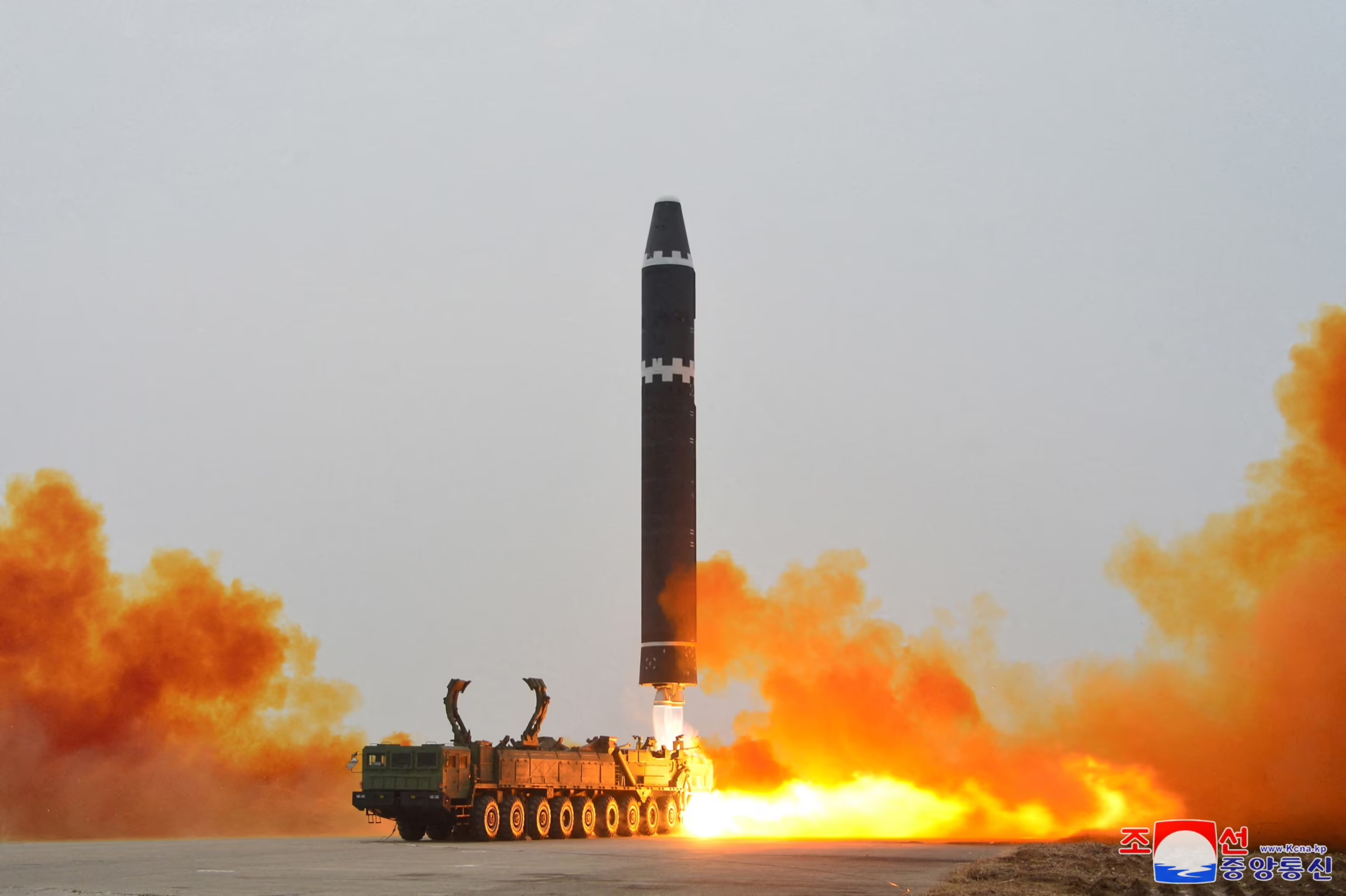
South Korean opposition to the withdrawal is strongly influenced by the accelerating pace of North Korea’s missile development, which has seen Pyongyang conduct more than twenty launches in 2026 alone across a range of advanced missile systems.
Among these tests are hypersonic glide vehicles and submarine-launched ballistic missiles, capabilities that complicate interception timelines and place increasing pressure on regional missile-defense networks.
Seoul’s security establishment fears that any reduction in visible American missile-defense presence could be interpreted in Pyongyang as an opportunity to exploit perceived weaknesses in allied deterrence posture.
Lee’s administration has repeatedly warned that a sudden shift in missile-defense coverage could create what officials describe as a potential “security vacuum” across the Korean Peninsula during a period of rising tensions.
Such a vacuum would not necessarily require the complete removal of American systems; even temporary reductions could alter the perceived balance of defensive capability during crisis escalation scenarios.
The concern is magnified by North Korea’s rhetorical escalation under Kim Jong-un, whose government has intensified warnings against the South while continuing to expand the operational diversity of its missile arsenal.
For military planners in Seoul, the strategic challenge lies in maintaining credible deterrence without appearing dependent on U.S. deployments that Washington may redistribute according to global priorities.
Lee has therefore emphasized South Korea’s indigenous Korean Air and Missile Defense system as a critical component of the nation’s long-term deterrence posture.
However, critics within South Korea argue that emphasizing domestic capabilities may understate the strategic importance of American missile-defense layers that provide additional interception depth against complex missile attacks.
Domestic Political Pressures Shape Seoul’s Strategic Messaging
The controversy surrounding the missile-defense withdrawal is unfolding within a politically sensitive environment for Lee’s Democratic Party government, which controls South Korea’s National Assembly but faces strong opposition from conservative political factions.
Historically, Lee’s party has advocated greater strategic autonomy from Washington, a position shaped partly by economic repercussions South Korea experienced following the 2017 deployment of THAAD that triggered Chinese consumer boycotts.
At the same time, domestic polling consistently shows that between 70 and 80 percent of South Koreans support the alliance with the United States as the cornerstone of deterrence against North Korea.
Lee’s opposition to the withdrawal therefore reflects a delicate political balancing act: projecting nationalist resolve while avoiding a direct confrontation with Washington that could undermine the alliance.
The messaging strategy has been complicated by statements from figures associated with the administration who have voiced criticism of U.S. military actions elsewhere.
One such figure, Kim Min-woong, brother of Prime Minister Kim Min-seok and a prominent activist, described U.S. strikes on Iran as “aggression” and labeled the presence of U.S. Forces Korea as the “biggest threat” to South Korean security.
Those remarks have fueled accusations from political opponents that elements within the ruling camp harbor anti-American sentiments.
For Lee’s administration, managing this perception has become strategically important because public confidence in the alliance remains central to national security policy.
Washington’s Global Military Priorities Drive Strategic Asset Redistribution
The redeployment of missile-defense systems from South Korea must also be understood within the broader context of American force-management challenges across multiple geopolitical theaters.
Washington is currently balancing simultaneous strategic pressures arising from the war in Ukraine, tensions in the Taiwan Strait, and the escalating confrontation with Iran.
The decision to transfer Patriot and THAAD systems to the Middle East therefore reflects an attempt to redistribute limited missile-defense assets across regions facing immediate threat environments.
In the Middle East, U.S. planners fear that Iranian retaliation following the death of Ali Khamenei could involve large-scale missile and drone attacks targeting American bases and allied infrastructure.
Deploying additional air-defense systems is intended to strengthen interception capacity against such attacks, particularly against ballistic missiles and long-range drones.
However, this redistribution strategy inevitably creates ripple effects among American allies who depend on those systems for their own security frameworks.
South Korean officials worry that the redeployment signals a gradual shift in U.S. strategic attention away from Northeast Asia.
Such perceptions could influence how regional actors—including China and North Korea—interpret the durability of American commitments in the Indo-Pacific security architecture.
Global Ripple Effects: Energy Markets, Alliances, and Strategic Signalling
The missile-defense redeployment controversy has produced diplomatic reverberations far beyond the Korean Peninsula, illustrating how decisions about force posture can influence alliance perceptions across multiple regions.
Japan, another key U.S. ally in Northeast Asia, has reportedly expressed unease about the potential precedent created by the withdrawal of missile-defense assets from South Korea.
Japanese policymakers fear that similar redistributions could eventually affect Japan’s own defensive coverage if global demand for American air-defense systems continues to increase.
Meanwhile, the redeployment is occurring against the backdrop of rising energy market volatility linked to tensions between Iran, Israel, and the United States.
Oil prices have surged to between US$105 and US$108 per barrel—equivalent to roughly RM399 to RM410 per barrel using an exchange rate of USD1 = RM3.8—placing additional economic pressure on energy-dependent economies such as South Korea.
The energy dimension underscores how military crises can trigger cascading economic consequences that extend far beyond the immediate conflict zone.
For Seoul, these economic pressures compound existing security concerns by increasing the strategic stakes of Middle Eastern instability.
At the geopolitical level, the episode also feeds into broader debates about whether the United States can sustain simultaneous deterrence commitments across multiple theaters without diluting its military presence in any single region.
Critics argue that the redeployment illustrates the growing limits of American resource allocation in a world defined by overlapping strategic competitions.
For South Korea, the central dilemma remains clear: the nation depends on the United States for extended deterrence against North Korea, yet the alliance structure provides limited leverage when Washington chooses to reposition its own military assets.
If tensions with North Korea intensify while American missile-defense systems remain deployed elsewhere, the issue could evolve from a diplomatic controversy into a potential flashpoint for regional security.
