
South Korea’s KDDX Stealth Destroyer Could Redraw Indo-Pacific Naval Power Balance Against China and North Korea
South Korea’s KDDX destroyer program combines stealth warship design, radar AESA technology, Integrated Electric Propulsion, ballistic missile defense capability, and long-range strike missiles to strengthen Indo-Pacific maritime deterrence against rising regional threats.
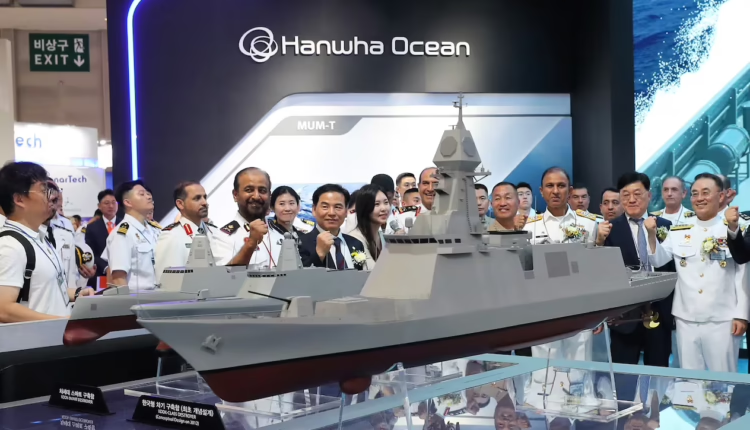
(DEFENCE SECURITY ASIA) — South Korea’s decision to accelerate the KDDX next-generation destroyer program is reshaping the Republic of Korea Navy’s future force posture at a moment when the Indo-Pacific maritime battlespace is increasingly defined by missile saturation threats, undersea competition, and escalating great-power rivalry.
The June 2026 selection of Hanwha Ocean as the preferred bidder for detailed design and lead-ship construction transformed the delayed KDX-IV initiative from an industrial competition into one of Seoul’s most consequential strategic defense modernization programs of the decade.
The KDDX program is designed to deliver six stealth-guided missile destroyers optimized for multi-domain warfare, ballistic missile defense support, anti-submarine warfare, long-range precision strike missions, and distributed maritime operations across increasingly contested regional sea lanes.

Valued at approximately KRW7.8 trillion, equivalent to about US$5.7 billion or RM21.6 billion, the project represents one of South Korea’s largest indigenous naval investments since the development of the Sejong the Great-class Aegis destroyers.
Unlike previous Republic of Korea Navy destroyer programs that depended heavily on foreign combat systems and imported technologies, the KDDX initiative is structured around fully domestic hull architecture, indigenous combat management systems, Korean vertical launch systems, and locally produced phased-array radar technologies.
The destroyer program therefore reflects more than fleet modernization because it directly supports Seoul’s broader strategic objective of reducing operational dependency on foreign defense suppliers while preserving interoperability with United States naval and missile defense networks.
Military planners in Seoul increasingly view maritime survivability, undersea detection superiority, and long-range strike capability as essential deterrence components against North Korea’s expanding missile arsenal and evolving submarine-launched attack capabilities.
The KDDX fleet is expected to become a central operational asset within South Korea’s evolving “3-axis” strategic framework comprising Kill Chain preemptive strike doctrine, Korean Air and Missile Defense architecture, and Korea Massive Punishment and Retaliation response operations.
Regional defense analysts assess the destroyer’s Integrated Electric Propulsion System as particularly significant because quieter propulsion signatures substantially improve anti-submarine warfare effectiveness against increasingly sophisticated North Korean underwater infiltration and missile submarine operations.
The transition toward Integrated Electric Propulsion also provides the electrical generation capacity required for future high-energy sensors, advanced electronic warfare suites, and possible directed-energy weapon integration during the vessel’s projected operational lifespan into the 2060s.
The KDDX initiative simultaneously strengthens South Korea’s ambitions to become a major blue-water maritime power capable of securing critical sea lines of communication supporting the country’s export-driven economy and energy import dependency.
As the Indo-Pacific increasingly becomes the focal point of strategic competition involving China, Japan, the United States, and North Korea, the KDDX program signals that South Korea intends to emerge not merely as a regional middle power but as an increasingly autonomous maritime security actor.
KDDX Reshapes South Korea’s Maritime Deterrence Architecture Against North Korean Threats
South Korea’s naval modernization strategy increasingly prioritizes survivable distributed combat capability because North Korea continues expanding missile inventories, submarine-launched weapons, electronic warfare systems, and asymmetric maritime infiltration capabilities along the Korean Peninsula.
The KDDX destroyer class directly addresses these operational pressures by combining stealth shaping, reduced acoustic signatures, advanced anti-air warfare systems, and long-range strike missiles within a more numerous platform than expensive KDX-III Aegis destroyers.
Republic of Korea Navy planners view force density as strategically essential because maintaining maritime persistence against simultaneous missile, submarine, and coastal infiltration threats requires larger numbers of survivable combatants rather than limited concentrations of high-value strategic assets.
The destroyer’s stealth-optimized hull geometry and integrated mast architecture significantly reduce radar cross-section signatures, thereby complicating enemy targeting cycles during high-intensity maritime engagements in the Yellow Sea, East Sea, and wider Indo-Pacific operational environment.
Integrated Electric Propulsion technology further enhances anti-submarine warfare survivability because quieter machinery signatures reduce detectability against hostile submarines operating near critical maritime chokepoints surrounding the Korean Peninsula.
The destroyer’s integrated sonar suite combining hull-mounted and towed-array systems substantially improves underwater detection capability against North Korea’s expanding submarine fleet, including emerging missile-launch capable underwater platforms intended to complicate allied maritime operations.
KDDX vessels are expected to deploy Hyunmoo-3C land-attack cruise missiles with ranges approaching 1,500 kilometers, thereby extending South Korea’s maritime strike envelope deep into adversary operational infrastructure and command networks.
The integration of Korean Vertical Launch Systems also reduces dependency on foreign launch architecture while enabling flexible deployment of domestic anti-air missiles, anti-submarine rockets, land-attack weapons, and future indigenous ballistic missile defense interceptors.
South Korea’s development of Ship-to-Air Missile-II systems additionally demonstrates Seoul’s effort to establish sovereign layered naval air defense capability independent from exclusive reliance on American Standard Missile inventories and foreign sustainment pipelines.
The destroyer class consequently strengthens deterrence credibility because it integrates maritime strike capability, missile defense support, and advanced anti-submarine warfare within platforms specifically engineered for sustained operations under high-threat conditions near the Korean Peninsula.
Regional military observers increasingly interpret KDDX as a practical transition from coastal defense doctrine toward integrated maritime battlespace dominance capable of supporting preemptive strike operations and retaliatory force projection under Seoul’s evolving strategic doctrine.

Indigenous Combat Systems Strengthen South Korea’s Strategic Defense Autonomy
The KDDX program represents one of South Korea’s most ambitious indigenous military-industrial projects because nearly every major subsystem is domestically designed, integrated, manufactured, or supported through Korean defense technology ecosystems.
South Korea consequently joins a highly limited group of nations capable of independently producing advanced stealth destroyers equipped with indigenous combat systems, integrated radar suites, electronic warfare architecture, and vertically launched missile ecosystems.
The strategic significance extends beyond naval capability because sovereign defense production substantially improves wartime sustainment resilience during scenarios involving disrupted global supply chains, export restrictions, or alliance political friction during major regional contingencies.
Hanwha Systems’ dual-band S-band and X-band phased-array radar architecture demonstrates the maturity of South Korea’s domestic radar AESA industry, which increasingly competes internationally across naval, aerospace, and integrated air defense sectors.
The radar suite simultaneously supports long-range air surveillance, ballistic missile tracking, surface targeting, and fire-control operations, thereby enabling multi-domain battlespace awareness previously dependent on imported foreign sensor technologies.
South Korea’s Advanced Electronic Warfare Equipment-II further expands indigenous electronic attack and electronic support capability, which military planners increasingly consider essential amid rapidly evolving electromagnetic warfare environments across the Indo-Pacific theater.
Automation technologies embedded throughout the destroyer class also reduce long-term personnel requirements, operational costs, and maintenance burdens while improving survivability during sustained high-intensity naval operations against technologically sophisticated adversaries.
The projected crew requirement of approximately 160 to 180 personnel reflects broader “smart ship” integration trends involving autonomous navigation support, automated ammunition handling systems, and digitally networked combat-management architecture.
The KDDX initiative additionally strengthens South Korea’s export credibility because international defense customers increasingly prioritize sovereign design ownership, domestic sustainment flexibility, and reduced dependence on geopolitical restrictions associated with foreign-origin combat systems.
Defense analysts therefore view the destroyer program as both a naval modernization initiative and a strategic industrial signaling mechanism demonstrating South Korea’s emergence as a technologically mature defense manufacturing power within the global aerospace industry and naval systems market.
The selection of Hanwha Ocean following prolonged industrial disputes also restores momentum to a program that had become politically sensitive because delays risked weakening Seoul’s long-term naval modernization roadmap during intensifying regional maritime competition.
China’s Indo-Pacific Calculus Could Shift as Seoul Expands Blue-Water Naval Reach
China is likely to closely monitor the KDDX program because the destroyer class expands South Korea’s operational flexibility beyond peninsula-focused defense missions into broader Indo-Pacific maritime security operations and strategic sea-lane protection activities.
Although Seoul officially frames KDDX primarily as a defensive modernization platform against North Korean threats, the destroyer’s long-range strike capability and advanced maritime surveillance architecture inevitably carry wider regional strategic implications.
The Republic of Korea Navy increasingly operates within a regional security environment shaped by Chinese naval expansion, disputed maritime zones, gray-zone coercion tactics, and intensified strategic competition across the Indo-Pacific maritime domain.
Chinese strategic planners may interpret expanded South Korean blue-water capability as indirectly supporting broader balancing efforts involving the United States, Japan, Australia, and emerging Indo-Pacific security coordination initiatives.
Potential future KDDX deployments near contested maritime regions including Ieodo, known internationally as Socotra Rock, could increase operational sensitivities between Beijing and Seoul despite both governments seeking stable bilateral economic relations.
The destroyer’s advanced anti-submarine warfare capability is also strategically relevant because China’s expanding submarine operations throughout regional waters increasingly shape Indo-Pacific maritime force posture calculations among neighboring naval powers.
South Korea’s ability to independently deploy stealth destroyers equipped with domestic radar AESA systems and long-range precision strike missiles strengthens its strategic flexibility during regional crises involving contested maritime access or coercive naval signaling.
The KDDX fleet additionally complements broader allied maritime surveillance architecture supporting freedom-of-navigation operations, ballistic missile tracking networks, and distributed naval interoperability across increasingly congested regional waterways.
Despite these developments, Seoul continues balancing defense modernization with diplomatic caution because excessive strategic alignment against China risks economic retaliation affecting South Korea’s export-driven industrial sectors and technology supply chains.
The destroyer program therefore reflects a carefully calibrated maritime strategy seeking enhanced operational independence without fundamentally abandoning alliance coordination or escalating direct regional confrontation with Beijing.
KDDX consequently embodies a broader Indo-Pacific reality in which middle powers increasingly pursue autonomous military modernization strategies while simultaneously navigating the strategic pressures generated by intensifying United States-China competition.
KDDX Could Deepen Both Maritime Tensions and Security Cooperation With Japan
The expansion of South Korea’s destroyer capability carries important implications for Japan because both countries increasingly confront overlapping missile threats, contested maritime security pressures, and growing Chinese naval activity throughout Northeast Asian waters.
Historical disputes involving Dokdo, referred to by Japan as Takeshima, continue generating periodic diplomatic friction that complicates military coordination despite shared concerns regarding North Korean missile launches and regional strategic instability.
A more capable Republic of Korea Navy equipped with stealth destroyers and long-range maritime strike systems could therefore heighten Japanese sensitivities surrounding future naval deployments near disputed maritime zones or overlapping operational areas.
At the same time, regional security realities increasingly compel deeper trilateral operational coordination involving South Korea, Japan, and the United States amid accelerating North Korean ballistic missile testing and expanding Chinese maritime activity.
The KDDX destroyer’s integrated sensor suite and ballistic missile defense support capability could significantly enhance regional maritime surveillance interoperability supporting trilateral missile tracking and early-warning coordination frameworks.
Japanese defense planners are also likely to evaluate the destroyer’s indigenous combat systems carefully because South Korea’s rapidly advancing naval technology base increasingly rivals established Northeast Asian defense manufacturing capabilities.
The KDDX fleet’s anti-submarine warfare specialization may additionally contribute to broader regional underwater surveillance operations as Chinese and North Korean submarine activities expand across strategic Indo-Pacific maritime corridors.
Operational cooperation involving maritime patrol, ballistic missile detection, anti-submarine warfare exercises, and sea-lane protection missions may therefore become increasingly practical despite unresolved political disputes between Seoul and Tokyo.
The destroyer program also demonstrates that South Korea no longer intends to remain solely dependent on American maritime power projection for regional deterrence credibility, thereby gradually reshaping Northeast Asia’s naval balance.
Strategic analysts increasingly argue that indigenous naval modernization programs across both Japan and South Korea collectively indicate a broader regional transition toward expanded middle-power maritime capability under worsening regional security conditions.
KDDX therefore functions simultaneously as a symbol of South Korean strategic autonomy and a potential catalyst for deeper regional naval coordination against shared missile, submarine, and maritime coercion threats across the Indo-Pacific theater.
KDDX Elevates South Korea Into a More Influential Indo-Pacific Maritime Power
The long-term strategic significance of KDDX ultimately extends beyond naval modernization because the destroyer class strengthens South Korea’s broader ambition to become a globally influential maritime security and defense technology power.
South Korea’s economy remains heavily dependent on uninterrupted maritime trade routes supporting energy imports, semiconductor exports, and industrial supply chains vulnerable to disruption during regional conflict or strategic coercion scenarios.
The Republic of Korea Navy therefore increasingly prioritizes blue-water operational capability enabling sustained deployment across distant sea lines of communication linking the Korean Peninsula to critical Indo-Pacific commercial corridors.
KDDX destroyers provide the operational flexibility required for escort missions, coalition maritime security operations, anti-submarine patrols, humanitarian response deployments, and strategic deterrence operations beyond immediate peninsula defense requirements.
The destroyer class additionally enhances Seoul’s credibility as an international defense exporter because successful indigenous production of advanced multi-role combatants strengthens confidence among potential foreign military customers.
South Korea’s defense industry already competes aggressively across combat aircraft, submarines, artillery systems, radar AESA technologies, and missile defense sectors, while KDDX expands this industrial portfolio into advanced stealth destroyer manufacturing capability.
The integrated electric propulsion architecture and domestic electronic warfare systems further signal technological maturity that positions South Korea competitively within future naval modernization markets emphasizing survivability, automation, and multi-domain combat integration.
As the Indo-Pacific security environment becomes increasingly volatile, naval presence and maritime access are emerging as decisive geopolitical instruments shaping regional influence, alliance relevance, and strategic deterrence credibility.
KDDX consequently provides South Korea with more independent strategic options because Seoul gains expanded capacity to protect maritime interests without overcommitting high-value Aegis destroyers optimized primarily for ballistic missile defense missions.
The destroyer program also reinforces the Republic of Korea Navy Task Fleet Command concept, which seeks to transform South Korea from a peninsula-focused naval force into a flexible expeditionary maritime security actor capable of sustained regional operations.
With lead-ship delivery targeted by 2032 and additional vessels expected throughout the early 2030s, the KDDX program is increasingly positioned to become the cornerstone of South Korea’s next-generation maritime deterrence and Indo-Pacific force projection strategy.
