
Serbia’s Chinese HQ-9 Missile Shield Sparks NATO Alarm as Vučić Signals New Fighter Jet Expansion
Belgrade’s confirmation of the Chinese HQ-9 long-range air defence system marks a major strategic shift in Europe’s military balance as Serbia deepens defence ties with Beijing while expanding its next-generation fighter fleet.
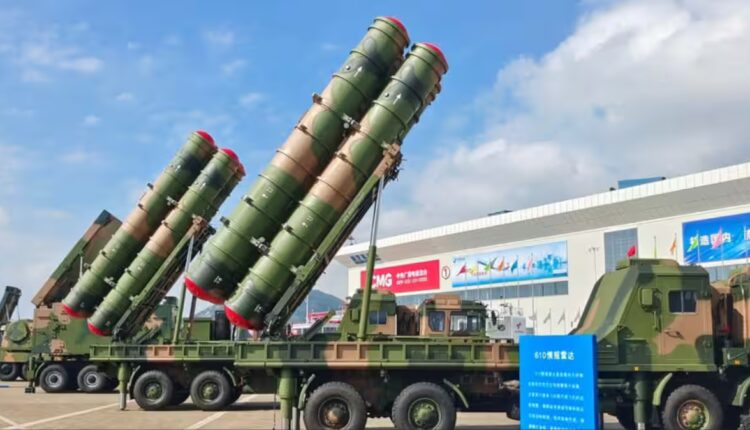
(DEFENCE SECURITY ASIA) — Serbian President Aleksandar Vučić has officially confirmed that Belgrade will acquire China’s HQ-9 long-range surface-to-air missile system, transforming Serbia into the most heavily Chinese-equipped air defence operator in Europe while intensifying strategic scrutiny across NATO’s southeastern flank.
Vučić’s confirmation during a military equipment demonstration at the “Pukovnik-pilot Milenko Pavlović” air base and the Pasuljanske livade training ground ended months of speculation surrounding Serbia’s next-generation integrated air and missile defence architecture.
The announcement immediately elevated Serbia-China defence cooperation from transactional procurement into a broader strategic alignment involving air defence modernization, aerospace integration, military modernisation, and long-term force posture restructuring near the European Union’s eastern security perimeter.

Vučić linked the HQ-9 acquisition with references to “something else” from China while simultaneously discussing incoming French Rafale combat aircraft, additional fighters, and the urgent need to expand Serbia’s pilot training pipeline and operational aviation manpower.
Serbian military analysts interpreted those remarks as a strong indication that Belgrade is evaluating Chinese fighter aircraft, particularly the J-10C or JF-17 Block III, alongside the previously contracted fleet of 12 Dassault Rafale multirole combat aircraft.
The development represents a major geopolitical signal because Serbia is now simultaneously integrating Western combat aircraft, Russian-origin legacy systems, and advanced Chinese strategic air defence technologies into a hybrid military ecosystem unprecedented anywhere in Europe.
Belgrade’s procurement trajectory increasingly reflects a deliberate multi-vector strategic doctrine designed to preserve defence autonomy while reducing overdependence on either Russia or NATO-aligned suppliers following the disruptions created by the Ukraine conflict and sanctions regime.
China’s HQ-9 system, exported under the FD-2000 designation in some variants, is considered Beijing’s premier long-range multirole air defence platform and is widely compared with the Russian S-300 and S-400 strategic deterrence families.
The system’s reported engagement range of approximately 200 kilometres for baseline variants and potentially 250 to 300 kilometres for the improved HQ-9B dramatically expands Serbia’s airspace denial capability against aircraft, cruise missiles, and selected tactical ballistic missile threats.
Military planners across the Balkans are closely monitoring the procurement because the HQ-9 would provide Serbia with one of Europe’s longest-range operational surface-to-air missile networks outside direct NATO command structures.
The acquisition also deepens concerns within Western security circles that China is steadily embedding itself into Europe’s military-technical ecosystem through layered defence partnerships, aerospace industry cooperation, unmanned systems exports, and advanced radar AESA-enabled command networks.
Although Serbian officials continue framing all acquisitions as defensive and transparent, neighbouring states including Croatia and authorities in Kosovo increasingly view Belgrade’s accelerating force projection capabilities as a catalyst for a wider regional military balance recalibration.
HQ-9 Acquisition Creates Serbia’s First True Strategic Air Defence Layer
The HQ-9 acquisition closes a critical long-range capability gap within Serbia’s evolving integrated air defence network after earlier efforts to procure Russian S-300 or S-400 systems reportedly encountered sustained Western political pressure and logistical obstacles.
Serbia’s existing layered structure already includes the Chinese HQ-22 medium-range system, exported as the FK-3, alongside HQ-17A short-range point defence platforms, Russian Pantsir-S1 systems, and modernised Soviet-era S-125 Neva batteries.
The HQ-9 effectively introduces a strategic upper-tier interceptor layer capable of engaging airborne threats at significantly greater distances while enhancing survivability through highly mobile truck-mounted launchers, command vehicles, and distributed radar elements.
Chinese military electronics integrated into the HQ-9 family are widely regarded as increasingly competitive in electronic warfare resilience, radar tracking discrimination, and target management compared with several older Russian export configurations.
Analysts believe the HQ-9B variant would be particularly significant because its extended engagement envelope could theoretically monitor and contest air activity across substantial portions of the western Balkans and adjacent regional air corridors.
The procurement substantially enhances Serbia’s anti-access and area denial potential by complicating hostile air operations while increasing the operational risks facing strike aircraft, stand-off weapons, and suppression-of-enemy-air-defence missions.
The HQ-9 network also strengthens Serbia’s strategic deterrence posture regarding Kosovo by providing deeper airspace protection against high-value aerial threats while increasing command confidence during potential regional crises or escalatory signalling episodes.
Serbia’s earlier acquisition of the HQ-22 system already represented a landmark moment because Belgrade became the first European operator of an advanced Chinese medium-range air defence platform delivered by Chinese Y-20 strategic transport aircraft during 2022.
The arrival of the HQ-9 therefore completes a layered Chinese-dominated system-of-systems warfare architecture integrating long-range interceptors, medium-range coverage, point defence, and mobile battlefield survivability into a unified operational framework.
Western defence observers increasingly interpret the Serbian model as evidence that China can now export sophisticated strategic military ecosystems rather than isolated platforms, thereby competing directly with traditional Russian and Western defence suppliers in contested markets.
Chinese Fighter Jet Speculation Signals Wider Airpower Transformation
Vučić’s references to additional “fighters” and “something else” from China intensified speculation that Serbia may eventually supplement its future Rafale fleet with Chinese combat aircraft designed for cost-effective fleet expansion and strategic diversification.
The Chengdu J-10C has emerged as the most frequently discussed candidate because the platform combines radar AESA capabilities, advanced beyond-visual-range missile integration, and comparatively lower acquisition costs than equivalent Western multirole fighters.
The Pakistan-operated JF-17 Block III also remains a plausible option because it offers modern avionics, Chinese weapons compatibility, and a significantly cheaper logistical footprint suitable for smaller air forces seeking rapid combat aircraft expansion.
Serbia’s current fighter inventory remains centred on modernised Russian-origin MiG-29 aircraft, but the Ukraine war has complicated long-term Russian aerospace support, spare parts availability, and future upgrade pathways for multiple international operators.
Belgrade’s diversification strategy therefore reflects both operational pragmatism and geopolitical calculation as Serbian planners attempt to preserve strategic flexibility amid intensifying rivalry between NATO, Russia, and China across the European security environment.
The integration of Chinese CM-400AKG supersonic or hypersonic air-to-surface missiles onto Serbian MiG-29 fighters during 2026 already demonstrated Belgrade’s willingness to combine Chinese strike systems with legacy Russian airframes.
Vučić previously confirmed that Serbian MiG-29 fighters would field the Mach 6-capable CM-400AKG missile, potentially making Serbia the first European operator of air-launched weapons possessing quasi-hypersonic strike characteristics and extended stand-off engagement capability.
That integration dramatically increases Serbia’s precision strike reach against heavily defended targets while complicating regional air defence planning due to the missile’s high-speed terminal profile and compressed interception timelines.
The future arrival of French Rafale fighters between 2028 and 2029 will further complicate Serbia’s operational ecosystem because Belgrade would simultaneously operate Western aircraft, Russian platforms, and Chinese missile technologies within a single force structure.
Such hybridisation creates significant interoperability and maintenance complexities, but it also reduces vulnerability to political restrictions, export controls, and supplier coercion while maximising Serbia’s procurement leverage across competing global defence blocs.
Military analysts increasingly view Serbia’s evolving procurement strategy as an attempt to construct a sovereign multi-source force model capable of sustaining operational readiness regardless of future geopolitical disruptions or sanctions-driven supply chain fragmentation.
Serbia-China Defence Cooperation Expands Beyond Conventional Procurement
China has steadily emerged as Serbia’s most important non-Western defence partner through successive transfers involving drones, air defence systems, missile technologies, surveillance platforms, and broader military modernisation cooperation.
Belgrade previously acquired Chinese CH-92 and CH-95 unmanned aerial systems, providing Serbia with expanded reconnaissance, battlefield surveillance, and armed drone capabilities aligned with broader trends in network-centric warfare modernization.
The HQ-9 acquisition therefore reinforces a wider strategic pattern in which China positions itself as a politically flexible supplier offering fewer ideological restrictions and more adaptable financing arrangements than many Western competitors.
For Serbia, Chinese systems provide comparatively affordable pathways toward advanced military capability development while avoiding the operational uncertainty generated by dependence on sanctions-exposed Russian supply networks.
The defence partnership also aligns with China’s broader geopolitical objective of expanding its technological and strategic footprint within Europe through infrastructure investment, industrial partnerships, and military-technical cooperation initiatives.
Chinese defence exports to Serbia simultaneously function as strategic signalling because they demonstrate Beijing’s capacity to penetrate regions traditionally dominated by NATO or Russian influence despite intensifying great-power competition.
The Balkans increasingly represent an important geopolitical testing ground where China can showcase integrated defence ecosystems combining drones, air defence networks, electronic warfare systems, and aerospace technologies for potential third-party export customers.
Serbia benefits from that relationship by leveraging competition between global powers to accelerate military modernisation while maintaining diplomatic flexibility regarding European Union integration and regional security policy.
Belgrade’s balancing strategy nevertheless carries operational risks because maintaining compatibility across Chinese, Russian, French, Israeli, and domestic military systems will require extensive integration expertise, training investment, and secure data architecture management.
Despite those challenges, Serbia appears increasingly committed to constructing a diversified strategic deterrence structure designed to maximise independent operational decision-making while avoiding exclusive dependence on any single geopolitical patron.
Regional Security Calculus Shifts Across the Balkans and NATO’s Southern Flank
Serbia’s expanding military capabilities are generating growing concern across southeastern Europe because the combination of long-range air defence systems, hypersonic-capable missiles, and modern combat aircraft substantially alters regional force projection calculations.
Croatia and Kosovo have repeatedly expressed concern regarding accelerating military procurement trends in the Balkans, particularly as unresolved political tensions continue shaping regional strategic perceptions and defence planning priorities.
The HQ-9 acquisition increases Serbia’s ability to contest regional airspace while simultaneously complicating contingency planning for neighbouring militaries operating within or alongside NATO integrated air operations frameworks.
Western security analysts are particularly focused on the implications of a Chinese-built long-range strategic air defence network operating near European Union territory and within proximity to NATO logistical and operational corridors.
The system’s extended detection and engagement range potentially provides Serbia with greater visibility into regional air activity while enhancing survivability against stand-off precision strike operations during potential escalation scenarios.
Military planners also recognise that layered systems integrating HQ-9, HQ-22, Pantsir-S1, and HQ-17A platforms create significantly more resilient defensive architectures than isolated single-tier air defence deployments.
The procurement therefore represents not merely an equipment purchase but a broader transformation of Serbia’s battlespace management capabilities involving command integration, radar networking, and distributed engagement coordination.
Belgrade’s military expansion remains heavily influenced by the strategic legacy of NATO’s 1999 bombing campaign, which continues shaping Serbian political narratives regarding sovereignty, deterrence, and independent defence capability development.
At the same time, Serbia continues publicly supporting European Union accession aspirations while maintaining extensive relationships with both Russia and China, creating a uniquely complex diplomatic and military balancing posture.
The result is an increasingly multipolar Balkan security environment where regional states are simultaneously modernising their militaries, diversifying suppliers, and adapting to intensified geopolitical competition across Europe’s southeastern strategic corridor.
Serbia’s Defence Posture Signals Long-Term Strategic Realignment by 2030
Although Serbian authorities have not disclosed the number of HQ-9 batteries, procurement costs, or delivery timelines, the acquisition clearly forms part of a broader late-2020s military transformation roadmap.
The absence of official financial figures prevents precise assessment of programme scale, but long-range strategic air defence systems typically require extensive investment in radar infrastructure, missile inventories, training, and logistical sustainment networks.
Depending on configuration and battery numbers, the overall programme could potentially involve expenditure reaching several billion Malaysian ringgit, reflecting Serbia’s prioritisation of integrated air defence modernization despite broader fiscal pressures.
Using the approximate conversion rate of USD1 to RM3.8, even a hypothetical US$1 billion procurement framework would represent roughly RM3.8 billion in strategic defence expenditure excluding lifecycle sustainment and future missile replenishment costs.
Serbia’s long-term objective appears centred on establishing a credible deterrence architecture capable of defending national airspace while supporting greater operational autonomy amid Europe’s increasingly fragmented security environment.
The combination of Rafale fighters, potential Chinese combat aircraft, layered missile defence systems, and advanced stand-off strike capabilities would significantly elevate Serbia’s military profile by the end of the decade.
That transformation also reflects wider global trends in which middle powers increasingly pursue diversified military procurement strategies to reduce vulnerability to geopolitical pressure, sanctions exposure, and supply chain disruption.
China’s growing role within Serbia’s defence ecosystem may therefore become a case study for how emerging powers challenge established Western and Russian dominance across international arms markets through integrated capability packages.
For NATO planners, Serbia’s evolving force posture introduces additional complexity into southeastern European security calculations because future regional crises may involve highly networked Chinese-origin air defence and strike systems operating near alliance territory.
The HQ-9 confirmation ultimately demonstrates that the Balkans are no longer merely a peripheral European security issue but an increasingly important arena where Chinese military technology, strategic deterrence competition, and geopolitical influence intersect directly with NATO’s regional defence architecture.

Croatia and “Kosovo” ?!
You forget that the so called “Kosovo” (Kosovo and Metohija / Kosmet) IS (still) an Autonomous Province within the Republic of Serbia. It’s NOT a country (and will never be country without major war OR if people in Serbia decide to grant them independence). UN1244 resolution and KFOR mission are still VERY MUCH active and directly prevent major escalations since Serbia would almost certainly react with force to the extremely irresponsible behavior of the ethnic Albanian (it’s ethnic Albanian “government” make no mistake there, they DO NOT represent Serbs in Kosovo even in the slightest, in fact they created a defacto apartheid in the middle of Europe with constant harrasement and intimidation campaings to expel the remaining Serbs from Kosovo) administration.
The fact is that the “Kosovo question” is nothing more then a FROZEN CONFLICT.
War waiting to re-start where things WILL be decided permanently.. just by military force (since ethnic Albanian side does not care about compromises, for them “Kosova/Kosovë” (as they call Kosovo) is an “independent” “country” and they are activelly working on expelling (or creating conditions so they leave themselves) the remaining ethnic non Albanians from Kosovo and eventually join with Albania defacto acomplishing their ultranationalistic “Great Albania” project (with areas within N.Macedonia, Greece and Montenegro being the next “goal”).
West (led by the US) has behave EXTREMELLY irresponsible by dealign with this issue and created for the world and themselves 10x more problems then they “solved” (or think they did).
Not to mention that both Serbia/Serbs and Albania/Albanians will outlast any international organization such as NATO/EU by A LOT and that the big questions will eventually be resolved, as always in such situations in history, by violence and military force.
As far as Croatia, i also have to say (as half ethnic Croat/half German) that i absolutely do not support their stance on this issue and that i think they just contribute to the destabilization of the region (by supporting ethnic Albanian separatists in Serbia) and that nothing good with come from it. I get why they are doing it but i do not support it, however “painful” the past century was between Serbs and Croats.