
F-35 Becomes America’s “Flying Sensor,” Linking Space Warning, THAAD and NGI Against Ballistic and Hypersonic Missile Threats
Lockheed Martin’s networked missile-defence architecture would connect F-35 sensors with OPIR satellites, C2BMC, THAAD, PAC-3 MSE, Aegis and the Next Generation Interceptor, potentially reshaping how America and its allies confront ballistic, cruise and hypersonic missile attacks.

(DEFENCE SECURITY ASIA) — Lockheed Martin has positioned the F-35 Lightning II as a forward airborne tracking and targeting node within America’s layered missile-defence architecture, potentially transforming thousands of stealth fighters into mobile sensors against ballistic, cruise and emerging hypersonic threats.
The concept, outlined in August 2026, connects space-based missile warning, forward F-35 sensor coverage, global command-and-control networks and multiple interceptor families, compressing the sensor-to-shooter timeline during attacks in which every second determines whether an engagement succeeds.
Rather than requiring the F-35 to destroy an incoming missile directly, the architecture exploits its stealth, mobility and sensor fusion to generate precise tracking information for THAAD, Next Generation Interceptor, PAC-3 MSE or Aegis-equipped forces positioned elsewhere.

Overhead Persistent Infrared satellites would initially detect a missile’s intense launch plume, after which forward-positioned F-35s could refine the preliminary trajectory using passive infrared sensors, electro-optical systems and, when tactically acceptable, their powerful active electronically scanned array radars.
Those measurements would flow into Command and Control, Battle Management and Communications, or C2BMC, which correlates geographically separated observations, eliminates duplicated tracks, prioritises threats and distributes engagement-quality information across a network spanning more than 30 locations and 18 time zones.
This architecture addresses a fundamental missile-defence problem because satellites provide indispensable early warning, yet Earth curvature, terrain masking, manoeuvring targets, decoys and sensor geometry can create uncertainty precisely when commanders require accurate predictions concerning an incoming weapon’s trajectory.
An F-35 operating closer to the threat could observe the missile from a different angle, improving track continuity and reducing positional uncertainty while preserving the aircraft’s survivability through low observability, passive detection and rapid repositioning across an evolving battlespace.
The resulting network could support launch-on-remote or engage-on-remote operations, allowing an interceptor battery to begin an engagement using information produced by distant sensors before its organic radar independently establishes the complete track required under traditional defensive arrangements.
Lockheed Martin describes the approach as an evolution from platform-centred warfare towards architecture-centred defence, where satellites, stealth fighters, command networks, ground radars and interceptors generate greater operational value collectively than their individual specifications would suggest in isolation.
However, the August 2026 proposition remains a high-level architectural vision because publicly available information does not disclose operational latency, classified interface standards, track-transfer reliability, cyber-security safeguards or performance against sophisticated manoeuvring hypersonic weapons and coordinated electronic attack.
Integrating F-35 operations with strategic missile defence would also affect force posture and logistics, potentially requiring aircraft, gateways, secure communications, maintainers and aerial refuelling support to remain forward deployed during crises rather than concentrating exclusively upon conventional strike missions.
If technically and operationally validated, the flying-sensor concept could expand America’s missile-warning geometry without building an entirely separate airborne fleet, while signalling that allied F-35 deployments may increasingly reinforce a wider transregional missile-defence network extending beyond national airspace.
From Space-Based Warning to a Continuous Missile Track
The engagement sequence begins with OPIR satellites continuously scanning for infrared signatures associated with missile launches, providing an approximate launch point, an initial trajectory estimate and the earliest warning available to commanders responsible for regional or homeland defence.
Although space-based sensors deliver broad strategic coverage, their observations may not independently provide uninterrupted precision throughout boost, coast, manoeuvre and re-entry phases, particularly when sophisticated weapons alter trajectory or deploy penetration aids intended to complicate discrimination.
C2BMC receives those initial observations and injects them into the wider Missile Defense System, enabling other sensors to search designated volumes of airspace instead of independently attempting to discover an already fast-moving target across an enormous surveillance area.
Forward F-35s would then use the satellite cue to orient onboard sensors towards the predicted trajectory, combining observations from different ranges and viewing angles to improve estimates of position, velocity, direction, uncertainty and probable impact area.
This multi-perspective approach matters because missile defence depends not merely upon detecting an object, but upon maintaining a sufficiently precise and persistent track to distinguish the threatening payload, calculate an intercept point and allocate a limited interceptor inventory.
F-35 mobility could strengthen coverage over oceans, mountainous terrain and expeditionary theatres where permanent radars remain politically unavailable, geographically constrained or vulnerable to pre-emptive attack, creating a repositionable sensor layer between orbital warning systems and surface-based defences.
Aircraft could also disperse across multiple operating locations, complicating an adversary’s attempt to disable the entire tracking architecture through attacks against several known radar sites, although dispersed operations would demand resilient fuel, maintenance, munitions and communications support.
The networked sequence therefore converts a momentary launch warning into a continuously refined track, with each participating sensor contributing different advantages rather than expecting one expensive platform to maintain perfect awareness throughout every stage of a complex engagement.
Against multi-axis raids, C2BMC could correlate observations from satellites, aircraft, ships and ground radars, helping commanders determine whether separate detections represent distinct missiles, detached booster components, decoys or duplicated reports concerning the same incoming weapon.
The architecture’s decisive test will remain whether this fused information reaches defensive units quickly and accurately enough under wartime congestion, jamming, cyberattack and physical attrition, rather than only during controlled demonstrations with predetermined flight paths and prepared communications.
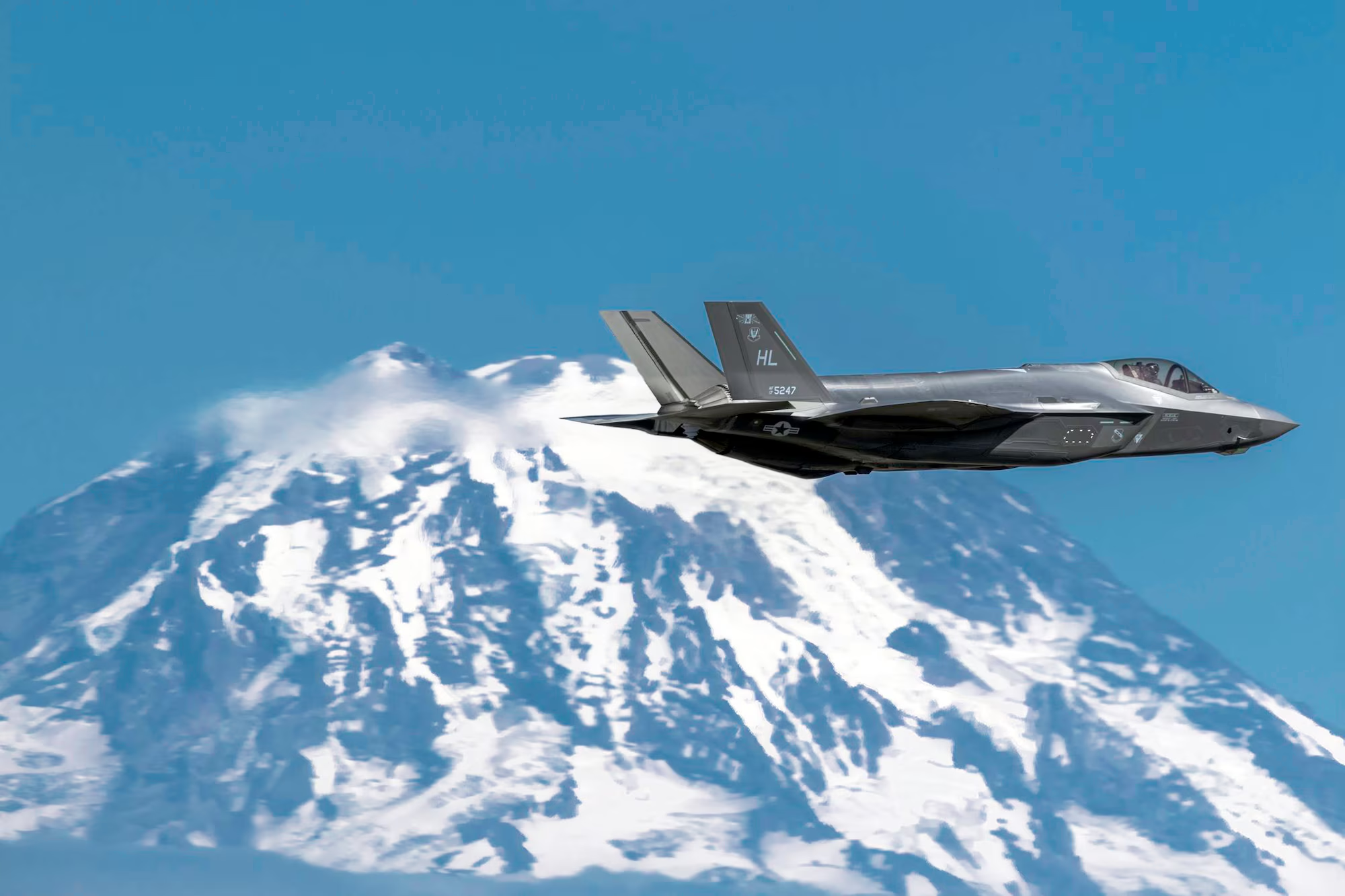
How F-35 Sensors Create an Airborne Tracking Node
The F-35’s AN/AAQ-37 Distributed Aperture System employs six mid-wave infrared sensors around the airframe, producing spherical coverage that can detect missile plumes and track multiple objects without requiring the pilot to manually point an individual sensor.
Earlier demonstrations indicated that DAS could follow ballistic missiles and rockets at distances exceeding 800 nautical miles, approximately 1,300 kilometres, although those results should not automatically be interpreted as guaranteed performance against every target, weather condition or operational environment.
Because DAS operates passively, an F-35 can observe infrared signatures without broadcasting radar energy that might reveal its location, preserving low observability while maintaining surveillance during missions near defended airspace or contested missile-launch regions.
The AN/AAQ-40 Electro-Optical Targeting System complements that broad coverage by providing higher-resolution infrared and electro-optical imagery, enabling more precise observation after DAS, space-based sensors or another network participant has established the target’s general location.
EOTS combines forward-looking infrared, infrared search-and-track functionality, laser ranging and target designation inside a stealth-compatible installation, allowing the aircraft to refine identification and tracking while avoiding the aerodynamic and radar-signature penalties associated with conventional external targeting pods.
The AN/APG-81 active electronically scanned array radar can contribute weapons-quality tracking and all-weather precision, but commanders must balance that performance against the possibility that active emissions could expose the stealth fighter to hostile electronic-support measures and long-range air defences.
Later F-35 configurations are expected to incorporate the more powerful AN/APG-85, yet public information indicates that its integration has encountered power and cooling challenges, illustrating how additional sensor performance can impose substantial engineering, reliability and logistics consequences.
Sensor-fusion software combines DAS, EOTS, radar, electronic-warfare and external observations into one track containing position, velocity, identification history and uncertainty data, preventing pilots and commanders from manually reconciling multiple potentially inconsistent displays during time-critical missile engagements.
Passive infrared technologies associated with IRST21 further illustrate the underlying operational principle, although equivalent F-35 functions primarily reside within its integrated sensor suite rather than requiring the aircraft to carry the externally mounted system used by other fighter types.
Collectively, these capabilities allow each deployed F-35 to function as more than a combat aircraft, turning its routine presence into an elevated intelligence, surveillance and reconnaissance asset capable of strengthening missile defence without relinquishing conventional air-superiority or strike responsibilities.
MADL, Gateways and C2BMC Form the Digital Kill Chain
Within F-35 formations, the Multifunction Advanced Data Link provides directional, high-bandwidth and low-probability-of-intercept communications, enabling stealth aircraft to exchange detailed fusion-quality tracks while reducing the electronic signature produced by less discreet omnidirectional tactical transmissions.
Moving that information beyond the F-35 community is more complicated because external missile-defence systems may use different data standards, security domains and communication pathways, requiring ground stations, adaptation kits, airborne relays or open-systems gateways to translate and distribute tracks.
Demonstrations conducted during 2019 and 2020 showed F-35 observations feeding the United States Army’s Integrated Air and Missile Defense Battle Command System, including a live-fire event in which elevated sensor data supported detection, tracking and interception of air-breathing threats.
Those demonstrations established an important technical precedent, but transferring information into IBCS does not conclusively prove seamless wartime integration with every C2BMC configuration, interceptor battery, allied network or classified interface envisioned within the broader August 2026 architecture.
C2BMC has operated since 2004 and connects more than 30 locations across 18 time zones, providing the central mechanism for correlating geographically dispersed tracks, producing a coherent operational picture and distributing engagement recommendations to commanders and weapon systems.
The system also supports interceptor-inventory management, an increasingly critical function because high-end defensive missiles are expensive, production capacity is finite and firing multiple interceptors against uncertain tracks can rapidly exhaust magazines during prolonged or concentrated attacks.
Better tracking could reduce unnecessary expenditure by allowing commanders to identify which objects threaten defended assets, although engagement doctrine may still demand multiple interceptors against particularly dangerous warheads when uncertainty, countermeasures or consequences of leakage remain unacceptable.
Planned C2BMC-Next enhancements include additional sensor feeds, improved cruise-missile and hypersonic tracking, and artificial-intelligence assistance, but automation would require strict validation because incorrect correlations or prioritisation could accelerate flawed engagement decisions across an interconnected defensive network.
Cyber resilience therefore becomes as important as aerodynamic or interceptor performance, since an adversary unable to defeat THAAD kinetically might instead attempt to corrupt sensor data, disrupt gateways, overload communications or create convincing false tracks inside the command architecture.
The entire concept consequently depends upon preserving trusted, low-latency connectivity from space to aircraft and from aircraft to commanders, making communications infrastructure, encryption, software assurance and gateway availability central elements of missile-defence force posture rather than administrative supporting functions.
THAAD, NGI and Other Interceptors Gain Remote Eyes
Once C2BMC establishes a refined track and engagement solution, THAAD could confront regional ballistic missiles during their terminal high-altitude phase, using hit-to-kill interceptors whose success depends upon precise predictions concerning the target’s location and movement.
For longer-range threats directed against the American homeland, the Next Generation Interceptor is intended to strengthen Ground-based Midcourse Defense, confronting warheads during midcourse flight when discrimination among payloads, decoys and associated objects becomes an especially demanding technical requirement.
The architecture could also incorporate PAC-3 MSE and Aegis Standard Missile interceptors when geography, target trajectory and available force posture make those systems appropriate, producing layered coverage rather than assigning every threat to one interceptor family or engagement phase.
Launch-on-remote would permit a defensive unit to fire using data supplied by an external sensor before its own radar acquires the target, thereby enlarging the available engagement window and potentially creating additional opportunities if the first interception attempt fails.
Engage-on-remote demands even greater confidence because the interceptor may depend substantially upon off-board observations throughout the engagement, making track accuracy, network latency and secure communications inseparable from the missile’s propulsion, seeker and manoeuvring performance.
An F-35 positioned beyond the horizon of a surface battery could extend that battery’s effective awareness, particularly against low-flying cruise missiles exploiting terrain and Earth curvature, although detecting such targets differs considerably from observing bright ballistic-missile launch plumes.
Hypersonic weapons present a more difficult proposition because their speed, manoeuvrability and potentially unpredictable flight paths compress reaction time while challenging sensors and engagement algorithms, so references to future applicability should be treated as an objective rather than demonstrated certainty.
Distributed airborne observations could nevertheless complicate adversary planning by reducing predictable radar blind spots, forcing attackers to account for mobile sensors whose positions can change rapidly across land and maritime theatres before or during a developing confrontation.
The arrangement also allows F-35s to enable engagements by other shooters while retaining their own weapons for air combat or strike missions, increasing joint-force efficiency but potentially exposing pilots to additional task saturation during already complex combat operations.
Interceptor effectiveness would therefore emerge from the entire kill chain rather than the missile alone, because exceptional kinematic performance cannot compensate for delayed warning, mistaken identification, broken communications, inaccurate tracking or exhausted magazines during a coordinated saturation attack.
Strategic Reach, Logistics Burden and Allied Implications
Turning the global F-35 fleet into a missile-defence sensor layer could create substantial geographic reach because aircraft already operate across North America, Europe and the Indo-Pacific, placing compatible airborne sensing capacity near several probable missile-threat corridors and contested regions.
For Indo-Pacific commanders, forward F-35 deployments could supplement fixed radars across immense maritime distances, providing flexible coverage around island chains and expeditionary bases that face ballistic, cruise and potentially hypersonic attacks from several directions simultaneously.
European operators could similarly contribute to NATO missile awareness, although sharing detailed tracks across national networks would raise questions concerning data sovereignty, release authorities, classified interfaces and whether every partner receives identical access to sensitive missile-defence information.
The concept therefore carries geopolitical significance beyond American force protection because allied F-35 purchases may gradually connect national fighter fleets to a United States-led defensive architecture, deepening interoperability while potentially increasing strategic dependence upon American software, gateways and command networks.
Forward sensing also creates a demanding logistics footprint, requiring mission-capable aircraft, trained pilots, specialised maintainers, spare parts, secure facilities, fuel, aerial tankers and protected communication links to remain available throughout periods of heightened missile warning.
Dispersed operations could improve survivability, but maintaining advanced stealth fighters across multiple austere locations imposes greater maintenance and supply complexity, especially when adversary attacks threaten runways, fuel storage, electrical power, repair equipment and transport connections simultaneously.
Commanders must additionally decide whether scarce F-35 sorties should support missile tracking, offensive counter-air, defensive counter-air or deep strike, because describing the aircraft as a multifunction node does not eliminate finite flying hours, maintenance capacity or crew endurance.
Potential adversaries may respond by targeting gateways, tankers and forward airfields, employing decoys to consume sensor capacity, or creating electronic and cyber interference designed to separate the airborne layer from C2BMC and its assigned interceptor batteries.
The architecture nonetheless represents powerful strategic signalling, demonstrating that American missile defence is evolving from isolated batteries towards a distributed multi-domain network capable of combining existing assets, complicating attack planning and improving resilience without awaiting an entirely new sensor fleet.
Its ultimate military value will depend upon rigorous operational testing under realistic electronic warfare, cyberattack, saturation and attrition conditions, because only resilient performance across that full environment can convert the F-35 flying-sensor vision into a dependable global missile-defence capability.
