
China’s USS Gerald R.Ford-Sized Type 004 Carrier Takes Shape as Naval Ambitions Expand
Satellite imagery indicates a Ford-sized carrier under construction at Dalian, with possible nuclear propulsion and replenishment capacity central to China’s future naval reach.

(DEFENCE SECURITY ASIA) — China’s fourth aircraft carrier is taking shape at Dalian Shipyard with a hull approaching American Ford-class dimensions, signalling an industrial push towards larger carrier groups whose strategic reach will depend as much on replenishment capacity as flight-deck size.
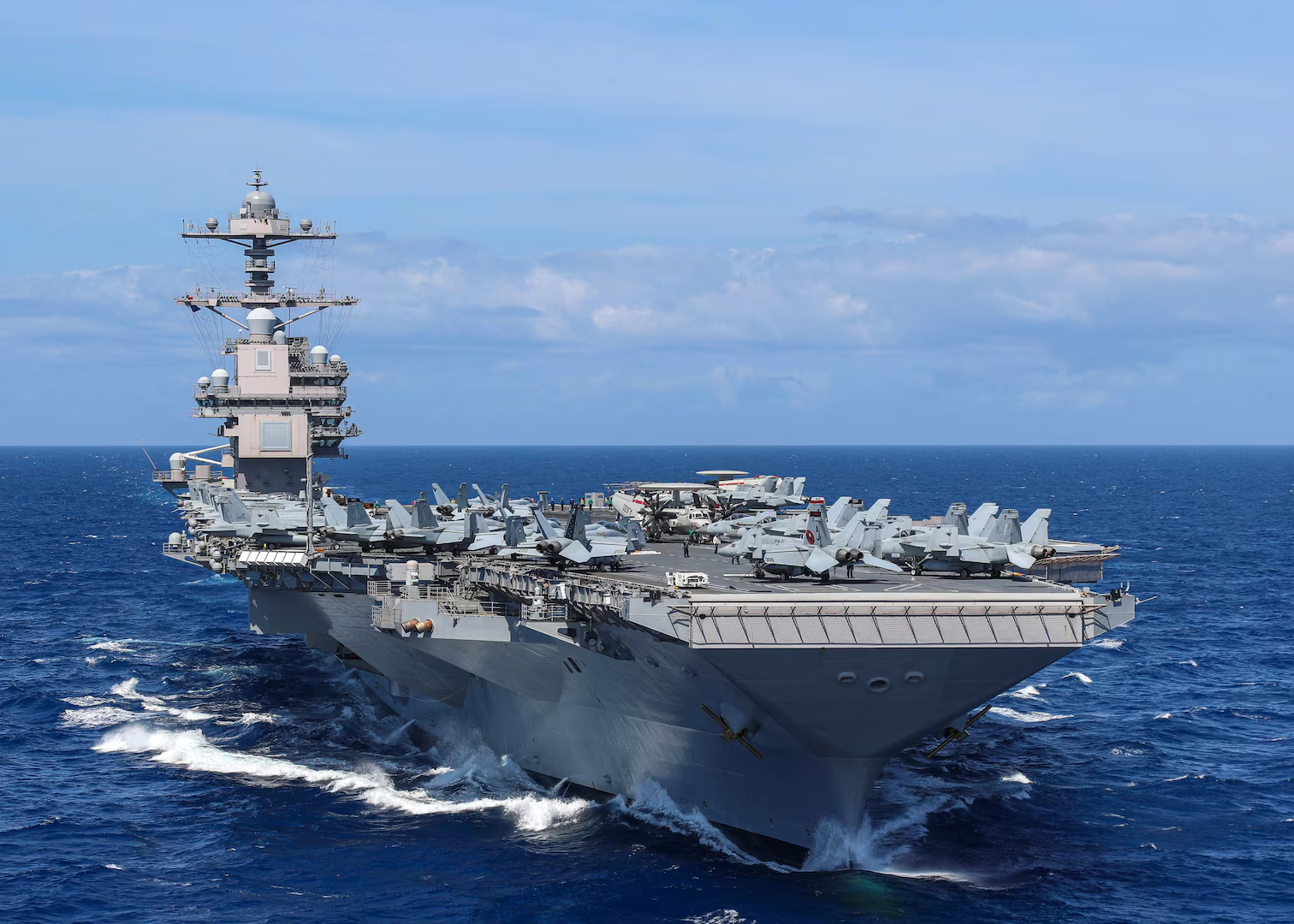
Satellite imagery dated September 4, 2026, indicates construction of the unnamed vessel’s bulbous bow, supporting an estimated completed length of 336–339 metres and placing the emerging Chinese aircraft carrier within the same size category as USS Gerald R. Ford.
That comparison carries geopolitical significance because a larger hull could accommodate additional aircraft, aviation fuel and weapons, but incomplete construction prevents reliable conclusions about displacement, combat effectiveness or whether the ship will ultimately exceed the American carrier’s dimensions.
The designation Type 004 remains an analytical label rather than an official identity, while Beijing has disclosed neither propulsion arrangements nor final specifications, leaving the consequential claims about this prospective supercarrier dependent on interpretation of construction features.
Former United States Navy submariner description of nuclear propulsion as “extremely likely” captures the strength of one imagery-based assessment, although an assessment of reactor-like compartments cannot substitute for official confirmation or observation of the propulsion installation.

If that interpretation proves correct, China would acquire its first nuclear-powered surface warship, removing the carrier’s propulsion-fuel constraint while potentially creating additional capacity for aviation support, without removing the replenishment requirements of its aircraft or accompanying escorts.
The emerging hull therefore matters beyond a comparison of national shipbuilding achievements, because sustained carrier operations require a connected system of launch machinery, aircraft, escorts, maintenance and supply ships capable of preserving combat availability at distance from home.
Construction of a larger fast combat-support ship near Guangzhou strengthens the logistics dimension of that assessment, suggesting that Beijing is addressing the supply burden associated with future carrier battle groups rather than expanding flight-deck capacity in isolation.
China’s existing carrier progression already spans the ski-jump-equipped Liaoning and Shandong to the electromagnetic-catapult-equipped Fujian, but adding another hull would expand force-structure options only after fitting-out, trials, aviation integration and training produce a deployable naval formation.
The supplied air-wing projections of 75–90 aircraft would represent a significant increase over Fujian’s estimated 50–60, potentially expanding the balance between strike aircraft, airborne early warning and support assets, although neither figure establishes deployed strength or sortie generation.
DSA’s assessment is that the carrier and support-ship programmes together suggest preparation for more persistent operations beyond China’s near seas, while their condition leaves deployment geography, fleet assignment and the timing of operational readiness unresolved for military planners.
For Indo-Pacific security observers, the immediate development is an expanding industrial foundation for future naval power projection, rather than an available change in combat balance, with logistics endurance and air-wing maturity determining how effectively that foundation becomes operational influence.
(CLICK): China’s Type 004 Nuclear Supercarrier Takes Shape, Challenging US Naval Power
Ford-Class Dimensions: What Dalian’s Carrier Hull Actually Reveals
The September imagery places the bow under construction within a broader sequence that began with prefabricated modules in early 2025 and keel blocks by midyear, indicating a sustained assembly effort whose strategic importance rests on converting industrial throughput into fleet capacity.
By May–August 2026, the hull had become recognisable as a carrier, while subsequent observations of sponson installation suggest progression towards flight-deck structures, although these milestones reveal construction status more reliably than they reveal the vessel’s combat configuration.
The projected 336–339-metre length comes from measuring between the existing stern and anticipated bow tip, making it sensitive to unfinished geometry and illustrating why satellite imagery can establish approximate scale without providing the precision of shipyard specifications.
A 333-metre figure used in the supplied comparison differs from the approximately 337-metre overall length associated with American measurements, so describing the Chinese vessel as Ford-sized is more defensible than declaring it longer than the American carrier.
Length alone also cannot establish displacement, because beam, hull depth, internal arrangement and the completed flight-deck structure influence the ship’s volume and loading, leaving circulating estimates of 110,000–120,000 tonnes unsupported by any official specification in the supplied material.
Compared with Fujian’s approximately 316-metre hull, the projected increase of around 20 metres suggests design space, but the operational value of that space depends on how it is allocated among aircraft handling, machinery, aviation stores and support.
Incomplete bow sections, flight-deck overhangs, island structures and catapult installations prevent a definitive reconstruction of the arrangement, meaning size advantages should be treated as design potential until the configuration needed to conduct sustained flight operations becomes visible.
A larger hangar and additional aviation storage could support a broader embarked force, yet those benefits remain conditional on aircraft elevators, maintenance access and deck circulation working together, since physical accommodation does not automatically translate into efficient launch and recovery cycles.
Open-source timelines in the supplied material place launch no earlier than 2027 and commissioning around 2030, providing a planning horizon rather than a schedule, with fitting-out and trials separating structural completion from acceptance into naval service and operational maturity.
For competing navies, Dalian’s progress provides warning of future capacity rather than proof of present superiority, allowing force planners to distinguish a measurable construction programme from unresolved questions about reliability, availability and the effectiveness of the eventual carrier group.
(CLICK): China’s Type 004 Nuclear Supercarrier Breakthrough: CSIS Satellite Imagery Reveals PLAN’s First Nuclear Aircraft Carrier Threatening Indo-Pacific Naval Balance
Nuclear Propulsion: Greater Endurance, Unresolved Technical Evidence
The strongest indication of nuclear propulsion is the appearance of two midships compartments measuring approximately 15 by 15 metres, with multilayered construction interpreted as consistent with reactor shielding, a potentially transformative arrangement whose purpose remains officially unconfirmed.
Those structures support the reactor-space interpretation because their location and construction are compatible with the propulsion concept, but imagery does not establish reactor performance, plant integration or the maintenance procedures that would govern the availability of a nuclear-powered carrier.
The nuclear-propulsion assessment should therefore be understood as confidence in a technical interpretation, while the absence of a Chinese propulsion announcement preserves an essential distinction between strong circumstantial evidence and a verified change in the navy’s surface-fleet architecture.
If installed, nuclear propulsion would remove the need to replenish the carrier’s bunker fuel during deployments, potentially allowing commanders greater flexibility in organising sustained movements, although aviation activity would continue to draw down jet fuel and weapons independently of propulsion endurance.
Internal space otherwise devoted to propulsion fuel could potentially support aviation fuel, ammunition or additional equipment, increasing the ship’s ability to sustain its embarked aircraft, but the supplied evidence does not quantify those gains or establish how designers have distributed the volume.
A nuclear-powered aircraft carrier would still operate within a conventionally fuelled support network, because escorts require fuel and stores, making the endurance of the complete formation dependent on replenishment schedules rather than the propulsion characteristics of its largest ship.
That distinction matters operationally because a carrier able to remain underway for longer may still need to reduce aviation activity when supplies diminish, meaning nuclear endurance cannot be treated as unlimited combat persistence or independence from a logistics chain.
The transition also introduces an unproven surface-warship operating model for China, since the supplied material identifies this vessel as its possible first nuclear-powered surface combatant without establishing the supporting maintenance arrangements or infrastructure that would sustain fleet service.
There is likewise no disclosed performance basis for assuming that nuclear power guarantees a maximum speed, catapult output or sortie rate, because propulsion choice, electrical architecture and aviation-system reliability interact through design details that remain absent from the public description.
Strategically, the propulsion question is consequential because it could widen the carrier’s deployment flexibility, but a sound assessment must connect that possibility to escort endurance, aviation consumption and support capacity before drawing conclusions about Chinese naval presence across distant maritime regions.
(CLICK): China’s 120,000-Ton Type 004 Nuclear Supercarrier Could Eclipse America’s Ford-Class and Redraw Indo-Pacific Naval Power
J-35, KJ-600 and EMALS: Air-Wing Potential Versus Combat Output
Fujian provides the clearest reference point for China’s next carrier because its electromagnetic catapults have launched J-15T, J-35 and KJ-600 aircraft during trials, demonstrating an aviation-development pathway while leaving the maturity of its carrier strike group unresolved.
Unlike the ski-jump-equipped Liaoning, commissioned in 2012, and Shandong, commissioned in 2019, Fujian introduces catapult-assisted take-off and arrested recovery, making the development of launch systems and compatible aircraft central to the structure of Chinese naval aviation capabilities at sea.
Commissioned on November 5, 2025, Fujian is conventionally powered and generally estimated above 80,000 tonnes, but its status as China’s most advanced carrier does not establish that its aviation systems, embarked force and accompanying ships already function as a mature operational formation.
The projected Type 004 air wing of 75–90 aircraft, compared with approximately 50–60 for Fujian and about 75 or more for a typical Ford-class load, suggests greater accommodation potential without proving equivalent aircraft readiness, availability or sustained combat output.
A prospective combination of J-35 stealth fighters, J-15T and J-15D variants, KJ-600 airborne early warning aircraft, Z-20 helicopters and drones would broaden mission options, although the composition remains a projection rather than a procurement or embarked-force plan for the carrier.
In DSA’s assessment, combining fighters with airborne early warning would matter because strike and defensive operations depend on detecting threats and coordinating aircraft, while the number of supporting platforms could influence how continuously those functions accompany combat missions at sea.
The expectation of electromagnetic aircraft launch systems, potentially with four catapults, suggests an effort to expand aviation throughput, but neither catapult numbers nor the launch arrangement have been officially disclosed, preventing a firm comparison with American flight-deck performance.
More aircraft could allow commanders to allocate additional capacity between defensive patrols, strike missions and support tasks, yet the military effect would depend on maintenance availability, crew proficiency and replenished stores rather than the size of the air wing alone.
A larger embarked force would also consume more aviation fuel and ammunition when used intensively, linking any increase in persistence to the support-ship programme and making logistics planning inseparable from assessments of the carrier’s potential contribution to force posture.
For military planners evaluating countermeasures, the future comparison concerns supported aviation output and surveillance coverage rather than hull dimensions, because the supplied evidence establishes a platform expansion while leaving the operational performance needed to measure its combat effect unknown.
China’s Replenishment Expansion: The Logistics Footprint Behind Carrier Reach
Satellite imagery from mid-2026 shows a new fast combat-support ship at the COMEC Longxue shipyard near Guangzhou, approximately 271 metres long and 37 metres in beam, indicating a replenishment platform that could support the demands of expanded carrier formations.
The vessel is assessed as a stretched Type 901 variant and substantially larger than existing ships of that class, suggesting additional support capacity, although the supplied material does not establish cargo volumes, transfer rates or the arrangement of replenishment equipment.
Its launch around July 9–12, 2026, places support-fleet development alongside carrier construction, an industrial sequence that matters because launching a larger aviation platform without supply capacity would leave its operating potential constrained by fuel, ammunition and stores availability.
These support ships are expected to carry aviation fuel, ammunition, dry stores and provisions, while helicopter facilities would support vertical replenishment, giving a carrier group mechanisms to receive supplies without making every replenishment event dependent on returning to port.
For a future nuclear-powered carrier, that capability would remain indispensable because aircraft consumption and escort requirements persist, making the support ship a central component of sustained force posture even if the carrier itself no longer needs conventional propulsion fuel replenishment at sea.
Imagery dated September 15 has been interpreted as showing the start of a second hull of the same design, but that assessment remains unverified and cannot yet support a conclusion about production scale or the number of available replenishment vessels.
China lacks an American-style worldwide network of overseas bases, making underway replenishment important for deployments far from home, where the carrier group’s operating duration would depend on moving consumable supplies across increasing distances and maintaining a workable support cycle.
Larger supply ships could reduce some capacity constraints by transporting more stores per voyage, but size alone does not establish fleet coverage, because sustained operations also require replenishment vessels to move between loading points, maintenance periods and deployed naval formations.
From a force-protection perspective, dependence on at-sea supply creates a vulnerability because disruption of replenishment could constrain aircraft activity and escort endurance, making the ability to protect and replace logistics support relevant to any assessment of distant carrier operations.
The Guangzhou programme consequently offers a more concrete indication of preparations for sustained reach than propulsion speculation alone, although its strategic significance remains conditional on ships, available cargo capacity and demonstrated integration with the carrier groups they are expected to support.
Beyond the Second Island Chain: Force Posture and Strategic Signalling
The combination of a larger hull, possible nuclear propulsion and expanded replenishment capacity supports an interpretation of increasing interest in sustained operations towards the second island chain and beyond, but no disclosed Chinese announcement establishes a deployment doctrine for this vessel.
A carrier group able to remain farther from home for longer periods could expand the locations where naval aviation is available, potentially influencing regional planning through persistent presence, while the extent of that influence would depend on air-wing readiness and logistical support.
For the United States Navy and regional defence planners, the prospective capability creates a future force-posture consideration rather than a deployment emergency, because construction evidence does not establish where the ship will be assigned or when its carrier group will become operational.
The unresolved homeport and fleet assignment matter because basing would shape transit distances, maintenance access and support requirements, making geographic deployment assumptions premature even when the visible shipbuilding programme supports a broader assessment of expanding Chinese maritime ambition and industrial capacity.
Likewise, an additional carrier could create more options for scheduling training, maintenance and deployments across the fleet, but the supplied information cannot establish a continuous multi-carrier presence or determine how many prepared carrier groups China will be able to sustain simultaneously.
The industrial speed visible at Dalian signals the capacity to assemble large naval structures, while the operational test will be whether propulsion systems, electromagnetic catapults, aircraft and replenishment ships can function reliably together through the cycles required for sustained deployments at distance.
Comparisons with Ford-class carriers therefore have analytical value when they describe design scale and accommodation, but they become misleading if treated as proof of equivalent combat experience, aviation output or global support infrastructure, none of which is demonstrated by hull imagery.
No confirmed radar suite, sensor architecture, elevator count or final air-wing composition is available, limiting assessments of defensive coverage and aircraft handling and requiring analysts to avoid assigning precise combat roles to systems whose installation and performance have not been established.
The milestones will extend beyond launch to propulsion confirmation, completed aviation systems, sea trials and carrier-group integration, because each would resolve a specific uncertainty about whether the construction programme can deliver the sustained naval capability implied by its scale.
DSA’s central assessment is that China is building the industrial and logistical foundations for larger, potentially longer-ranging carrier groups, with the geopolitical effect determined by deployable aviation power and sustained support rather than an unverified claim to the world’s largest warship.
