
IRIFI: France Unveils 2,000-km Strike Drone Designed to Navigate Without GPS
Harmattan AI’s autonomous one-way strike drone links satellite-independent navigation with Morocco’s defence industrial ambitions, although its advertised full-range performance remains unverified publicly.

(DEFENCE SECURITY ASIA) — France’s Harmattan AI has unveiled IRIFI, an autonomous one-way strike drone advertised with a range approaching 2,000 kilometres, positioning satellite-independent navigation as the mechanism intended to preserve long-range attack capability when electronic warfare disrupts conventional positioning and communications.
Announced recently, the system enters a strategically consequential category of weapons that could extend conventional strike reach while reducing dependence on continuous remote control, although its advertised performance remains unsupported by publicly disclosed full-range testing.
Its emergence also carries an industrial dimension, with Morocco signing a development letter of intent that connects autonomous deep-strike ambitions with domestic defence manufacturing, potentially expanding national military options while leaving procurement quantities, delivery schedules and operational readiness unresolved.
The central military proposition concerns mission continuity rather than range alone, because a drone capable of travelling substantial distances still requires reliable navigation, target identification and terminal guidance before geographical reach becomes a credible instrument of conventional deterrence.
Harmattan AI chief executive and co-founder Mouad M’Ghari framed IRIFI as an attempt to reconcile the manufacturing scalability of Shahed-type attack drones with the precision and survivability associated with sophisticated cruise missiles, presenting an ambition that remains to be demonstrated.
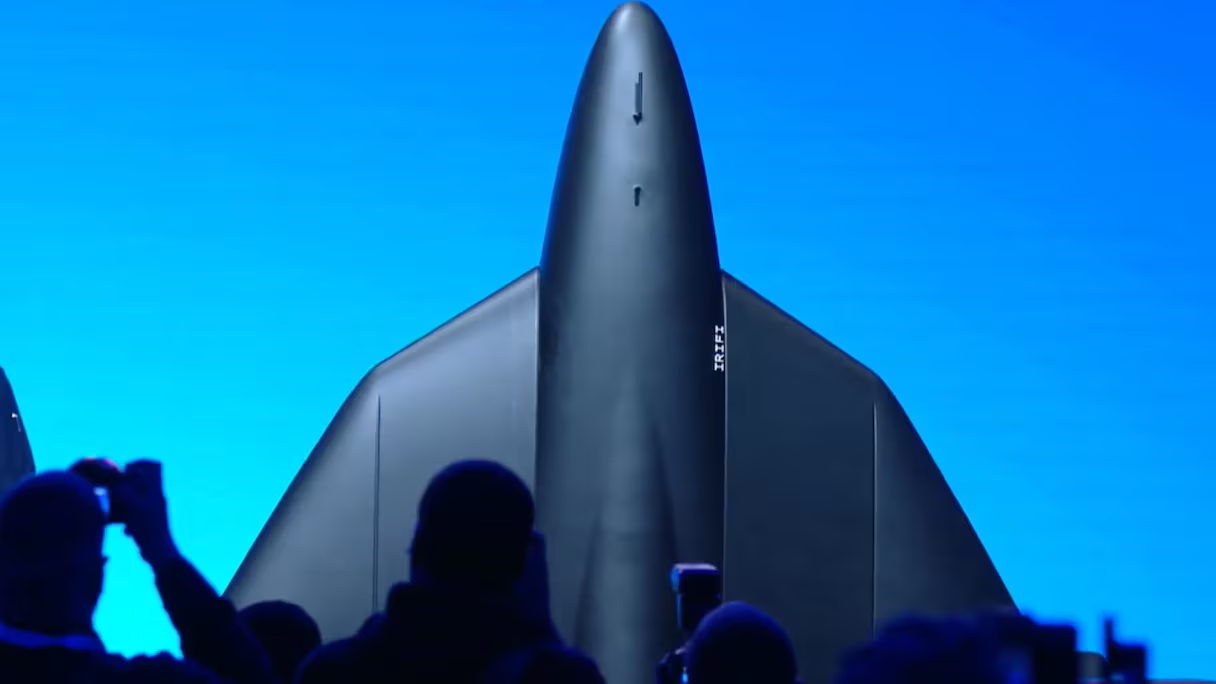
That comparison should be understood as commercial positioning rather than established technical equivalence, since IRIFI’s undisclosed payload, unannounced cruise speed and unavailable survivability measurements prevent meaningful confirmation that it reproduces the operational advantages attributed to those different weapon categories.
The published architecture combines mobile containerised deployment, onboard processing and autonomous execution within human-approved parameters, creating a proposed force package whose effectiveness would depend on the interaction between launch dispersal, intelligence preparation, navigation reliability and terminal target discrimination.
For military planners, the relevant uncertainty is whether this combination can sustain useful accuracy across contested airspace at an affordable production scale, rather than whether an advertised maximum range alone permits distant locations to appear inside a theoretical engagement envelope.
Morocco’s involvement makes the development particularly significant for defence industrial sovereignty, because domestic manufacturing and research could eventually influence replenishment capacity, technical support and national control over mission systems, provided the partnership progresses beyond its current announced development framework.
Harmattan’s wider relationship with Dassault Aviation adds financial and technological context, following a US$200 million funding round led by the aircraft manufacturer, but that association does not establish Dassault responsibility for IRIFI’s design or confirm integration with Rafale fighters.
The distinction between verified announcements and operational capability is therefore essential, with the unveiling, published specifications and industrial agreements establishing programme intent while unresolved testing, production and deployment questions determine how much strategic weight the system can ultimately carry.
DSA’s assessment is that IRIFI’s potential significance lies in linking autonomous navigation with dispersed long-range strike capacity, while its actual military value will remain conditional on evidence concerning accuracy, payload effectiveness, reliability, manufacturing output and performance against layered defences.
(READ): China’s WZ-7 Drone Enters Scarborough Shoal Standoff, Raising Pressure on Philippine Patrols
Satellite-Independent Navigation: The Claim Behind IRIFI’s Strategic Reach
IRIFI’s launch announcement describes onboard navigation that does not rely on global navigation satellite systems, making independence from positioning signals the defining advertised feature intended to protect mission execution when satellite navigation becomes unavailable, degraded or deliberately disrupted.
The distinction matters because satellite positioning and command communications perform different functions, meaning a weapon must address both location uncertainty and control-link interruption if it is expected to complete an authorised long-range mission without continuous assistance from human operators.
Harmattan describes multiple onboard navigation sources alongside sensing and processing, but has not publicly identified the complete architecture, preventing firm conclusions about particular inertial components, terrain-referencing methods or the balance between different navigation inputs during extended autonomous flight.
Accordingly, assigning IRIFI a specific terrain-matching system or detailed visual navigation algorithm would exceed the available information, while treating satellite independence as proof of immunity to electronic warfare would confuse one advertised resilience mechanism with comprehensive protection against disruption.
The terminal phase introduces another requirement, with visual guidance intended to direct the aircraft toward its designated objective, although the published material does not establish performance across different visibility conditions, target appearances or levels of uncertainty surrounding the intended aimpoint.
Metre-level precision is an advertised objective rather than a publicly demonstrated statistical result, because no disclosed accuracy distribution or representative test series currently allows readers to assess how consistently IRIFI could achieve its claimed terminal performance during operationally demanding missions.
Its advertised 2,000-kilometre reach therefore cannot be separated from navigation endurance, because errors accumulated during transit must remain manageable before onboard terminal sensing can translate arrival near a target area into the authorised effect against a specific objective.
Autonomous execution could reduce the operational consequences of communications loss, but it also places greater importance on prelaunch mission preparation, since the system is described as proceeding within approved boundaries rather than depending on uninterrupted human direction throughout its flight.
This architecture should be described as mission autonomy under human authority, because targets and parameters are approved before launch, while the disclosed information does not support portraying IRIFI as a weapon authorised to select unrestricted objectives independently during execution.
The strategic implication is conditional but substantial: if satellite-independent navigation proves reliable over its advertised range, defenders could no longer assume that disrupting positioning signals alone will prevent this particular class of incoming weapon from completing an approved mission.
(READ): US Deploys “Task Force Scorpion Strike”: Reverse-Engineered LUCAS Drones from Iran’s Shahed-136 Could Target Iranian Soil

Mobile Launchers and the Logistics Burden of Sustained Deep Strike
IRIFI’s mobile containerised launch architecture is intended to support distributed deployment, linking the weapon’s advertised reach with a basing concept that could disperse launch assets rather than concentrating an entire strike capability around a small number of fixed installations.
Dispersal could complicate an opponent’s efforts to identify and suppress launch capacity, but mobility alone does not establish survivability, particularly when the public specifications provide no information about preparation time, launcher signatures or the support arrangements needed between successive missions.
The logistics footprint consequently deserves scrutiny alongside flight performance, because sustained deep-strike operations require a functioning chain of production, storage, transport, mission preparation and replenishment, each of which influences whether an initial capability can generate repeated military effects over time.
An attritable one-way effector is consumed during its mission, making replacement output a central force-planning consideration, although IRIFI-specific manufacturing capacity remains undisclosed and cannot be inferred directly from Harmattan’s experience producing other autonomous systems within its broader defence portfolio.
The manufacturer promotes coordinated saturation as an intended employment concept, but the announcement does not establish available inventory, launcher capacity or the demonstrated ability to manage multiple aircraft reliably, leaving the scale of any prospective operational formation publicly unresolved.
Force structure would therefore depend on more than the number of drones purchased, because launcher availability, trained personnel, intelligence support and replenishment arrangements collectively determine the proportion of an inventory that can translate into usable strike capacity during sustained operations.
The undisclosed combustion engine provides only limited insight into sustainment requirements, since identifying the broad propulsion category does not establish fuel consumption, maintenance demands, flight endurance or the infrastructure needed to support deployment under demanding field conditions before a mission.
Likewise, the absence of published dimensions and launch weight prevents credible estimates of transport efficiency or storage density, limiting assessments of how easily operators could redistribute IRIFI launch units while maintaining sufficient stocks and support resources for continued mission generation.
Claims of affordability also require caution because no unit price has been disclosed, while the operational economics of autonomous deep strike depend on the wider system cost, including launch equipment, mission software, support services and the resources consumed in preparation.
For prospective operators, the strongest logistics proposition would be a reproducible capability that remains supportable after initial deliveries, but that outcome requires industrial evidence connecting manufacturing volume, quality control and field support with the advertised concept of dispersed autonomous strike.
(READ): Iran Seeks Russia’s Geran-5—Shahed Drone War Comes Full Circle
Morocco’s Industrial Partnership and the Politics of Strategic Autonomy
Morocco’s October 7 letter of intent concerns development of IRIFI as a sovereign autonomous deep-strike system, establishing a political and industrial commitment while stopping short of publicly confirming a completed acquisition, an operational unit or a defined delivery programme.
The distinction carries direct strategic consequences because announcing participation can signal future military ambition before forces possess an executable capability, requiring neighbouring governments and external observers to separate diplomatic messaging from changes in immediately available combat power and readiness.
Defence Administration Minister Delegate Abdeltif Loudyi and Royal Armed Forces Inspector General Mohammed Berrid attended the signing, placing the initiative within Morocco’s national defence framework without resolving the publicly unanswered questions concerning programme financing, production quantities or entry into service.
The agreement follows Harmattan’s June partnership with the Royal Armed Forces, which outlined manufacturing capabilities, a defence artificial intelligence research centre and cooperation with Moroccan academic institutions, creating a broader industrial foundation than an isolated announcement about a single drone.
M’Ghari’s emphasis on strategic autonomy and technological sovereignty reflects that industrial objective, but domestic participation should not automatically be equated with complete independence, since the available information does not establish ownership arrangements or the origins of every critical system component.
Manufacturing participation could eventually strengthen Morocco’s control over replenishment and technical support, while the extent of that benefit would depend on which production processes, software functions and maintenance responsibilities are genuinely established inside the country under the evolving partnership.
Research cooperation could also develop expertise relevant to autonomous mission systems, although no disclosed programme detail currently demonstrates that Moroccan institutions will receive unrestricted access to IRIFI’s navigation architecture, terminal guidance technology or the underlying intellectual property supporting those capabilities.
From a force-posture perspective, a successfully fielded long-range conventional strike system could broaden military planning beyond immediate territorial proximity, but maximum advertised range alone does not establish target coverage because deployment location, flight constraints and payload requirements remain unspecified publicly.
The programme therefore carries strategic signalling value without supporting claims that Morocco has already transformed the regional balance, since neither available inventory nor operational acceptance has been disclosed and no public evidence establishes a combat-ready IRIFI formation at this stage.
For international readers, the consequential development is the connection between defence technology investment and prospective national strike capacity, with Morocco seeking an industrial role that could shape future sustainment while the programme’s actual operational contribution remains dependent on implementation milestones.
Dassault’s Backing and the Limits of Cruise-Missile Comparisons
Dassault Aviation’s leadership of Harmattan AI’s US$200 million Series B funding round provides substantial corporate context, supporting the expansion of autonomous defence technologies without proving that the aircraft manufacturer has financed a specific IRIFI procurement or endorsed every advertised performance claim.
The January partnership includes work on controlled autonomy and embedded artificial intelligence associated with future combat aviation, including Rafale F5 and unmanned combat aircraft systems, placing Harmattan within a broader technological ecosystem whose activities extend beyond this newly announced strike drone.
However, those relationships should not be compressed into a claim that IRIFI is a Dassault weapon, because investment, strategic cooperation and aircraft integration represent different arrangements, and the available announcements do not establish a Rafale carriage or launch capability for IRIFI.
M’Ghari’s comparison with Shahed, Tomahawk and Storm Shadow highlights a proposed market position between scalable attack drones and sophisticated cruise missiles, but those references cannot substitute for published measurements of IRIFI’s own accuracy, survivability, destructive effect or acquisition cost.
The missing payload specification is particularly consequential because reaching an objective and producing a militarily useful effect are separate requirements, meaning the advertised range does not establish whether IRIFI can meaningfully damage every category of infrastructure cited in its presentation.
Cruise speed is equally important for capability comparison, since transit duration influences responsiveness and the interval between mission authorisation and arrival, yet the disclosed combustion propulsion category provides no reliable basis for calculating IRIFI’s timing across a full-range engagement.
The description of an attritable one-way effector supports its placement within expendable strike systems, but the available information does not establish a loitering duration or search pattern, making detailed assertions about persistent target-area surveillance unsupported by the published specifications presently available.
Its advertised capacity for low-altitude flight also requires careful wording, because the launch announcement associates that profile with avoiding radar detection without supplying altitude figures or independent evidence demonstrating the aircraft’s detectability against representative surveillance and engagement systems under operational conditions.
DSA’s assessment is that comparisons should remain organised around disclosed functions rather than implied equivalence, distinguishing IRIFI’s announced navigation autonomy and mobile launch architecture from the unverified questions of penetration performance, target effects and repeatable accuracy during contested long-range operations.
Dassault’s involvement strengthens the industrial credibility of Harmattan’s wider expansion, but the decisive evidence for IRIFI will come from programme-specific testing and production results, rather than from transferring the established reputation of an investor onto an undisclosed weapons performance record.
Air Defence Implications and the Evidence Needed Before Operational Credibility
If IRIFI performs as advertised, its autonomy could weaken a defensive assumption that severing communications or denying satellite positioning will reliably stop an incoming drone, increasing the importance of other protective measures within a balanced and layered air defence posture.
That prospect does not make electronic warfare irrelevant, because resilience against one form of disruption cannot establish protection against every interference mechanism, while the absence of detailed public architecture prevents reliable judgments about IRIFI’s remaining electromagnetic dependencies or onboard system vulnerabilities.
Likewise, navigation autonomy does not remove exposure to physical interception, making the relationship between detection, engagement and incoming raid volume central to any future assessment of whether IRIFI can generate useful effects against protected objectives during contested long-range strike operations.
Coordinated attacks could place pressure on defensive capacity if sufficient weapons arrive within a demanding engagement window, but that possibility remains an analytical implication of the advertised saturation concept rather than a demonstrated IRIFI capability supported by disclosed operational testing results.
A credible evaluation would require evidence connecting full-range navigation with terminal accuracy, because separate demonstrations of flight endurance or visual guidance would not automatically prove that the complete system can reproduce both achievements within one demanding mission under representative contested conditions.
Testing would also need to clarify the boundaries of autonomous execution, including how the aircraft behaves when information becomes insufficient or mission assumptions fail, since operating within human-approved parameters is a published principle whose implementation has not been publicly explained in detail.
Operational acceptance would provide another important milestone, distinguishing a manufacturer’s unveiled product from a system that a military organisation has assessed and incorporated into its force structure, although no such IRIFI-specific acceptance evidence appears in the public material reviewed for this assessment.
Production disclosure would further determine strategic relevance, because an expendable weapon’s sustained contribution depends on replacement availability, while a promising navigation architecture produced in limited quantities would create a different military proposition from a replenishable inventory supported by dependable industrial output.
Relevant force-planning questions therefore concern how IRIFI would complement existing capabilities, what support its deployment requires and which missions justify its expenditure, with the answers remaining constrained by missing price, payload, reliability and programme-specific production information in the currently available disclosures.
IRIFI’s announcement marks a significant development in the pursuit of autonomous deep strike, but its capacity to alter military balances will depend on demonstrated navigation resilience, effective payload delivery and sustainable deployment rather than the strategic impression created by a 2,000-kilometre headline.
