
Malaysia Navy Super Lynx ASW Helicopter Makes Emergency Sea Landing off Melaka During Night Demonstration Flight
All four aircrew rescued safely as Royal Malaysian Navy launches salvage operations and formal investigation into night-time Super Lynx emergency landing off Pantai Klebang

(DEFENCE SECURITY ASIA) — A Royal Malaysian Navy (RMN) Super Lynx Anti-Submarine Warfare (ASW) helicopter was forced to execute an emergency landing in the waters off Pantai Klebang, Melaka, late last night, prompting immediate rescue and salvage operations amid heightened public attention.
In an official statement, the RMN confirmed that the incident occurred at 10:50 p.m. while the helicopter was conducting a demonstration flight in conjunction with the 60th Anniversary Celebration of the Grup Gerak Khas (GGK), an elite special operations unit of the Malaysian Army.
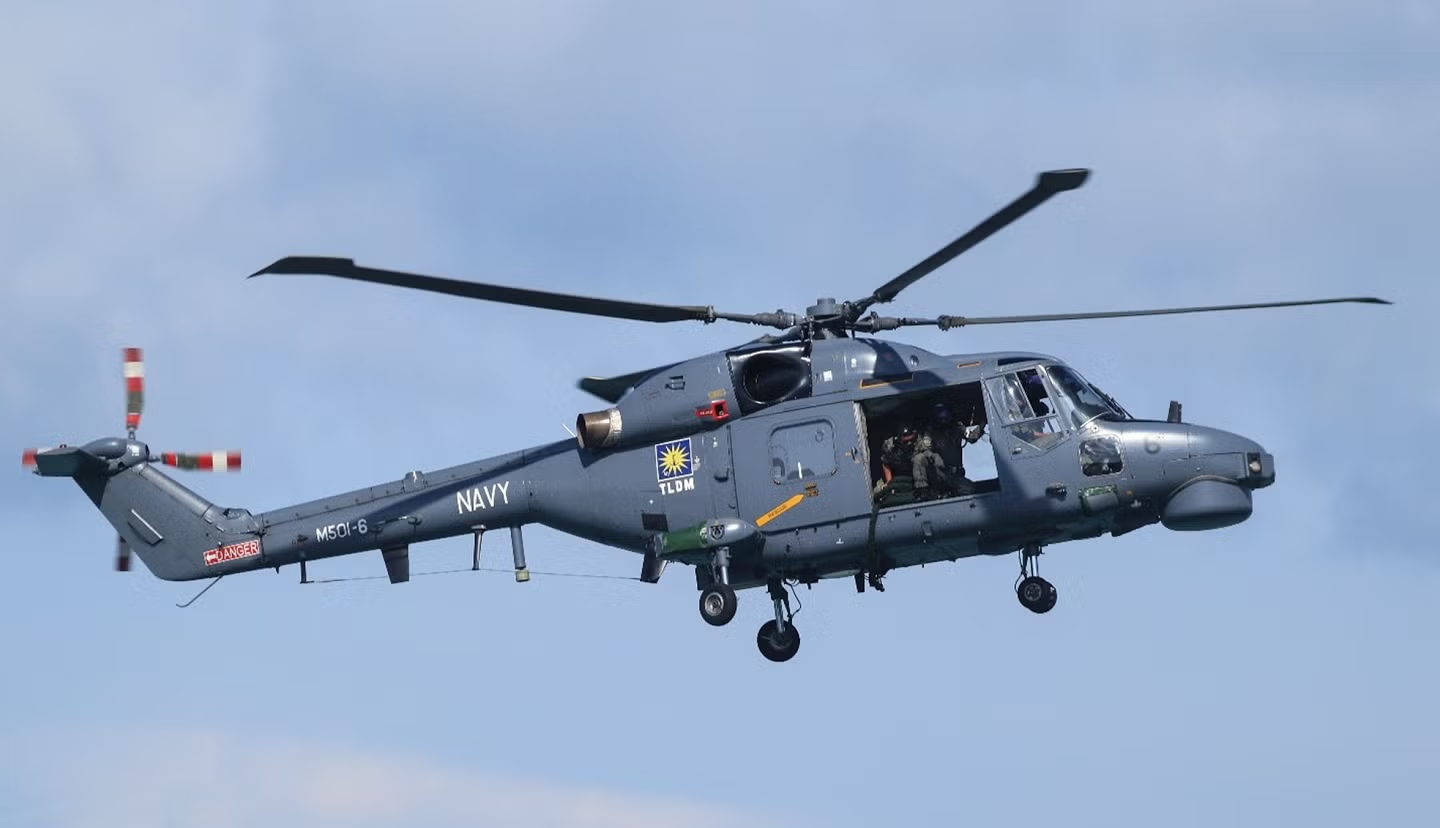
The navy said that four aircrew members were on board the aircraft at the time of the incident, and all were successfully rescued from the scene before being transported to Melaka Hospital for further medical assessment.
“All crew members are conscious, in stable condition, and are currently under close medical observation,” the RMN said, underscoring that there were no fatalities or life-threatening injuries.
The RMN added that it moved swiftly to coordinate salvage operations for the downed helicopter, while simultaneously establishing a Board of Inquiry to conduct a comprehensive investigation into the circumstances and technical factors that led to the emergency landing.
In a clear appeal aimed at preserving operational integrity and investigative transparency, the RMN urged members of the public to refrain from circulating videos or imagery of the incident, citing concerns over sensitivity and the need to ensure an unobstructed inquiry process.
The incident has once again drawn attention to the operational demands placed on the RMN’s ageing Super Lynx Mk300 fleet, which has formed a critical pillar of Malaysia’s embarked naval aviation capability since entering service in 2003.
Developed by AgustaWestland—formerly known as GKN Westland Helicopters—the Super Lynx was conceived as a highly adaptable maritime rotorcraft capable of operating from surface combatants in challenging sea states and contested environments.
In its naval configuration, the Super Lynx is a genuinely multi-role platform, optimised for anti-surface warfare, anti-submarine warfare (ASW), search and rescue (SAR), maritime surveillance, and a wide array of fleet support missions.
Globally, an estimated 200 Super Lynx helicopters remain in service with 11 navies, and the platform has accumulated significant operational experience, including combat deployments during Operation Iraqi Freedom, reinforcing its reputation as a battle-proven maritime asset.
For surface strike missions, the Super Lynx can be armed with up to four Sea Skua anti-ship missiles, a configuration long employed by the RMN to provide its frigates and corvettes with an organic, over-the-horizon attack capability.
Developed by MBDA—originally by British Aerospace before its integration into MBDA UK—the Sea Skua missile offers a precision stand-off strike range of up to 25 kilometres, allowing naval helicopters to engage hostile surface combatants while remaining outside the effective envelope of most point-defence systems.
Using an active radar seeker and a low-altitude, sea-skimming flight profile, Sea Skua is optimised for engagements against fast attack craft, missile boats and lightly protected warships operating in cluttered littoral environments where compressed reaction times and accurate target discrimination are decisive.
Operationally, the missile transforms a naval helicopter from a sensor-centric platform into a critical offensive node within the fleet’s distributed maritime kill chain, enabling surface combatants to project lethality beyond the radar horizon while minimising exposure to adversary anti-ship and air-defence threats.
Beyond Malaysia, other navies that have integrated Sea Skua onto their Super Lynx fleets include the United Kingdom, Bahrain and Germany, particularly when paired with the Seaspray maritime radar to maximise detection and engagement envelopes.
For undersea warfare, the Super Lynx can also be equipped with depth charges and lightweight torpedoes, reinforcing its value as an ASW platform capable of operating across both littoral choke points and open-ocean approaches.
The helicopter is powered by two Rolls-Royce engines, providing the redundancy, performance margins and survivability required for sustained operations over water and in high-risk maritime environments.
As the Super Lynx fleet approaches the limits of its economic and operational lifespan, attention has increasingly turned to potential successors, chief among them the AW159 Wildcat, developed by Leonardo.
The AW159 Wildcat is widely regarded as one of the most capable and modern naval helicopters currently available, optimised from inception for anti-submarine warfare and anti-surface warfare missions across a wide spectrum of operational theatres.
Beyond its core combat roles, the Wildcat is also designed to conduct Intelligence, Surveillance, Target Acquisition and Reconnaissance (ISTAR) missions, maritime interception operations, and network-enabled fleet support tasks.
The platform’s operational maturity is underscored by its selection into service with the Republic of Korea Navy and the Philippine Navy, both of which operate in complex littoral and archipelagic environments similar to Malaysia’s maritime domain.
Industry sources also indicate that Korea Aerospace Industries (KAI) is positioning itself as a contender in the RMN’s future ASW helicopter competition.
Defence Security Asia understands that KAI is expected to offer the Marineon Marine Operation Helicopter (MOH), a navalised derivative of the Surion helicopter family that is already in widespread service across multiple branches of the Republic of Korea Armed Forces.
The Marineon/Surion programme draws on South Korea’s extensive operational experience with U.S.- and European-built helicopters, while incorporating proven, off-the-shelf mission systems and a modular architecture tailored for maritime operations.
Configured for flexibility, the Marineon MOH can be armed with air-to-surface missiles, air-to-air missiles, lightweight torpedoes, Gatling guns, heavy machine guns, and other mission-specific weapons depending on operational requirements.
Its sensor suite can include sonobuoys, Electronic Support Measures (ESM), Forward Looking Infra-Red (FLIR) systems, maritime search radar, and other mission-enabling sensors, reflecting its multi-domain maritime design philosophy.
Crucially for ASW missions, the Marineon MOH can also be equipped with a dipping sonar, enabling it to detect, track and prosecute hostile submarines, positioning it as a credible candidate for Malaysia’s future embarked ASW helicopter requirement amid an increasingly contested undersea domain.

In a past interview with a local newspaper, the then Chief of Navy, Abdul Rahman Ayob, disclosed that only four of the RMN’s six Super Lynx Mk300 helicopters remained operational.
“The RMN is currently operating four out of the six helicopters for maritime role operations to support fleet operational and training requirements,” he said at the time.
“The remaining two aircraft have been placed under Long-Term Storage (LTS) due to the absence of the necessary logistical support,” he added.
He further confirmed that the Super Lynx Mk300 fleet would eventually be replaced, a move expected to significantly enhance the RMN’s naval aviation capability for specialised maritime combat roles.
Last year, Malaysia’s Ministry of Defence Malaysia registered a programme to acquire new anti-submarine warfare helicopters for the RMN under the 13th Malaysia Plan (RMK-13), which is scheduled to commence in 2026.
According to Defence Minister Mohamed Khaled Nordin, the acquisition is intended to align with the RMN’s long-term “15 to 5” Fleet Transformation Programme, which seeks to rationalise and modernise the navy’s surface and aviation assets.
“The RMN is currently planning the procurement of new combat helicopters to replace the Super Lynx under the ASW helicopter acquisition programme registered under RMK-13,” he said.
“This procurement is intended to meet the alignment targets of the RMN’s 15 to 5 Transformation Plan,” the minister added in a written parliamentary reply to Commander Nordin Ahmad Ismail (Lumut) during a Dewan Rakyat session.
Industry sources told Defence Security Asia that the RMN has already issued a Request for Proposal (RFP) for the acquisition of six ASW helicopters, marking the first formal step in a long-anticipated replacement programme.
The RFP is intended to replace the RMN’s six Super Lynx Mk300 helicopters, of which only four remain operational today, as the fleet reaches 21 years of service—an operational milestone that increasingly underscores the urgency of recapitalisation for Malaysia’s naval aviation arm. — DEFENCE SECURITY ASIA
