
Pentagon Prepares Ground Troop Deployment Into Iran — Marine Units, 82nd Airborne, Kharg Island Scenario Signal Possible U.S. Coastal Invasion in Expanding Hormuz War
Detailed U.S. contingency planning involving Marine Expeditionary forces, airborne rapid-response units, and Kharg Island seizure options signals widening American force posture as the Strait of Hormuz crisis threatens global oil supply and regional stability.

(DEFENCE SECURITY ASIA) — Pentagon contingency planning for the possible deployment of United States ground troops inside Iran has moved into detailed operational preparation, signalling a widening force-posture framework as Washington seeks additional leverage in a conflict that is already reshaping the strategic balance across the Persian Gulf energy corridor.
Senior military commanders have submitted specific readiness requests involving rapid-deployment formations, detention planning for Iranian personnel, and amphibious force integration as the White House evaluates escalation options in the third to fourth week of the ongoing U.S.–Israel-led war against Iran.
Officials have framed the planning as standard contingency preparation intended to provide the President with maximum operational flexibility, yet the scope of the measures being discussed indicates that Washington is actively positioning forces for scenarios that could place American troops on Iranian soil for the first time in the conflict.

Ground-Force Planning Expands Beyond Air Campaign Contingency
Pentagon internal discussions include detailed preparations for the potential deployment of elements from the 82nd Airborne Division and the U.S. Army Global Response Force, formations specifically structured for rapid insertion, air-assault operations, and expeditionary combat in high-intensity environments.
Planning also covers the handling and detention of Iranian soldiers and paramilitary personnel, including identification of facilities capable of processing prisoners, a requirement that normally appears only in scenarios involving sustained ground engagement rather than limited air operations.
The inclusion of detention logistics indicates that planners are considering scenarios in which U.S. forces could temporarily control territory, conduct raids, or secure strategic facilities inside Iran rather than relying solely on long-range strikes or maritime operations.
Senior officials have emphasised publicly that no final decision has been made regarding ground deployments, stating that contingency planning is routine practice intended to ensure the President retains the widest possible range of military options during a rapidly evolving crisis.
Public statements from the White House have stressed that the existence of operational planning does not mean an invasion has been authorised, but the scale of the preparations suggests that the Pentagon is building executable plans rather than theoretical concepts.
The President has denied any immediate intention to send troops, stating that no such deployment is planned at this time, while also declining to rule out future action, reinforcing the strategic ambiguity that often accompanies high-risk military signalling.
Press briefings have repeated that maintaining optionality is the central objective of the planning process, allowing Washington to escalate or de-escalate depending on battlefield developments, Iranian responses, and the stability of global energy markets.
Multiple reports from officials briefed on the discussions confirm that these preparations are linked directly to the broader U.S. campaign in the Persian Gulf, where naval, air, and amphibious forces are already operating at elevated readiness levels.
The combination of airborne, amphibious, and rapid-response elements suggests that planners are designing flexible operational packages capable of supporting raids, seizures of infrastructure, or short-duration occupation of key terrain rather than a full-scale invasion.
Such planning reflects a strategic shift from deterrence posture toward coercive leverage, in which the credible threat of ground action is used to influence Iranian behaviour without necessarily committing to immediate escalation.
READ: IRGC Vows to “Hunt and Kill” Netanyahu as Iran-Israel-US War Enters Third Week, Assassination Threat Signals Dangerous Regional Escalation
Kharg Island Scenario Becomes Central Strategic Pressure Option
Within the same planning framework, U.S. officials are reviewing operational concepts for occupying or blockading Iran’s Kharg Island, a move intended to force Tehran to reopen the Strait of Hormuz after the waterway’s closure disrupted global oil shipping and triggered sharp energy-price increases.
Internal discussions describe the island as a primary pressure point because it functions as the central hub of Iran’s oil-export system, meaning any interruption there would immediately affect government revenue and the country’s ability to sustain prolonged conflict.
Sources familiar with the planning state that seizure of the island would likely be considered only after additional airstrikes degrade Iranian defensive positions around the northern Persian Gulf, reducing the risk to U.S. amphibious and airborne forces during the operation.
Officials involved in the deliberations have indicated that the objective of such an operation would not necessarily be permanent occupation, but rather temporary control sufficient to force Tehran to alter its blockade posture and restore shipping through Hormuz.
Public comments from senior administration figures have acknowledged that reopening the strait is a priority objective, and that military options remain under review should diplomatic or coercive measures fail to achieve that outcome.
Operational assessments recognise that placing U.S. troops on Iranian territory would represent a significant escalation with unpredictable consequences, including the possibility of wider regional retaliation or disruption of additional oil facilities.
Military planners are therefore evaluating the balance between the strategic benefit of controlling Kharg Island and the risk that Iran could respond by targeting energy infrastructure elsewhere in the Gulf, potentially expanding the conflict beyond its current scope.
Recent U.S. airstrikes against military targets on the island were interpreted by analysts as signalling actions intended to demonstrate capability without immediately damaging export facilities, preserving leverage while avoiding a sudden shock to global supply.
The deliberate avoidance of oil-loading infrastructure during those strikes suggests that Washington is attempting to keep the option of economic pressure available rather than triggering an immediate collapse of Iranian export capacity.
This approach reflects a broader strategy in which military force is used selectively to shape negotiations and battlefield conditions rather than to achieve outright destruction of economic assets at the outset.
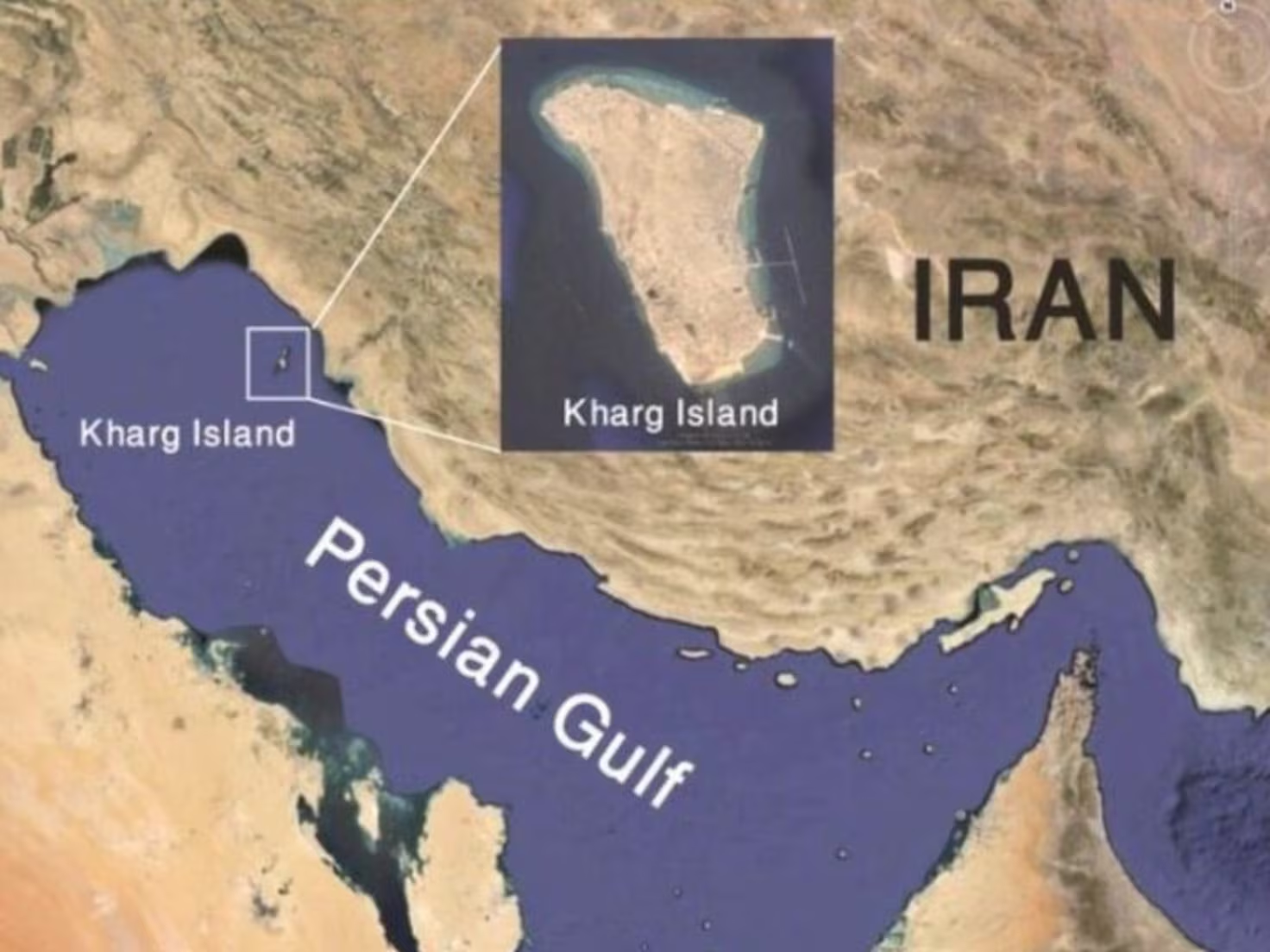
Kharg Island’s Oil Infrastructure Makes It a Strategic Center of Gravity
Kharg Island’s geographic position in the northern Persian Gulf gives it unique operational value because deep surrounding waters allow supertankers to dock directly, enabling high-volume export operations that cannot easily be replicated elsewhere in Iran.
Approximately ninety percent of Iran’s crude-oil exports pass through facilities on the island, making it the single most critical node in the country’s petroleum logistics chain and therefore a prime target for coercive strategy.
The island’s loading capacity, estimated at several million barrels per day, allows simultaneous handling of multiple supertankers, which means even short-term disruption would produce immediate effects on global energy supply.
Pipeline networks from Iran’s major onshore oil fields terminate at Kharg, meaning damage or occupation there would sever the final link between production sites and international markets without requiring strikes deep inside the country.
Because the island also handles petroleum by-products and other industrial shipments, its loss would have cascading economic effects beyond crude exports, complicating Iran’s ability to sustain wartime operations.
Military planners consider the island a strategic center of gravity because control of that single location could influence both battlefield dynamics and international energy markets simultaneously.
The island’s vulnerability has been demonstrated historically during previous conflicts when it was repeatedly targeted, reinforcing the assessment that it remains one of Iran’s most exposed yet most valuable assets.
Any operation against Kharg would require coordinated naval, air, and amphibious forces to secure surrounding waters, neutralise coastal defences, and maintain supply lines to troops deployed on the island.
Such requirements explain why current contingency planning integrates airborne units, Marine Expeditionary forces, and naval assets into a single operational concept rather than treating the island scenario as an isolated strike mission.
The central role of Kharg in Iran’s economic survival means that even the discussion of its possible seizure functions as strategic signalling intended to influence Tehran’s decision-making without immediate escalation.
Marine Expeditionary Deployments Expand Amphibious and Coastal Options
The Pentagon has confirmed the accelerated deployment of additional Marine Expeditionary forces and naval units to the U.S. Central Command theatre, expanding the range of operational choices available for coastal or amphibious missions.
The departure of an Amphibious Ready Group carrying a Marine Expeditionary Unit provides Washington with a self-contained force capable of conducting raids, evacuations, limited landings, or securing key infrastructure without requiring a full-scale invasion.
Each Marine Expeditionary Unit typically includes infantry, aviation, logistics, and command elements integrated to operate independently, making it suitable for rapid response in situations where speed and flexibility are critical.
Deployment timelines indicate that these forces could arrive in the region within weeks, aligning with reports that planners expect additional air operations to precede any potential ground or amphibious action.
Officials have indicated that this is the second such Marine formation sent to the theatre since the conflict began, suggesting a deliberate build-up rather than a routine rotation of forces.
The presence of multiple expeditionary units increases the ability of commanders to conduct simultaneous missions, including protection of shipping lanes, evacuation of civilians, and potential operations near the Iranian coast.
Amphibious forces are particularly relevant to scenarios involving Kharg Island because they provide the ability to land troops directly from the sea while maintaining naval fire support and logistical supply lines.
The integration of Marine units with airborne forces in contingency planning suggests that U.S. commanders are preparing for multi-axis operations combining air assault, naval landing, and precision strike capabilities.
Such preparations also serve as strategic signalling to Tehran by demonstrating that Washington is positioning forces capable of escalating beyond airpower if required.
Even if no ground operation occurs, the visible deployment of amphibious forces reinforces the credibility of U.S. threats and strengthens the negotiating position of the administration.
Strategic Optionality Defines Current U.S. Force Posture in the Iran Conflict
All current preparations appear designed to maximise operational flexibility rather than commit to a single course of action, allowing the United States to adjust its response depending on developments in the Strait of Hormuz and the wider Gulf region.
Officials repeatedly describe the planning process as providing the President with maximum optionality, a term that reflects the desire to maintain credible escalation paths without prematurely triggering them.
This approach allows Washington to combine airstrikes, naval operations, economic pressure, and potential ground actions into a layered strategy intended to force Iran to alter its behaviour without immediate full-scale war.
The possibility of ground deployment, even if remote, increases the psychological and strategic pressure on Tehran by raising the cost of continued confrontation.
At the same time, the administration’s public denial of imminent troop deployment helps manage domestic and international reactions, preserving diplomatic space while military preparations continue.
The coexistence of strong military signalling and cautious public messaging reflects the complexity of the current crisis, where energy security, regional stability, and alliance credibility are all at stake.
Control of the Strait of Hormuz remains the central strategic issue, because disruption there affects not only the combatants but the entire global economy.
For that reason, planning for operations such as a Kharg Island seizure must be viewed not as isolated tactics but as part of a broader campaign to restore maritime access and maintain international energy flows.
The arrival of additional Marine and airborne forces indicates that Washington is preparing for contingencies that extend beyond the current air-and-sea campaign.
The situation remains fluid, but the scale of planning now underway demonstrates that the conflict has entered a phase where ground-force options are no longer theoretical but are being shaped into executable operational plans.
