
Pakistan’s ‘Shahed-Style’ Drone Surge Could Transform Arabian Sea Warfare and Challenge India’s Naval Dominance
Pakistan is rapidly building indigenous Shahed-like loitering munitions designed for long-range maritime strikes, signalling a major shift in regional force posture and threatening to reshape naval competition across the Arabian Sea.

(DEFENCE SECURITY ASIA) — Pakistan’s accelerating pursuit of indigenous Shahed-like loitering munitions is rapidly emerging as one of South Asia’s most consequential unmanned warfare developments, potentially altering maritime force balances across the Arabian Sea and northern Indian Ocean.
The programme reflects Islamabad’s determination to build a large inventory of attritable, long-range precision weapons domestically rather than remain dependent upon imported unmanned systems vulnerable to sanctions, embargoes, and wartime supply disruptions.
By prioritising low-cost delta-wing kamikaze drones for maritime operations, Pakistan is signalling a force-posture shift toward distributed, asymmetric strike networks designed to complicate rival naval planning and overwhelm conventional defences.
The strategic urgency intensified after January 2026 exercises demonstrated that Pakistan Navy loitering munitions could operate alongside unmanned surface vessels and conventional missile batteries inside contested Arabian Sea environments.
Pakistani defence planners increasingly view inexpensive one-way attack drones as a method for imposing disproportionate costs upon technologically superior naval forces without matching those fleets platform-for-platform.
That calculation now places private Pakistani firms, particularly Sysverve Aerospace, at the centre of a rapidly expanding indigenous drone ecosystem with potentially significant implications for regional deterrence, maritime security, and escalation dynamics.
The emergence of these indigenous loitering munitions is likely to intensify regional investment in naval electronic warfare, layered air-defence networks, and counter-drone interception systems across South Asia.
Indian and Gulf naval planners are increasingly likely to interpret Pakistan’s expanding drone inventory as an effort to create persistent maritime denial zones.
Because these systems can be launched from dispersed coastal positions, trucks, or improvised maritime platforms, they significantly complicate adversary targeting cycles and pre-emptive strike calculations.
The broader consequence is that Pakistan’s drone programme may gradually shift regional military competition away from expensive conventional platforms toward mass-produced, expendable, and electronically resilient autonomous weapons.
Sysverve Aerospace Becomes Pakistan’s Principal Drone Industrial Base
Sysverve Aerospace, headquartered in Rawalpindi, has emerged as Pakistan’s largest indigenous unmanned aerial systems developer, positioning itself as the primary private-sector engine behind Islamabad’s new loitering munition strategy.
Unlike earlier Pakistani drone programmes centred upon state-owned entities, Sysverve represents a deliberate industrial transition toward privately managed production cycles capable of accelerating innovation, reducing procurement delays, and lowering manufacturing costs.
The company has publicly displayed inspection lines containing more than 130 assembled drones, underscoring an industrial capacity intended to support sustained production rather than limited demonstration quantities.
That production scale is strategically important because attritable loitering munitions derive battlefield value less from individual sophistication than from numerical saturation, persistence, and the ability to absorb heavy wartime losses.
Sysverve’s portfolio extends beyond attack drones, including surveillance systems, target drones, and combat platforms, enabling the company to integrate multiple unmanned functions within a single domestically controlled ecosystem.
This integrated approach allows Pakistan to reduce logistical dependence upon foreign avionics suppliers, imported maintenance chains, and external software support during periods of regional crisis or conflict.
Pakistani officials have increasingly emphasised that Sysverve’s loitering munitions are locally designed, engineered, assembled, and tested, strengthening the political narrative of national technological self-reliance.
That message carries particular importance because Pakistan’s defence establishment increasingly expects future conflicts to involve prolonged disruption of international supply chains and imported weapons deliveries.
Consequently, Sysverve is being positioned not merely as a manufacturer, but as a strategic enabler for Pakistan’s broader transition toward indigenous, networked, and expendable strike capabilities.
READ: Pakistan’s Electronic Ambush: Indian Warmate Drone Captured Intact in EW Intercept
Mudamir-LR Gives Pakistan a Long-Range Maritime Strike Option
The centrepiece of Sysverve’s loitering munition programme is the Mudamir-LR, a domestically developed long-range kamikaze drone reportedly capable of striking targets beyond 600 kilometres.
A 600-kilometre engagement radius would allow Pakistan Navy operators to threaten surface vessels, logistics nodes, and maritime infrastructure across substantial sections of the Arabian Sea without exposing crewed aircraft.
Unlike many earlier loitering munitions, the Mudamir-LR reportedly incorporates artificial intelligence-based navigation designed specifically for operations inside GNSS-denied and GPS-jammed combat environments.
That capability is strategically significant because modern naval conflict increasingly assumes extensive electronic warfare, satellite interference, and signal degradation intended to neutralise precision-guided weapons.
If the system performs as claimed, Pakistan would possess an indigenous drone capable of maintaining navigation and target acquisition despite heavy electronic countermeasures from technologically superior adversaries.
The Mudamir-LR appears optimised for precision attacks against surface targets, suggesting a mission profile focused upon naval vessels, coastal installations, radar sites, and expeditionary logistics infrastructure.
Pakistan reportedly tested the Mudamir-LR during January 2026 naval exercises in the North Arabian Sea, using the system both as an aerial target and an operational strike platform.
During those exercises, the drone was reportedly engaged by LY-80(N) naval surface-to-air missile batteries before later being used to attack and destroy designated maritime targets.
That dual-role testing suggests Pakistani planners are simultaneously evaluating the drone’s survivability against modern air-defence systems and its effectiveness within operational maritime strike scenarios.

Pakistan’s Delta-Wing Design Closely Mirrors the Shahed Formula
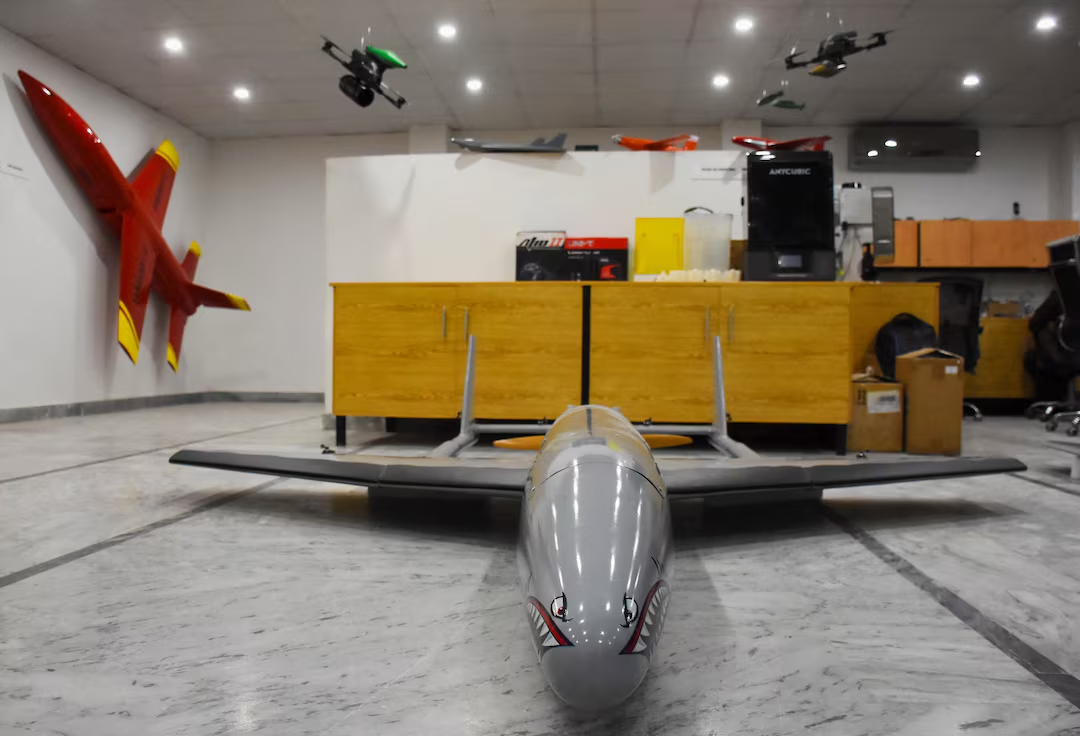
Publicly displayed Mudamir-LR models revealed during April 2026 exhibitions strongly resemble the aerodynamic architecture associated with Iran’s Shahed-136 loitering munition family.
The drone features a streamlined blended fuselage, delta-wing profile, rear-mounted pusher propeller, and vertical tail surfaces configured for endurance, simplicity, and comparatively low production costs.
Some displayed variants appear to incorporate canted tail structures, which may modestly reduce radar cross-section while preserving aerodynamic stability during long-range maritime operations.
The resulting configuration reflects a deliberate attempt to maximise range, persistence, and manufacturability rather than pursue expensive stealth technologies requiring sophisticated industrial infrastructure.
Open-source imagery also suggests the drone maintains a relatively compact size broadly comparable to Shahed-type systems measuring approximately 3.5 metres in length and 2.5 metres across.
Analysts increasingly regard such dimensions as ideal for low-cost strike systems because they enable truck-based transport, dispersed storage, and rapid launch preparation under wartime conditions.
Pakistan appears to be adapting the Shahed concept rather than simply copying it, integrating indigenous avionics, artificial intelligence guidance, and locally developed mission systems.
That distinction matters because the incorporation of domestic electronics potentially shields the programme from foreign component restrictions, export controls, and political vulnerability during future crises.
The visual symbolism surrounding displayed models, including shark-mouth nose art and prominent Pakistani insignia, further indicates that Islamabad intends these systems to become nationally recognisable strategic assets.

Maritime Exercises Revealed a Broader Unmanned Strike Network
Pakistan Navy’s January 2026 exercises demonstrated that Islamabad is pursuing loitering munitions not as isolated weapons, but as components within a wider unmanned maritime architecture.
During those exercises, the Mudamir-LR reportedly operated alongside an unmanned surface vessel developed by another Pakistani private company, Woot-Tech.
That pairing indicates Pakistan is experimenting with cooperative strike networks in which unmanned surface vessels identify, track, or relay targeting information for airborne loitering munitions.
Such integration could significantly expand maritime surveillance coverage while reducing the operational burden upon conventional frigates, patrol aircraft, and crewed reconnaissance platforms.
The Pakistan Navy appears particularly interested in using inexpensive autonomous systems to complicate adversary operations inside congested littoral zones and narrow maritime approaches.
In practical terms, coordinated unmanned systems could threaten surface combatants, amphibious formations, logistics convoys, and offshore infrastructure using multiple simultaneous attack vectors.
That concept mirrors wider global military trends in which navies increasingly combine unmanned surface, aerial, and subsurface systems to saturate defensive networks and exhaust interceptor inventories.
Pakistan’s interest in these capabilities is especially notable because maritime force asymmetry remains one of Islamabad’s most persistent strategic disadvantages against larger regional competitors.
Consequently, low-cost unmanned strike networks offer Pakistan a relatively affordable method for increasing deterrence while avoiding the enormous financial burden of major fleet expansion programmes.
Pakistan’s Drone Strategy Signals a Larger Shift in Regional Warfare
Pakistan’s Shahed-inspired drone development reflects more than a single weapons programme, instead revealing a broader doctrinal shift toward mass-produced, expendable, and locally sustained unmanned warfare.
The emergence of additional domestic systems, including the Sarfarosh loitering munition reportedly capable of ranges between 700 and 1,000 kilometres, reinforces that long-term trajectory.
With a claimed endurance exceeding 120 minutes and a 50-kilogram warhead, the Sarfarosh suggests Pakistan is constructing an entire family of complementary long-range strike drones.
Pakistan’s state-owned defence sector is also contributing through programmes such as the YALGHAR-series loitering munitions displayed during World Defense Show 2026.
However, the most significant development remains the growing reliance upon private technology firms able to innovate faster than traditional state-controlled defence bureaucracies.
That private-sector emphasis could permit Pakistan to iterate new drone designs rapidly, introduce battlefield modifications quickly, and scale production during periods of escalating regional tension.
The financial logic is equally compelling because loitering munitions costing comparatively little can threaten naval assets worth hundreds of millions, or even billions, of dollars.
For comparison, even a modest Pakistani drone production programme valued at US$100 million would equal approximately RM380 million while potentially generating several thousand strike systems.
Whether Pakistan’s indigenous loitering munitions ultimately prove operationally decisive remains uncertain, but their emergence is already forcing regional militaries to reconsider assumptions regarding maritime security, air defence, and future conflict escalation.
