
Pakistan Upgrades Mirage Fleet with Grifo-E AESA Radar: 157km Detection Range Boosts Air Combat Edge Against India’s Rafale Expansion
Grifo-E AESA integration with 157km detection range and 24-target tracking capability signals Pakistan’s strategic recalibration in South Asia’s high-intensity, network-centric air warfare environment.

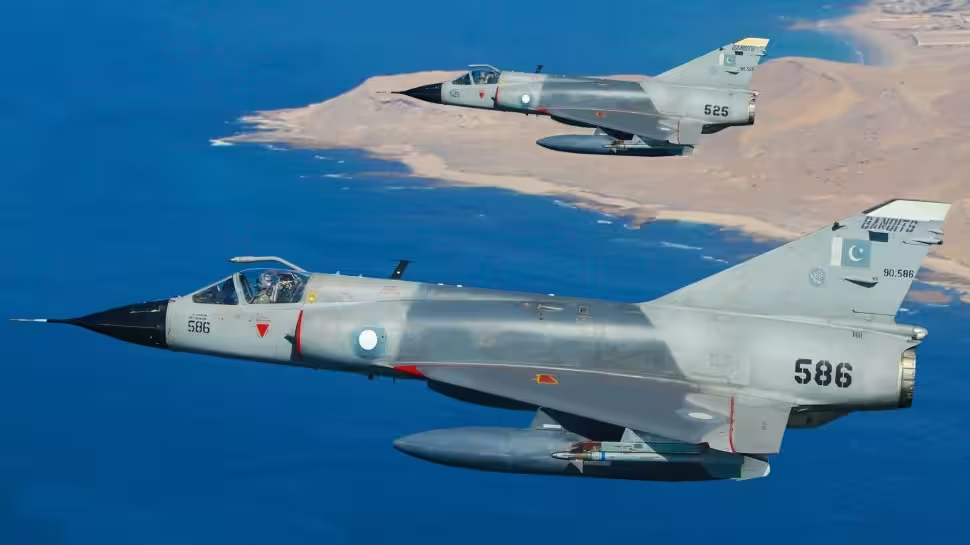
(DEFENCE SECURITY ASIA) — Pakistan reportedly has decided to integrate the Italian-built Grifo-E active electronically scanned array (AESA) radar onto its Mirage-III and Mirage-V fleet.
The move represents not merely a technical refresh of aging delta-wing fighters, but a calculated doctrinal recalibration aimed at sustaining credible air combat capability within an increasingly network-centric and electronic warfare-saturated South Asian battlespace shaped by India’s expanding Rafale inventory and layered long-range air defence deployments.
The strategic significance of this modernization trajectory is underscored by persistent regional rivalry, where India’s multi-billion-dollar airpower acquisitions—including expanded Rafale procurement packages and next-generation surveillance assets—are reshaping the balance of aerial deterrence, compelling Pakistan to leverage cost-effective yet technologically transformative upgrades to preserve operational parity without incurring unsustainable fiscal burdens estimated in tens of billions of US dollars (USD).

Recent defence analysis circulating within aerospace and security circles has highlighted that the Grifo-E AESA radar, developed by Leonardo, delivers a detection envelope of up to 157 kilometres while simultaneously tracking as many as 24 airborne or surface targets, a dramatic expansion in situational awareness compared to earlier mechanically scanned radars that limited engagement sequencing and multi-target processing in high-density threat environments.
“Mirage III & V Rose 3 multi-role combat of the Pakistan Airforce expected to get another and final upgrade by the installation of Grifo E AESA radars with a range of 157 kms, capable of tracking 24 enemy ground and air targets and Dual Racks for hosting more missiles,” stated a defence observer, encapsulating both the technical leap and the intended doctrinal enhancement of salvo capacity and beyond-visual-range lethality.
The persistence of the Mirage platform within Pakistan’s inventory—despite airframes dating back to the late 1960s and 1970s—illustrates a long-standing strategic culture of adaptive modernization through indigenous engineering at the Pakistan Aeronautical Complex (PAC) in Kamra, where structural life extensions, avionics retrofits, and weapons integration have collectively transformed obsolescent fighters into viable multi-role assets capable of delivering stand-off munitions deep into contested airspace.
As India accelerates defence expenditure with modernization initiatives valued at approximately US$40 billion (roughly RM188 billion at current exchange rates), the introduction of a 157-kilometre-class AESA radar onto legacy Mirages signals Pakistan’s intent to offset numerical and qualitative disparities through sensor enhancement, network integration, and expanded beyond-visual-range engagement capacity rather than sheer fleet expansion.
India on Thursday gave initial clearance for a 3.6-trillion-rupee (US$40 billion) boost to the country’s armed forces, including procurement of more Rafale fighter jets for the air force, reinforcing the urgency behind Islamabad’s radar-centric countermeasures in an environment increasingly shaped by sensor dominance and layered air defence systems such as the S-400.
At a time when electronic countermeasures, low-observable threats, and data-linked combat formations define aerial warfare doctrine, the Grifo-E AESA integration represents not merely a hardware update but a structural enhancement of Pakistan’s sensor-to-shooter cycle, enabling Mirages to detect, track, and engage adversaries at ranges that restore tactical relevance well into the 2030s despite airframe age.
Historical Continuity: From Project ROSE to AESA-Driven Relevance
Pakistan’s association with the Mirage-III began in 1967 following the 1965 Indo-Pakistani War, when Islamabad sought to rapidly augment air superiority capability through the acquisition of French-built delta-wing interceptors optimized for high-speed interception and adaptable strike roles.
The subsequent induction of Mirage-V variants, tailored for ground attack missions, diversified operational flexibility and entrenched the Mirage as a core strike asset capable of delivering both conventional ordnance and later stand-off weapons across multiple theatres including maritime domains and contested border regions.
By the 1990s, airframe fatigue and avionics obsolescence compelled the launch of Project ROSE (Retrofit of Strike Element), a phased modernization program that embedded Italian Grifo-M3 radars, inertial navigation systems, GPS integration, radar warning receivers, and expanded weapons compatibility to convert aging fighters into credible multi-role combatants.
Under ROSE-I, Mirage-V aircraft acquired from Libya received French ATLIS II laser designation pods and forward-looking infrared systems, dramatically enhancing precision-guided strike capability and night operational endurance in asymmetric and conventional environments alike.
ROSE-II and ROSE-III extended upgrades to Mirage-III airframes sourced from Australia and Spain, integrating the Grifo-M3 multimode radar with approximately 75-kilometre detection range, which significantly expanded interception geometry and air-to-surface targeting envelopes during the early 2000s.
These incremental transformations enabled integration of indigenous and imported stand-off weapons such as the H-4 glide bomb and the Ra’ad air-launched cruise missile, consolidating the Mirage as Pakistan’s principal platform for long-range precision strike missions.
“The Mirage III/5 is the PAF’s sole delivery platform for key stand-off weapons (SOW), namely the H-2 and H-4 glide-bombs,” observed analysts at Quwa, highlighting the aircraft’s continued centrality in Pakistan’s precision-strike architecture.
Upgrades in the 1990s also equipped each Mirage III fighter with an inertial navigation system, a GPS system, a new radar warning receiver (RWR), as reported by Military Watch Magazine, emphasizing how avionics modernization has historically extended airframe viability despite structural aging.
The proposed Grifo-E AESA integration therefore represents the logical technological apex of Project ROSE’s philosophy—transitioning from mechanically scanned radar architectures to digital beam steering arrays capable of rapid target reallocation, low probability of intercept (LPI) operations, and resistance to electronic jamming.
Grifo-E AESA: Technical Capabilities and Combat Multiplier Effects
The Grifo-E radar, weighing approximately 87 kilograms and engineered for compact integration into light fighter nose cones, introduces active electronically scanned array architecture that leverages distributed transmit/receive modules for instantaneous beam steering without mechanical repositioning.
Unlike traditional pulse-Doppler systems reliant on mechanical antenna rotation, AESA arrays enable simultaneous multi-mode operations including air-to-air tracking, ground mapping, maritime surface search, synthetic aperture radar imaging, and ground moving target indication within a single sortie profile.
The 157-kilometre detection range reported for the Grifo-E effectively doubles the engagement envelope previously associated with Grifo-M3-equipped Mirages, enabling earlier threat detection and expanded beyond-visual-range (BVR) missile cueing against hostile aircraft formations.
“By 2025, Leonardo expanded international collaborations, partnering with Hanwha Systems to develop a Grifo-E-derived active electronically scanned array (AESA) radar for the South Korean KF-21 fighter,” reports Grokipedia, reinforcing industrial maturity and export credibility of the radar platform.
The ability to track up to 24 targets simultaneously dramatically enhances battle management flexibility in scenarios involving swarm tactics, multiple intercept vectors, or dense electronic countermeasure environments typical of modern South Asian aerial engagements.
Dual missile rack integration, as referenced in open-source commentary, would potentially expand salvo density, permitting Mirages to carry additional beyond-visual-range missiles or stand-off weapons to overwhelm layered air defences including India’s S-400 Triumf batteries.
The GaN-based architecture associated with contemporary AESA systems increases power efficiency and thermal resilience, translating into improved range, durability, and resistance to electronic countermeasures compared to earlier gallium arsenide (GaAs) arrays.
In maritime strike roles, the Grifo-E’s surface search and synthetic aperture radar capabilities would strengthen Pakistan’s deterrent posture in the Arabian Sea, particularly against carrier battle groups or high-value naval assets operating within contested sea lanes.
Ground mapping precision and GMTI functionality would also expand intelligence, surveillance, and reconnaissance (ISR) capacity in counter-insurgency operations along volatile border regions, aligning the Mirage fleet with multi-domain operational doctrine.
Regional Balance: India’s Airpower Expansion and Sensor Competition
India’s approval of defence modernization packages valued at approximately US$40 billion (around RM188 billion) underscores the accelerating sensor and platform race unfolding across South Asia, where Rafale fighters, indigenous Tejas Mk-1A variants, and S-400 air defence deployments collectively redefine aerial engagement parameters.
The integration of AESA radar on Pakistan’s Mirage fleet must therefore be viewed within a broader sensor competition, where detection range, electronic warfare resilience, and network interoperability increasingly determine combat survivability rather than raw airframe performance metrics alone.
Enhanced radar range would allow Mirage squadrons to detect Indian incursions across the Line of Control at greater standoff distances, improving reaction time and complicating adversary penetration strategies.
In potential conflict scenarios, Mirages equipped with Grifo-E could conduct coordinated BVR engagements supported by data-linked JF-17 Block-III aircraft, creating layered interception frameworks that exploit sensor fusion across mixed-generation fleets.
“In December 2020, PAC began serial production of a more advanced Block 3 version of the aircraft with an active electronically scanned array (AESA) radar,” states Wikipedia regarding the JF-17 program, illustrating how Pakistan is gradually standardizing AESA capabilities across its frontline platforms.
This standardization could facilitate radar ecosystem interoperability, enabling shared threat libraries, common maintenance frameworks, and coordinated electronic warfare tactics across Mirage, JF-17, and potentially J-10CE fleets.
The introduction of AESA-equipped Mirages also complicates adversary planning by extending the operational lifespan of airframes otherwise assumed to be nearing obsolescence, thereby expanding Pakistan’s available sortie generation capacity in high-intensity contingencies.
From a cost perspective, upgrading legacy fighters rather than procuring entirely new fleets offers significant financial efficiency, particularly under conditions of economic pressure and limited access to Western defence financing mechanisms.
“The Grifo E AESA is a mediocre cost radar with excellent specifications,” remarked one analyst in a Facebook discussion, encapsulating the affordability-performance calculus underpinning Islamabad’s modernization approach.
Implementation Risks and Airframe Sustainability
Despite the operational promise of AESA integration, structural fatigue within airframes exceeding five decades of service presents non-trivial engineering challenges requiring comprehensive inspection, reinforcement, and life-extension programs at PAC facilities.
Integration costs—though significantly lower than acquisition of new-generation fighters—remain substantial when factoring radar procurement, avionics compatibility upgrades, pilot training, and maintenance ecosystem adjustments potentially measured in hundreds of millions of US dollars.
Assuming a hypothetical upgrade cost of US$5–10 million (RM23–47 million) per aircraft depending on scope and avionics integration depth, a fleet-wide modernization of even 50 Mirages could represent an investment of US$250–500 million (RM1.17–2.35 billion), a considerable yet strategically manageable expenditure relative to multibillion-dollar fighter acquisitions.
Compatibility with existing weapons systems, including stand-off munitions and potential beyond-visual-range missile integration, will require software harmonization and fire-control system recalibration to fully exploit the radar’s multi-target engagement capacity.
Training pilots transitioning from mechanically scanned radars to AESA systems demands doctrinal adaptation emphasizing sensor management, electronic counter-countermeasure tactics, and networked data-sharing within multi-aircraft formations.
Supply chain resilience also warrants scrutiny, as export controls or geopolitical shifts affecting Leonardo’s European production base could influence delivery timelines or sustainment support continuity.
Nevertheless, Pakistan’s historical experience executing Project ROSE in the 1990s demonstrates institutional competence in complex avionics integration, suggesting that similar engineering pathways could mitigate implementation risk for the Grifo-E transition.
Pakistan’s Mirage fleet was upgraded with third and fourth generation technologies allowing them to remain viable in modern warfare, explains a YouTube analysis on the fleet, reinforcing precedent for successful incremental modernization.
Future Outlook: Bridging Toward Next-Generation Induction
While AESA-equipped Mirages will not rival fifth-generation platforms in stealth or sensor fusion, they represent a critical bridging capability sustaining operational mass until next-generation programs such as Project Azm or expanded JF-17 Block-III procurement mature.
Potential acquisition of additional J-10CE fighters or long-term induction of advanced platforms could eventually displace Mirage squadrons, yet the Grifo-E integration ensures that legacy aircraft contribute meaningfully during transitional force restructuring.
The upgrade also strengthens Pakistan’s deterrence narrative, projecting technological adaptability despite economic and geopolitical constraints, and signaling to regional adversaries that sensor modernization can offset aging airframes.
Moeed Pirzada previously questioned, “Will these old Mirage-V squadrons be adding value to PAF when Indian Airforce relies upon advanced Mirage-2000 planes?”—a rhetorical challenge that gains renewed relevance in light of AESA-enhanced radar performance.
Deagel.com describes the Grifo family as “a fourth generation, multimode, pulse Doppler, X-band radar with navigation, air-to-air and air-to-surface modes along with fire control and IFF,” underscoring the evolutionary lineage culminating in the Grifo-E AESA architecture.
The Mirage’s enduring reputation within the PAF—colloquially referenced in online commentary as “The Boss 😁 is still there and continues to hold the line”—reflects institutional confidence in a platform repeatedly revitalized through strategic upgrades.
In aggregate, the reported Grifo-E AESA integration affirms that airpower modernization in South Asia is increasingly defined by sensor transformation, electronic warfare resilience, and multi-domain adaptability rather than exclusive reliance on platform replacement cycles.
Should official confirmation materialize, Pakistan’s Mirage fleet will transition from mechanically constrained interceptors to digitally empowered sensor nodes within a broader network-centric combat ecosystem, sustaining credible air combat capability amid intensifying regional competition valued in the tens of billions of US dollars and hundreds of billions of Malaysian Ringgit.
As defence spending surges across Asia and technological convergence accelerates, Pakistan’s Mirage radar upgrade stands as a case study in strategic pragmatism—where affordability, industrial ingenuity, and selective technological infusion converge to extend operational relevance in one of the world’s most contested aerial theatres.
— DEFENCE SECURITY ASIA
