
Malaysia Eyes China’s QW-19 MANPADS Amid Urgent Drone Warfare Threat Across Indo-Pacific
Loitering munitions and low-altitude drone attacks expose critical gaps in Malaysia's air defence network, pushing China's QW-19 man-portable missile system into strategic contention.

(DEFENCE SECURITY ASIA) –Malaysia is staring down a very short-range air defence problem it can no longer afford to ignore. Drones, loitering munitions, and low-altitude precision strikes have become the defining threats of modern warfare, from the skies over the Indo-Pacific to the battlefields of the Middle East, and Malaysia’s existing defences simply weren’t built for this fight.
Now, Kuala Lumpur is reportedly eyeing a solution from an unlikely but increasingly consequential source: China.
The problem is bigger than any one country. Cheap, mass-produced drones have repeatedly punched through air defence networks engineered decades ago to shoot down fighter jets, not swarms of expendable quadcopters and loitering munitions costing a few thousand dollars each.
That mismatch has already proven costly on battlefields from Ukraine to the Middle East, and it’s forcing militaries everywhere, Malaysia included, to rethink what “layered defence” even means in the drone age.
Enter the QW-19. China’s latest man-portable air defence system (MANPADS) is compact, mobile, and packs an advanced infrared seeker, all at a fraction of the cost of comparable Western systems, making it an increasingly attractive option for the Malaysian Armed Forces as they look to plug a growing hole in their short-range air defence coverage without blowing up an already tight procurement budget.

The QW-19 belongs to China’s modern Qianwei family of infrared-homing MANPADS and represents a marked technological leap beyond earlier Chinese shoulder-fired missile generations once dismissed as secondary alternatives to Western systems.
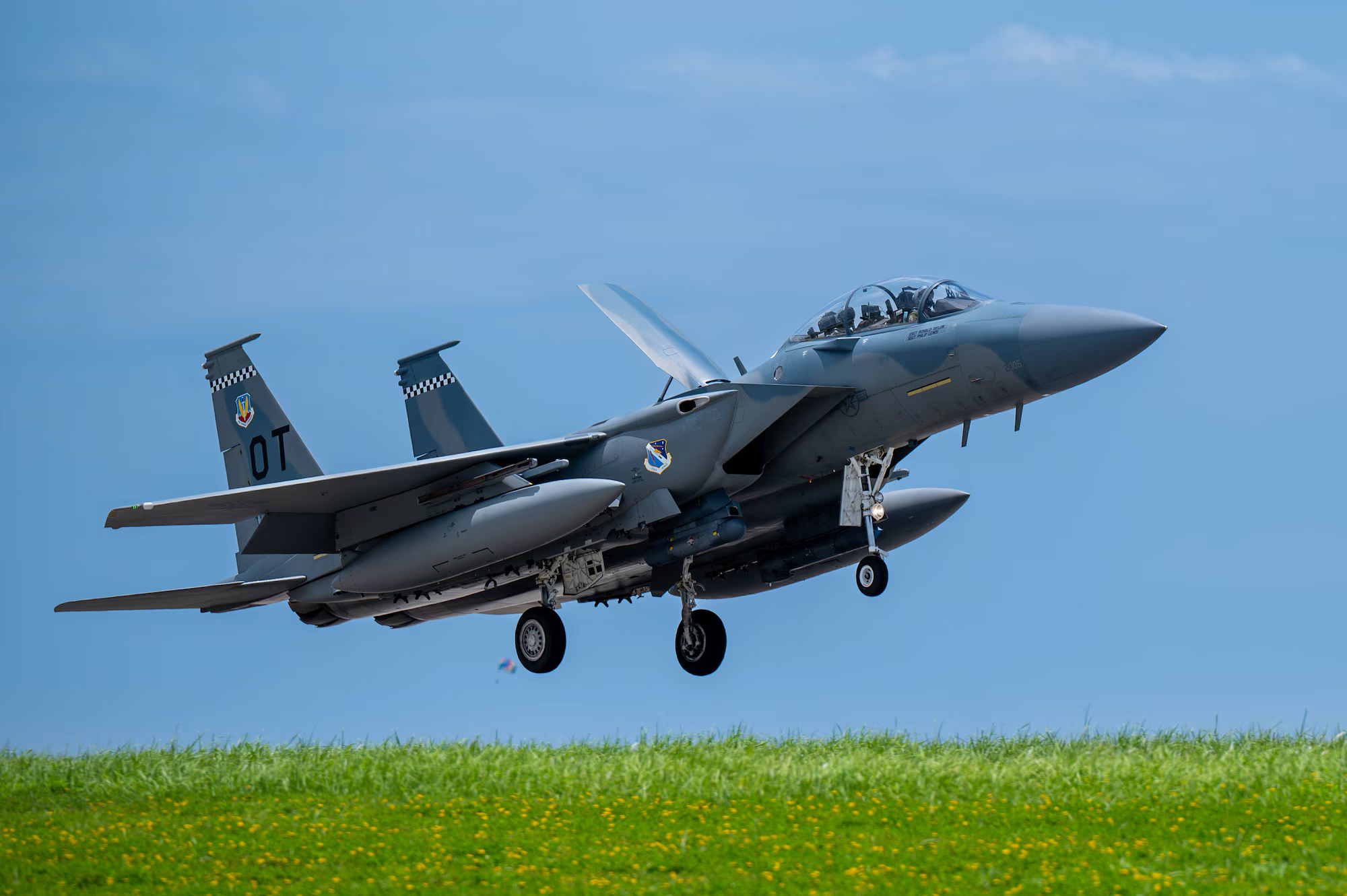
Strategic interest in the system intensified sharply after reports emerged that a Chinese-made MANPADS was linked to the downing of a United States Air Force F-15E Strike Eagle during operations over southwestern Iran in April 2026.
The aircraft, part of Operation Epic Fury, was shot down on April 3, 2026 near Yasuj in the Zagros Mountains, with Iranian state media quickly claiming victory and releasing wreckage photographs.
The jet, callsign “Dude 44,” was reportedly assigned to the 494th Fighter Squadron out of RAF Lakenheath, and both crew members ejected safely into hostile territory.
While the pilot was extracted within seven hours in a high-risk rescue operation, the weapons systems officer spent two full days evading Iranian forces in rugged foothill terrain before being recovered.
The incident, which occurred in Iran’s Kohgiluyeh and Boyer-Ahmad province, marked the first known combat loss of a U.S. crewed aircraft during the conflict and the first time in decades that a U.S. fighter jet was reportedly downed by hostile enemy fire.
U.S. President Donald Trump had publicly hinted in April that the aircraft was hit by a Chinese MANPADS, a claim the Chinese Embassy in Washington immediately dismissed as a “baseless allegation.”
By late May, however, the embassy’s tone shifted to a more measured position, stating that China “always acts prudently and responsibly on the export of military products” while rejecting what it called “groundless smear and ill-intentioned association.”
According to NBC News sourcing, three unidentified U.S. officials assessed that the F-15E was “probably struck by a Chinese-made shoulder-launched missile” measuring roughly seven feet long and weighing about forty pounds.
Open-source specifications for comparable Chinese systems such as the FN-6 and FN-16 indicate engagement ranges of approximately five to six kilometres and altitude ceilings exceeding 4,000 metres, figures that would not typically threaten a fighter operating at high altitude.
However, during low-level penetration missions, transit through mountainous terrain, or close air support operations, an aircraft could still enter the engagement envelope of such shoulder-fired weapons.
The estimated operating altitude of approximately 7,000 feet placed the F-15E near the upper boundary of engagement zones achievable by advanced shoulder-fired systems, according to assessments cited in defence reporting.
Although the precise missile variant involved remains publicly unconfirmed, the weapon was assessed to belong to the same technological lineage of modern Chinese infrared-guided systems that includes the QW-series architecture.
Compounding the geopolitical sensitivity, sources familiar with the matter told NBC News that China may also have supplied Iran with a long-range early-warning radar capable of detecting stealth aircraft designed to evade conventional detection.
That radar, identified in defence reporting as the YLC-8B, is a UHF-band 3D surveillance system with a declared detection range of up to 500 kilometres against fighter-sized targets and is reportedly capable of detecting stealth aircraft such as the F-22 Raptor at distances of up to 350 kilometres.
The disclosure complicates Washington’s relationship with Beijing at a delicate diplomatic moment, with President Trump having sought China’s help in brokering an end to the conflict ahead of a planned meeting with President Xi Jinping.
The incident marked the first publicly confirmed loss of a United States fighter aircraft to hostile fire in decades, dramatically intensifying international scrutiny of the maturity and lethality of modern Chinese air defence technology.
The engagement also reinforced broader geopolitical concerns that advanced Chinese tactical air defence systems are now demonstrably capable of threatening premium Western combat aircraft operating in contested battlespaces.
For Malaysia, the QW-19’s appeal extends beyond raw technical performance, aligning closely with Kuala Lumpur’s long-standing preference for diversified procurement and fiscally sustainable defence modernisation.
Malaysia already operates the earlier Chinese FN-6 MANPADS, giving its armed forces existing institutional familiarity with Chinese shoulder-fired air defence concepts, handling procedures and logistical support requirements.
The system’s comparatively low acquisition and lifecycle costs could enable Malaysia to field larger numbers of MANPADS units across infantry formations, air bases, littoral installations and strategic infrastructure than more expensive Western alternatives would permit.
QW-19 Signals China’s Rapid Rise in Modern Tactical Air Defence Technology
The QW-19 was officially unveiled in 2014 as the latest evolution of China’s Qianwei-series MANPADS family and was specifically developed to address the rapidly changing realities of modern low-altitude aerial warfare.
The missile system reportedly weighs between approximately 16.5kg and 18kg, placing it broadly within the same portability class as the widely deployed American FIM-92 Stinger shoulder-fired air defence missile.
The missile itself measures approximately 1.526 metres in length while the launch tube extends to roughly 1.576 metres with a missile diameter of 71mm designed for lightweight infantry portability.
Operationally, the system possesses an engagement range between 500 metres and 6km while maintaining an interception altitude capability reaching approximately 4km to 4.5km depending on target profile and engagement conditions.
One of the most strategically significant features of the QW-19 is its dual-band infrared seeker architecture combined with advanced digital signal processing intended to improve target discrimination and electronic counter-countermeasure resistance.
Publicly available descriptions also indicate that certain seeker variants incorporate ultraviolet detection channels to further strengthen resistance against flares, infrared decoys and electronic interference designed to defeat infrared-guided missiles.
The missile reportedly travels at speeds between 600m/s and 660m/s, placing it within the Mach 2 performance category and allowing rapid engagement against helicopters, cruise missiles and low-flying combat aircraft.
Reaction time from cold-start launch conditions has reportedly been reduced to as little as 10 seconds, providing infantry operators with improved responsiveness during sudden low-altitude attack scenarios involving fast-moving threats.
The QW-19 also incorporates a composite impact and laser proximity fuze arrangement intended to improve lethality against small aerial targets including drones, loitering munitions and low-signature cruise missile profiles.
Collectively, these characteristics place the QW-19 within the same broad technological category as advanced late third-generation or early fourth-generation Western and Russian MANPADS systems currently fielded by major military powers.

Dual-Band Digital Seeker Technology Changes the Drone Warfare Equation
The most strategically important component of the QW-19 is widely considered to be its advanced digital dual-band seeker system designed specifically for contemporary drone-heavy and electronically contested battlespace conditions.
Unlike older infrared-guided MANPADS systems that primarily focused on engine exhaust tracking, the QW-19 seeker reportedly tracks both the target’s exhaust plume and aerodynamic airframe heating signatures simultaneously.
This dual-band approach significantly improves lock-on reliability during head-on or beam-aspect engagements where older missiles often struggled to maintain stable target acquisition against fast-moving or low-signature aerial threats.
Digital seeker architecture introduced within the QW-19 represented a major departure from earlier analogue seeker generations previously used within China’s older MANPADS inventory and reportedly enhanced jamming resistance considerably.
Chinese defence industry representatives stated publicly during Air Show China 2014 that the digital seeker substantially increased immunity against electronic warfare interference, infrared decoys and flare-based countermeasure systems.
The missile’s anti-jamming capability reportedly includes non-temperature identification algorithms capable of comparing infrared characteristics across multiple spectral bands to distinguish genuine aerial targets from false thermal signatures.
This capability is strategically significant because modern combat aircraft increasingly rely upon advanced flare dispensers and electronic warfare suites designed specifically to confuse or saturate infrared-guided missile seekers during low-altitude operations.
The system’s imaging and digital discrimination features are also reportedly optimised for engaging small unmanned aerial vehicles and loitering munitions possessing relatively weak thermal signatures compared with conventional aircraft engines.
Its reported minimum engagement altitude of approximately 15 metres further strengthens relevance against contemporary low-altitude threats including terrain-masking helicopters, sea-skimming cruise missiles and low-flying reconnaissance drones.
In operational terms, the QW-19 appears specifically configured for the type of distributed drone-centric warfare increasingly witnessed across Ukraine, Gaza and the Red Sea rather than purely traditional Cold War-era aircraft interception missions.
QW-19 MANPADS Technical Specifications
| Specification | Details |
|---|---|
| System Name | QW-19 (Qianwei-19 / Vanguard-19) |
| System Type | Man-Portable Air Defence System (MANPADS) |
| Manufacturer | China Aerospace Science and Industry Corporation (CASIC) |
| Role | Very Short-Range Air Defence (VSHORAD) |
| Introduction Year | 2014 |
| Predecessor | QW-18 |
| Missile Guidance | Dual-band passive infrared seeker with digital processing |
| Additional Seeker Feature | Ultraviolet channel mentioned in some descriptions |
| Seeker Type | Dual-band imaging infrared (IIR) digital seeker |
| Engagement Capability | All-aspect engagement |
| Target Types | UAVs, loitering munitions, helicopters, cruise missiles, low-flying aircraft |
| Effective Range | 0.5 km – 6 km |
| Engagement Altitude | Up to 4 km – 4.5 km |
| Minimum Engagement Altitude | Approximately 15 metres |
| Missile Speed | 600–660 m/s |
| Speed Class | Approximately Mach 2 |
| Missile Length | 1.526 metres |
| Launch Tube Length | Approximately 1.576 metres |
| Missile Diameter | 71 mm |
| System Weight | Approximately 16.5–18 kg |
| Reaction Time | As low as 10 seconds from cold start |
| Fuze Type | Composite impact and laser proximity fuze |
| Anti-Jamming Capability | Advanced IRCCM and digital anti-jamming processing |
| Countermeasure Resistance | Resistant to flares, decoys and electronic countermeasures |
| Target Tracking Method | Tracks exhaust plume and airframe heating simultaneously |
| Operational Configuration | Two-person portable team or vehicle-mounted |
| Optimised Threat Environment | Drone-heavy and low-altitude warfare environments |
| Battlefield Role | Point defence and tactical battlefield air defence |
| Export Operator | Indonesia (confirmed) |
| Indonesian Procurement Year | 2023 |
| Indonesian Contract Value | IDR20.2 billion (approximately USD1.2 million / RM4.56 million) |
| Known Regional User | Indonesian Air Force (TNI AU) |
QW-19 Versus Stinger Reflects Shifting Global MANPADS Competition
The QW-19 is increasingly compared directly against the American FIM-92 Stinger because the Stinger remains widely regarded internationally as the benchmark Western man-portable air defence system.
In terms of portability and system weight, both systems are broadly comparable and remain deployable by lightweight two-person infantry teams operating in highly mobile battlefield environments.
The QW-19’s dual-band infrared seeker combined with digital processing architecture reportedly provides resistance levels against modern infrared countermeasures comparable with or potentially exceeding certain earlier Stinger variants.
Its all-aspect engagement capability also reduces limitations associated with older MANPADS generations that often required rear-aspect tail-chase engagements against aircraft operating at low altitude and high speed.
Analytically, the QW-19’s strongest comparative advantage may lie in its optimisation against drones, ultra-low-altitude threats and cruise missiles rather than purely traditional fixed-wing combat aircraft engagements.
While Western systems including the Stinger, Mistral and Starstreak remain highly capable, many were initially designed during periods when drone saturation attacks and attritable unmanned systems were not dominant operational concerns.
The QW-19’s proximity fuze and low-altitude optimisation therefore align closely with current battlefield conditions where inexpensive drones and loitering munitions increasingly threaten military infrastructure, logistics hubs and forward operating bases.
Cost also represents a potentially decisive factor because Chinese systems generally offer substantially lower procurement and sustainment expenses together with faster production timelines than equivalent Western missile inventories.
For middle-power militaries balancing multiple modernisation priorities simultaneously, affordability increasingly influences procurement calculations as governments attempt to field larger quantities of distributed air defence systems within constrained defence budgets.
The growing maturity of Chinese seeker technology also demonstrates how global competition within the MANPADS sector is no longer dominated exclusively by Western and Russian defence-industrial manufacturers.
Why the QW-19 Aligns Closely With Malaysia’s Evolving Defence Posture
Malaysia’s National Air Defence Strategy emphasises layered defensive coverage integrating multiple short-range and medium-range systems designed to protect strategic infrastructure, airspace approaches and critical military assets.
Within this framework, the QW-19 would likely function as a complementary capability rather than a replacement for Malaysia’s existing inventory of Starstreak, Igla, Anza and FN-6 systems.
The missile’s operational relevance is strengthened further by Malaysia’s terrain and climate conditions where lightweight rapid-reaction systems remain essential for dispersed jungle, littoral and island-based military deployments.
Drone-centric warfare lessons emerging from Ukraine, Gaza and maritime Red Sea confrontations have also reinforced the importance of highly mobile point-defence systems capable of rapid low-altitude target engagement.
Large-scale drone attacks have repeatedly demonstrated how relatively inexpensive unmanned systems can impose disproportionate operational and economic costs upon traditional air defence networks relying exclusively upon high-end interceptor missiles.
Under these conditions, the QW-19 offers what defence analysts frequently describe as a cost-imposing defensive capability capable of countering inexpensive aerial threats without exhausting premium missile inventories.
Malaysia’s existing experience operating Chinese-origin FN-6 systems may also reduce institutional adaptation requirements compared with introducing an entirely unfamiliar foreign MANPADS architecture into operational service.
Chinese defence suppliers have additionally demonstrated willingness in other markets to discuss technology transfer arrangements, industrial offsets and local production cooperation aligned with Malaysia’s long-term defence-industrial self-reliance objectives.
From a geopolitical perspective, integrating another Chinese-origin tactical air defence capability would also reinforce Malaysia’s traditional procurement diversification strategy rather than deepening dependence upon any single external defence supplier.
Although no Malaysian procurement decision has been publicly confirmed, the QW-19 increasingly appears strategically relevant within debates surrounding future VSHORAD modernisation priorities and distributed counter-drone defence planning.
Indonesia’s Procurement Offers Malaysia a Regional Operational Reference Point
Indonesia has already procured the QW-19 as part of efforts by the Indonesian Air Force to modernise its very short-range air defence capability alongside the earlier QW-3 missile system.
The procurement reportedly occurred during 2023 with a contract value estimated at approximately IDR20.2 billion equivalent to roughly USD1.2 million or approximately RM4.56 million using current article conversion rates.
Public reporting did not disclose the exact number of launchers or missiles acquired, suggesting the procurement may have represented a limited evaluation or capability familiarisation batch rather than a full fleet replacement programme.
Available information indicates deliveries likely occurred during early 2024, making Indonesia one of the few publicly confirmed export operators of the QW-19 outside China itself.
Training programmes involving both the QW-3 and QW-19 systems were reportedly launched formally by the Indonesian Air Force during May 2024 at Iswahjudi Air Base in East Java.
The training initiative reportedly focused on technical proficiency, operational handling, maintenance procedures and readiness management associated with the more advanced seeker and fuze technologies integrated into the QW-19 architecture.
Operationally, the Indonesian Air Force intends the system for battlefield and point-defence missions against helicopters, low-flying aircraft, drones and cruise missile threats within distributed tactical operating environments.
The QW-19 can reportedly be operated either by infantry teams or mounted upon lightweight vehicles and naval platforms, increasing deployment flexibility across archipelagic and littoral operational theatres relevant to Southeast Asian geography.
As of mid-2026, there are no publicly confirmed reports regarding large-scale follow-on Indonesian orders, indicating Jakarta may still be evaluating long-term operational integration and performance outcomes before broader procurement expansion.
For Malaysia, Indonesia’s cautious but tangible adoption of the QW-19 provides a valuable regional case study illustrating how Southeast Asian militaries are increasingly exploring cost-effective counter-drone air defence capabilities amid rapidly evolving regional threat environments.
The broader strategic implication is increasingly difficult to ignore because the reported destruction of a United States F-15E by a Chinese-origin MANPADS has demonstrated that advanced Chinese air defence technology can no longer be dismissed as operationally inferior.
Whether or not Malaysia ultimately selects the QW-19, the system’s emergence reflects a wider transformation within the global defence-industrial landscape where Chinese tactical missile systems are now competing directly against established Western benchmarks.
For Kuala Lumpur, the core procurement challenge will ultimately revolve around balancing affordability, operational effectiveness, industrial cooperation potential and long-term strategic autonomy within an increasingly contested Indo-Pacific security environment.
