
Japan Eyes Nuclear Submarines as China Reshapes Pacific Power
Tokyo is assessing nuclear-powered attack submarines as China’s expanding naval reach exposes the endurance, speed and missile-capacity limits of Japan’s conventional undersea fleet.

(DEFENCE SECURITY ASIA) — Japan has formally placed nuclear-powered attack submarines within its defence posture review, dismantling a decades-old policy taboo as Tokyo confronts Chinese naval expansion, longer Pacific operating distances, and mounting pressure to strengthen conventional deterrence beyond the First Island Chain.
Defence Minister Shinjiro Koizumi confirmed that Japan would proceed while “not ruling them out as an option,” although his carefully qualified language signalled an authorised assessment rather than any approved SSN acquisition or shipbuilding programme.
The distinction is strategically important because Japan is evaluating whether its exceptionally quiet diesel-electric submarine fleet can still deliver the submerged endurance, sustained speed, electrical power, and long-range weapons capacity demanded by an increasingly dispersed Western Pacific battlespace.
Koizumi identified nuclear propulsion’s principal operational advantages as dramatically longer submerged endurance and speeds several times those of existing Japanese submarines, while acknowledging higher costs, larger hulls, specialised maintenance, demanding training requirements, and potentially inferior acoustic discretion.
Tokyo’s review therefore concerns propulsion and force design, not nuclear armament, with any prospective Japanese SSN expected to remain conventionally armed while supporting sea denial, anti-submarine warfare, intelligence collection, carrier tracking, and survivable counterstrike operations.
Japan’s accelerated revision covers the National Security Strategy, National Defense Strategy, and Defense Buildup Program, whose expected completion by late 2026 could determine whether nuclear propulsion remains exploratory research or becomes an intended future military capability.
The policy opening follows incremental steps beginning with coded expert recommendations, advancing through an October 2025 coalition agreement, increasingly explicit ministerial statements, and culminating in political proposals that directly connected nuclear propulsion with vertical-launch-system submarines carrying long-range missiles.
Former Defence Minister Gen Nakatani sharpened the operational argument in November 2025, declaring that Japan would “eventually need to use nuclear propulsion” because conventional submarines could not match neighbouring nuclear fleets in underwater endurance or sustained transit speed.
Yet no reactor design, nuclear-qualified shipyard, training pipeline, regulatory framework, construction funding, or technology-transfer agreement presently exists, leaving a substantial gulf between political permission to investigate an SSN and the industrial machinery required to deploy one.
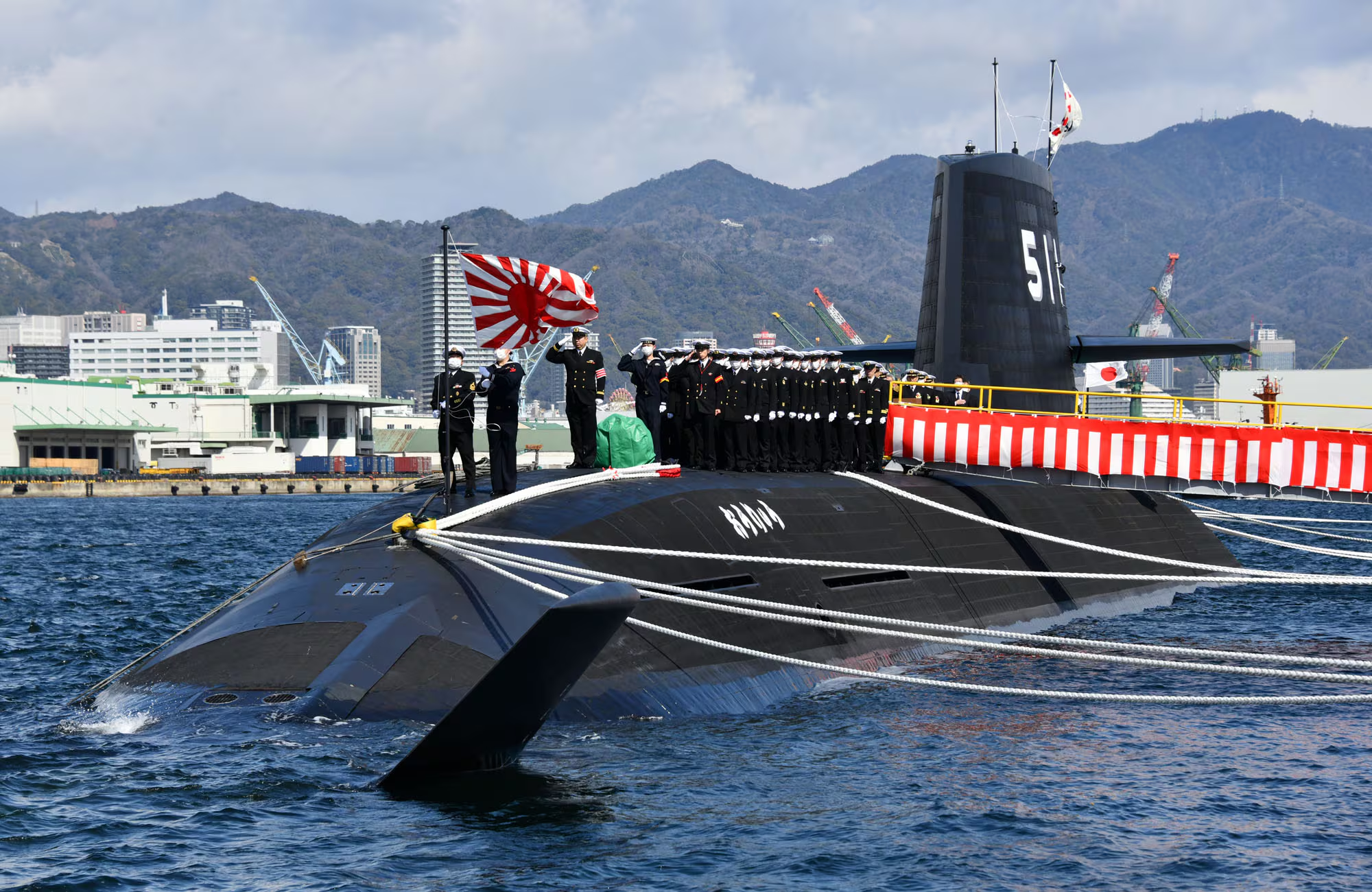
Japan currently operates approximately 22 to 23 attack submarines centred on the Sōryū and lithium-ion-powered Taigei classes, creating a sophisticated conventional undersea force whose replacement is not urgent, but whose geographic reach may constrain evolving strategic missions.
The central question is consequently not whether Japan’s submarines are obsolete, but whether even world-leading conventional boats can move rapidly across oceanic distances, remain persistently submerged, support power-intensive sensors, and escape predictably after launching future stand-off weapons.
By admitting nuclear propulsion into formal review, Tokyo is signalling to China, Russia, North Korea, South Korea, and the United States that its traditional model of quiet diesel-electric submarines concentrated near home waters is no longer strategically immutable.
(CLICK HERE): Japan Unleashes F-2A ASM-2 Anti-Ship Missiles Near Guam In Deadly New Sea-Denial Signal To China
From Political Taboo to Official Japanese Defence Option
Japan secretly examined developing or purchasing nuclear-powered attack submarines while drafting its 2004 defence guidelines, but abandoned the concept because of legal constraints, prohibitive costs, absent naval-reactor expertise, and extraordinary domestic sensitivity surrounding nuclear technology.
That early study never entered published policy, allowing nuclear propulsion to remain institutionally taboo for two decades even as China expanded its navy and Japan progressively modernised its conventional submarine production, batteries, sensors, weapons, and acoustic treatments.
The policy barrier began weakening after the Defence Ministry established an expert panel in February 2024 to evaluate implementation of the 2022 security documents and identify capabilities required for a harsher, faster-moving, and technologically demanding regional threat environment.
Its September 2025 report recommended VLS-equipped submarines able to carry long-range missiles and remain submerged across extended distances, urging research into “next-generation propulsion systems without being bound by conventional precedents,” language sufficiently broad to encompass naval reactors.
Officials initially emphasised solid-state batteries and fuel cells while insisting that no possibility had been excluded, preserving political ambiguity but establishing the first public government-sponsored formulation under which nuclear propulsion could be examined without being explicitly endorsed.
The October 2025 coalition agreement between the Liberal Democratic Party and Nippon Ishin no Kai transformed that technical opening into policy, pledging next-generation-propulsion submarines capable of prolonged submerged movement while carrying long-range missiles in vertical launch cells.
Coalition figures subsequently described nuclear propulsion as the obvious leading candidate, although the LDP retained deliberately ambiguous wording that protected cabinet flexibility, reduced immediate political exposure, and avoided prematurely committing resources to an extraordinarily complex military nuclear enterprise.
Nippon Ishin removed the euphemism in June 2026, arguing that only nuclear power could credibly reconcile vertical-launch payloads, prolonged high-speed movement, long-distance patrols, and sustained submerged operations, while demanding immediate research investment and concrete deployment planning.
The LDP remained more cautious, reflecting uncertainty over affordability, legislation, reactor development, public acceptance, alliance cooperation, and opportunity costs, while Koizumi’s September statement nevertheless confirmed that exclusion had been replaced by structured consideration within official strategic planning.
The late-2026 documents will reveal whether Tokyo merely authorises continuing studies or identifies SSNs as an acquisition objective, making their precise verbs—“examine,” “introduce,” or “acquire”—critical indicators of bureaucratic commitment, funding priority, and eventual force structure.

Taigei Fleet Is Formidable—But Geography Exposes Its Limits
Japan’s Fleet Submarine Force, headquartered at Yokosuka and divided between flotillas at Yokosuka and Kure, fields roughly 22 to 23 operational attack boats, supported by training and test hulls and sustained through continuous domestic construction.
Six remaining Oyashio-class submarines provide older operational capacity, twelve Sōryū-class boats form the numerical core, and four Taigei-class sisters serve on the front line, while the lead Taigei has operated as an experimental submarine since 2024.
The Sōryū class displaced approximately 4,200 tonnes submerged, introduced X-shaped stern planes, and combined Stirling air-independent propulsion with lead-acid batteries on its first ten boats before Ōryū and Tōryū pioneered an operational transition to lithium-ion energy storage.
That transition became foundational for the Taigei class, whose approximately 3,000-tonne surfaced displacement, 84-metre hull, 70-person crew, diesel-electric plant, and submerged speed exceeding 20 knots provide Japan with an exceptionally capable modern conventional attack submarine.
Taigei-class boats combine large lithium-ion battery banks with an improved ZQQ-8 sonar suite, non-penetrating periscopes, and six 533-millimetre HU-606 bow tubes firing Type 18 heavyweight torpedoes and UGM-84L Harpoon Block II anti-ship missiles during layered maritime engagements.
Lithium-ion batteries offer more than twice the energy density of older lead-acid systems, accelerate recharging, extend submerged endurance, and enable harder sprints, materially improving Japanese lethality and survivability across the East China Sea and Ryukyu approaches.
They cannot eliminate the conventional submarine’s energy ceiling, however, because prolonged speed rapidly depletes stored power and eventually forces snorkelling, creating detectable acoustic, infrared, radar, electronic, and visual signatures that an adversary can exploit operationally.
This indiscretion rate matters increasingly when missions require hundreds or thousands of kilometres of rapid submerged transit, weeks on station, and another high-speed movement after weapons release, rather than patient ambushes inside geographically confined maritime chokepoints.
Japanese boats remain optimised for shallow, acoustically complex waters surrounding the home islands and First Island Chain, where superior quietness can outweigh speed, but that design balance becomes less favourable during sustained operations across the open Philippine Sea.
Mitsubishi Heavy Industries and Kawasaki Heavy Industries preserve critical skills by alternating construction at approximately one submarine annually, meaning Tokyo can continue Taigei production while investigating an SSN without immediately disrupting a mature and strategically valuable industrial base.
China’s Expansion Pushes Japan Beyond the First Island Chain
China represents the principal military driver because its expanding nuclear submarine and carrier forces increasingly operate beyond the First Island Chain, creating a mobile, layered maritime challenge that Japanese diesel-electric submarines may struggle to shadow continuously across Pacific distances.
Open estimates cited for 2026 place the People’s Liberation Army Navy at more than 30 nuclear submarines, including expanding Type 093B attack and cruise-missile boats and an operational Type 094 ballistic-missile fleet armed with longer-range JL-3 missiles.
Bohai’s capacity to assemble several nuclear hulls simultaneously suggests that numerical and qualitative pressure could continue, enabling Beijing to field submarines supporting carrier escorts, sea-control operations, strategic deterrence, and attacks against American and allied surface forces.
Chinese carrier groups have conducted major flight operations deeper into the Pacific, while warships and aircraft increasingly appear around Okinotorishima and Minamitorishima, expanding Japan’s surveillance geometry far beyond the short transit distances favouring conventional undersea ambush platforms.
A nuclear-powered Japanese submarine could transit rapidly while submerged, maintain contact with a manoeuvring carrier formation, reposition between distant operating areas, and remain deployed until food and crew endurance intervened, rather than exposing itself periodically to recharge batteries.
Nuclear propulsion would not automatically guarantee acoustic superiority, because larger machinery and coolant systems introduce noise-management challenges, but sustained mobility could reduce operational predictability and complicate Chinese anti-submarine warfare planning across a wider oceanic search area.
Russia continues operating nuclear submarines near Japan, North Korea has declared ambitions for nuclear-powered boats, and South Korea is pursuing conventionally armed SSNs, making undersea endurance increasingly central to Northeast Asian force posture, prestige, and strategic signalling.
Nakatani explicitly referenced nuclear submarine fleets surrounding Japan, presenting propulsion as a comparative operational requirement rather than technological ambition, although political comparisons cannot substitute for rigorous mission analysis, lifecycle costing, and assessments of alternative conventional solutions.
Tokyo must therefore distinguish missions genuinely requiring sustained high submerged speed from those better performed by quieter diesel-electric submarines, maritime patrol aircraft, unmanned systems, seabed sensors, surface escorts, or closely coordinated American nuclear-powered attack submarines.
The most credible future structure may consequently be mixed rather than substitutive, retaining conventional boats for chokepoint control around the Ryukyus while assigning nuclear submarines to distant surveillance, carrier tracking, sea-lane defence, and wider allied maritime-denial operations.
VLS Strike Mission Transforms the Propulsion Calculation
Japan’s 2022 security documents established a conventional counterstrike mission against hostile missile and command infrastructure, and subsequent recommendations connected that role with submarines carrying long-range weapons in vertical launch systems, substantially changing requirements for hull volume and propulsion.
Current Taigei-class submarines launch every weapon through six bow torpedo tubes, providing potent anti-ship and anti-submarine capability but no operational VLS battery for a larger salvo of submarine-launched stand-off or future hypersonic missiles during combat patrols.
An underwater vertical launch system could expand magazine depth, permit simultaneous carriage of specialised weapons, and preserve torpedo-tube availability, but it would enlarge displacement, impose integration demands, and potentially compromise speed, range, stability, habitability, and acoustic performance.
Nuclear power provides continuous energy and greater horsepower for a larger missile-carrying hull, supporting sensors, combat systems, hotel loads, and sustained manoeuvre without consuming finite battery reserves that become especially precious during high-threat patrols and post-launch evasion.
Once a submarine fires long-range missiles, launch detection may reveal an approximate operating area, making rapid departure and unpredictable repositioning essential; nuclear propulsion would permit prolonged escape speed, whereas conventional boats must manage batteries and eventual snorkelling exposure.
Research into submarine-launched stand-off weapons, underwater VLS technology, and hypersonic missiles therefore strengthens the SSN argument indirectly, even though these parallel programmes neither prove that a reactor is necessary nor constitute funding for a nuclear-powered submarine.
A stretched conventional design could offer a lower-risk hedge by integrating limited VLS capacity while exploiting Japan’s existing shipyards, crews, maintenance system, and battery expertise, but added payload might reduce the endurance and agility the larger submarine seeks.
Conversely, an SSN optimised around missile volume could shift Japanese submarines from primarily local sea denial toward mobile conventional strike, intensifying regional threat perceptions even without nuclear weapons and demanding clearer doctrine, command arrangements, targeting safeguards, and escalation controls.
The Three Non-Nuclear Principles address nuclear weapons rather than propulsion reactors, yet opponents question whether long-range nuclear-powered submarines remain compatible with Japan’s exclusively defensive posture, ensuring that technical definitions will not neutralise domestic constitutional and strategic controversy.
Tokyo’s decisive analytical test is whether VLS strike, distant sea denial, and rapid Pacific repositioning must coexist aboard one platform, because separating those missions among conventional submarines, surface vessels, land launchers, and allied SSNs could reduce nuclear requirements.
(CLICK HERE): Japan Fires First Tomahawk From JS Chokai, Unlocking Long-Range Counterstrike Power Against China and North Korea
Reactor, Logistics and Workforce Barriers Define the Real Timeline
Japan possesses advanced civilian nuclear technology and world-class submarine construction, but combining those capabilities into a safe, quiet, combat-survivable naval reactor demands specialised metallurgy, compact plant design, shock qualification, radiation control, security procedures, and entirely new regulatory competence.
No Japanese naval-reactor design has been selected, no shipyard has been designated for nuclear construction, and no officers, engineers, maintainers, inspectors, or emergency responders currently belong to an established military nuclear training and certification pipeline.
Shore infrastructure would require protected reactor-maintenance facilities, radiological monitoring, specialised waste handling, secure fuel arrangements, emergency planning, and potentially new berthing restrictions, producing a logistics footprint extending far beyond the price of each submarine hull.
Koizumi acknowledged that SSNs would cost more, require larger hulls and specialised support, and might prove acoustically less discreet than Japan’s best conventional designs, weaknesses that must be measured against endurance rather than obscured by nuclear propulsion’s prestige.
A Taigei-class submarine costs roughly US$450 million to US$650 million depending on exchange rates and construction year, while an indigenous SSN would likely cost several times more before accounting for reactor development, shore facilities, training, regulation, and lifecycle support.
Legal work is equally consequential because naval reactors sit uneasily within an Atomic Energy Basic Act structured around peaceful nuclear use, requiring Tokyo to establish whether propulsion qualifies, amend legislation if necessary, and create credible civilian and parliamentary oversight.
Any American assistance involving propulsion technology, nuclear fuel, crew training, or safety practices would carry exceptional proliferation and security sensitivities, and a favourable comment by one United States Navy official does not constitute an authorised technology-transfer framework.
Opportunity costs will shape force design because every dollar committed to an SSN enterprise cannot simultaneously purchase additional Taigei-class boats, long-range missiles, unmanned systems, maritime patrol capacity, maintenance resilience, hardened infrastructure, or deeper wartime munition stockpiles.
Even approval in the 2026 Defense Buildup Program would initially produce concept studies, legal arrangements, reactor research, workforce development, partner consultations, and shore planning rather than steel cutting, placing any operational Japanese SSN well beyond the late 2020s.
South Korea’s pursuit of a mid-2030s launch illustrates the likely timescale, but Japan could move more slowly because it must construct naval nuclear institutions from nothing while sustaining annual conventional submarine production and avoiding readiness gaps during transition.
