
South Korea’s 270-Metre Drone Carrier Plan Shifts Focus From F-35Bs to Indo-Pacific Fleet Command
Seoul’s proposed successor to the F-35B-centred CVX programme would combine unmanned aviation and fleet command, giving South Korea more options in Indo-Pacific crises while adding to the demands on its navy.

(DEFENCE SECURITY ASIA) — South Korea’s navy has proposed a 270-metre drone carrier to succeed its stalled F-35B-centred CVX programme, betting that a fleet built around maritime surveillance and command can give Seoul greater influence over how regional crises are monitored and managed.
At the October 20, 2026 parliamentary audit at Gyeryongdae, Chief of Naval Operations Admiral Kim Kyung-ryul presented a design concept exceeding 30,000 tonnes in light displacement, more than twice that of the roughly 14,000-tonne Dokdo class.
South Korea’s Joint Chiefs of Staff were still reviewing the revised requirement at the time of the audit, with a decision expected by the end of 2026 and an early-2040s service target superseding the previous late-2030s window.
The Republic of Korea Navy intends to embark more than 20 unmanned systems across several categories, a measure of mission breadth that leaves open questions about aircraft availability for any single task over a deployment.
The transition from an F-35B-centred air wing to manned-unmanned teaming shifts the emphasis from embarked fighter aviation to the coordination of reconnaissance aircraft, combat drones, helicopters and uncrewed surface vessels within a larger South Korean naval force.

Admiral Kim Kyung-ryul, the Republic of Korea’s Chief of Naval Operations, has linked naval strength to sovereignty, maritime security and prosperity, framing disruption to sea routes as an economic risk and widening the carrier debate beyond peninsula deterrence.
The proposal arrives alongside plans for nuclear-powered attack submarines, KDDX destroyers and intelligence collection ships, each with an earlier target window that could make those programmes earlier measures of changes in its maritime force posture.
The large angled flight deck allows for a broader aviation mix, while the absence of published launch and recovery specifications leaves the compatibility of future unmanned combat aircraft with the ship unresolved at the requirements stage.
A fleet able to sustain surveillance and coordinate dispersed ships beyond the Korean Peninsula would give Seoul more options in regional crises, particularly when allied priorities diverge or maritime disruption threatens trade routes that South Korea depends on.
The carrier’s logistics footprint would extend beyond aviation fuel and spare parts to the maintenance and support of several families of uncrewed systems, making the manpower and sustainment burden central to comparisons with the original fighter-carrier model.
The Navy also envisages amphibious support and disaster relief, broadening the ship’s peacetime and crisis utility while introducing competing demands for deck space, embarked personnel and transport capacity for the eventual design and operating concept to reconcile.
The procurement choice will test how far Seoul is prepared to extend its naval role beyond peninsula defence while committing escorts, crews and maintenance capacity to a flagship that would share resources with the submarines and destroyers already in its plans.
(READ) South Korea’s Nuclear Submarine Push Raises Stakes for China and North Korea
From CVX and the F-35B to Manned-Unmanned Teaming
The original CVX grew out of LPX-II under President Moon Jae-in, and its proposed complement of roughly 16 to 20 F-35Bs would have given South Korea an embarked short take-off and vertical landing fighter force alongside helicopters for supporting missions.
The early CVX programme targeted service around 2033 and entailed costs ranging from ship construction to aircraft acquisition, aircrew training and through-life support for a naval aviation community that Seoul would have had to establish.
The 2023 defence budget proposal allocated no funding to CVX, while South Korea prioritised additional land-based F-35As, illustrating how pressure to reinforce near-term peninsula deterrence could outweigh the case for an embarked fighter force whose benefits would arrive years later.
Under President Yoon Suk-yeol, the three-axis deterrence system gained priority, sharpening the competition between CVX and investments in missile defence, conventional strike and other capabilities with more direct roles in South Korea’s response to North Korean nuclear and missile threats.
The Navy outlined its drone-centred direction to lawmakers in May 2025 and submitted the revised operational requirement in October, giving manned-unmanned teaming a formal place in force planning after several years of uncertainty over the original carrier’s mission and funding.
Under then-Chief of Naval Operations Admiral Kang Dong-gil, the October 2025 audit put service in the late 2030s, so the early-2040s target under Admiral Kim leaves a longer interval in which existing ships will carry the Navy’s shipborne aviation ambitions.
The Navy drew on lessons from Ukraine to justify greater investment in drones and artificial intelligence, although the relevance of those lessons to sustained naval aviation depends on how well uncrewed aircraft perform across repeated cycles of sea-based operations and maintenance.
Navy Sea GHOST provides the doctrinal context for the revised carrier, linking crewed ships with unmanned air, surface and underwater systems and making fleet integration a programme objective that can be pursued before the proposed flagship reaches operational service in the 2040s.
Dropping the F-35B air wing removes a major prospective procurement expense and shifts part of the programme’s industrial focus toward South Korean shipbuilders, while the eventual aircraft and shipboard equipment selections will determine how much reliance on foreign suppliers changes.
South Korea’s demographic pressures help explain the attraction of a more technology-intensive fleet, but a shift toward uncrewed platforms could transfer some staffing demands to aircraft maintenance, software support and mission supervision, making total personnel requirements more informative than ship’s company alone.
(READ) South Korea’s Cheongwang and Mobile Laser Destroy All Test Drones, Target Costly Missile Reliance
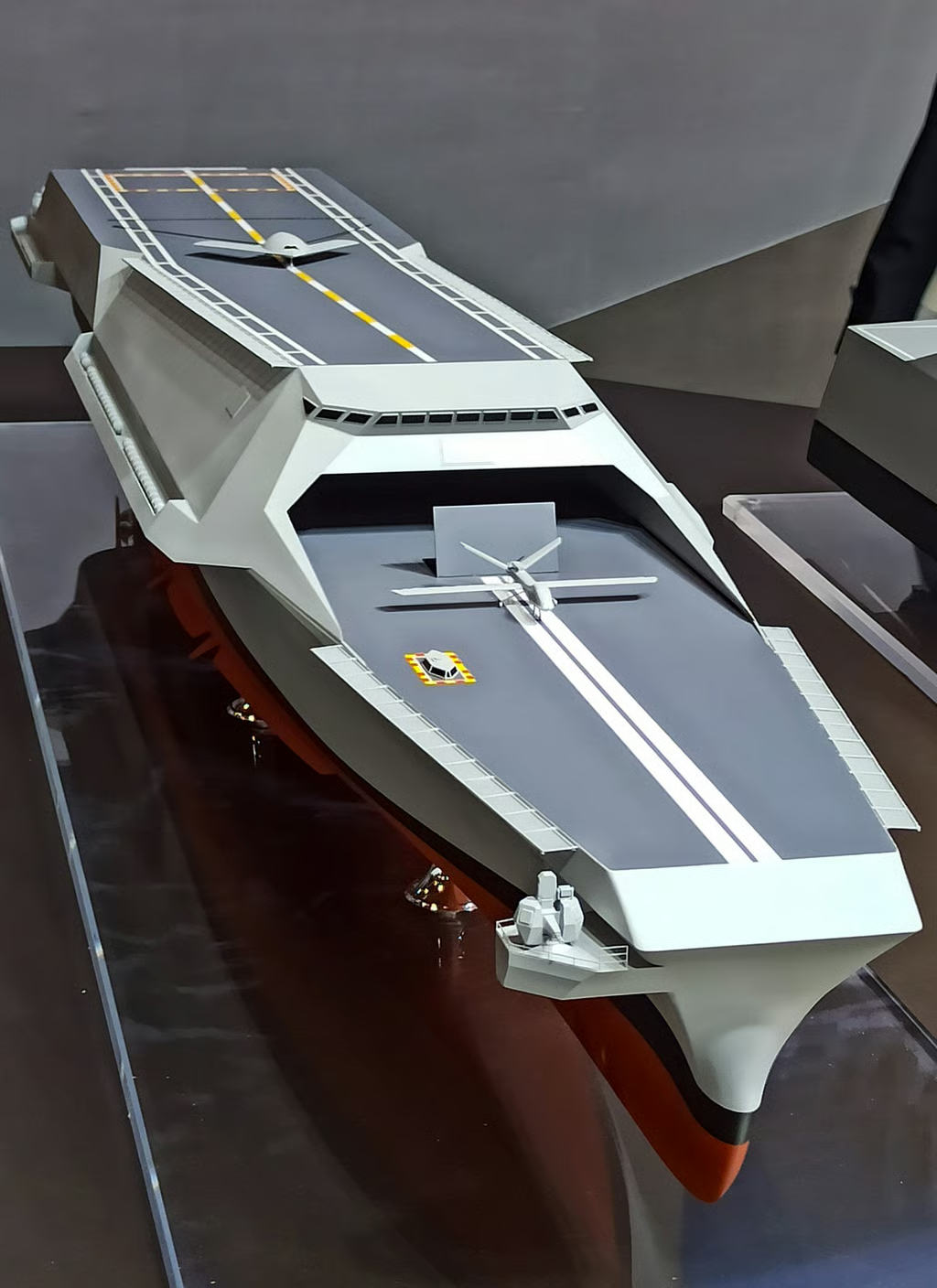
What the 270-Metre Angled Deck Tells Us
The public outline puts the ship at 270 metres long and 70 metres wide, with light displacement above 30,000 tonnes, giving the Navy a much larger aviation platform than Dokdo while leaving full-load displacement and the final hull form unresolved.
Against the roughly 250-metre by 40-metre baseline cited for an earlier concept, the revised dimensions imply a substantially wider operating envelope, although the Navy has yet to publish enough detail to determine how that width is divided between deck and hull.
An angled flight deck is an explicit feature of the proposal, but the Navy has disclosed neither a catapult selection nor a recovery system, leaving no firm basis for projecting aircraft compatibility, turnaround times or the tempo of sustained fixed-wing operations.
The planned unmanned complement spans combat aircraft, surveillance drones, one-way attack drones and surface vessels, so the headline capacity figure combines systems that place very different demands on deck handling, storage, maintenance and the number of operators the ship must accommodate.
Reconnaissance drones could widen Seoul’s independent maritime picture, giving South Korean commanders more evidence on which to base national decisions and more information to share with partners, provided the fleet can sustain collection and assess what the aircraft report.
Transport and attack helicopters would preserve an aviation role in amphibious operations, and high-speed landing craft would broaden the ship’s transport options, creating a design trade-off between accommodating several mission types and retaining sufficient space to sustain each of them.
A well deck remains a possibility rather than a confirmed feature, a distinction that matters because the choice of how to handle landing craft and uncrewed surface vessels affects the ship’s internal arrangement and its balance between aviation and amphibious functions.
Hanwha Ocean’s Ghost Commander II pairs a roughly 42,000-tonne concept with electromagnetic catapults and a well deck, illustrating one industry approach to mixed operations while leaving the Navy’s own launch equipment, internal layout and choice of builder open to review.
HD Hyundai’s smaller HCX-23 Plus concept uses a dual-deck arrangement, illustrating how differently domestic shipbuilders have interpreted the drone-carrier mission and why comparisons of tonnage or deck area alone tell little about the final mix of aviation and amphibious capacity.
The Navy has released no confirmed propulsion, speed, crew size, armament or hangar capacity, leaving the headline dimensions useful for judging ambition while the evidence for assessing endurance, personnel burden and compatibility with other fleet units remains largely unavailable.
The Logistics Footprint Behind a Drone Battle Group
The manned-unmanned battle group envisages a networked flagship coordinating dispersed assets, an arrangement whose value depends on whether information from aircraft, surface craft and other ships can reach commanders in a form they can interpret and use across the fleet.
Managing a mixed embarked force would add inventory and maintenance demands because an uncrewed aircraft, a helicopter and an uncrewed surface vessel have different servicing cycles, spare parts and specialist requirements even when all three share the same deployment and support chain.
An embarked total also says little about readiness across a deployment, because aircraft undergoing inspections or repair draw on hangar space and technical staff even when they are unavailable to fly, limiting what nominal capacity reveals about persistent maritime surveillance.
Communications disruption is a material constraint for any networked fleet, making resilience and clear supervision important measures of programme maturity, especially when uncrewed assets are expected to contribute information while the flagship is also managing helicopter or amphibious activity nearby.
An uncrewed air wing may change the distribution of personnel between the ship and shore, with software maintenance, training and certification requirements creating support demands that are easy to overlook when programme comparisons focus mainly on the number of people embarked.
The planned adaptation of Dokdo and Marado for UAV and command roles gives South Korea a nearer-term way to develop deck procedures and assess how much maintenance and operator capacity a mixed crewed and uncrewed deployment places on amphibious ships.
Two developmental loitering munitions reportedly crashed shortly after launch during a 2026 trial from ROKS Marado, a result specific to those test rounds that nevertheless illustrates the gap between embarking an unmanned system and demonstrating reliable operation from a naval platform.
A flagship intended for disaster relief and amphibious support would need enough flexibility to accommodate different combinations of aircraft, craft and personnel, and the time required to reconfigure between assignments would shape the ship’s usefulness during a rapidly developing regional crisis.
With the Navy also emphasising ship maintenance and civil-military cooperation, the carrier’s scale makes access to suitable repair facilities and long-term industrial support a force-planning question, since time in refit would directly reduce the availability of the proposed flagship.
With only one hull described in the outline, every extended refit could interrupt the carrier’s contribution to regional deployments, making Dokdo and Marado important to the continuity of South Korean naval engagement even if they offer a different mix of capabilities.
Submarines and Destroyers Will Shape the Fleet First
South Korea’s planned conventionally armed Jangbogo-N nuclear-powered attack submarines are intended to strengthen persistent undersea surveillance, giving the Navy a separate means of monitoring North Korean naval activity before the proposed carrier reaches the early-2040s window for its own operational debut.
The submarine plan envisages at least three boats of roughly 8,000 tonnes, with the lead boat targeted for launch in the mid-2030s and service in the late 2030s, placing an ambitious domestic undersea programme ahead of the carrier in the timetable.
The nuclear-powered submarine initiative also has an alliance dimension through the 2025 United States–South Korea summit agreement, while unresolved fuel-supply and cost questions leave its timetable exposed to decisions extending beyond the Navy and its preferred domestic shipbuilding arrangements.
The next-generation KDDX destroyer offers a different contribution to South Korean force posture, combining a planned indigenous combat management system and phased-array radar with air-defence, surface warfare and anti-submarine roles that would remain relevant across several kinds of naval task group.
With the first KDDX delivery targeted for 2032 and six ships envisaged, the destroyer programme could shape the surface fleet well before the carrier enters service, although no public plan in the audit defines a permanent escort allocation for the flagship.
Plans for two new maritime intelligence ships by around 2035 would also add dedicated signals and acoustic collection capacity, giving Seoul a separate means of sustaining maritime awareness while a carrier’s surveillance contribution would depend on its embarked systems and availability.
The audit placed ship-to-surface ballistic missiles and SM-3 and SM-6 interceptors within the same modernisation portfolio, indicating that Seoul’s maritime contribution to deterrence already includes strike and missile defence functions assigned to other ships independently of the carrier decision.
Within South Korea’s three-axis deterrence architecture, the carrier’s clearest prospective contribution is maritime awareness and coordination, while dedicated combatants’ separately planned defensive and strike roles could reinforce peninsula deterrence years before the flagship contributes to the fleet’s posture.
Different programme schedules create a risk of uneven readiness, because destroyers, intelligence ships, submarines and uncrewed aviation will require distinct training and support pipelines even where the Navy eventually expects them to contribute to a common fleet posture and strategic message.
If crew, maintenance and escort demands rise across the fleet at the same time, the carrier’s regional utility will depend on whether it adds maritime coverage without drawing resources away from ships already tasked with peninsula surveillance and deterrence.
What the Carrier Signals Across the Indo-Pacific
The October audit signalled that Seoul still wants a large aviation ship after CVX stalled, but the emphasis on surveillance, maritime command and amphibious support points toward a regional role built around gathering information and coordinating a response at sea.
For the United States and other regional partners, a South Korean fleet with greater surveillance and command capacity could broaden cooperation on maritime awareness and crisis response, provided information-sharing arrangements and decisions on deployment support that role in practice.
For Pyongyang, the nearer-term change in South Korean naval posture would come from the planned destroyers, surveillance ships and submarines, because their earlier service targets give them a clearer path to influencing peninsula deterrence before the carrier could deploy.
From Beijing and Moscow, the earlier arrival of dedicated intelligence ships would be the more concrete sign of expanded South Korean maritime observation, while a later carrier deployment could make Seoul’s role in regional exercises and partner operations more visible.
Exercises and disaster relief could turn that visibility into practical cooperation by familiarising partners with South Korean command procedures, although Seoul’s ability to sustain those commitments would narrow whenever a peninsula crisis draws ships and crews back toward home waters.
Domestic industry has demonstrated interest through competing designs, yet integrating ship construction, aviation and digital systems carries delivery risk that neither a public exhibition model nor the Navy’s proposed hull dimensions can resolve at the current stage.
The end-2026 Joint Chiefs of Staff decision anticipated at the audit is the next milestone for determining whether the revised requirement advances and could open the way to funding, design responsibility and the timetable for selecting compatible embarked systems.
The revised carrier has no published programme cost, leaving any comparison with the earlier CVX dependent on future estimates that account for the ship, its embarked systems, personnel, support infrastructure and maintenance over its service life.
Even after a favourable decision, milestones for aircraft selection and shipboard trials will say more about usable capability than the announced service date alone, because the force depends on the ship and its embarked systems reaching sufficient maturity at broadly compatible times.
The geopolitical payoff would be a South Korea better able to assess maritime events independently and contribute to regional responses, but that influence depends on how often the fleet can deploy the flagship while sustaining its commitments on the peninsula.
