
Iran Claims Another US MQ-1 Drone Downed Over Hormuz as Reaper Losses Mount
Tehran says its integrated air defence network destroyed another American drone over the Strait of Hormuz, as reported MQ-9 losses sharpen questions about sustained US surveillance.

(DEFENCE SECURITY ASIA) –Iran’s Islamic Revolutionary Guard Corps (IRGC) claims it destroyed another American MQ-1 drone over the Strait of Hormuz on 21 September, asserting that its air defences are challenging US surveillance above a passage central to Gulf security.
The alleged interception matters because persistent drone coverage helps American commanders monitor maritime activity and regional threats, while repeated aircraft losses could increase pressure on a Reaper fleet already affected by substantial reported attrition.
The IRGC says its Aerospace Force used a new system operating within Iran’s integrated air defence network, suggesting a coordinated detection-and-engagement capability, although neither the weapon nor this incident’s aircraft identity has been independently established.
If confirmed, another loss near Hormuz would strengthen Tehran’s ability to contest American surveillance and influence US force posture; for now, the shootdown remains an Iranian claim whose operational and geopolitical consequences depend on verification.
That strategic message reaches beyond the aircraft itself: surveillance over Hormuz contributes to maritime awareness and military planning, so interference with sustained coverage could complicate how American commanders monitor threats and position regional forces.
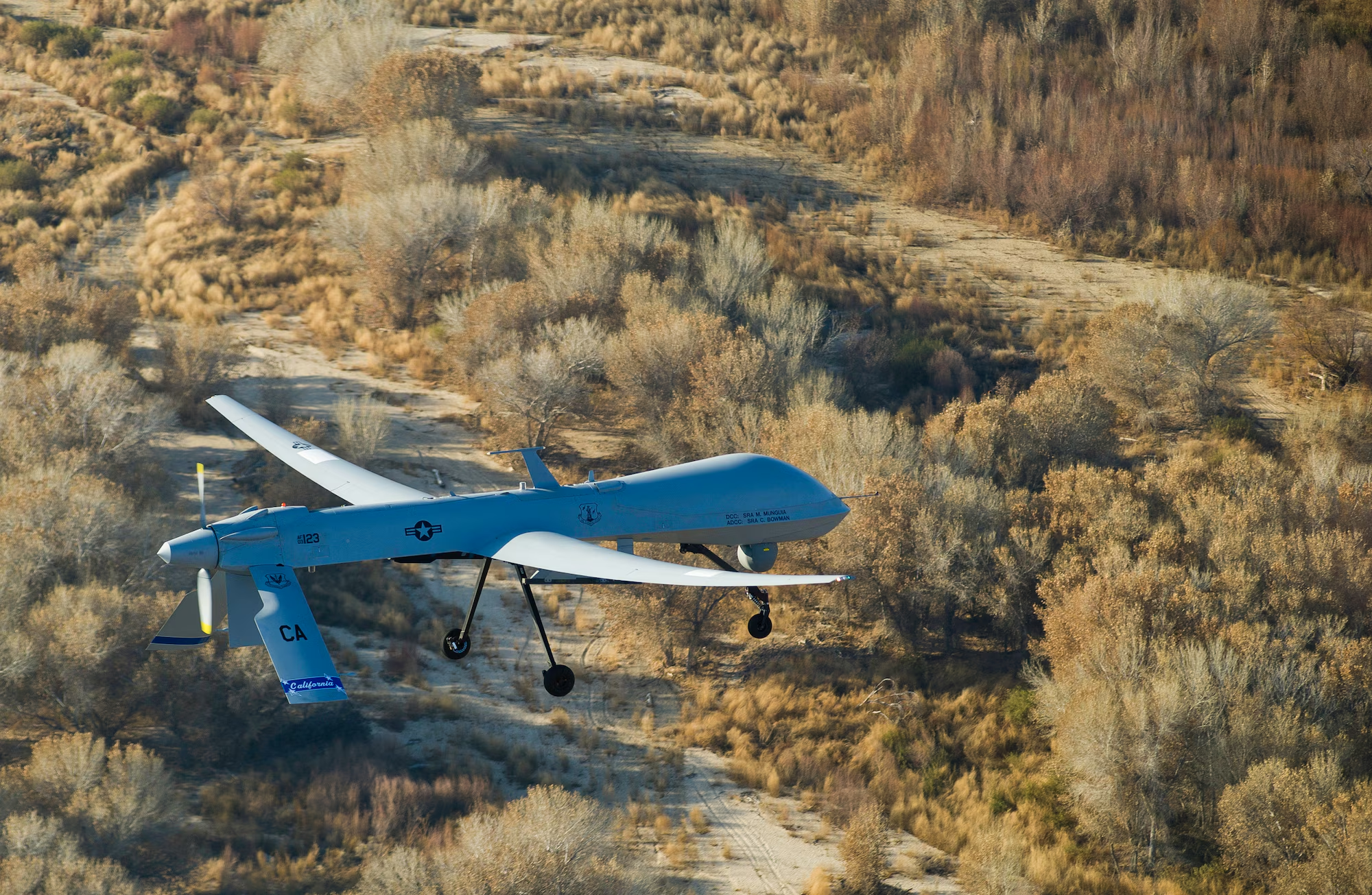
Iranian media reported that footage of the engagement was released, but its time, location and depiction of the aircraft have not been independently established, leaving the claimed shootdown and the precise type of drone unresolved.
The distinction is essential because the designation MQ-1 could refer to different aircraft, while the IRGC’s assertion that Reaper losses forced Washington to return a retired Predator to service lacks independently verified deployment evidence.
Even with those uncertainties, Tehran has placed an important military question before Washington: whether expensive, long-endurance surveillance aircraft can continue operating predictably near a defended coastline without absorbing losses or surrendering coverage.
By mid-May, Lieutenant General David Tabor put the US Air Force’s operational Reaper fleet at approximately 135 aircraft, a figure below its longstanding planning level of 189 and a sign of genuine pressure on available capacity.
American reporting later placed MQ-9 losses at at least 45 by August, although those aircraft were reportedly lost through several mechanisms, including shootdowns, communications failures and attacks on regional bases, rather than air defence interceptions alone.
IRGC spokesman Hossein Mohebbi reinforced the announcement’s strategic purpose by warning of “new weapons with new capabilities” and previously untouched targets if the United States attacks again, linking a claimed drone kill to deterrent signalling.
The result is a contested but consequential development: Iran is asserting greater control over the air approaches to Hormuz, while the evidence available so far cannot determine whether this specific engagement occurred as Tehran describes.
(CLICK HERE): Iran War Wipes Out 25 Percent of US MQ-9 Reaper Fleet in Historic Drone Attrition
Iran Presents Hormuz as a Contested Surveillance Corridor
The IRGC’s communiqué said its Aerospace Force had intercepted and destroyed “yet another American MQ-1 drone” over the Strait of Hormuz, using wording that places the latest announcement within a continuing Iranian campaign against US surveillance activity.
Iranian reports describe alleged MQ-1 losses on 14 and 15 September near the strait’s western and eastern approaches, although the repeated announcements have not been matched publicly to independently identifiable wreckage or confirmed American loss records.
From Tehran’s perspective, the pattern supports a deterrent message: aircraft sent to observe Iranian forces may themselves become vulnerable when national sensors, command systems and air defence units operate as a connected network.
That would represent a meaningful military mechanism if verified, because a network capable of detecting and engaging drones across different approaches could force American crews to reconsider routes, operating areas and the duration of surveillance missions.
The IRGC has not named the weapon used, disclosed its detection method or supplied engagement coordinates, however, so its claim of an integrated interception cannot yet establish which Iranian capability was decisive.
Iranian outlets circulated video described as showing the drone’s destruction, but footage can confirm an incident only when the aircraft, place, time and sequence of events can be reliably connected to the announcement.
The lack of those details does not make the claim irrelevant to military planning, since commanders must account for credible threats even before every public account can be independently resolved.
It does limit the conclusion that can be drawn: multiple Iranian statements demonstrate a sustained information and deterrence effort, while the number of distinct aircraft actually destroyed remains unverified in the material available.
Some Iranian coverage called the aircraft the “Beast” or “Butcher of Kandahar,” but the former nickname has commonly referred to the RQ-170 Sentinel, making technical identification more important than rhetorical labels.
For Iran, the announcement’s strongest strategic effect is therefore its challenge to assumptions about uncontested surveillance near Hormuz; confirmation of the aircraft and engagement would determine how far that effect extends beyond signalling.
(CLICK HERE): Iran Claims MQ-9 Reaper Kill as US Drone Losses Hit Crisis Point

How Iranian Air Defence Could Change the Operational Equation
A long-endurance drone gains value by remaining over an area for extended periods, allowing commanders to follow maritime activity and emerging threats instead of relying on brief observations separated by intelligence gaps.
That persistence can also expose predictable flight patterns, creating opportunities for defenders to combine surveillance, command decisions and weapons employment against an aircraft that must remain close enough to gather useful information.
Iran’s account emphasises national integration for precisely this reason: a coordinated network would make the defended area more difficult to penetrate than a collection of air defence units acting without shared awareness.
If the claimed Hormuz interceptions prove accurate, American planners could face a choice between accepting further aircraft risk and moving surveillance orbits farther from the areas where timely observation matters most.
Moving an aircraft away from a threat may protect its crewless platform and sensors, but the operational price can be reduced coverage, weaker continuity or slower confirmation of movements requiring a prompt response.
Iran would gain leverage from that effect even without destroying every aircraft, because changing an opponent’s behaviour can reduce the practical value of a surveillance fleet before losses become unsustainable.
The available evidence does not establish that such a reduction has occurred around Hormuz, and the IRGC’s announcement provides no measurable account of changes to American intelligence coverage or mission frequency.
Nevertheless, reported MQ-9 attrition makes the Iranian claim more consequential than it would be against an easily replenished fleet, since every additional loss could narrow commanders’ options across several operational theatres.
The threat also extends to the infrastructure behind a drone orbit: communications links, maintenance capacity and regional bases determine whether an aircraft can launch, remain connected and return to service after a mission.
Iran’s strongest potential advantage would arise from pressure across that entire system, although no evidence supplied with the latest announcement demonstrates that its forces caused this particular alleged MQ-1 loss.
(CLICK HERE):[VIDEO] 100 Patriots in One Night?” Iran Missile Barrage Tests U.S. Air-Defence Arsenal Over Jordan
Reaper Attrition Gives Tehran a Strategic Opening
Before the war began on 28 February 2026, the supplied figures placed the US military’s MQ-9 inventory near 185 aircraft, including approximately 165 Air Force Reapers and 20 operated by the Marine Corps.
Tabor’s mid-May figure of about 135 operational Air Force aircraft points to a smaller available force, although it does not describe every American Reaper or establish the inventory remaining on 21 September.
The Air Force said it could still support 56 contracted combat lines, indicating that the reduced fleet had not then prevented it from meeting those commitments despite concern over continuing attrition.
Subsequent American loss estimates rose from 24 in early accounts to nearly 30 by May, while reporting attributed to three US officials in August put the figure at at least 45.
Those numbers give Tehran a factual backdrop for arguing that drone losses matter, but they cannot validate its separate claims about the number of Reapers Iranian air defences have shot down.
Some aircraft reportedly crashed after communications failures, while others were destroyed on the ground, meaning a total fleet-loss figure must never be treated as a count of successful Iranian interceptions.
Iranian claims of more than 50 MQ-9 losses are also unverified in the material provided, and differing dates and definitions make direct comparison with American figures particularly prone to error.
Still, the underlying force-structure pressure is significant: an aircraft valued for persistent surveillance and strikes becomes harder to allocate globally when combat losses outpace the arrival of replacements.
Iran can use that pressure to argue that its defences are raising the cost of American operations, even though the evidence does not show that Iran caused every loss contributing to the smaller fleet.
The more durable geopolitical implication is that Reaper attrition may compel Washington to make sharper decisions about where it maintains surveillance, giving regional defenders potential leverage over American force allocation.
Production Constraints Magnify the Cost of Each Loss
The MQ-9A production line closed in 2025, leaving the United States with limited immediate options for replacing aircraft lost during sustained operations in and around a contested regional battlespace.
A small number of remaining airframes and components cannot quickly restore a fleet on a large scale, while returning stored aircraft to service offers little relief if suitable reserves are scarce.
The continuing MQ-9B SkyGuardian line does not provide an instant solution because the Air Force has not purchased that aircraft as a direct, one-for-one replacement for its existing Reapers.
A replacement must also arrive with sensors, communications support, maintenance capacity and an operating location, making the restoration of a persistent surveillance orbit more demanding than delivery of an airframe alone.
Air Force Chief of Staff General Kenneth Wilsbach called the MQ-9 the “most valuable player” of Operation Epic Fury, reflecting its reported contribution to strikes against mobile targets and its ability to remain on station.
That endorsement also reveals why attrition matters to Iran’s calculations: degrading a platform that American commanders find unusually useful could impose costs greater than the aircraft’s purchase price.
The Air Force and Defense Innovation Unit launched the Massed Modular Aircraft initiative in July with a proposed aircraft costing around $10 million before sensors and designed for more numerous production.
Its goals include a payload of at least 2,800 pounds and a combat radius of roughly 2,300 nautical miles with payload, but those specifications describe a programme objective rather than an operational replacement.
General Atomics has proposed its Wildfire design for that requirement, while American officials anticipate that several aircraft types may ultimately succeed the Reaper across different missions.
Until such systems are produced and deployed at scale, Iran can exploit a genuine American planning challenge: defending persistent coverage with aircraft whose losses are difficult to replace quickly.
What Iran’s Claim Means for Regional Force Posture
The IRGC’s alleged shootdown is designed to communicate that Iran can impose costs over Hormuz, a message aimed at American planners who depend on surveillance to support maritime security and regional strike decisions.
Mohebbi’s warning that future attacks could bring new weapons and different targets broadens that message, although his comments provide no technical evidence about the system allegedly used against the MQ-1.
For Washington, the immediate operational test is whether drone attrition changes where aircraft are based, how they are protected and how much risk commanders accept to maintain coverage near Iran.
Those choices have global implications because aircraft assigned to the Gulf cannot simultaneously meet demands elsewhere, while replacing a lost Reaper remains more difficult after the MQ-9A production line’s closure.
For Tehran, verified interceptions across different approaches to Hormuz would strengthen its claim that American aircraft face a persistent networked threat rather than a single vulnerable operating point.
The present record falls short of that finding: the latest statement does not establish the drone’s variant, the weapon used, the engagement location or the number of independently confirmed MQ-1 losses.
The IRGC’s claim that Reaper shortages forced an MQ-1 return likewise remains an interpretation, since no supplied American deployment record connects a specific older aircraft to that stated decision.
Iran has nevertheless succeeded in focusing attention on an American vulnerability that is supported by broader reporting: Reaper losses are substantial, and near-term replacement capacity is constrained.
The strategic contest now turns on evidence as much as firepower, with Iran seeking to demonstrate effective air defence and the United States facing scrutiny over the resilience of its surveillance posture.
If independently confirmed, another American drone destroyed over Hormuz would reinforce Iran’s ability to challenge persistent observation; until then, Tehran’s claimed success remains a serious operational allegation with unresolved technical details.
