
Iran Deploys Cobra V8 Electronic Warfare System Near Strait of Hormuz : F-35 Radar ‘Fingerprint’ Claim Escalates US-Iran Power Confrontation
Tehran integrates its domestically produced Cobra V8 electronic warfare platform with Bavar-373 and S-300 air defenses near the Strait of Hormuz, directly contesting US Navy ISR operations and reshaping the electromagnetic balance in the Persian Gulf.
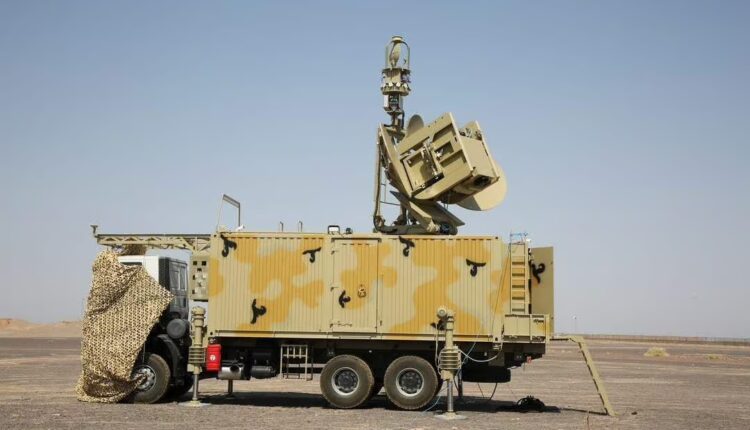
(DEFENCE SECURITY ASIA) — Iran’s deployment of its domestically produced Cobra V8 electronic warfare system near Tehran and Bandar Abbas represents a calibrated escalation in electromagnetic spectrum dominance at a moment when United States carrier strike groups, including the USS Gerald R. Ford and USS Abraham Lincoln, are operating within operational reach of the Persian Gulf.
The positioning of this truck-mounted electronic attack platform amid rising tensions with Washington and Israel transforms the electromagnetic spectrum from a support domain into a primary battlespace, directly contesting US Navy P-8 Poseidon reconnaissance patrols, carrier-based ISR missions, and the sensor networks underpinning fifth-generation stealth operations.
Admiral Amir Rastegari, Chief Executive Officer of Iran Electronic Industries, framed the deployment as an operationally proven deterrent capability when he declared, “The foreign reconnaissance aircraft were flying within the Flight Information Region (FIR) and started emitting waves to gather intelligence, and we disrupted the activities carried out by the aircraft in question.”

He further asserted, “The pilots of the reconnaissance aircraft thought their aircraft was experiencing problems, so they contacted their base claiming there was an issue with the aircraft’s systems and that they would return to base. We have recordings of that conversation,” thereby implying real-world electromagnetic denial operations against foreign ISR aircraft.
Rastegari’s additional claim that “We have the ‘electronic fingerprints’ of enemy electronic equipment” signals an ambition to move beyond brute-force jamming toward signal intelligence exploitation capable of mapping and cataloguing the emissions of advanced Western systems.
He extended this claim to fifth-generation aircraft by stating, “For example, if an F-35 fighter jet starts operating and monitoring using its radar, (its radar) will emit different waves from other F-35 fighter jets’ radars… Today, we can identify those waves… and determine which F-35 aircraft they belong to,” thereby framing Cobra V8 as a counter-stealth enabler within Iran’s layered air defense doctrine.
Satellite imagery capturing Cobra V8 units deployed alongside indigenous Bavar-373 and Russian-supplied S-300 systems suggests deliberate integration into a multi-layered air defense network designed to fuse kinetic interception with non-kinetic electronic attack.
The deployment near Bandar Abbas, overlooking the Strait of Hormuz through which approximately one-fifth of global oil shipments transit, places Cobra V8 at a strategic chokepoint where electromagnetic disruption could shape maritime intelligence collection and carrier air wing reconnaissance profiles.
Unveiled in September 2023 by Iran’s Defense Ministry, Cobra V8 is presented as a multi-mission electronic warfare platform capable of intercepting, analyzing, and jamming airborne radar systems, ground-based sensors, and low Earth orbit satellites within a claimed operational envelope reaching 250 kilometers.
Its reported interference with US Navy P-8 Poseidon maritime patrol aircraft during Persian Gulf operations underscores the platform’s operational intent: to contest persistent ISR coverage that underpins US maritime domain awareness and regional deterrence posture.
Layered Air Defense Architecture: Cobra V8 Integrated with Bavar-373 and S-300 Around Strategic Nodes
The co-deployment of Cobra V8 with Bavar-373 and S-300 air defense batteries around Tehran reflects a doctrinal shift toward integrated air and electronic warfare architecture intended to create overlapping denial zones across radar, communications, and missile engagement layers.
By pairing long-range surface-to-air missile interceptors with spectrum denial systems, Iran appears to be constructing a defensive ecosystem in which adversary aircraft face degraded sensor awareness before entering kinetic engagement envelopes.
This layered architecture potentially complicates suppression of enemy air defenses (SEAD) operations by forcing adversaries to allocate additional assets toward electronic counter-countermeasures and spectrum resilience before executing strike packages.
The Bandar Abbas deployment extends this concept to maritime space, positioning Cobra V8 within range of naval aviation patrol patterns and satellite downlink corridors traversing the Strait of Hormuz.
Such positioning allows Iran to threaten reconnaissance aircraft operating over international waters without direct kinetic escalation, thereby expanding deterrence through ambiguity and reversible electronic disruption.
The system’s claimed ability to jam reconnaissance platforms up to 250 kilometers establishes an anti-access electromagnetic perimeter that could overlap with missile engagement zones, increasing operational uncertainty for US and allied planners.
Satellite imagery indicating Cobra V8 proximity to key strategic facilities suggests prioritization of regime survival nodes, including command infrastructure and high-value military installations.
The integration of electronic warfare with traditional air defense reduces Iran’s reliance solely on missile interceptors by enabling pre-engagement sensor disruption.
This approach mirrors broader trends in contemporary warfare in which electromagnetic superiority increasingly determines the viability of precision-guided munitions and network-centric operations.
The deliberate geographic dispersion of Cobra V8 units between the political center in Tehran and the maritime gateway at Bandar Abbas signals a dual-axis defensive strategy targeting both aerial penetration and maritime ISR persistence.

Electronic Fingerprints and Counter-Stealth Ambitions: Claims Targeting F-35 Radar Signatures
Rastegari’s assertion that Iran can catalog unique radar emissions from individual F-35 aircraft introduces a strategic narrative aimed at undermining the perceived invisibility of fifth-generation platforms operating in the region.
By claiming the ability to detect and analyze telecommunications, radio, and magnetic signals, Iranian officials are framing Cobra V8 not merely as a jammer but as an electronic intelligence collector capable of building emission libraries.
If operationally validated, such capability would enable predictive tracking and mission pattern analysis, potentially eroding the operational security advantages associated with stealth aircraft deployments.
The emphasis on “electronic fingerprints” suggests a shift toward signal characterization techniques that rely on subtle waveform distinctions rather than brute-force detection of radar cross-section.
This claim aligns with broader efforts by adversarial states to exploit passive detection and multi-static radar concepts to counter low-observable aircraft.
However, electromagnetic propagation losses, atmospheric attenuation, and countermeasures deployed by advanced aircraft complicate the verification of such claims, introducing uncertainty regarding effective operational range.
The strategic communication value of these statements nevertheless serves deterrence objectives by signaling to US and Israeli planners that stealth platforms may not operate uncontested within Iran’s electromagnetic envelope.
The assertion that Iran would recognize the same F-35 aircraft “immediately afterward” implies ambitions for persistent tracking databases rather than episodic detection.
Such messaging also reinforces domestic narratives of technological self-sufficiency amid decades of sanctions and arms embargoes.
In contested information environments, distinguishing operational capability from strategic signaling remains essential for accurate threat assessment.
Cobra V8 and the Krasukha-4 Parallel: Indigenous Innovation or Adapted Russian Design
The visual and architectural similarities between Cobra V8 and Russia’s 1RL257E Krasukha-4 system have prompted analytical scrutiny regarding technology transfer or reverse-engineering pathways.
Both systems feature truck-mounted containers equipped with dual circular antennas flanking horizontal plates designed to focus jamming beams and suppress sidelobe interference.
The Krasukha-4 is documented as targeting frequencies within the 8 GHz to 18 GHz spectrum, encompassing X-band and Ku-band radars used in airborne surveillance and satellite communications, with an engagement radius reportedly reaching 300 kilometers.
Cobra V8’s claimed 250-kilometer range and similar frequency targeting profile reinforce speculation of shared design lineage, even as Iranian officials emphasize indigenous development.
A report assessing Russia-Iran defense cooperation noted, “Iran is presently producing and deploying Cobra V8 jamming vehicles, which some analysts assess to be Iran’s version of the Russian 1RL257 Krasukha-4.”
The same assessment highlighted that “Russia has provided Iran with GPS denial and jamming capabilities, sharing lessons from its own use of electronic warfare in Syria,” suggesting experiential knowledge transfer.
Operational refinement of Russian electronic warfare in Ukraine, particularly against precision-guided munitions, may have further influenced Iranian doctrine.
The collaboration reportedly extends to spoofing systems such as the R-330Zh, enhancing capabilities to disrupt airborne and space-based radars.
While definitive confirmation of technology transfer remains absent, convergent design characteristics and overlapping operational concepts underscore deepening defense cooperation.
The strategic implication is the diffusion of advanced spectrum denial techniques into the Middle Eastern security environment, raising the threshold for conventional air superiority operations.
Electromagnetic Chokepoint Strategy: Bandar Abbas, Strait of Hormuz, and Maritime ISR Denial
Bandar Abbas functions as a maritime nerve center overseeing the Strait of Hormuz, a chokepoint through which roughly 20 percent of global oil trade transits, rendering electromagnetic control in this area strategically consequential.
Positioning Cobra V8 within this corridor enhances Iran’s capacity to contest persistent maritime patrols conducted by US Navy P-8 Poseidon aircraft and carrier-borne surveillance assets.
Electronic disruption at this chokepoint could degrade real-time maritime domain awareness, complicating early warning and targeting cycles for carrier strike groups.
The deployment also intersects with heightened US naval presence, including the USS Gerald R. Ford and USS Abraham Lincoln, amplifying the risk of spectrum confrontation without kinetic engagement.
The electromagnetic dimension offers Iran a deniable escalation ladder below the threshold of missile exchange while still imposing operational friction.
Analysts caution that sustained jamming effectiveness at maximum range may be constrained by signal attenuation and counter-jamming resilience embedded in advanced Western systems.
Nonetheless, even localized disruption within a 5–10 kilometer radius, as reported in separate electronic warfare testing, could create tactical blind spots during high-tempo operations.
The presence of Cobra V8 in proximity to maritime transit routes introduces uncertainty into intelligence-gathering missions, potentially forcing greater reliance on space-based ISR.
Reports indicating experimentation against satellite communications systems suggest ambitions to extend spectrum denial vertically into low Earth orbit domains.
Such a posture reframes the Strait of Hormuz not only as a maritime chokepoint but as an electromagnetic battlespace intersecting naval, air, and space assets.
Strategic Signaling, Deterrence, and Escalation Risks in the Middle Eastern Spectrum Battlespace
The unveiling of Cobra V8 during the “Shield of Velayat’s Guardians” exercises signaled institutional prioritization of electronic warfare across fixed, mobile, ground-based, and airborne platforms.
Testing against mock drones, helicopters, and fighter jets indicates integration of electronic attack into combined arms scenarios rather than standalone defensive roles.
The system’s pairing with legacy platforms such as Bell-205 helicopters during exercises underscores multi-domain experimentation linking air mobility with electronic disruption.
Iran’s broader air defense narrative positions Cobra V8 as complementary to Bavar-373 interceptors, which Tehran claims can counter advanced Western stealth aircraft.
As tensions persist over Iran’s nuclear program and proxy conflicts involving Hezbollah, electronic warfare offers a calibrated deterrent tool that stops short of overt missile engagement.
The Center for Nonproliferation Studies observed that “The growing cooperation between Russia and Iran in electronic warfare raises alarms in Israel,” reflecting regional concern over spectrum denial capabilities.
Armada International warned that “Iran’s deployment of the Cobra-V8 is a cause for concern and something that allied powers, who may have to face the country’s military in any future conflict, should take seriously.”
Such assessments highlight the operational implications for allied air forces planning potential contingency operations in contested electromagnetic environments.
At the same time, the absence of independently verifiable performance data introduces analytical caution regarding advertised maximum ranges and anti-stealth efficacy.
The Cobra V8 deployment thus represents both a tangible enhancement of Iran’s non-kinetic defense architecture and a strategic communication instrument shaping perceptions of risk in one of the world’s most volatile security theaters. — DEFENCE SECURITY ASIA
