
Indonesia Moves to Acquire South Korea’s Cheongung-II Missile Shield as Indo-Pacific Air Defence Race Intensifies
Jakarta’s planned acquisition of South Korea’s Cheongung-II medium-range missile defence system signals a major acceleration in Indonesia’s layered air-defence strategy amid growing ballistic missile, drone, and Indo-Pacific security threats.

(DEFENCE SECURITY ASIA) — Indonesia’s issuance of a non-binding Letter of Intent for South Korea’s MSAM-II Cheongung II system signals a decisive acceleration in Jakarta’s transition from fragmented point-defence architecture toward a geographically distributed layered air-defence network capable of protecting one of the world’s most strategically exposed maritime states.
The Indonesian Ministry of Defence Logistics Agency formally issued the LOI on 18 May 2026 to LIG Defense & Aerospace, a subsidiary of LIG Nex1, indicating Jakarta’s intention to procure two fully operational medium-range surface-to-air missile batteries amid intensifying Indo-Pacific missile proliferation and persistent regional airspace pressure.
Although the LOI remains non-binding and subject to financing approvals, milestone payments, and performance guarantees, the procurement framework reveals Indonesia’s determination to close longstanding medium-range interception gaps that have historically exposed critical infrastructure and sea-lane chokepoints across the archipelago.
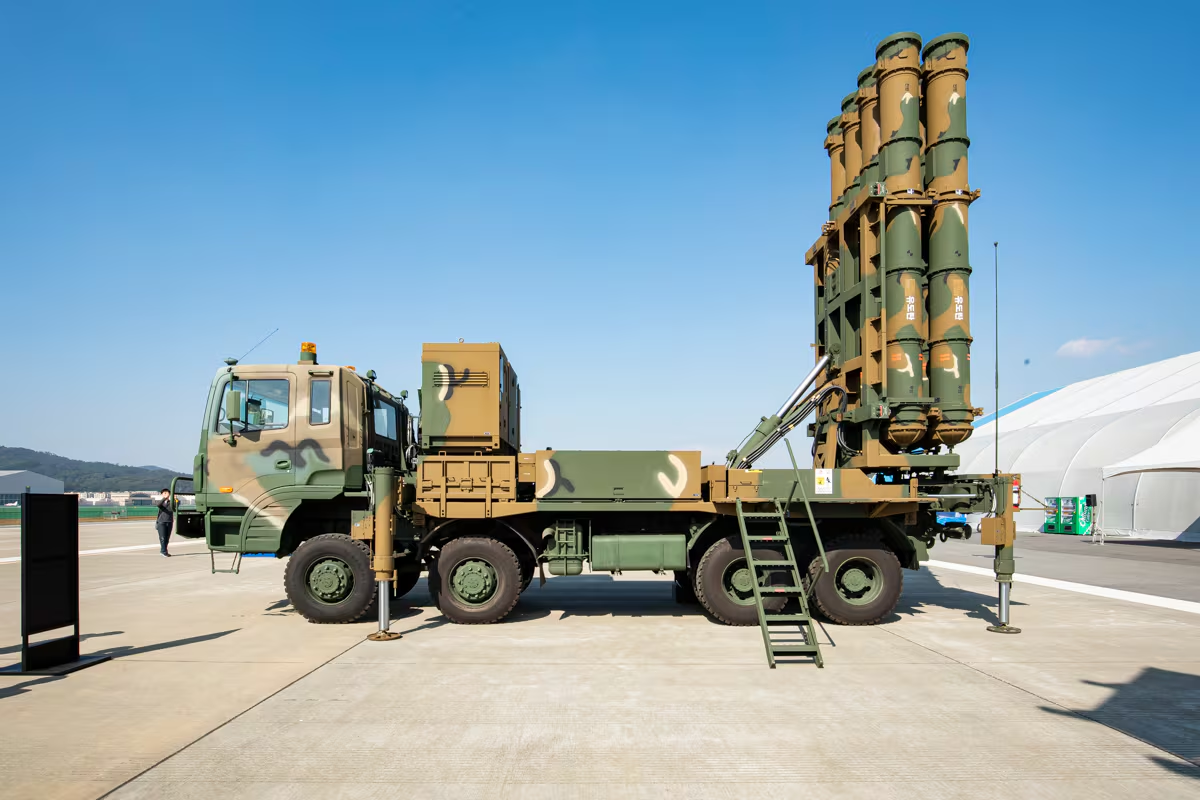
The proposed acquisition package includes engagement control stations, multifunction radars, vertical launch systems, transporter-erector-launchers, missile transloader vehicles, spare parts inventories, technical documentation, integrated logistics support, and technology-transfer arrangements engineered to strengthen Indonesia’s domestic defence-industrial ecosystem.
Indonesia’s decision to pursue the Cheongung II system reflects a broader doctrinal shift in Southeast Asian military planning, where layered integrated air-and-missile defence architectures are increasingly viewed as essential deterrence instruments against ballistic missiles, cruise missiles, loitering munitions, drones, and long-range precision strike platforms.
The strategic significance of the LOI extends beyond procurement mechanics because it positions Indonesia inside a rapidly expanding South Korean defence export ecosystem already spanning the United Arab Emirates, Saudi Arabia, and Iraq, thereby elevating Seoul’s role as a major Indo-Pacific missile defence supplier.
Jakarta’s evolving air-defence posture also reflects mounting concern regarding the vulnerability of critical economic arteries such as the Malacca Strait and Sunda Strait, whose disruption could trigger severe military and economic consequences throughout the Indo-Pacific maritime trading network.
Indonesia’s fragmented geography across more than 17,000 islands has historically complicated radar coverage, fighter interception coordination, and surface-to-air missile deployment, creating exploitable gaps that increasingly concern Indonesian planners as regional missile inventories expand dramatically.
The Cheongung II procurement effort therefore represents not merely an equipment acquisition programme, but a structural attempt to establish overlapping interception layers capable of supporting Indonesia’s “Sishankamrata” total-defence doctrine and the Mandala operational concept emphasizing defence-in-depth.
The LOI emerged publicly through defence-industry channels on 8 June 2026 rather than through official government statements, underscoring Jakarta’s cautious political approach while sensitive budgetary negotiations and strategic consultations remain underway behind closed institutional frameworks.
If finalized, the acquisition would deepen South Korea–Indonesia defence-industrial integration at a time when Jakarta simultaneously pursues fighter modernization programmes involving Rafale aircraft, KF-21 Boramae participation, and expanded indigenous aerospace manufacturing ambitions.
The absence of disclosed contract value or delivery schedules has not diminished regional interest because the proposed acquisition directly intersects with broader Indo-Pacific concerns surrounding missile defence resiliency, distributed command networks, and the survivability of strategic infrastructure under modern precision-strike conditions.
Cheongung II Expands Indonesia’s Medium-Range Interception Capability
The MSAM-II Cheongung II system was developed by South Korea’s Agency for Defense Development with technological influences linked to Russian 9M96 missile architecture associated with the S-350 and S-400 air-defence ecosystem, giving the platform substantial credibility within export markets.
Designed as a mobile medium-range surface-to-air missile system mounted on 8×8 KIA KM1500 tactical trucks, the Cheongung II provides operational flexibility essential for Indonesia’s geographically fragmented island battlespace and rapidly shifting coastal defence requirements.
The Block II interceptor reportedly possesses engagement ranges between 40 and 50 kilometres while operating at altitudes approaching 20 kilometres, allowing Indonesian forces to establish layered defensive envelopes against both aerodynamic and ballistic threats.
The missile’s Mach 5 velocity substantially compresses engagement timelines for hostile aircraft, cruise missiles, and short-range ballistic missiles, thereby strengthening Indonesia’s ability to counter saturation attacks designed to overwhelm slower defensive architectures.
Cheongung II employs inertial navigation, mid-course datalink updates, and terminal active radar homing, enabling networked interception capability against maneuvering targets while reducing dependence on continuous ground-based radar illumination during complex engagement scenarios.
South Korea’s incorporation of hit-to-kill ballistic missile interception capability into the Block II configuration significantly elevates the platform’s strategic value because Southeast Asian militaries increasingly confront regional missile proliferation trends and expanding precision-strike arsenals.
A standard battery configuration reportedly includes one X-band multifunction phased-array radar capable of tracking approximately 40 targets simultaneously alongside four to six transporter-erector-launchers carrying eight ready-to-fire interceptors each.
This engagement architecture substantially enhances Indonesia’s ability to establish overlapping defended zones protecting military bases, logistics nodes, government facilities, and maritime chokepoints vulnerable to modern stand-off missile attacks and drone swarming operations.
The system’s combat credibility received major international attention in March 2026 after UAE-operated Cheongung II batteries reportedly achieved a 96 percent interception rate against Iranian ballistic missiles and drones during regional escalation scenarios.
That operational performance transformed Cheongung II from an emerging export platform into a combat-proven missile defence system, dramatically increasing its attractiveness among countries seeking cost-effective alternatives to more expensive Western missile-defence architectures.
Existing export contracts involving the United Arab Emirates worth approximately US$3.5 billion (RM13.3 billion), Saudi Arabia valued near US$3.2 billion (RM12.16 billion), and Iraq estimated at US$2.8 billion (RM10.64 billion) demonstrate the platform’s accelerating geopolitical significance.

Indonesia’s Layered Air Defence Doctrine Gains Strategic Momentum
Indonesia’s pursuit of Cheongung II aligns directly with Jakarta’s long-term effort to establish a fully integrated layered air-defence architecture spanning surveillance, point defence, medium-range interception, and long-range area defence across the archipelago.
The country’s air-defence modernization strategy is increasingly driven by concerns regarding airspace intrusions, drone proliferation, maritime competition, and the vulnerability of strategic infrastructure supporting Southeast Asia’s critical trade and energy corridors.
Indonesia’s National Air Defense Command, known as Koopsudnas, currently coordinates a three-tiered operational structure combining point air defence, terminal air defence, and broader area-defence responsibilities supported by expanding radar and command-and-control integration.
At the foundation of this architecture lies Indonesia’s rapidly expanding surveillance network centered around Thales Ground Master 403 long-range AESA radars acquired through PT Len Industri to reduce dangerous radar blind spots across national airspace.
Several Ground Master radar systems have already been deployed near Nusantara in East Kalimantan, reflecting Jakarta’s strategic prioritization of protecting Indonesia’s future capital against increasingly sophisticated airborne surveillance and precision-strike threats.
Indonesia additionally plans to field 25 new air-defence radar sites by 2029, including replacement systems for aging installations alongside entirely new facilities intended to support real-time airspace monitoring and fighter interception coordination.
Indigenous radar development programmes are simultaneously underway through Indonesian Army initiatives focusing on surveillance systems capable of detecting UAVs, helicopters, and fast jets at ranges approaching 100 kilometres under tactical operating conditions.
Future modernization plans reportedly envision artificial intelligence-assisted threat detection, expanded satellite integration, and fully networked C2/C4ISR connectivity capable of fusing radar, fighter, missile, and drone defence data into a unified operational picture.
This architecture reflects Indonesia’s growing recognition that modern air defence increasingly depends less on isolated missile batteries and more on resilient sensor fusion networks capable of sustaining operations under electronic warfare and saturation attack conditions.
Cheongung II would therefore serve as the operational bridge between Indonesia’s short-range point-defence systems and emerging long-range air-defence assets, creating layered interception zones engineered to complicate adversary operational planning throughout the archipelago.
NASAMS, Buk-M2 and ADS-400 Create Multi-Layered Shield
Indonesia’s existing medium-range air-defence inventory already includes the NASAMS II system acquired from Norway in 2017 for approximately US$77 million (RM292.6 million), primarily tasked with defending Jakarta and critical national command infrastructure.
The NASAMS deployment established Indonesia as Southeast Asia’s first operator of the highly networked AMRAAM-based system, significantly improving the protection of strategic sites including the presidential palace and Soekarno-Hatta International Airport.
However, the limited scale of Indonesia’s NASAMS inventory exposed enduring capability gaps across broader national territory, particularly given the immense geographic complexity associated with defending thousands of islands and maritime chokepoints simultaneously.
The planned integration of Cheongung II alongside NASAMS would create complementary engagement layers combining Western and South Korean technologies, thereby enhancing operational redundancy and reducing overdependence on a single defence supplier ecosystem.
Indonesia also fields Belarus-origin Buk-M2 systems through its Army air-defence units, providing additional mobile medium-range interception capability against aircraft, cruise missiles, and tactical ballistic threats operating within contested battlespace environments.
At the long-range level, Jakarta is simultaneously advancing the ADS-400 programme involving cooperation between Czech defence firms, Republikorp Indonesia, and potentially Turkish missile industry participation, reflecting Indonesia’s deliberate diversification strategy.
The ADS-400 system reportedly possesses detection ranges approaching 470 kilometres and missile engagement distances nearing 100 kilometres, potentially giving Indonesia an indigenous-linked long-range interception capability tailored to regional operational requirements.
This layered procurement model demonstrates Jakarta’s preference for diversified supplier relationships spanning Europe, South Korea, and domestic industry rather than reliance upon a single geopolitical bloc for national air-defence infrastructure modernization.
Indonesia’s air-superiority modernization plans involving 42 Rafale fighters, continued KF-21 Boramae participation, F-15EX interest, and upgraded F-16 and Su-30 fleets further reinforce the layered-defence concept through mobile beyond-visual-range interception capability.
Armed with long-range air-to-air missiles such as Meteor, these fighter fleets effectively function as the outer mobile interception layer complementing ground-based missile systems protecting strategic facilities, economic zones, and maritime approaches throughout Indonesian territory.
The resulting architecture represents one of Southeast Asia’s most ambitious attempts to integrate fighters, radars, missiles, command networks, and emerging anti-drone systems into a coherent nationwide air-and-missile defence ecosystem by the early 2030s.
South Korea’s Defence Exports Reshape Indo-Pacific Security Networks
Indonesia’s interest in Cheongung II further strengthens South Korea’s emergence as a major defence-industrial actor whose missile exports increasingly shape regional security alignments across the Middle East and Indo-Pacific strategic theatres.
LIG Nex1’s expanding export success reflects broader South Korean efforts to position domestic defence manufacturers as credible alternatives to traditional American, Russian, and European suppliers within highly competitive global arms markets.
Unlike several Western procurement ecosystems burdened by extended delivery timelines and political restrictions, South Korean defence firms increasingly market rapid production cycles, technology-transfer flexibility, and comparatively lower acquisition costs to export customers.
This model has proven especially attractive to middle-power states seeking rapid modernization without excessive geopolitical dependence, thereby enabling Seoul to expand strategic influence through defence-industrial partnerships rather than formal military alliances alone.
Indonesia’s procurement philosophy strongly emphasizes offsets, industrial participation, and technology transfer arrangements designed to strengthen PT Len Industri, Republikorp Indonesia, PTDI, and broader domestic defence manufacturing capabilities over the long term.
The inclusion of offset and technology-transfer provisions inside the Cheongung II LOI therefore indicates Jakarta’s intention to extract industrial and technological value beyond simple missile acquisition, reinforcing broader national defence-industrial self-sufficiency objectives.
South Korea meanwhile benefits strategically from deeper defence ties with Indonesia because Jakarta occupies a central geopolitical position astride critical Indo-Pacific maritime trade arteries linking the Pacific Ocean and Indian Ocean operational theatres.
Expanded South Korean defence integration with Indonesia additionally strengthens Seoul’s strategic relevance inside Southeast Asia at a time when competition among global defence exporters increasingly intersects with wider geopolitical influence contests across the Indo-Pacific.
The Indonesian case also illustrates how missile-defence exports increasingly function as instruments of strategic signalling because layered air-defence systems directly influence regional deterrence calculations, operational planning assumptions, and escalation management frameworks.
Should Indonesia finalize the Cheongung II procurement, the resulting deployment would likely accelerate additional Southeast Asian interest in medium-range ballistic-missile defence systems as regional militaries adapt to intensifying drone warfare and precision-strike proliferation trends.
Budget Constraints and Geographic Complexity Remain Major Obstacles
Despite accelerating modernization momentum, Indonesia still confronts severe structural challenges associated with defending one of the world’s largest archipelagic states against increasingly sophisticated airborne and missile threats operating across enormous distances.
The geographic scale of the Indonesian archipelago creates persistent difficulties involving radar coverage continuity, missile battery deployment density, command-network survivability, and rapid logistical sustainment during high-intensity regional contingency operations.
Indonesia’s historical underinvestment in ground-based air-defence infrastructure means current modernization efforts effectively require simultaneous development of sensors, interceptors, communications networks, and operator training pipelines rather than isolated procurement programmes alone.
Budgetary limitations therefore remain a decisive factor because large-scale nationwide layered-defence coverage requires substantial long-term expenditure involving missile inventories, spare parts stockpiles, maintenance infrastructure, and continuous radar-network expansion.
The Cheongung II LOI itself explicitly remains contingent upon financing arrangements, loan approvals under Indonesian Ministry of Finance regulations, milestone payments, and bid-performance guarantees before any binding contract materializes.
Indonesia must additionally reconcile interoperability challenges arising from its increasingly diversified procurement portfolio involving Norwegian, South Korean, Belarusian, Czech, French, and indigenous defence systems operating simultaneously inside a unified command structure.
Maintaining operational compatibility across multiple radar standards, datalink architectures, missile systems, and command networks will require substantial investment in C2/C4ISR integration capable of supporting real-time multi-domain battlespace coordination.
Emerging threats including hypersonic weapons, low-observable cruise missiles, electronic warfare, and mass drone attacks further complicate Indonesia’s modernization roadmap because future adversaries may exploit saturation tactics against distributed island-based defensive infrastructure.
Nevertheless, Jakarta’s current trajectory clearly indicates strategic commitment toward establishing a credible nationwide layered air-defence ecosystem protecting Nusantara, strategic maritime chokepoints, military facilities, and critical economic zones by the early 2030s.
Indonesia’s Cheongung II initiative therefore represents far more than a missile purchase because it signals the transformation of Southeast Asia’s largest archipelagic state into an increasingly networked air-and-missile defence actor shaping the future Indo-Pacific security environment.
