
India-UAE Strategic Defence Pact Reshapes Gulf Power Balance: Modi-MBZ Security Deal Signals New Indo-Pacific Axis Amid Rising Regional Tensions
India and the UAE formalized a Strategic Defence Partnership framework in Abu Dhabi combining military cooperation, maritime security, technology integration and US$5 billion (RM19 billion) investment commitments, signaling an emerging Indo-Pacific–West Asia strategic convergence with wider geopolitical implications.
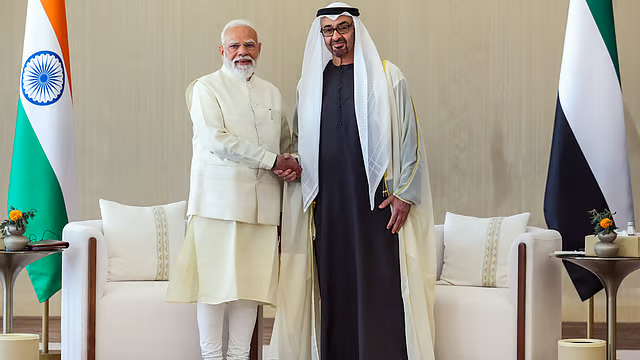
(DEFENCE SECURITY ASIA) — The signing of a Strategic Defence Partnership framework between India and the United Arab Emirates in Abu Dhabi may ultimately reshape the evolving Gulf–Indian Ocean security architecture at a moment when geopolitical alignments across West Asia are entering a new period of strategic fluidity.
The agreement, finalized during Indian Prime Minister Narendra Modi’s May 15 visit to Abu Dhabi and accompanied by highly visible diplomatic symbolism including UAE fighter aircraft escorting his aircraft, carries significance extending far beyond ceremonial defence diplomacy.
Combined with expanding energy agreements, technology cooperation, and approximately US$5 billion (RM19 billion) in investment commitments, the framework reflects the emergence of a broader India-UAE strategic convergence capable of influencing maritime security calculations stretching from the Strait of Hormuz to the Indian Ocean.

Indian officials emphasized through public statements that the arrangement does not target any third country and preserves both states’ strategic autonomy, while Foreign Secretary Vikram Misri stressed the agreement remains a framework rather than an alliance structure carrying automatic military obligations.
The framework expands a relationship that began under a 2003 defence memorandum and later evolved into a Comprehensive Strategic Partnership in 2017, but now introduces institutional mechanisms intended to move bilateral relations toward operational coordination and capability integration.
The latest accord builds directly upon the January 19 Letter of Intent signed during UAE President Sheikh Mohamed bin Zayed Al Nahyan’s visit to New Delhi, transforming political intent into a structured defence architecture spanning industrial cooperation, maritime security, cyber defence, interoperability and technology transfer.
At a time when Gulf security calculations are being reshaped by emerging Saudi-Pakistan defence arrangements, maritime tensions, and intensified strategic competition across Eurasian corridors, the India-UAE agreement introduces a significant new variable into regional power equations.
The agreement’s timing may therefore become as strategically important as its contents because Gulf realignment increasingly reflects competition among flexible middle-power networks rather than rigid Cold War alliance systems.
The convergence also emerges amid intensifying competition over emerging strategic corridors linking the Indo-Pacific and West Asia, where infrastructure resilience, energy flows, and maritime access increasingly function as instruments of geopolitical leverage.
Viewed through a broader force-posture lens, the India-UAE framework may represent an early indicator of how twenty-first century security architectures are shifting toward interconnected middle-power coalitions designed to maximize strategic flexibility without formal alliance entanglements.
READ: India’s BrahMos Missile Crisis Deepens: Production Collapse Threatens Indian Navy Strike Power Against China
From Bilateral Cooperation To Structured Defence Architecture
The Strategic Defence Partnership framework focuses on defence industrial collaboration, co-production initiatives, innovation ecosystems, advanced technology cooperation, military training, interoperability and secure information exchange mechanisms.
Special operations cooperation and counter-terrorism coordination, originally embedded within the January Letter of Intent, remain part of the broader architecture and indicate shared concern regarding transnational security challenges.
Maritime security provisions are likely to receive especially close attention because the agreement links two states whose economic lifelines remain heavily dependent upon uninterrupted sea-based trade and energy routes.
Unlike conventional alliance treaties, the framework deliberately avoids mutual defence clauses or automatic military intervention obligations, preserving strategic flexibility for both capitals.
This distinction carries considerable importance because both India and the UAE have increasingly pursued multi-alignment strategies rather than exclusive bloc-based security structures.
The agreement therefore functions as a capability-enhancement mechanism instead of a collective defence arrangement resembling NATO treaty obligations.
For New Delhi, maintaining strategic autonomy remains a central doctrine shaping military diplomacy across competing geopolitical theatres from Washington and Moscow to Tehran and Abu Dhabi.
Similarly, Abu Dhabi increasingly seeks diversified partnerships that reduce overdependence on traditional Western security guarantors while preserving policy flexibility.
This approach reflects broader regional trends where states increasingly prioritize issue-based security cooperation over rigid alliance commitments.
Implementation over the next two to five years will ultimately determine whether this framework produces substantive military capabilities or remains primarily a political signalling instrument.

India’s Expanding Strategic Footprint Across West Asia
For India, the agreement strengthens geopolitical positioning across a region supplying approximately sixty percent of its imported oil while hosting more than nine million Indian nationals.
Energy security considerations remain especially significant amid continuing concerns surrounding instability affecting strategic maritime routes near the Strait of Hormuz.
The Strait of Hormuz handles a substantial proportion of globally traded petroleum flows and remains one of the world’s most critical maritime chokepoints.
Consequently, any mechanism improving regional maritime stability directly contributes to India’s broader national security calculations.
The defence agreement was signed alongside strategic petroleum reserve cooperation designed to support India’s long-term energy resilience objectives.
Additional long-term LPG arrangements involving Indian firms and ADNOC further reinforce this dimension of strategic interdependence.
India simultaneously seeks to expand strategic petroleum storage capacity toward approximately thirty million barrels alongside associated gas reserves.
The package additionally included agreements concerning ship repair infrastructure development at Vadinar in Gujarat through cooperation involving Cochin Shipyard and UAE-linked Drydocks World.
Such initiatives collectively illustrate how logistical infrastructure increasingly functions as an integral component of modern strategic competition.
Rather than treating defence and economics separately, New Delhi increasingly integrates energy security, industrial partnerships and military diplomacy within a single geopolitical framework.
Defence Industrial Cooperation And “Make In India” Calculations
Defence industrial collaboration represents one of the framework’s most strategically consequential components because it aligns directly with India’s long-term indigenous defence manufacturing ambitions.
Co-production arrangements could potentially create pathways for Indian defence systems and technologies to gain greater visibility within Gulf and broader international markets.
Indian defence planners have consistently emphasized reducing external procurement dependency while expanding export opportunities under the “Make in India” initiative.
Industrial cooperation therefore serves not merely as economic engagement but also as a force multiplier supporting national strategic autonomy.
The framework’s emphasis upon advanced technology and innovation ecosystems suggests both states intend to move beyond traditional buyer-seller defence relationships.
Technology-sharing initiatives could potentially strengthen indigenous industrial capacity while reducing procurement vulnerabilities associated with concentrated supplier networks.
The UAE meanwhile gains opportunities to access cost-effective manufacturing ecosystems and military technologies through collaboration with a major emerging defence producer.
For Abu Dhabi, defence diversification increasingly represents both strategic insurance and an instrument supporting military modernization objectives.
Such arrangements also permit gradual capability expansion without requiring formal alliance commitments potentially constraining policy freedom.
Whether industrial cooperation evolves into tangible defence production outcomes, however, remains dependent upon implementation mechanisms that have yet to become fully visible.
Maritime Security Signals Across The Gulf–Indian Ocean Continuum
Joint maritime coordination embedded within the framework introduces important implications extending beyond bilateral naval cooperation.
India and the UAE occupy strategic geographic positions connected through major maritime routes linking the Gulf, Arabian Sea, Red Sea and wider Indian Ocean.
Enhanced naval coordination therefore potentially contributes toward broader sea-lane security across economically critical trade corridors.
Military planners increasingly view logistics networks and maritime infrastructure as decisive components within contemporary strategic competition.
Joint exercises, intelligence-sharing and interoperability mechanisms may therefore gradually strengthen operational awareness along regional maritime spaces.
These initiatives acquire additional relevance amid concerns surrounding regional instability and previous attacks affecting UAE-linked infrastructure.
Prime Minister Modi publicly condemned recent attacks impacting UAE facilities and reiterated Indian support during his visit.
Such statements demonstrate how political messaging increasingly intersects with maritime and energy security calculations.
The agreement simultaneously reinforces broader connectivity concepts associated with emerging strategic corridors linking Indo-Pacific and West Asian theatres.
Consequently, maritime security cooperation increasingly functions as geopolitical architecture rather than narrowly defined naval engagement.
Gulf Realignments And Emerging Middle-Power Security Networks
The timing of the agreement has generated interest because it emerged months after Saudi Arabia and Pakistan signed a Strategic Mutual Defence Agreement during September 2025.
Some observers view the latest India-UAE initiative as evidence of subtle balancing behaviour occurring amid evolving Gulf security alignments.
The existence of multiple overlapping defence frameworks increasingly reflects a fragmented strategic environment driven by flexible partnerships rather than centralized alliance blocs.
Several analysts have suggested emerging security poles could gradually reshape longstanding regional relationships traditionally influenced by Saudi-Pakistan strategic ties.
India potentially gains indirect geopolitical leverage through expanded engagement across a region where Pakistan historically maintained strong defence relationships.
The framework additionally aligns with broader middle-power convergence associated with initiatives involving technology, infrastructure and security cooperation.
Such networks increasingly emphasize practical cooperation focused upon trade routes, energy security and technological resilience.
Both India and the UAE nevertheless continue emphasizing that their partnership does not target specific states or geopolitical rivals.
Regional responses remain closely monitored because Pakistan reportedly views developments cautiously while wider reactions from China and Iran remain relatively restrained.
The agreement ultimately reflects a twenty-first century model where strategic partnerships increasingly emerge from shared economic and security calculations rather than ideological alignment.
READ: “Shadow War Explodes”: UAE Secretly Strikes Iran as Gulf Conflict Pushes Strait of Hormuz Toward Global Energy Crisis
Strategic Optionality Instead Of Alliance Politics
Perhaps the most significant consequence of the India-UAE framework lies in what it reveals regarding changing international security behavior.
Rather than constructing rigid alliance systems, middle powers increasingly prefer adaptable arrangements preserving strategic maneuverability across multiple geopolitical theatres.
This agreement therefore reinforces a broader pattern where states simultaneously pursue diversified partnerships without committing to exclusive geopolitical camps.
For India, the framework strengthens access, resilience and strategic presence across one of its most critical external regions.
For the UAE, the arrangement expands defence options while reducing overreliance upon traditional security structures.
The result is not an Indo-Pacific military bloc extending into the Gulf but a more distributed architecture emphasizing optionality, interoperability and shared strategic interests.
As implementation unfolds during coming years, observers will closely assess whether the framework evolves into a meaningful force-posture mechanism or remains primarily a diplomatic milestone.
What already appears evident, however, is that India and the UAE are positioning themselves as increasingly influential middle powers within a more networked and multipolar regional security environment.
