
India Reinforces Nuclear Second-Strike Capability as INS Arihant Successfully Test-Fires K-4 SLBM
Successful submarine-launched ballistic missile test underscores India’s transition from declaratory nuclear posture to operationally credible sea-based second-strike deterrence

(DEFENCE SECURITY ASIA) — India has crossed another decisive threshold in its pursuit of a survivable and credible nuclear deterrent with the successful test of the K-4 submarine-launched ballistic missile (SLBM) from the nuclear-powered ballistic missile submarine INS Arihant in the Bay of Bengal on 23 December 2025, a development that fundamentally strengthens New Delhi’s second-strike capability while reshaping the strategic calculus across South Asia and the wider Indo-Pacific maritime domain.
The launch, executed from a concealed underwater platform operating within India’s eastern seaboard bastion, reflects a deliberate maturation of the sea-based leg of India’s nuclear triad and signals the transition from experimental deterrence to routine, operationally credible undersea nuclear patrols capable of surviving a first strike and delivering assured retaliation.

By validating a submarine-launched ballistic missile with an operational range of approximately 3,500 kilometres, India has demonstrated the ability to hold at risk strategic targets deep inside continental Asia while maintaining its ballistic missile submarines well away from hostile shores, thereby reinforcing deterrence stability through survivability rather than escalation.
This milestone unfolds against a backdrop of intensifying strategic competition marked by persistent India-China border tensions, Pakistan’s evolving sea-denial doctrines, and the expanding militarisation of the Indian Ocean, elevating the K-4 test from a technical exercise to a geopolitical signal of intent, capability, and strategic maturity.
The discreet nature of the operation, conducted without official fanfare, aligns with India’s long-standing doctrine of “No First Use” and credible minimum deterrence, whereby strategic signalling is calibrated to reassure allies, caution adversaries, and preserve escalation control without unnecessary provocation.
India’s successful K-4 SLBM test also underscores the quiet consolidation of a command-and-control architecture capable of securely transmitting launch authority to submerged assets, a prerequisite for credible second-strike deterrence that separates mature nuclear forces from declaratory ones.
By demonstrating repeatable launch readiness from an operational SSBN rather than a test platform, New Delhi signals that its sea-based deterrent has moved beyond symbolic capability toward sustained patrol credibility, a shift that adversaries must now factor into real-time strategic planning.
The test further compresses the decision-making timelines of rival nuclear planners by introducing uncertainty over patrol locations and survivability, thereby strengthening deterrence through ambiguity rather than numerical expansion of warheads or delivery systems.
From a regional balance perspective, the K-4’s validated reach recalibrates deterrence equations by reducing India’s reliance on vulnerable land-based missiles in early conflict phases, allowing escalation management to remain firmly under political control.
Taken together, these dynamics indicate that India’s nuclear posture is evolving toward a more stable, survivable, and strategically restrained model of deterrence, one designed not to seek dominance but to deny adversaries any illusion of a disarming first strike.
K-4 SLBM: Technical Architecture and Strategic Reach Beneath the Waves
The K-4 SLBM, also known as Kalam-4, represents a generational leap in India’s indigenous missile design, combining range, accuracy, stealth compatibility, and payload flexibility into a system purpose-built for nuclear deterrence from submerged platforms.
With a launch mass of approximately 17 tonnes, a length of around 12 metres, and a diameter of 1.3 metres, the two-stage, solid-fuel missile is engineered to be compatible with India’s Arihant-class vertical launch architecture while maintaining sufficient energy margins for long-range trajectories.
The missile’s cold-launch mechanism, in which compressed gas ejects the missile from the launch tube before main motor ignition, is a defining feature that dramatically reduces acoustic and thermal signatures during launch, enhancing submarine survivability in contested anti-submarine warfare environments.
Guidance is achieved through a sophisticated inertial navigation system augmented by multi-GNSS updates and terminal terrain contour matching, producing a circular error probable reportedly below 10 metres, a level of accuracy that places the K-4 firmly among modern strategic-grade SLBMs.
The missile’s payload capacity of up to 2,500 kilograms allows for flexibility in warhead configuration, with nuclear payloads forming the core deterrent mission while retaining the theoretical capacity for future conventional strategic roles if doctrine evolves.
At its full payload, the K-4’s effective range of approximately 3,500 kilometres enables coverage of strategic targets across Pakistan and significant portions of mainland China from patrol areas in the northern Indian Ocean, while reduced payload configurations potentially extend reach toward the 4,000-kilometre threshold.
This reach dramatically surpasses that of the earlier K-15 Sagarika SLBM, which was constrained to approximately 750 kilometres and required submarines to operate dangerously close to adversary coastlines, exposing them to detection and neutralisation.
The K-4’s manoeuvring re-entry profile and trajectory shaping further complicate interception efforts by regional missile defence systems, including layered intercept architectures and evolving sea-based sensors, thereby preserving the credibility of penetration in a missile defence-saturated battlespace.
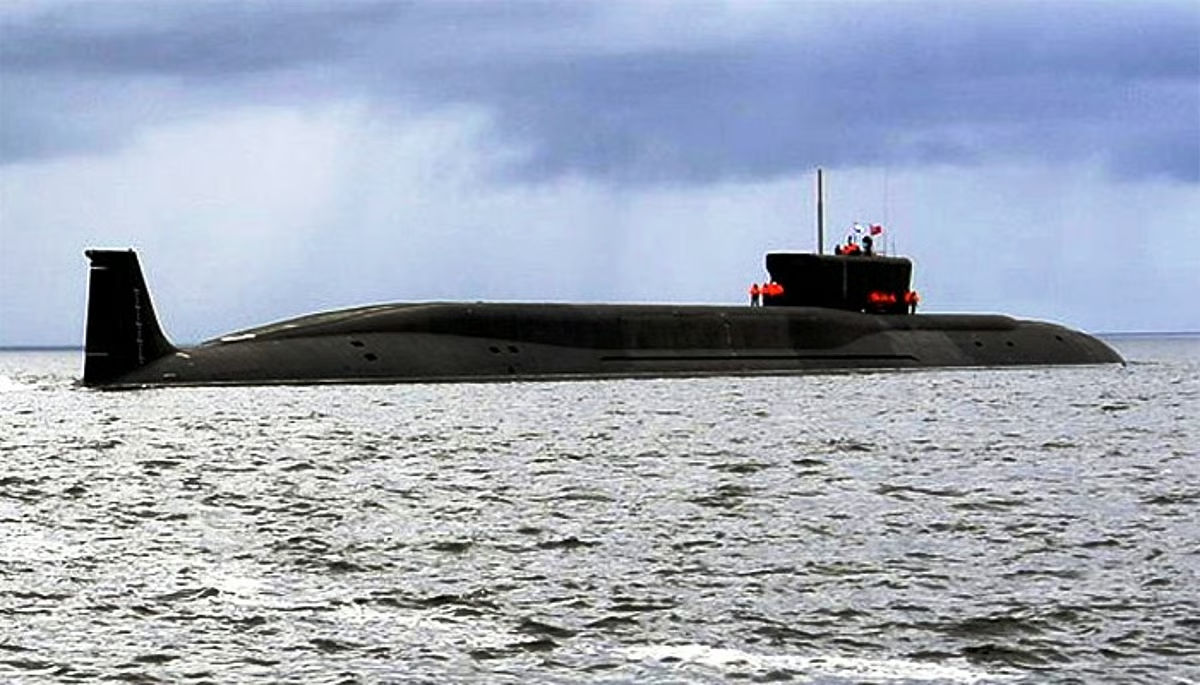
INS Arihant and the Quiet Emergence of India’s SSBN Force
The launch platform, INS Arihant, stands as the cornerstone of India’s sea-based nuclear deterrent, embodying decades of indigenous technological development under the highly classified Advanced Technology Vessel programme.
Commissioned into service in 2016, the submarine displaces approximately 6,000 tonnes submerged and is powered by an 83-megawatt pressurised water reactor, enabling extended underwater endurance and sustained deterrence patrols without the need for surfacing.
INS Arihant is equipped with four vertical launch tubes capable of carrying either multiple K-15 SLBMs or a single K-4 missile per tube, allowing commanders to tailor deterrence loadouts based on mission objectives and strategic requirements.
The December 2025 launch marks a critical shift from developmental testing to user-validated operational employment, signalling that the platform, missile, crew training, command-and-control integration, and safety protocols have matured sufficiently for active deterrence patrols.
India’s SSBN fleet expansion further amplifies this capability, with INS Arighaat, commissioned in August 2024, already incorporating K-4 compatibility and forming the second leg of a rotational deterrence posture.
The forthcoming INS Aridhaman (S4), expected to enter service in early 2026, features an extended hull and eight launch tubes, effectively doubling missile capacity and enabling greater patrol endurance and redundancy.
Beyond this, the planned S5-class SSBNs, designed to carry longer-range systems such as the K-5 and K-6 with ranges exceeding 5,000 kilometres, will elevate India’s deterrent reach to intercontinental scales by the 2030s.
The Bay of Bengal has emerged as India’s principal sea-based testing and patrol corridor, supported by carefully delineated air and maritime exclusion zones that allow for discreet validation of strategic systems without undue international escalation.
From IGMDP to K-Series: The Long Arc of India’s Strategic Missile Evolution
India’s pursuit of a credible nuclear triad has been shaped by decades of strategic restraint combined with persistent technological investment, beginning with the Integrated Guided Missile Development Programme and culminating in the K-series of submarine-launched missiles.
While land-based systems such as the Agni-III and air-delivered nuclear options provided early deterrence coverage, they remained vulnerable to pre-emptive strikes and surveillance, underscoring the necessity of a survivable sea-based leg.
The K-4 programme emerged as a direct response to these vulnerabilities, addressing the operational shortcomings of shorter-range SLBMs while integrating lessons learned from both successful and failed test campaigns.
Early milestones included a submerged pontoon launch in January 2010, followed by a successful 3,000-kilometre test in March 2014 that validated propulsion and guidance architectures.
The first firing from INS Arihant in 2016 marked a conceptual breakthrough, while subsequent tests in 2020 and 2024 incrementally refined reliability, accuracy, and system integration.
Failures, including a notable setback in December 2017, served as inflection points for improvements in energetic materials, propulsion stability, and launch system robustness, ultimately strengthening the programme’s resilience.
The development ecosystem supporting the K-4 spans multiple specialised entities responsible for propulsion chemistry, guidance algorithms, launch system mechanics, and safety architecture, reflecting a mature and increasingly self-reliant defence industrial base under the Atmanirbhar Bharat framework.
This indigenous focus not only reduces external dependency but also insulates India’s deterrent from geopolitical supply-chain vulnerabilities, a critical factor in long-term strategic stability.
Strategic Signalling and Deterrence Dynamics in South Asia and Beyond
The successful K-4 test carries profound strategic implications, reinforcing India’s ability to maintain assured retaliation in a region characterised by nuclear asymmetry, evolving doctrines, and intensifying great-power competition.
By enabling SSBNs to operate from protected oceanic bastions, India significantly complicates adversary targeting calculations, forcing potential opponents to invest disproportionately in anti-submarine warfare, surveillance, and missile defence resources.
This shift is particularly consequential in the context of China’s expanding nuclear arsenal and growing maritime footprint in the Indian Ocean, including port access arrangements and dual-use infrastructure projects.
The presence of foreign research and surveillance vessels in the Indian Ocean during the testing window underscores the increasingly contested nature of the maritime domain and the intelligence value attributed to India’s strategic programmes.
In the Pakistan context, the K-4 enhances deterrence stability by reinforcing mutual vulnerability at the strategic level, countering Islamabad’s emphasis on tactical nuclear weapons and sea-denial strategies.
At a broader Indo-Pacific level, India’s strengthened sea-based deterrent intersects with the strategic interests of like-minded maritime powers, potentially contributing to a balance that discourages unilateral escalation while raising concerns about arms racing among rivals.
“The alignment of India’s high-profile strategic missile testing and China’s expanded maritime presence marks a clear uptick in interactions between nuclear powers in the region,” reflects a growing recognition that strategic signalling at sea now plays a central role in regional stability.
“The Indian Ocean…currently lacks a strong incident prevention framework, especially amongst nuclear armed or nuclear capable states,” underscores the risks inherent in increased undersea and surface interactions without robust confidence-building mechanisms.
Global Standing, Future Trajectories, and the Cost of Strategic Credibility
With the K-4 SLBM validated from an operational SSBN, India joins a select group of nations possessing a functional, indigenous sea-based nuclear deterrent, elevating its strategic standing alongside established nuclear powers.
This capability, while stabilising in theory, also carries significant financial and operational costs, as continuous at-sea deterrence demands sustained investment in submarines, missiles, training, maintenance, and command infrastructure.
While precise programme costs remain classified, the cumulative investment in India’s SSBN force and K-series missiles is widely assessed to run into tens of billions of US dollars, equivalent to hundreds of billions of Malaysian Ringgit, reflecting the premium placed on strategic autonomy and survivability.
Looking ahead, additional K-4 trials are expected to further integrate the missile across the fleet, while parallel development of longer-range systems will extend deterrence reach well into the next decade.
“Reducing escalation risks in the Indian Ocean does not require resolving regional rivalries, but the significant risks must be managed more responsibly,” encapsulates the challenge facing nuclear-armed states operating in an increasingly crowded maritime environment.
The December 2025 test stands not merely as a demonstration of engineering prowess, but as a defining moment in India’s evolution from a restrained nuclear power to a fully matured, sea-based deterrence state.
“Massive boost to India’s nuclear triad! Successful test of nuclear-capable K-4 SLBM (~3500km range) from Arihant-class submarine in Bay of Bengal,” captures the strategic weight of the achievement and its enduring implications for regional and global security.
As India continues to refine its undersea deterrent while advocating stability and restraint, the K-4 programme will remain a central pillar of its strategic architecture in an era defined by multipolar competition and maritime contestation. — DEFENCE SECURITY ASIA
