
India Moves to Build 600 HAMMER Precision Bombs as Rajnath Singh Pushes Sovereign Air Strike Power Against China-Pakistan Threat Axis
India’s decision to domestically manufacture approximately 600 HAMMER precision-guided weapons represents a major strategic shift toward sovereign precision strike capability, resilient wartime logistics, and long-term Indo-Pacific deterrence against China and Pakistan.
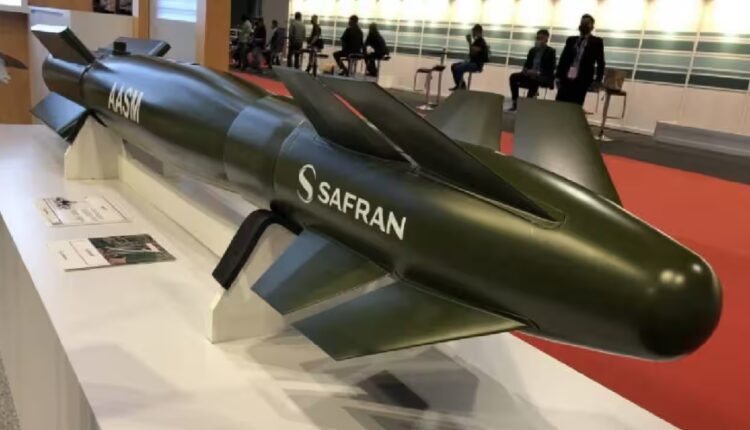
(DEFENCE SECURITY ASIA) — India’s decision to pursue indigenous production of approximately 600 HAMMER precision-guided weapons marks a strategic transition from import-dependent strike capability toward sovereign air-launched precision warfare architecture across the Indo-Pacific security environment.
The proposal, evaluated during the July 3 meeting of the Defence Acquisition Council chaired by Defence Minister Rajnath Singh, directly links India’s future aerial strike doctrine with domestic military-industrial expansion and resilient wartime logistics sustainability.
This was the first Defence Acquisition Council session attended by India’s newly appointed military leadership, including the Chief of Defence Staff alongside the chiefs of the Army and Navy, giving additional strategic significance to the procurement deliberations.

The proposed acquisition, valued at roughly ₹2,400 crore equivalent to approximately USD 279 million or RM1.06 billion, centres on the localised production of the French-origin HAMMER precision-guided stand-off weapon system under the “Make in India” framework.
Most of the 600 modular precision-guided munitions are expected to equip the Indian Air Force’s Rafale multirole combat aircraft and the indigenous Light Combat Aircraft Tejas fleet, substantially expanding India’s precision-strike inventory density.
A dedicated portion of the proposed inventory will also arm the Indian Navy’s future Rafale Marine fighters, extending India’s maritime precision-strike capability into carrier-based expeditionary operations across contested Indo-Pacific sea lanes.
The procurement emerges as India increasingly prioritises survivable stand-off strike systems capable of penetrating layered air defence networks without exposing combat aircraft to short-range and medium-range surface-to-air missile engagement envelopes.
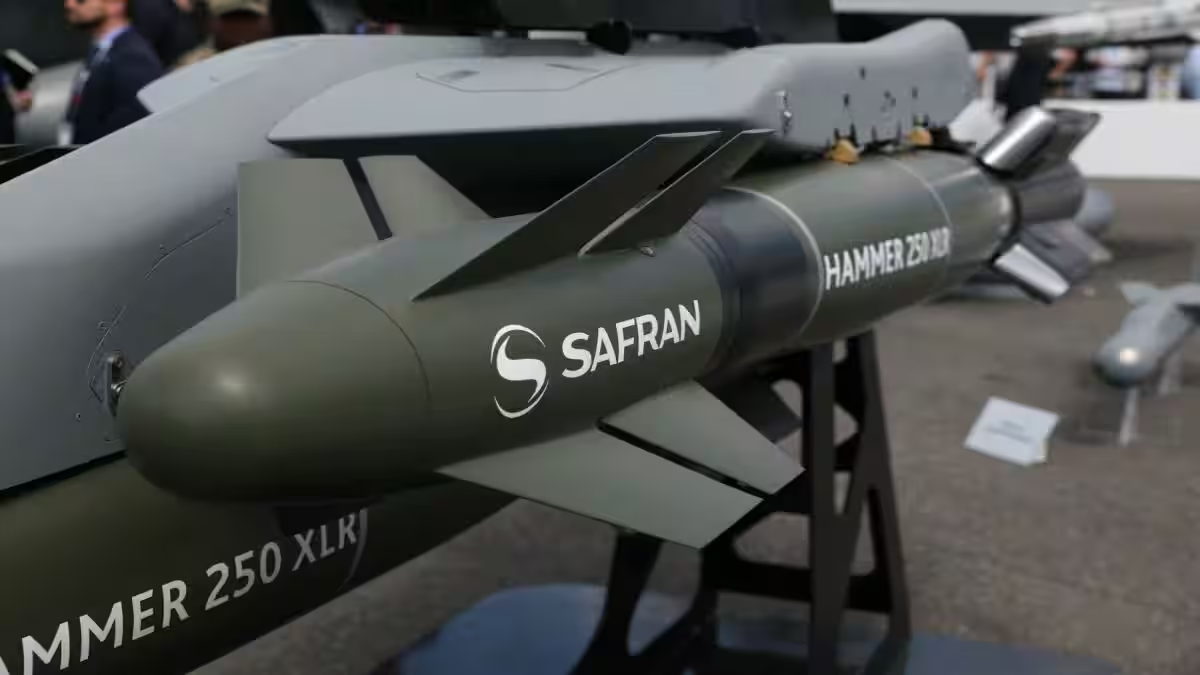
The HAMMER weapon system, developed by Safran Electronics & Defence, converts conventional unguided bombs into modular precision-guided munitions through the integration of advanced guidance packages and rocket-assisted range-extension kits.
Its modular architecture allows the weapon to employ INS/GPS, infrared imaging, or semi-active laser guidance systems, enabling highly adaptable strike profiles against hardened, mobile or heavily defended targets under all-weather operational conditions.
With operational ranges exceeding 70 kilometres from high-altitude release profiles, the weapon significantly enhances India’s ability to conduct deep precision strikes while remaining outside hostile air defence engagement zones.
The programme also reinforces the expanding India-France strategic defence partnership, which increasingly extends beyond platform acquisition into industrial localisation, aerospace technology absorption and long-term sovereign sustainment capability development.
More importantly, the localisation of HAMMER production represents a broader geopolitical signal that India intends to institutionalise military self-reliance while simultaneously reducing operational vulnerabilities associated with external wartime supply-chain disruption.
Indigenous HAMMER Production Reshapes India’s Precision-Strike Logistics Ecosystem
The indigenous production structure is expected to be executed through the 50:50 joint venture between Bharat Electronics Limited and Safran Electronics & Defence, formalised through agreements signed between February and November 2025.
The industrial arrangement moves beyond simple licensed assembly because Bharat Electronics Limited will oversee final integration, testing, quality assurance and long-term sustainment responsibilities for the precision-guided weapon programme.
Key electronic modules, mechanical assemblies and mission-critical subsystems are expected to be progressively manufactured inside India, supporting an indigenisation target approaching approximately 60 percent across future production batches.
The programme is also strategically designed to qualify under India’s “Buy Indian–IDDM” procurement category, requiring at least 50 percent indigenous content to reinforce national defence-industrial sovereignty objectives.
Such localisation substantially reduces India’s dependence on foreign precision-guided munition replenishment pipelines during prolonged regional contingencies involving high operational expenditure rates or embargo-related supply-chain instability.
By internalising production capacity, India simultaneously shortens replenishment timelines, strengthens inventory resilience and expands wartime scalability for future high-intensity air campaigns requiring sustained precision-strike sortie generation.
The establishment of a dedicated Centre of Excellence for HAMMER-related production and technology absorption further suggests India intends to institutionalise advanced aerospace manufacturing competencies rather than pursue short-term procurement substitution alone.
This industrial approach reflects a wider Indian defence modernisation strategy increasingly focused on securing sovereign control over ammunition ecosystems, avionics integration pathways and combat sustainment infrastructure supporting network-centric warfare operations.
The programme additionally creates opportunities for India to evolve into a regional maintenance, repair and sustainment hub for future operators of the HAMMER ecosystem across the broader Indo-Pacific defence market environment.
From a geopolitical perspective, the localisation initiative also strengthens the durability of India-France defence ties by transforming the relationship from transactional procurement into long-term co-development and industrial interdependence architecture.
Rafale and Tejas Integration Expands India’s Deep-Strike Battlespace Flexibility
The majority allocation of HAMMER precision-guided weapons to India’s Rafale fleet directly enhances the Indian Air Force’s ability to conduct survivable deep-strike operations against heavily defended strategic targets.
India previously integrated HAMMER weapons onto Rafale aircraft following emergency acquisitions conducted after the 2020 border crisis environment, providing the Indian Air Force with rapid-response precision-strike capability expansion.
The weapon’s off-axis launch capacity, reportedly reaching up to 90 degrees, substantially complicates enemy defensive calculations because strike aircraft no longer require predictable attack vectors against defended targets.
Its ability to ripple-fire multiple weapons during a single attack run also increases operational saturation potential, allowing fewer combat aircraft to generate disproportionately larger precision-strike effects during compressed engagement windows.
Integration with the indigenous Tejas platform carries equally important strategic implications because it extends advanced stand-off strike capability beyond India’s imported combat aircraft ecosystem into domestically produced fighter infrastructure.
This integration strengthens the credibility of the Tejas programme as a genuinely multirole combat aircraft capable of participating in sophisticated precision-strike operations rather than remaining confined to limited air-defence responsibilities.
The combination of Tejas and HAMMER also enhances distributed force posture flexibility because India can field precision-guided strike capability across a broader number of operational squadrons and forward air bases.
For India’s military planners, standardising a common precision-guided munition across Rafale, Tejas and future Rafale Marine fleets reduces logistical fragmentation while improving maintenance efficiency, pilot training continuity and inventory management coherence.
The weapon’s all-weather operational profile additionally strengthens India’s capacity to sustain combat effectiveness during degraded visibility conditions frequently encountered across mountainous northern sectors and maritime operational environments.
Collectively, the integration effort reflects India’s broader transition toward system-of-systems warfare concepts where combat aircraft, precision-guided munitions, sensors and logistics architecture function as interconnected operational ecosystems rather than isolated platforms.
Rafale Marine Integration Strengthens India’s Carrier-Based Strike Posture
The allocation of HAMMER weapons to the Indian Navy’s future Rafale Marine fighters significantly strengthens India’s emerging carrier-based precision-strike capability across the Indian Ocean and broader Indo-Pacific maritime battlespace.
Carrier aviation increasingly functions as a strategic signalling instrument in regional power competition because naval aviation assets enable rapid force projection without dependence on vulnerable overseas basing arrangements.
By equipping Rafale Marine fighters with stand-off precision-guided weapons, India enhances its ability to conduct anti-surface, coastal suppression and maritime interdiction operations while maintaining survivability against integrated naval air-defence systems.
The extended engagement envelope offered by HAMMER weapons allows carrier-based strike aircraft to remain farther from hostile radar coverage and layered shipborne missile engagement zones during offensive operations.
This capability becomes strategically significant as Indo-Pacific maritime competition increasingly centres on contested sea lanes, expeditionary naval operations and anti-access or area-denial force postures across regional chokepoints.
The weapon’s precision guidance architecture also improves India’s ability to execute selective tactical strikes while minimising collateral damage during maritime escalation scenarios involving densely trafficked commercial shipping corridors.
For the Indian Navy, integrating HAMMER onto Rafale Marine aircraft strengthens operational interoperability between naval aviation and Indian Air Force strike doctrines, creating greater joint-force targeting coherence during combined campaigns.
The programme also reinforces India’s ambition to transform carrier groups into multi-domain strike formations capable of supporting air dominance, maritime denial and expeditionary deterrence simultaneously across extended operational theatres.
Strategically, the move signals that India increasingly views naval aviation not merely as fleet defence infrastructure but as a central instrument of regional strategic deterrence and maritime power projection.
This evolution aligns with broader Indo-Pacific military trends where carrier aviation platforms are progressively integrated into network-centric battlespace architectures supporting long-range precision engagement and distributed combat operations.
DAC Procurement Agenda Reflects India’s Multi-Domain Military Modernisation Push
The HAMMER proposal formed part of a broader Defence Acquisition Council procurement package reportedly valued at more than ₹1 lakh crore before subsequent approval stages refined specific acquisition figures and operational priorities.
Post-meeting reporting indicated that the council granted Acceptance of Necessity approvals for acquisitions valued at approximately ₹52,000 crore, equivalent to roughly USD 6.05 billion or RM22.99 billion.
Alongside the HAMMER programme, the procurement agenda included India’s indigenous Man-Portable Anti-Tank Guided Missile system alongside Russian-origin Verba very short-range air-defence systems and high-altitude pseudo-satellite capabilities.
This procurement mix demonstrates India’s increasing focus on multi-domain warfare preparedness spanning tactical ground combat, integrated air defence, persistent surveillance and long-range precision engagement architecture.
The inclusion of indigenous systems alongside foreign-origin technologies also illustrates New Delhi’s hybrid procurement strategy balancing operational urgency with long-term industrial sovereignty and technology absorption objectives.
India’s broader military modernisation effort increasingly prioritises scalable domestic manufacturing ecosystems capable of sustaining future combat requirements independently from unpredictable geopolitical supply-chain dynamics.
The HAMMER programme particularly illustrates how India now links precision-guided munition acquisition directly with aerospace industry expansion, sovereign sustainment capability and strategic deterrence credibility across multiple operational theatres.
From a regional security perspective, the expansion of India’s stand-off precision-strike inventory may influence neighbouring military procurement priorities, particularly regarding integrated air defence systems and counter-strike survivability planning.
The programme also reinforces India’s positioning as an increasingly self-reliant aerospace and defence manufacturing actor capable of integrating imported technology into domestically sustained military ecosystems.
Although additional official clarification regarding exact procurement quantities and contract finalisation timelines may still emerge, the initiative already represents one of India’s most strategically consequential precision-strike localisation efforts in recent years.
HAMMER Procurement Alters Regional Airpower Calculations Across South Asia and the Indo-Pacific
India’s decision to localise production of 600 HAMMER precision-guided weapons is likely to trigger broader regional reassessments regarding air-defence survivability, strike-range asymmetry and precision-engagement readiness across South Asia and the Indo-Pacific.
The expansion of India’s stand-off strike inventory increases operational pressure on neighbouring militaries because fixed command infrastructure, logistics hubs and forward operating facilities become more vulnerable to precision engagement from protected launch distances.
For regional air forces operating legacy combat aircraft without equivalent stand-off precision-guided capability, India’s evolving strike architecture may widen technological and doctrinal asymmetries during future high-intensity contingency scenarios.
The integration of HAMMER across Rafale, Tejas and Rafale Marine platforms also enhances India’s distributed combat resilience because precision-strike capability becomes less dependent on a single aircraft ecosystem or operational theatre.
This operational flexibility complicates adversary targeting calculations because Indian precision-strike assets can now be dispersed across multiple air bases, carrier groups and operational sectors without degrading mission effectiveness.
The programme additionally strengthens India’s deterrence posture along contested border sectors because stand-off precision weapons improve escalation-control options between conventional artillery exchanges and higher-risk strategic missile employment.
From a military-technical perspective, the HAMMER system’s combination of modular guidance packages, high manoeuvrability and all-weather engagement capability reflects the growing importance of adaptable smart munitions in modern network-centric warfare environments.
Its integration into India’s force structure also supports future combat concepts involving sensor fusion, collaborative targeting and real-time battlespace adaptation where precision-guided weapons increasingly function as interconnected nodes within larger operational ecosystems.
For France, the localisation initiative reinforces Paris’ expanding strategic role within Indo-Pacific defence-industrial partnerships, particularly as regional states seek alternatives to excessive dependence on single-source military suppliers.
Ultimately, India’s indigenous HAMMER production programme signals that future Indo-Pacific military competition will increasingly depend not only on combat aircraft numbers, but on resilient precision-strike ecosystems integrating logistics, manufacturing, sustainment and sovereign technological control.
