
Guam No Longer Safe: China’s DF-26 Missile Threat Forces U.S. Marines to Move War Stockpiles Deep Into Australia
The Pentagon’s US$30 million (RM114 million) logistics expansion in southeastern Australia signals a major Indo-Pacific force posture shift as China’s DF-26 and DF-27 missile systems increasingly threaten Guam, the First Island Chain, and America’s traditional Pacific rear bases.

(DEFENCE SECURITY ASIA) — The Pentagon’s decision to establish a permanent war-ready U.S. Marine Corps logistics stockpile in southeastern Australia reflects a strategic admission that China’s anti-access and area-denial architecture has fundamentally altered the survivability of America’s Indo-Pacific force posture.
Washington’s allocation of US$30 million (RM114 million) for new warehouses, offices, ammunition storage infrastructure, and sustainment facilities in Victoria demonstrates how rapidly the operational geography of the Pacific theatre is being rewritten by Chinese long-range precision strike capabilities.
The emerging logistics complex at Bandiana military base in Victoria is designed to support “critical forward provisioning,” allowing combat-ready weapons, vehicles, ammunition, spare parts, and sustainment materiel to flow rapidly into Indo-Pacific contingencies without depending exclusively on vulnerable forward depots.

The facility is expected to achieve full operational capacity by 2028, creating what American planners increasingly view as a strategic depth node supporting distributed maritime operations, expeditionary advanced base operations, and wider U.S.-allied force projection across the Pacific battlespace.
The relocation of critical logistics farther south reflects growing Pentagon concern that traditional rear-area sanctuaries inside the First Island Chain, and even Guam itself, may no longer survive sustained Chinese missile saturation attacks during a high-intensity regional conflict.
China’s People’s Liberation Army Rocket Force has steadily expanded a layered strike network integrating intermediate-range ballistic missiles, anti-ship ballistic missiles, hypersonic glide systems, long-range cruise missiles, and space-enabled targeting infrastructure designed specifically to dismantle U.S. operational logistics.
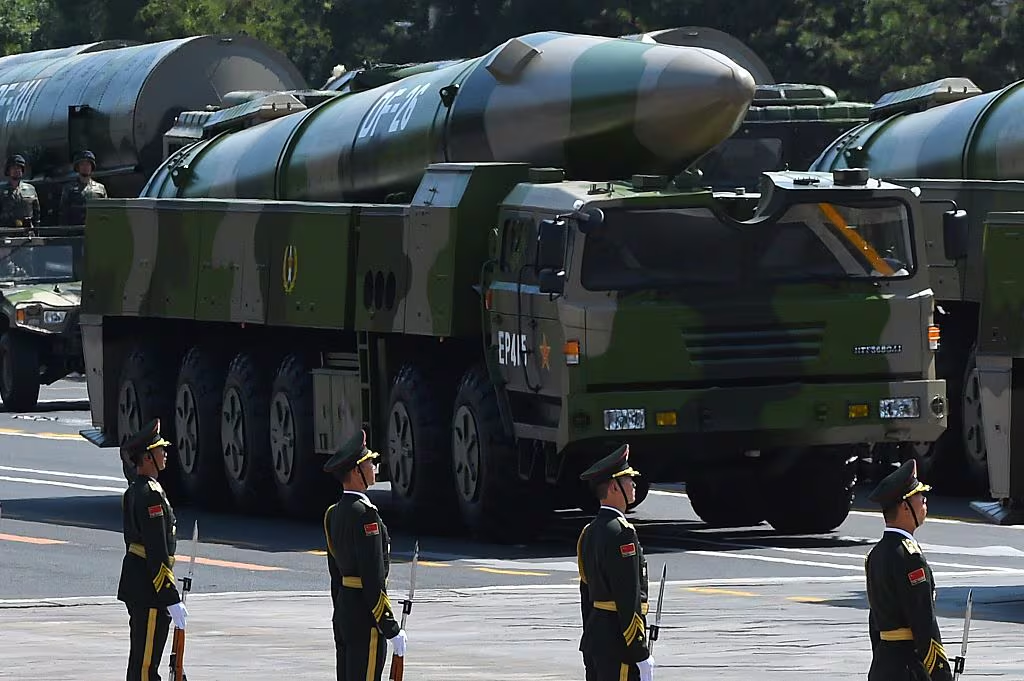
The DF-26 intermediate-range ballistic missile, widely labelled the “Guam Killer,” possesses an estimated strike radius of approximately 4,000 kilometres, placing Andersen Air Force Base, Apra Harbor, fuel depots, ammunition bunkers, and command infrastructure on Guam firmly inside Chinese targeting envelopes.
Military planners increasingly assess that Guam has transitioned from a protected operational rear hub into a contested battlespace vulnerable to precision missile salvos capable of degrading U.S. sortie generation, logistics throughput, and strategic reinforcement timelines during the opening stages of conflict.
The Pentagon’s concerns have intensified further following assessments surrounding China’s DF-27 missile programme, which reportedly possesses a strike range estimated between 5,000 and 8,000 kilometres while potentially incorporating manoeuvrable hypersonic capabilities complicating interception by existing missile defence architectures.
The strategic implication is profound because China’s expanding missile reach steadily compresses the survivable geography available to U.S. forces while simultaneously increasing Beijing’s ability to hold dispersed allied infrastructure at operational risk across the Indo-Pacific theatre.
American military planners are therefore attempting to purchase distance, redundancy, survivability, and decision-making time by pushing critical war sustainment infrastructure deeper into allied territory considered comparatively more resilient against concentrated missile strikes.
However, the deeper strategic reality confronting Washington is that no fixed sanctuary across the Indo-Pacific can now be assumed permanently secure as China’s anti-access strike network continues evolving into a theatre-wide precision engagement system.
Australia Becomes America’s New Strategic Rear Base
The selection of southeastern Australia reflects a deliberate Pentagon effort to create logistics infrastructure outside the densest concentration of Chinese conventional missile threat envelopes while maintaining access to critical Indo-Pacific maritime and air corridors.
Bandiana military base in Victoria offers geographic depth, hardened infrastructure potential, allied political reliability, and access to major transportation networks supporting sustained force generation during prolonged regional contingencies involving Taiwan or the South China Sea.
The facility will reportedly hold ready-for-issue military equipment including crew-served weapons, tactical vehicles, ammunition stockpiles, engineering systems, spare parts, communications infrastructure, and sustainment packages supporting rapid Marine Corps deployment operations.
A U.S. Navy contracting solicitation also revealed plans to employ approximately 110 logisticians, engineers, mechanics, safety specialists, and sustainment personnel responsible for maintaining continuous operational readiness at the Australian logistics node.
The stockpile forms part of a broader Pentagon-wide transition toward distributed logistics architecture intended to reduce the vulnerability created by concentrated prepositioned depots vulnerable to Chinese long-range missile strikes and precision targeting systems.
Australian Defence Minister Richard Marles described the initiative as part of an expanding American military footprint supporting regional deterrence and allied interoperability amid worsening Indo-Pacific strategic competition.
The Victoria facility also complements the rotational deployment of roughly 2,000 U.S. Marines through Darwin, strengthening integrated U.S.-Australian operational planning under evolving Indo-Pacific contingency scenarios linked to AUKUS and broader allied defence coordination.
American strategists increasingly view Australia as a critical logistics sanctuary capable of sustaining dispersed operations even if northern Pacific facilities suffer severe degradation during the initial phases of major conflict with China.
The Pentagon’s investment additionally reflects concerns that shipping reinforcements directly from Hawaii or the continental United States would create unacceptable deployment delays during rapidly escalating regional military crises involving Taiwan or maritime chokepoints.
By prepositioning ammunition, vehicles, and sustainment systems closer to the theatre, Washington hopes to preserve operational tempo while reducing dependency on vulnerable trans-Pacific supply chains exposed to missile interdiction and maritime disruption.
China’s Missile Expansion Is Rewriting Pacific Warfare
China’s missile modernisation strategy has systematically targeted the operational assumptions underpinning American military dominance throughout the Pacific since the end of the Cold War.
The DF-26 missile represented a major strategic inflection point because it became China’s first conventionally armed ballistic missile capable of striking Guam while simultaneously threatening large surface combatants operating inside the Second Island Chain.
The missile’s anti-ship DF-26B variant further complicates U.S. naval operations because it expands China’s capacity to threaten carrier strike groups and amphibious formations attempting to reinforce regional allies during wartime contingencies.
Pentagon assessments now indicate that the newer DF-27 missile extends Chinese precision strike reach substantially beyond the Second Island Chain while potentially integrating hypersonic manoeuvrability capable of evading traditional missile defence interception windows.
The operational significance of hypersonic-capable systems lies not merely in velocity but in their unpredictable flight trajectories, reduced warning timelines, and ability to complicate command-and-control decision cycles for defending forces.
Chinese anti-access doctrine increasingly integrates ballistic missiles, cruise missiles, submarines, long-range aviation, electronic warfare, cyber operations, and space-based surveillance into a system-of-systems warfare architecture intended to overwhelm U.S. operational resilience.
This layered anti-access umbrella effectively transforms large portions of the Western Pacific into a contested strike zone where fixed infrastructure, fuel depots, logistics hubs, and air bases face persistent precision attack vulnerability.
Military analysts increasingly argue that Beijing’s strategic objective is not necessarily territorial conquest through attrition alone but operational paralysis through systematic disruption of American sustainment, reinforcement, and command infrastructure.
The emergence of long-range Chinese strike systems also complicates allied defence planning because survivability calculations must now account for missile salvos capable of reaching deeper into previously protected operational rear areas.
The resulting battlespace transformation forces Washington and its allies to prioritise mobility, redundancy, dispersal, hardened infrastructure, deception measures, and distributed logistics rather than relying on concentrated forward operating hubs vulnerable to precision destruction.
Guam’s Strategic Transformation Changes U.S. Force Posture
For decades, Guam functioned as America’s principal strategic logistics and power projection hub in the Western Pacific, supporting bombers, submarines, naval task forces, and rapid reinforcement operations across Asia.
Andersen Air Force Base historically enabled sustained bomber rotations and long-range strike operations while Apra Harbor provided critical sustainment access for submarines, carrier groups, and maritime logistics vessels operating throughout the Indo-Pacific.
China’s expanding missile inventory has steadily transformed Guam from a sanctuary into a frontline operational node requiring substantial missile defence investment and distributed survivability planning.
The Pentagon has consequently accelerated efforts to deploy layered missile defence systems on Guam integrating radar networks, interceptor batteries, command infrastructure, and sensor fusion architectures designed to counter ballistic and hypersonic threats.
However, even advanced missile defence systems face severe challenges against large-scale saturation attacks involving mixed ballistic, cruise, and hypersonic salvos supported by electronic warfare and cyber disruption capabilities.
American operational planners increasingly acknowledge that defending every fixed installation against mass precision strike attacks may prove financially and operationally unsustainable during prolonged high-intensity warfare.
This strategic reality explains why the Pentagon is simultaneously investing in hardened infrastructure, rapid runway repair capabilities, distributed basing concepts, and deeper rear-area logistics positioning throughout allied territories.
The relocation of ammunition reserves toward Australia therefore reflects not abandonment of Guam but recognition that survivability increasingly depends upon dispersion rather than concentration of military infrastructure.
Washington’s revised logistics map effectively treats Guam as a contested operational platform supporting forward operations rather than an untouchable rear-area sanctuary protected by geographic isolation.
The broader implication is that future Indo-Pacific conflict scenarios may involve simultaneous strikes across an enormous geographic battlespace extending from Japan and the Philippines to Guam, northern Australia, and critical maritime chokepoints.
Subic Bay Emerges As Forward Logistics Node
While Australia provides strategic depth, the United States is simultaneously constructing forward sustainment nodes closer to potential flashpoints surrounding Taiwan and the South China Sea.
A new U.S. Marine Corps equipment storage and maintenance facility near Subic Bay in the Philippines is expected to begin operations during 2026 under the framework of the Enhanced Defense Cooperation Agreement.
The Subic infrastructure reportedly includes climate-controlled warehouses, maintenance facilities, vehicle sustainment capabilities, and prepositioned operational equipment supporting expeditionary Marine Corps deployments across maritime Southeast Asia.
Although public reporting has focused primarily on equipment sustainment rather than large ammunition storage, congressional discussions have also explored expanding joint ammunition production and logistics infrastructure around Subic Bay.
The strategic logic behind the Philippines node differs significantly from Australia because Subic Bay prioritises operational responsiveness and forward access despite considerably higher exposure to Chinese missile threats.
American planners increasingly accept that certain forward logistics hubs will remain inherently vulnerable during conflict but argue that distributed networks complicate enemy targeting and preserve operational continuity.
The Philippines occupies immense strategic significance because its geography straddles critical maritime approaches linking the South China Sea, Taiwan Strait, and broader Pacific operational theatre.
Expanded U.S. access to Philippine facilities therefore enhances surveillance, maritime denial operations, logistics sustainment, and rapid reinforcement pathways supporting wider Indo-Pacific contingency planning.
Beijing has repeatedly criticised expanding U.S.-Philippine defence cooperation, arguing that enhanced American military access risks destabilising regional security and intensifying great-power confrontation across maritime Asia.
The coexistence of deeper rear logistics in Australia and forward sustainment nodes in the Philippines illustrates a layered Pentagon strategy balancing survivability, operational access, alliance integration, and force projection across increasingly contested battlespaces.
America’s Pacific Logistics Map Is Being Rewritten
The Pentagon’s logistics restructuring demonstrates how profoundly China’s missile modernisation programme has altered the military geography underpinning American Indo-Pacific strategy.
Traditional assumptions separating secure rear areas from contested frontline operational zones are steadily collapsing under the reach of long-range precision strike systems capable of targeting infrastructure thousands of kilometres from Chinese territory.
Washington’s response increasingly emphasises distributed operations, allied integration, hardened infrastructure, prepositioned sustainment networks, and multi-layered logistics redundancy capable of surviving sustained attritional conflict.
Australia’s growing role as a strategic logistics sanctuary also highlights the rising military importance of allied territory in sustaining American power projection across the Indo-Pacific theatre.
Yet even southeastern Australia may not remain permanently outside Chinese targeting envelopes as longer-range missile systems, space-enabled surveillance networks, and hypersonic strike technologies continue advancing over the coming decade.
This evolving strategic reality means future Indo-Pacific competition may hinge less on individual weapons systems and more on which side can sustain combat operations under persistent precision strike pressure.
China’s expanding anti-access network seeks to deny American operational freedom by turning logistics vulnerability into a decisive strategic lever capable of degrading force projection before major combat operations fully begin.
The United States is therefore attempting to offset China’s geographic advantages through depth, dispersal, redundancy, alliance integration, and distributed logistics architectures designed to preserve operational endurance during prolonged conflict.
Whether these measures ultimately restore credible deterrence remains uncertain because the strategic competition increasingly resembles a contest between expanding Chinese strike reach and America’s ability to preserve resilient sustainment under fire.
The deeper message emerging from Victoria, Guam, and Subic Bay is that the Pacific’s military geography is undergoing its most consequential transformation since the end of the Second World War.
