
Beijing’s Secret Weapon: PLAN Tests XXL Uncrewed Submarines in South China Sea Amid Rising Tensions
China’s People’s Liberation Army Navy (PLAN) has quietly deployed the world’s largest uncrewed submarines to the South China Sea, marking a pivotal shift in undersea warfare and signaling Beijing’s intent to dominate contested waters.

(DEFENCE SECURITY ASIA) — In a dramatic escalation of its naval modernization drive, China has quietly deployed the world’s largest uncrewed submarines to the contested waters of the South China Sea.
These colossal vessels, categorized as “XXL” or extra-extra-large uncrewed underwater vehicles (XXLUUVs), dwarf all Western equivalents and represent a profound leap in autonomous undersea warfare.

Based temporarily off Hainan Island, these platforms mark a critical milestone in the People’s Liberation Army Navy’s (PLAN) ambition to dominate the underwater battlespace of the Indo-Pacific.
Beijing has made no public acknowledgment of the submarines, underscoring the secretive and strategic nature of its unmanned naval projects.
The development was first revealed through open-source intelligence (OSINT), with defence analyst H. I. Sutton detailing their presence in Naval News, supported by satellite imagery and technical deductions.
This deployment comes at a time of spiraling tensions in the South China Sea, as the PLAN seeks to shift the balance of power in one of the world’s most strategically contested maritime zones.
The timing of the deployment is highly symbolic, occurring as the United States and its allies intensify freedom of navigation operations and joint naval patrols across disputed waters.
By positioning such unprecedented assets in Hainan, Beijing signals that the South China Sea will serve as both a proving ground and a forward operating theatre for its most advanced maritime technologies.
The move also highlights China’s doctrinal pivot toward unmanned systems as a cost-effective way of projecting power without exposing sailors to direct risk, thereby lowering the threshold for escalation.
For regional states like Vietnam and the Philippines, the presence of XXLUUVs underscores the widening technological gap with the PLAN and raises fresh concerns about Beijing’s ability to impose an underwater blockade during crises.
Background on China’s Uncrewed Submarine Programs
China has invested heavily in unmanned underwater vehicles (UUVs) for more than a decade, racing ahead of the United States and its allies in sheer scale and ambition.
While Washington’s Boeing Orca XLUUV remains under development and plagued by integration delays, China has already fielded prototypes, trialed multiple variants, and is now pushing boundaries with the XXLUUV class.
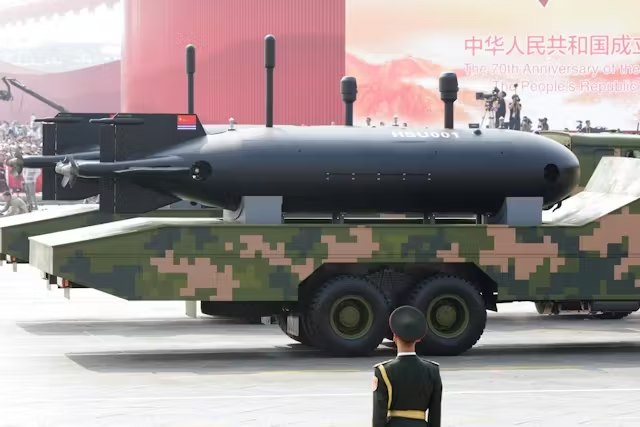
Earlier generations included the Sea Wing glider and the HSU-001 large displacement UUV (LDUUV), which were deployed for surveillance, mine warfare, and intelligence gathering missions.
The HSU-001 in particular gained global attention when it was paraded during the 2019 National Day celebrations in Beijing, signaling China’s intent to showcase UUVs as a core element of its naval arsenal.
China’s maritime research infrastructure, concentrated around Hainan Island and shipyards like Dalian and Huludao, has rapidly matured into a formidable centre for submarine and UUV innovation.
Satellite imagery has revealed new underwater test structures near Dalian, believed to support docking and data relay for autonomous underwater vehicles.
Specialized vessels, including crane barges and stealthy transport craft resembling the U.S. M80 Stiletto, have been observed supporting UUV operations, further demonstrating a systemic and holistic approach to uncrewed warfare.
This ecosystem reflects not only industrial capacity but also a doctrinal shift: China increasingly sees UUVs as asymmetric force multipliers capable of overwhelming adversary defences.
Details of the XXL Uncrewed Submarines
The two new XXLUUVs deployed to Hainan are extraordinary in scale, measuring between 40 and 42 meters in length.
This makes them 10 to 20 times larger in displacement than European designs such as Germany’s MUM (Modifiable Underwater Mothership) and far surpassing the U.S. Navy’s Orca XLUUV.
Lacking traditional sails, the vessels sport X-form stern rudders designed for agility and reduced acoustic signature, optimised for both endurance and survivability in hostile environments.
Their hulls adopt a streamlined profile, prioritizing stealth characteristics and minimising hydrodynamic drag.
Propulsion is believed to rely on diesel-electric systems supplemented by high-capacity lithium-ion batteries, enabling long-endurance missions without the complications of nuclear propulsion.
While smaller than China’s crewed Type-093 and Type-095 nuclear attack submarines, their displacement allows for a vast internal payload bay.
Estimates suggest each could carry the equivalent of eight heavyweight torpedoes, naval mines, or long-range anti-ship missiles in modular compartments.
Alternatively, they could deploy swarms of smaller UUVs or unmanned aerial vehicles (UAVs) launched from canisters, enabling multi-domain operations.
Sensors are expected to include flank sonar arrays, synthetic aperture sonar, and AI-enhanced data processors capable of fusing information in real time.
One of the XXLUUVs is linked to the 705 Research Institute under China Shipbuilding Industry Corporation (CSSC), known for its role in naval weapons development.
Deployment to Hainan was facilitated by the Zhuan Yong Fu Chuan Wu 001, a floating dock launched in 2024, which has been used to conceal and transport the platforms discreetly.
Testing is concentrated around Gangmen Harbour and Yinggezui, areas west of the PLAN’s Sanya nuclear submarine base—already a hub for carriers, SSNs, SSBNs, and advanced UUV projects.
Satellite imagery shows the submarines partially submerged in floating docks, a method reminiscent of how the U.S. Navy shielded experimental vessels like Sea Shadow during early testing.
Potential Capabilities and Roles
The extraordinary scale of these platforms unlocks mission profiles far beyond reconnaissance or mine countermeasures.
They could operate as autonomous “arsenal submarines,” carrying torpedoes or anti-ship cruise missiles for covert strikes.
Mine warfare is a particularly likely role, as demonstrated by the AJX002 minelayer UUV also tested near Hainan, raising the risk of PLAN mining campaigns against Taiwan or U.S. naval choke points.
Another role would be long-range intelligence, surveillance, and reconnaissance (ISR), linking with China’s “Underwater Great Wall” sensor network for continuous monitoring of U.S. and allied submarines.
Their endurance and autonomy allow deployments deep into the Philippine Sea, the Malacca Strait, or Indian Ocean choke points without risking crew.
In a grey-zone scenario, they could harass adversary shipping or conduct covert sabotage under the veil of deniability.
AI-driven navigation and decision-making mean they require minimal operator input, though communication links would likely depend on extremely low frequency (ELF) or acoustic modems.
If paired with satellites or underwater relay nodes, these XXLUUVs could become fully integrated into China’s expanding “system of systems” approach to maritime dominance.
Analysis and Strategic Implications
The arrival of these submarines in the South China Sea signals a paradigm shift in naval competition.
Western analysts have long assumed China lagged behind in advanced uncrewed systems, but this deployment exposes that assumption as dangerously outdated.
Where the United States is cautiously testing Orca XLUUV prototypes, China has boldly leapfrogged into fielding full-scale XXLUUVs.
This positions Beijing as the undisputed leader in autonomous underwater warfare, with consequences that ripple far beyond the South China Sea.
For the United States and its allies, the strategic challenge is stark: traditional anti-submarine warfare (ASW) doctrines may not be sufficient against swarms of autonomous, stealthy, and expendable UUVs.
The deployment complicates U.S. carrier strike group operations, creating new risks from hidden mines, torpedo ambushes, and persistent ISR coverage.
For Taiwan, the threat is existential.
PLAN XXLUUVs could mine its approaches, shadow its surface fleet, or even target undersea communication cables vital to its economy.
For Southeast Asia, it reinforces China’s coercive power in disputed waters, giving Beijing another asymmetric tool to pressure claimants like Vietnam, the Philippines, and Malaysia.
India, too, must take note.
If China can project XXLUUVs into the Indian Ocean via Gwadar or Hambantota, it could threaten India’s sea lines of communication and tilt the undersea balance in Beijing’s favour.
Yet challenges remain.
Uncrewed submarines lack the adaptability of manned SSNs, and vulnerabilities such as jamming, AI errors, or compromised control links could be exploited by adversaries.
The U.S., Japan, and Australia are already investing in counter-UUV technologies, including undersea drones, seabed sensors, and directed-energy weapons for maritime patrol aircraft.
However, unless Western navies accelerate uncrewed development at scale, they risk ceding dominance of the underwater battlespace to Beijing.
Conclusion
China’s deployment of XXLUUVs represents not just a technical achievement, but a strategic declaration.
It signals Beijing’s intent to dominate the seabed and subsurface domain as comprehensively as it has militarised the surface of the South China Sea.
These vessels are more than prototypes; they are harbingers of a new era where the oceans teem with autonomous machines, reshaping the very character of naval warfare.
As Beijing conceals details, OSINT will remain the primary tool for understanding how these behemoths evolve.
What is clear, however, is that the future of undersea conflict has arrived—and China is determined to lead it.
Their presence also represents a powerful deterrent to adversaries, as the psychological effect of an invisible, autonomous undersea fleet complicates naval planning and risk assessments for any potential challenger.
The development reflects Beijing’s strategic philosophy of “unrestricted warfare,” where technological leaps are harnessed to offset U.S. conventional advantages without engaging in direct confrontation.
It also suggests that China may seek to export derivative UUV technologies to strategic partners like Pakistan or Iran, reshaping regional naval balances well beyond the Indo-Pacific.
For Washington and its allies, the challenge is not only technological but doctrinal, as countering autonomous submarines requires an entirely new generation of anti-submarine warfare tools and strategies.
Failure to adapt quickly could leave traditional surface and submarine forces vulnerable to saturation tactics, where numbers and autonomy overwhelm even the most advanced Western fleets.
By fielding these submarines in contested waters first, Beijing ensures that their deterrent value is maximized, embedding them directly into the heart of regional flashpoints where U.S. and allied navies operate daily.
In the longer term, these XXLUUVs foreshadow an arms race in undersea autonomy, one that could redefine the geopolitics of maritime power for decades to come. — DEFENCE SECURITY ASIA
