
Type 055 Showdown: China Moves Powerful Naval Task Group Through Tsushima Strait As Japan Activates 1,000km Missiles
Beijing dispatched a Type 055 destroyer, two Type 052D destroyers and an intelligence vessel through the Tsushima Strait just as Japan completed deployment of new 1,000km-range missiles capable of reaching parts of mainland China.

(DEFENCE SECURITY ASIA) — China’s decision to send one of its most powerful surface action groups through the Tsushima Strait came precisely as Japan activated new long-range missiles capable of striking the Chinese mainland, creating the most consequential Sino-Japanese military signalling episode in years.
The near-simultaneous appearance of a Type 055 destroyer, two Type 052D destroyers, an intelligence-collection vessel, and a fleet replenishment ship inside the Sea of Japan has transformed an already volatile regional dispute into a visible contest over force posture.
Because Tokyo’s newly deployed missile systems can now reach more than 1,000 kilometres, including portions of eastern China from Kyushu, Beijing appears determined to demonstrate that any Japanese counterstrike capability will immediately encounter Chinese naval pressure.

Japanese military tracking showed the Chinese flotilla entering the Sea of Japan between March 29 and March 31, only hours before Japan completed operational deployment of its upgraded Type-12 missile batteries and hypersonic glide systems.
The timing carried unmistakable strategic weight because China had already warned Tokyo that deploying what Beijing described as “long-range offensive weapons” would trigger a “strong response” from the People’s Liberation Army.
Chinese Foreign Ministry spokeswoman Mao Ning subsequently condemned Japan’s deployment as “neo-militarism,” arguing that Tokyo’s expanding strike capability represented an offensive departure from Japan’s post-war constitutional restraints.
Japanese Defence Minister Shinjiro Koizumi meanwhile declared that the new missile systems were essential because Japan now faced its “most severe and complex security environment” since the Second World War.
The result is a rapidly intensifying military competition in which Chinese naval deployments, Japanese counterstrike doctrine, and the increasingly central geography of the Tsushima Strait are becoming tightly interconnected.
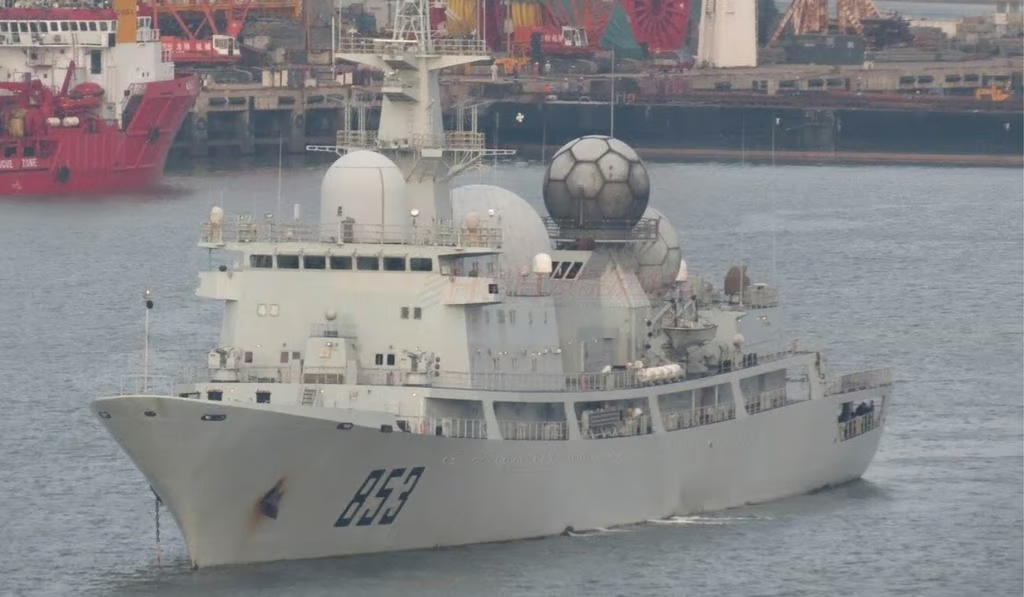
Japan’s Ministry of Defense confirmed that the first vessel detected was the Type 815A intelligence-collection ship Jinxing, which was tracked roughly 80 kilometres southwest of Tsushima Island before entering the strait heading northeast.
The deployment of the Jinxing before the arrival of the larger warships strongly suggests that Beijing intended to map Japanese radar emissions, communications networks and naval response procedures before introducing its principal surface combatants.
Shortly afterwards, Japanese tracking assets identified the Type 055 destroyer Lhasa together with the Type 052D destroyers Guiyang and Chengdu, creating a compact but highly capable surface action group centred on layered air-defence and long-range strike capability.
The inclusion of the Type 903A replenishment ship Kekexilihu added a significant logistical dimension because it indicated that the Chinese formation was structured not merely for symbolic transit, but for extended operations beyond the Tsushima Strait.
Military analysts note that a Type 055 operating alongside two Type 052Ds possesses sufficient firepower to establish a localized anti-access and area-denial umbrella capable of challenging Japanese and allied naval forces in the Sea of Japan.
The Chinese deployment also coincided with the first confirmed appearance of a new variant of the Y-9 maritime patrol and anti-submarine warfare aircraft over the East China Sea, suggesting a broader effort to integrate naval and airborne surveillance operations.
Taken together, the synchronized movement of advanced warships, intelligence vessels, replenishment assets and surveillance aircraft points to a deliberate Chinese rehearsal for future high-intensity operations along Japan’s southwestern maritime approaches.
READ: Japan Deploys 1,000km Type-25 Missile as New Hypersonic Weapon Puts China Coast and Taiwan Strait Within Range
Why Beijing Chose the Sea of Japan
The later arrival of the Type 055 destroyer Lhasa, accompanied by the Type 052D destroyers Guiyang and Chengdu, immediately elevated the deployment beyond the profile of a routine naval transit.
The Lhasa is among the most heavily armed surface combatants in the People’s Liberation Army Navy, displacing approximately 13,000 tonnes and carrying 112 vertical launch cells capable of firing anti-ship, land-attack, anti-air, and anti-submarine weapons.
Its inclusion suggested that Beijing wanted to send a message not merely of presence, but of credible high-end naval combat capability positioned near Japan’s western approaches.
The accompanying Type 052D destroyers added layered air-defence and anti-ship capacity, creating a compact but operationally balanced task group capable of surviving and fighting beyond coastal waters.
The presence of the Type 903A replenishment ship Kekexilihu was especially significant because replenishment ships are usually deployed when China intends to sustain naval operations over longer periods and greater distances.
Rather than conducting a symbolic patrol lasting only several hours, the Chinese flotilla therefore appeared structured for endurance, surveillance, and continued regional presence beyond the Tsushima Strait transit.
Equally important was the deployment of the intelligence vessel Jinxing, whose mission profile strongly indicates electronic surveillance, radar mapping, and communications interception against Japanese and allied military activity.
By combining frontline combatants, logistical support, and signals intelligence collection inside a single formation, Beijing effectively demonstrated an ability to monitor, sustain, and protect future naval operations near Japan.
Japan’s Missile Deployment Has Changed the Strategic Equation
Tokyo completed deployment of its upgraded Type-12 surface-to-ship missile at Camp Kengun in Kumamoto Prefecture on March 31, precisely during the Chinese flotilla’s movement into the Sea of Japan.
The improved Type-12 now possesses a range exceeding 1,000 kilometres, compared with approximately 200 kilometres for earlier variants, fundamentally changing Japan’s military reach across the East China Sea.
From Kyushu, the new missile can theoretically hold Chinese warships, air bases, and military infrastructure at risk across substantial sections of China’s eastern seaboard.
Japanese forces simultaneously deployed a Hyper Velocity Gliding Projectile system at Camp Fuji, giving Tokyo its first operational hypersonic capability intended for island defence and long-range strike missions.
Together, these systems represent the operational beginning of Japan’s “counterstrike capability” doctrine, which seeks to allow Japan to attack hostile missile launchers before they can strike Japanese territory.
For decades, Japan’s military strategy remained tightly constrained by a self-defence interpretation that largely avoided offensive reach beyond immediate territorial protection.
The new missile deployments therefore represent the most important shift in Japanese force posture since Tokyo revised its national security strategy during 2022.
Beijing appears to view that shift not as a defensive adjustment, but as the emergence of a regional military architecture capable of threatening Chinese mainland targets directly.
The New Y-9 Aircraft Suggests Beijing Is Expanding Maritime Surveillance
Japanese authorities also detected a previously unseen variant of the Chinese Y-9 maritime patrol aircraft over the East China Sea during the same weekend.
The aircraft flew approximately 160 miles northeast of Okinawa and conducted repeated racetrack patterns near the edge of Japan’s exclusive economic zone before Japanese fighters intercepted and photographed it.
Japanese officials believe the aircraft may be the Y-9FQ, an advanced anti-submarine warfare and maritime surveillance platform sometimes associated with the “High New 15” programme.
Unlike earlier Y-9 variants, the aircraft reportedly featured a different nose section and sensor configuration, indicating new radar or electronic surveillance capabilities.
Its appearance at the same moment as the Chinese naval transit suggests Beijing was coordinating air and naval reconnaissance rather than conducting isolated operations.
That coordination matters because the East China Sea and the Sea of Japan are increasingly becoming linked battlespaces in any future conflict involving Taiwan, Japan, or the wider Western Pacific.
An upgraded Y-9 maritime patrol aircraft could help China detect Japanese submarines, track naval movements through the Ryukyu chain, and provide targeting information for long-range missile strikes.
The combination of surface combatants, intelligence vessels, and new airborne surveillance assets therefore indicates that Beijing may already be rehearsing the sensor network required for sustained maritime operations near Japan.
Tsushima Strait Is Emerging as the Region’s Most Important Naval Chokepoint
The Tsushima Strait has historically served as the principal gateway between the East China Sea and the Sea of Japan, making it one of Northeast Asia’s most strategically valuable waterways.
Any Chinese warship moving toward the Sea of Japan, northern Japan, or the Russian Far East must normally transit either the Tsushima Strait or the narrower passages near Hokkaido.
Because the strait sits between Japan and the Korean Peninsula, it also functions as a critical bottleneck through which Chinese naval movements can be observed, monitored, and potentially blocked.
Japan’s decision to deploy long-range missiles in Kyushu has effectively transformed the southern approaches to the Tsushima Strait into an increasingly militarised anti-access zone.
China’s decision to transit that same strait immediately afterward therefore carried a direct message that Beijing will continue operating inside waters Tokyo increasingly considers strategically sensitive.
The deployment also served another purpose because the Sea of Japan provides Chinese naval commanders with an operational route toward Russian waters and future joint operations with Moscow.
Chinese naval formations have previously entered the Sea of Japan during combined exercises with Russia, but the present deployment differed because it occurred alongside an overt political dispute with Japan.
That distinction makes the current episode less important as a single naval patrol and far more important as an early indicator of how future Sino-Japanese military crises may unfold.
Neither Side Appears Ready to De-Escalate
Japanese forces responded to the Chinese deployment by dispatching a P-1 maritime patrol aircraft and the missile boat Otaka to shadow the flotilla throughout its movement.
Tokyo emphasised that none of the Chinese ships entered Japanese territorial waters, allowing Japan to avoid an immediate legal or military escalation while still publicising the deployment.
Japan’s decision to release photographs of the Chinese vessels nevertheless demonstrated an effort to expose Beijing’s activities and shape international perceptions of Chinese coercive behaviour.
China, however, appears equally determined to use visible naval deployments as part of a broader campaign opposing Japan’s new missile doctrine and expanding military role.
Neither side presently appears interested in immediate confrontation, yet both governments are deliberately increasing military signalling designed to influence future regional calculations.
The most dangerous element is that each side increasingly interprets its own actions as defensive while viewing the other’s actions as evidence of aggressive intent.
That dynamic has repeatedly driven arms races elsewhere because every new missile deployment, naval transit, intelligence mission, or aerial intercept becomes interpreted through a cycle of mutual suspicion.
Unless a political mechanism emerges to manage the growing confrontation, the Tsushima Strait may become not merely a transit route, but the frontline of Northeast Asia’s next major military crisis.
