
India Eyes January Tejas Mk1A Debut as Fighter Squadrons Run Short
A limited AESA radar software concession could clear the first Tejas Mk1A handover, while GE F404 engine supply will shape how quickly India can rebuild fighter squadrons for its China and Pakistan fronts.
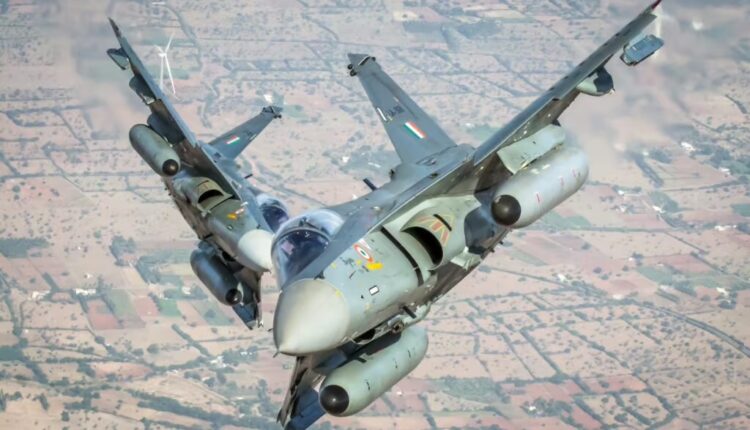
(DEFENCE SECURITY ASIA) — India could receive its first Tejas Mk1A fighters in January 2027 under a proposed arrangement that would allow limited radar software concessions, opening a route to initial acceptance nearly three years after the Indian Air Force expected first deliveries.
The reported window would put the first handover before Aero India 2027 in Bengaluru, but Hindustan Aeronautics Limited, the Indian Air Force and India’s Ministry of Defence have yet to confirm the date or acceptance terms.
The immediate decision concerns whether selected functions associated with the Israeli EL/M-2052 active electronically scanned array radar can be completed after delivery, while the aircraft still meets the core weapons, electronic warfare and flight requirements for acceptance.
India has ordered 180 aircraft across two contracts, yet the Indian Air Force had formally accepted none by mid-November 2026, leaving the programme’s contribution to fighter force regeneration dependent on the pace of certified deliveries after the first handover.
Air Chief Marshal A P Singh, chief of the Indian Air Force, has said the delays are “hurting” the service, which he estimates needs 36 to 40 new fighters annually to arrest the decline in numbers and begin rebuilding squadron strength.

With roughly 29 to 30 fighter squadrons against an authorised strength of about 42, India has fewer units available for sustained commitments along its Pakistan-facing western sector and its northern and eastern fronts, where planning is shaped by China.
The shortfall widened after the last MiG-21 Bison squadrons retired in 2025, creating a gap between the withdrawal of legacy units and the arrival of their intended replacement that also complicates crew conversion and the redistribution of maintenance personnel.
Two constraints now operate on different timelines, with radar software and certification shaping the first acceptance decision and engine deliveries from GE Aerospace determining how quickly Hindustan Aeronautics Limited, or HAL, can turn completed airframes into a steady flow of fighters.
The reported concessions could let the service begin building experience with its new aircraft while engineers finish selected functions, although the operational value of that early access depends on which software capabilities remain outstanding and how quickly fleet updates follow.
The first contract covers 83 aircraft fitted with the EL/M-2052, while the subsequent order for 97 envisages India’s Uttam radar, creating separate integration commitments even as both tranches depend on the same GE F404-IN20 engine family for production continuity.
A January handover would carry strategic signalling value because it would mark a visible recovery in a programme central to India’s defence manufacturing policy, while sustained fleet growth would depend on how many aircraft HAL can deliver in an accepted configuration.
The gap between an aircraft handover and a deployable squadron is therefore the programme’s central test, because India needs enough fighters, trained personnel and support capacity to restore usable force strength before further legacy retirements begin adding pressure around 2029–30.
(READ) HAL Completes Tejas Mk-1 Order Decade Late as IAF Fighter Crisis Deepens
Radar Concessions and First Delivery
The reported arrangement would temporarily relax selected Air Staff Qualitative Requirements for one or two radar-related functions, placing the first Tejas Mk1As on an initial software baseline that would evolve as outstanding items are resolved and subsequent updates are cleared.
The precise functions remain undisclosed, which limits any assessment of the practical effect of a concession on cockpit workload, training procedures or the missions for which the initial aircraft could be cleared when they reach an Indian Air Force unit.
Earlier reporting pointed to possible limits on automation of certain electronic warfare functions, raising the prospect that crews would manage some responses manually, although the public record leaves open whether those functions are part of the January arrangement under discussion.
Core weapons capability and the integration of radar, electronic warfare and fire-control systems remain central acceptance requirements, because a concession intended to accelerate induction would have a different operational effect if it restricted the aircraft’s ability to employ its cleared weapons.
Radar and electronic warfare integration matters because both systems have to coexist aboard the same aircraft, and interference from onboard jamming can affect radar reception unless the combined configuration performs as intended during the conditions covered by the test programme.
The Astra beyond-visual-range missile adds a distinct validation requirement, since an earlier firing can establish progress while leaving further work on the links between the radar, mission computer and weapons controls in the configuration that the air force actually receives.
Proprietary radar software can also make troubleshooting dependent on access to the original equipment supplier, a constraint that matters after delivery if changes require coordination across the radar manufacturer, HAL and the organisations responsible for clearing the aircraft’s configuration.
The reported estimate of 20 to 30 additional sorties illustrates the workload that can remain near the end of integration, when software refinements, detection and tracking checks, and follow-up validation compete for test aircraft and time ahead of formal acceptance.
HAL has publicly pursued full compliance, while discussions over narrowly scoped relief suggest the air force may distinguish between functions essential to initial acceptance and software items that can be completed after it has started working with the aircraft.
A staged handover would therefore shift some workload from pre-delivery integration into early fleet support, where software revisions would need to be incorporated into the aircraft, reflected in training and documentation, and managed across successive deliveries as the fleet grows.
(READ) ‘Bad Decision’ — Ex-IAF Chief Slams Tejas Mk1A Radar Reversal
GE F404 Supply Sets the Pace
HAL ordered 99 GE F404-IN20 engines in 2021 under a contract valued at approximately US$716 million, securing propulsion for the first tranche through a dedicated production restart whose schedule subsequently became a constraint on Indian fighter aircraft deliveries.
The production line had closed after earlier Tejas Mk1 orders, so restarting it required restoring work across lower-tier suppliers, including those responsible for castings, before completed engines could reach HAL in numbers sufficient to support a predictable delivery cadence.
The first engine arrived in March 2025 roughly two years late, delaying the point at which HAL could combine its expanding airframe output with the engines needed for installation, ground checks and the preparation of aircraft for acceptance.
Late-2026 figures put receipts at around ten in one snapshot and shipments at 14 in another, leaving the number of engines available for installation uncertain because shipment, arrival and acceptance each describe a different stage of the supply process.
One engine reportedly failed HAL’s acceptance checks, illustrating how the usable inventory can fall below the headline delivery figure when units need investigation, repair or replacement and production planners must adjust the sequence in which aircraft are completed.
Contractual pressure runs through the chain, with HAL invoking liquidated damages against GE Aerospace and the Ministry of Defence warning HAL about penalties, leaving both companies under pressure as completed airframes, incoming engines and final acceptance work move at different rates.
GE’s projected ramp-up towards roughly 30 engines annually would improve the prospect of regular deliveries if achieved, although the rate at which serviceable engines arrive still has to align with HAL’s installation capacity and the pace of testing.
The follow-on order for 113 F404-IN20 engines supports the second batch of 97 aircraft and extends the importance of dependable US propulsion supply across both contracts, even as India plans to localise more onboard systems in the later aircraft.
For the Indian Air Force, engine availability also has a support dimension as initial deliveries create demand for spares, maintenance capacity and dependable replacement stock alongside the propulsion units HAL needs to complete aircraft on its expanded production lines.
The distinction between the first acceptance and a delivery ramp is clearest here, because a limited number of engines can support a small initial handover while a reliable production stream is needed to equip successive units and establish their support inventories.
HAL’s Airframe Backlog
HAL was reported to have completed roughly 27 airframes by September 2026, giving the company a pool of aircraft to advance through final integration as engines arrive and leaving the delivery schedule exposed to the rate of acceptance testing.
Some estimates put about 30 aircraft at various stages of production, a broader measure than structurally complete airframes that highlights the uncertainty around how much work remains before individual jets can be counted towards an Indian Air Force handover target.
The third Tejas production line at Nashik opened in October 2025 and raised theoretical output towards 24 aircraft annually, adding assembly capacity whose effect on fleet growth depends on the supply of engines and the throughput of final integration and certification.
The first order comprises 73 single-seat fighters and ten twin-seat trainers, a distinction that matters for force regeneration because the total order count includes aircraft whose contribution also lies in pilot conversion and the broader training pipeline for new units.
The February 2021 contract envisaged deliveries beginning in February 2024 and ending by February 2028, leaving the original completion schedule increasingly exposed as HAL approaches an initial handover with much of the delivery window already elapsed.
The approximately 90 to 95 percent completion estimate signals that much of the development effort has been undertaken, while the remaining radar, weapons and software validation can still determine when a given configuration becomes eligible for routine air force acceptance.
Certification by India’s Centre for Military Airworthiness and Certification links engineering progress to the configuration cleared for delivery, making repeatable validation important as HAL moves from individual test aircraft towards production batches built for service induction.
HAL’s aim of a first full squadron of about 16 to 18 jets by March 2027 would require a steep increase in acceptances after a January handover of one or two aircraft, a cadence that remains contingent on certification and engine availability.
The second contract covers 68 fighters and 29 twin-seaters, with deliveries envisaged from fiscal 2027–28 over about six years, making the transition between orders a production planning challenge while the first tranche is still working through its delayed entry into service.
Even at a sustained annual rate of about 24 aircraft, completing all 180 deliveries could extend into the early to mid-2030s, placing the ability to maintain output over several years at the centre of the Indian Air Force’s recovery timetable.
Uttam Radar and Fighter Self-Reliance
India initially intended to replace the EL/M-2052 with the domestically developed Uttam AESA radar from around the 41st aircraft, a transition that would have brought Indian radar production into the first order while requiring a second integration baseline during the tranche.
HAL instead decided in 2025 to keep the EL/M-2052 across the first 83 aircraft, prioritising continuity of configuration while the existing radar integration was still being completed and shifting the planned introduction of the Indian radar to the second order.
Former Indian Air Force chief Air Chief Marshal R K S Bhadauria called the radar choice a “bad decision,” arguing Uttam was mature enough, a judgement that places the earlier opportunity to field an Indian sensor against HAL’s concern over certification delays.
The EL/M-2052 is manufactured under licence in India, giving the first tranche a domestic production component, while the role of ELTA engineers in software work illustrates how manufacturing location and authority over system changes can affect different parts of sustainment.
Moving Uttam into the later batch is intended to raise indigenous content above roughly 64 percent, but its effect on self-reliance will also depend on India’s ability to support the new configuration and manage its software and validation over time.
Any change of radar calls for its own integration work with the aircraft’s mission computer, electronic warfare equipment and weapons controls, so shifting Uttam to the second order moves the engineering workload to a later stage.
Keeping the EL/M-2052 common across the first order could simplify early support and training around a single radar configuration, provided any aircraft accepted with temporary limitations are brought onto a common standard as successive software revisions are cleared.
A fleet with two radar baselines would give India a pathway to expand its domestic sensor ecosystem while creating longer-term demands for configuration records, test support and maintenance training as the air force absorbs aircraft from both contracts into operational units.
The continued use of the GE F404-IN20 across both tranches qualifies the strategic effect of greater domestic sensor content, because stronger Indian control over one part of the aircraft can coexist with substantial foreign leverage over the pace of propulsion supply.
The programme’s industrial significance ultimately rests on whether India can reproduce accepted aircraft and sustain them through upgrades, a test that spans domestic assembly, access to foreign suppliers and the certification capacity required as new Indian systems enter the fleet.
India’s Two-Front Air Posture
The authorised strength of about 42 fighter squadrons reflects India’s longstanding requirement to plan for simultaneous demands involving China and Pakistan, while the current gap narrows the pool of units available for forward commitments, training, maintenance and rotation across the force.
The planned focus on western sectors for early Tejas Mk1A units means the first force-structure gains are expected on the Pakistan-facing front, while any contribution to northern or eastern deployments depends on the subsequent pace of aircraft and squadron formation.
An initial pair of fighters could support conversion and maintenance familiarisation, but a squadron’s availability depends on a wider logistics footprint that includes sufficient aircraft, qualified crews, ground support personnel and a supply of serviceable components.
Fewer squadrons also reduce flexibility when aircraft are needed for both operational commitments and training, because drawing on the same force for sustained deployments limits the pool available to rotate crews and airframes through recovery and scheduled maintenance.
The Mk1A is expected to help fill the gap left by the MiG-21 and contribute to the transition from older Jaguar, Mirage 2000 and MiG-29 fleets, making its delivery rate increasingly consequential as further retirements approach around 2029–30.
Tejas Mk2 and the Advanced Medium Combat Aircraft extend India’s domestic fighter ambitions on separate timelines, leaving near-term fleet regeneration heavily dependent on the Mk1A as the larger successor and longer-term stealth programme work through development.
Potential multirole fighter acquisitions, including further Rafales, and limited additions to the Su-30MKI fleet offer parallel means of reinforcing the force, with their contribution tied to procurement schedules and the time required to absorb further aircraft.
HAL’s theoretical rate of about 24 aircraft annually falls below the 36 to 40 fighters the air chief says the service needs each year, underscoring the role of parallel acquisitions and the influence of continuing retirements on net squadron growth.
For international observers, the first handover would signal that India has begun absorbing its upgraded domestic fighter, while the more consequential measure of changing regional air power will be the rate at which accepted aircraft form units that can sustain operations.
A January delivery would start that process if the reported timetable holds, with the scale of India’s force recovery still tied to the closure of radar software concessions, a stable flow of GE engines and an assembly system that delivers at squadron scale.
