
Alleged Pakistan Air Force Strikes on Houthis Test Saudi Defence Alliance
Alleged Pakistani fighter strikes against the Houthis sharpen scrutiny of Pakistani troops, Turkish military support and the Saudi alliance’s response to missile and drone threats.

(DEFENCE SECURITY ASIA) — Allegations that Pakistan Air Force fighter jets are striking Yemen’s Houthis have raised the stakes of Islamabad’s military presence in Saudi Arabia, potentially connecting Pakistani airpower to a widening campaign involving missile defence, Red Sea territory and collective security commitments.
A Pakistani military official, speaking anonymously, alleged that Pakistani fighters were being used against the Houthis, introducing the possibility of combat participation beyond the acknowledged deployment of Pakistani forces inside Saudi Arabia.
A second anonymous Pakistani official described an expected mission focused on degrading Houthi drone and missile threats through air support rather than a ground offensive, suggesting a specialised contribution aimed at reducing attacks on Saudi infrastructure and population centres.
Neither account identifies aircraft numbers, bases, strike dates or targets, and neither establishes whether Pakistani jets operated inside Yemen, meaning the allegation raises questions about combat employment without providing evidence needed to reconstruct an offensive air operation.
The allegations emerged as Pakistan, Saudi Arabia and Turkey activated collective defence commitments under the Makkah alliance, placing troop deployments, reconnaissance assistance and protective military capabilities at the centre of a response to Houthi attacks against the Saudi kingdom.
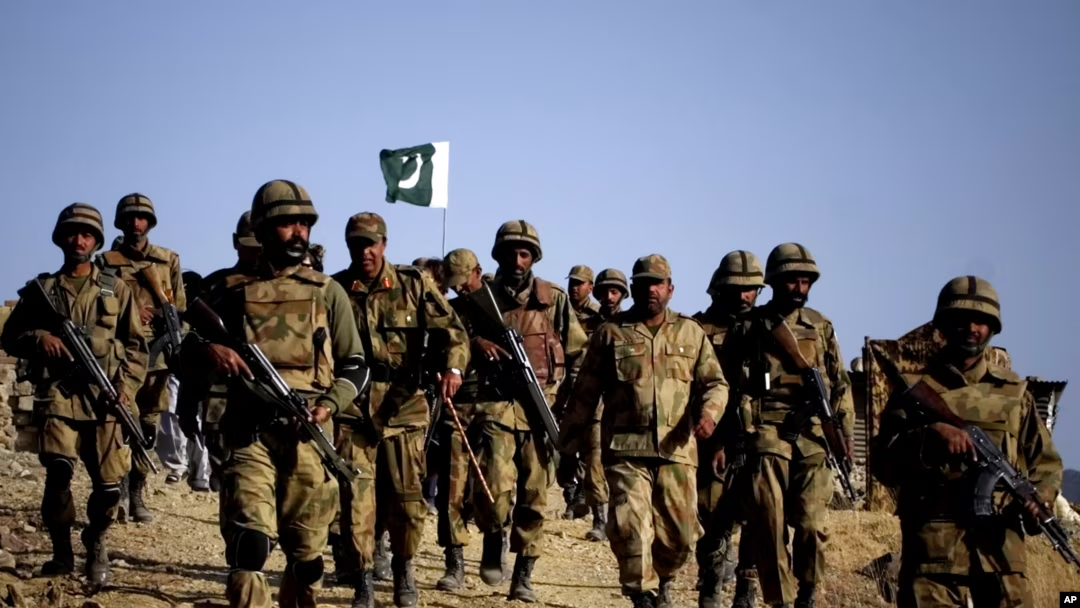
Defence Minister Khawaja Asif acknowledged that Pakistan and Turkey “have a presence here” and are providing assistance, including “reconnaissance and other things,” connecting both partners to Saudi security efforts while leaving their personnel strengths and operational assignments undisclosed.
Inter-Services Public Relations chief Lieutenant General Ahmed Sharif Chaudhry confirmed Pakistani forces “are already there” in multiple capabilities and domains, establishing a presence whose significance now extends beyond bilateral cooperation because the alliance has activated collective commitments.
Former United States Army attaché Colonel David O. Smith described an analyst consensus of approximately 8,000 Pakistani troops in Saudi Arabia, including an air force contingent and army air defence personnel, but explicitly acknowledged that he lacked access to classified figures.
Earlier accounts described Pakistani fighter jets, air defence units and ground troops already in the kingdom, with additional artillery, drones and counter-drone systems being sent, indicating a force package capable of supporting several missions without establishing its operational configuration.
The Saudi-led coalition’s announcement of 100 fighter jets and strikes on 324 high-value targets gives the allegations a campaign backdrop, although coalition spokesman Major General Turki al-Maliki did not identify Pakistan among the aircraft contributors to that operation.
For Islamabad and Ankara, the strategic question concerns how deployed personnel and equipment translate into military support, because air defence, reconnaissance and offensive strike missions require different command arrangements, maintenance resources and political authorisations during regional conflict.
DSA’s assessment is that alleged Pakistani combat participation would mark a consequential shift if substantiated, while the acknowledged Pakistani and Turkish presence already gives the Makkah alliance significance through reinforcement, readiness and the coordination of Saudi Arabia’s security response.
(READ): Türkiye–Saudi Arabia–Pakistan Defence Pact: New Military Power Triangle Could Reshape Middle East Security and Global Deterrence
Alleged Pakistan Air Force Strikes and the Houthi Missile Threat
The allegation of Pakistani fighter employment against the Houthis points towards an airpower contribution to countering missile and drone threats, but the anonymous accounts do not distinguish attacks on launch infrastructure from defensive patrols, reconnaissance support or military assistance.
That distinction changes the assessment because intercepting an incoming threat protects a defended area, whereas striking launch equipment would require locating targets before or after firing and obtaining approval to attack positions that may lie inside neighbouring Yemeni territory.
The second official’s reference to degrading drone and missile threats suggests a capability objective rather than a stated territorial campaign, although the absence of target descriptions prevents any conclusion about whether launchers, storage facilities or supporting infrastructure were allegedly attacked.
If Pakistani aircraft conducted such missions, their contribution would depend on intelligence, target identification and coordination with coalition air operations, because combat aircraft availability alone does not establish the ability to locate and engage dispersed threat systems.
Reconnaissance assistance acknowledged by Asif could support warning and surveillance, while its value for offensive targeting would depend on collection coverage and quality, neither of which has been disclosed sufficiently to link Pakistani intelligence support to strike missions.
No aircraft type or weapons configuration is identified in the available information, preventing comparisons of precision-strike capability, endurance or payload and ruling out any assertion that particular Pakistani fighters or named munitions were used against the Houthis.
Basing would also shape the logistics footprint of air support, since aircraft operating from Saudi facilities would require maintenance, ammunition handling and mission support, but the anonymous officials supplied no locations from which deployment distances or sortie sustainability could be calculated.
The absence of disclosed strike dates leaves the relationship between alleged Pakistani sorties and Operation Dawn of Yemen unresolved, making it impossible to establish whether the claimed activity preceded the coalition offensive, accompanied its opening phase or referred to separate operations.
Similarly, the coalition’s 100-aircraft figure cannot be used to infer Pakistan’s contribution, because an announcement identifies campaign scale without disclosing national allocations, aircraft availability or the proportion assigned to strike, escort, surveillance and other supporting functions.
The strategic implication remains conditional but significant: substantiated Pakistani attacks would connect Islamabad directly to combat effects, whereas an air-support role confined to Saudi defence would impose a different set of operational responsibilities and regional political consequences.
(READ): Pakistan’s JF-17s and HQ-9 Anchor Saudi Defence as Turkey Prepares Support

Pakistani Troops in Saudi Arabia and the Disputed Combat Role
Chaudhry’s confirmation places Pakistani forces inside Saudi Arabia across several domains, but he gave no personnel total, leaving the deployment’s composition more important than troop estimates when assessing its capacity to protect infrastructure or support broader coalition military activity.
Smith’s approximately 8,000-person estimate includes assessed air force and army air defence components, suggesting a supporting force with technical functions rather than establishing a ground combat formation, although no official order of battle confirms the allocation of those personnel.
An air force contingent could encompass aircrew, maintenance specialists and other support personnel, while army air defence troops would require command and technical support, meaning the estimated total cannot be translated directly into combat strength or available protective coverage.
Smith assessed that the troops would likely help secure oil infrastructure, a mission that would connect Pakistani support to Saudi economic resilience by protecting assets whose disruption could impose costs beyond the military confrontation with the Houthis in Yemen.
Such a protective assignment would require decisions about surveillance coverage, defended facilities and interceptor allocation, especially if airports and energy infrastructure faced simultaneous pressure, but the available information does not identify which locations Pakistani forces have been assigned to protect.
The Pakistani presence predates the current fighting by decades, according to Chaudhry, making the key force-posture question whether existing contingents are receiving new tasks, equipment or reinforcement rather than assuming that every acknowledged unit represents a fresh deployment.
Asif said “the army fighting is that of Saudi Arabia,” distinguishing Pakistani and Turkish assistance from Saudi ground combat while leaving reconnaissance, air defence and other support functions acknowledged without specifying their proximity to offensive operations inside Yemeni territory.
On 8 October, Pakistan’s Ministry of Information and Broadcasting called the attribution of Pakistan Air Force aircraft against the Houthis “fake and fabricated,” placing a direct official denial against the anonymous strike allegations and materially qualifying assessments of Pakistani combat participation.
The ministry urged outlets to avoid “speculative reporting” about Pakistani forces under the Makkah Joint Defence Agreement, while saying deployment details would come from the relevant authorities, without publishing aircraft inventories, mission records or the contingent’s assignments.
Chaudhry separately described any involvement as “defensive in nature” and declined to clarify operations across Yemen’s border, leaving Pakistani presence acknowledged but offensive strikes disputed, with no official Pakistani, Saudi or coalition confirmation establishing those missions.
(READ): Pakistan Deploys 8,000 Troops, JF-17 Fighters and HQ-9 Missiles to Saudi Arabia — New Gulf Alliance Could Reshape Middle East Power Balance
Turkish Presence and the Makkah Alliance’s Military Deployment
Turkey’s acknowledged presence alongside Pakistan gives the Saudi reinforcement effort a trilateral dimension, but Asif’s statement does not disclose Turkish troop numbers, service branches, aircraft or weapons, preventing a reconstruction of Ankara’s contingent or its contribution to Saudi operations.
That information gap matters because a personnel presence could support several functions without representing a combat formation, and the available material does not identify Turkish units or establish whether Ankara deployed additional forces after the alliance’s collective commitments were activated.
Pakistan, Saudi Arabia and Turkey signed the Makkah Alliance for Defense on 7 August 2026, extending the earlier Pakistani–Saudi mutual defence arrangement into a three-country framework that treats an attack against one member as an attack against all alliance members.
The Strategic-Political and Defense Committee met in Riyadh on 5 October and agreed to move immediately towards practical implementation, calling for agreed military forces and capabilities to be provided and rapidly deployed in Saudi Arabia under each participating country’s national laws.
The deployment language establishes a commitment to reinforce the kingdom, but does not disclose the capability packages assigned to Pakistan or Turkey, leaving national contributions, reinforcement schedules and the relationship between existing contingents and newly requested forces unspecified.
Saudi Defence Minister Khalid bin Salman said the alliance had activated collective deterrence measures against attacks on the kingdom and holy sites, making the presence of partner forces a political signal whose military credibility depends on readiness and coordinated employment.
Retired Pakistani Lieutenant General Nauman Mahmood’s appointment as the alliance’s first secretary-general provides a coordination point, although the statement does not disclose a combined targeting authority, air command structure or the command relationships governing Pakistani and Turkish forces.
For deployed contingents, those arrangements would affect how reconnaissance information reaches Saudi commanders, how friendly aircraft are coordinated and how air defence engagements are authorised, making interoperability a requirement rather than an outcome established simply by signing a defence agreement.
The commitment to operate under national laws also leaves room for different restrictions on military employment, so Pakistan and Turkey could support the same Saudi security objectives while retaining separate approval requirements for intelligence assistance, weapons use and cross-border operational involvement.
DSA assesses that the alliance’s strategic weight now rests on converting acknowledged presence into sustained capability, with transparent mission boundaries and effective coordination shaping whether Pakistani and Turkish support strengthens deterrence while keeping national participation aligned with declared operational commitments.
Fighter Jets, Air Defence, Artillery and Counter-Drone Logistics
The reported Pakistani package in Saudi Arabia includes fighter jets, air defence and ground troops, with additional artillery, drones and counter-drone systems described as being sent, combining capabilities that could support surveillance, infrastructure protection and other missions depending on deployment arrangements.
These descriptions remain insufficient to establish an equipment inventory because system types, quantities and receiving units are undisclosed, but they suggest that the military relationship encompasses more than manpower and may involve technical support for several elements of Saudi security.
Air defence personnel and equipment would contribute most effectively when integrated with detection and command networks, because engagement decisions require identification and coordination, while the available material provides no radar configuration or interceptor details from which protective performance could be calculated.
Counter-drone systems could address a different part of the threat spectrum, but their usefulness depends on the mechanism employed and the attacking platform, leaving claims about electronic disruption, kinetic interception or engagement ranges unsupported without identification of the deployed equipment.
Artillery introduces a separate ammunition and maintenance requirement from aircraft or air defence systems, meaning a mixed deployment would require separate supply streams, although no disclosed quantities or unit locations establish how the reported Pakistani artillery would be employed inside Saudi Arabia.
Drones could provide reconnaissance or other support depending on their configuration, but the reporting does not identify their models or mission equipment, making it inappropriate to assume an armed drone deployment or assign Turkish or Pakistani platforms to surveillance tasks.
A separate account describes four Pakistani cargo planes delivering air defence systems, light artillery, drones and anti-drone equipment to Aden in September for Yemen’s internationally recognised government, placing that reported supply route inside Yemen rather than within the Saudi-based deployment.
The same account alleges that Pakistani advisers worked alongside Saudi counterparts supporting Yemeni troops, a role that could assist equipment integration and operational planning if substantiated, but which has not received the same acknowledgement as Pakistan’s presence in Saudi Arabia.
Maintaining that geographical distinction is essential because Saudi infrastructure protection and adviser support in Yemen involve different exposure, legal arrangements and supply routes, even if both activities contribute to the military partnership supporting Riyadh and the Saudi-backed Yemeni government.
Across either location, sustained effectiveness would depend on spare parts, ammunition, trained crews and repair capacity, making the logistics footprint a stronger indicator of military support than cargo flight numbers alone or an aggregate estimate of personnel in the theatre.
Yemen Air War, Red Sea Security and Pakistan’s Iran Balance
Al-Maliki said Operation Dawn of Yemen opened with 100 fighter jets and strikes on 324 high-value targets, while describing continuous air support for Yemeni government forces, presenting an official account of campaign scale without independently demonstrated target effects or national aircraft allocations.
He also announced air cover over Bab al-Mandab, linking the offensive to the Red Sea’s strategic geography, although the availability of aircraft overhead cannot establish control of coastal territory or the elimination of threats that could affect maritime access and regional security.
Yemeni Presidential Leadership Council chairman Rashad al-Alimi announced an offensive to recover Red Sea territory and ultimately Sanaa, setting objectives that would require sustained ground operations and supply support beyond the effects claimed for the coalition’s opening air attacks.
Saudi authorities said attacks on Abha and King Khalid international airports killed three people and injured dozens, while Houthi spokesman Yahya Saree claimed both attacks, connecting the reinforcement effort to threats against civilian transport infrastructure as well as the military campaign.
Further explosions were reported in Riyadh on 8 October alongside a Houthi ballistic-missile claim and a coalition interception statement, illustrating the pressure on Saudi defences while leaving interception outcomes and damage assessments unresolved in the available operational account.
Pakistan’s Foreign Office condemned Houthi attacks, including a 29 September drone strike on a power station serving the Prophet’s Mosque in Medina, tying Islamabad’s diplomatic response to Saudi infrastructure protection without establishing which Pakistani military capabilities were subsequently tasked against those threats.
Smith assessed that Pakistan would avoid direct ground combat to preserve relations with Iran, an interpretation that highlights Islamabad’s competing regional interests but does not disclose the political instructions or operational restrictions governing its contingent and any alleged air-support missions.
Pakistan’s parliamentary vote against joining the 2015 Saudi-led intervention provides historical context, while the activated Makkah pact creates a different framework in which Islamabad must reconcile collective commitments with the domestic and regional consequences of its military involvement.
Nearly 200,000 people have been displaced in Yemen since early September, according to the stated United Nations figure, underscoring the consequences of renewed fighting while demonstrating why expanded military support must be assessed alongside the campaign’s territorial ambitions and political objectives.
The alleged Pakistani strikes therefore raise a strategic question about whether Saudi Arabia’s partners are moving from supporting presence towards combat integration, with troops, weapons, logistics and national mission restrictions determining the alliance’s operational reach and regional signalling.
