
Singapore and US Fire HIMARS, MLRS in Joint Drill as Indo-Pacific Rocket Artillery Ties Deepen
Exercise Daring Warrior 2026 tests Singaporean HIMARS and US MLRS fire-mission procedures at Fort Sill, where overseas range access is essential to Singapore’s rocket artillery training.
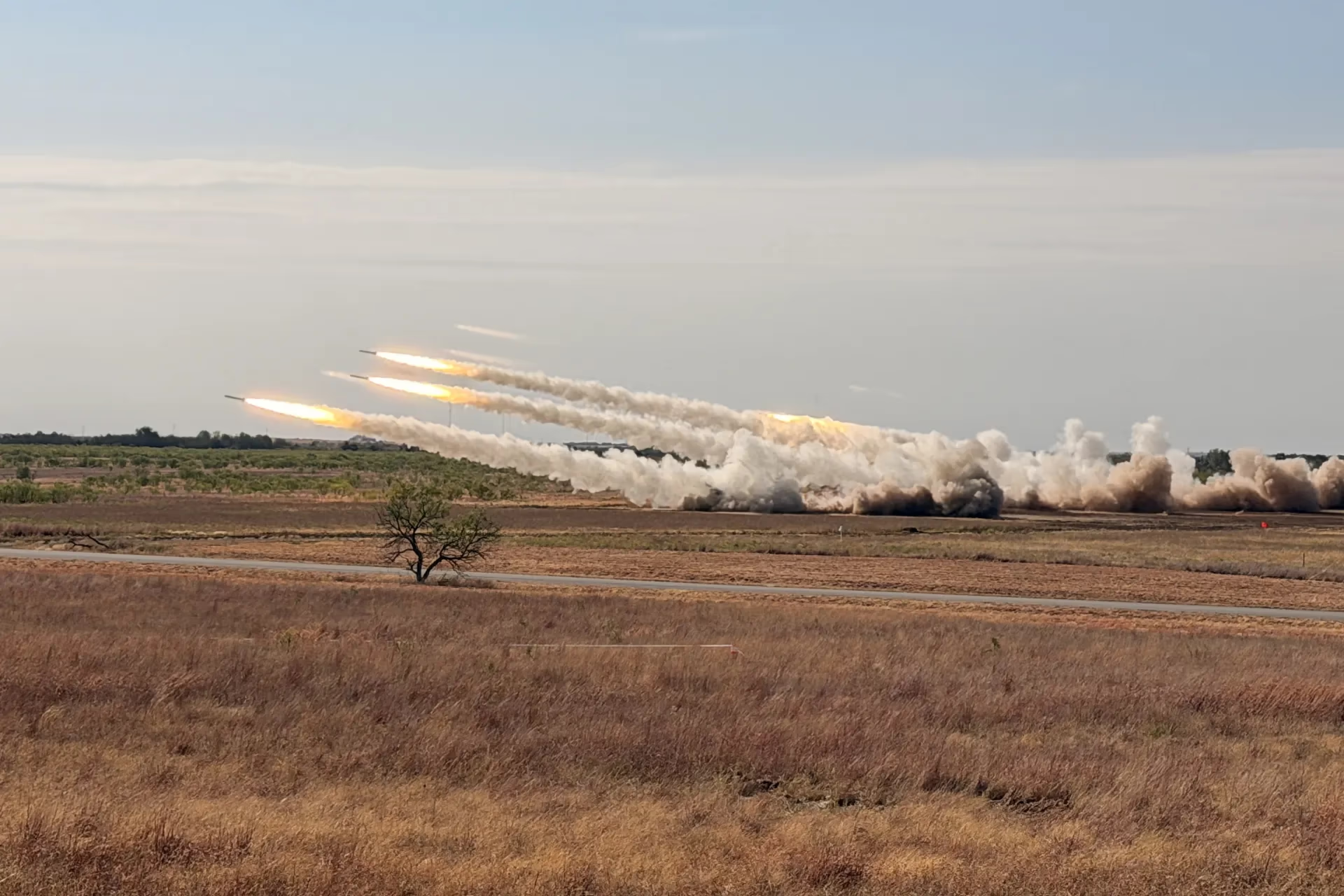
(DEFENCE SECURITY ASIA) — Singaporean and American rocket artillery crews conducted a combined live fire at Fort Sill, Oklahoma, on 22 September, testing the procedures behind precision strikes while exposing a persistent constraint on Singapore’s military readiness: its long range rockets cannot be fired at home.
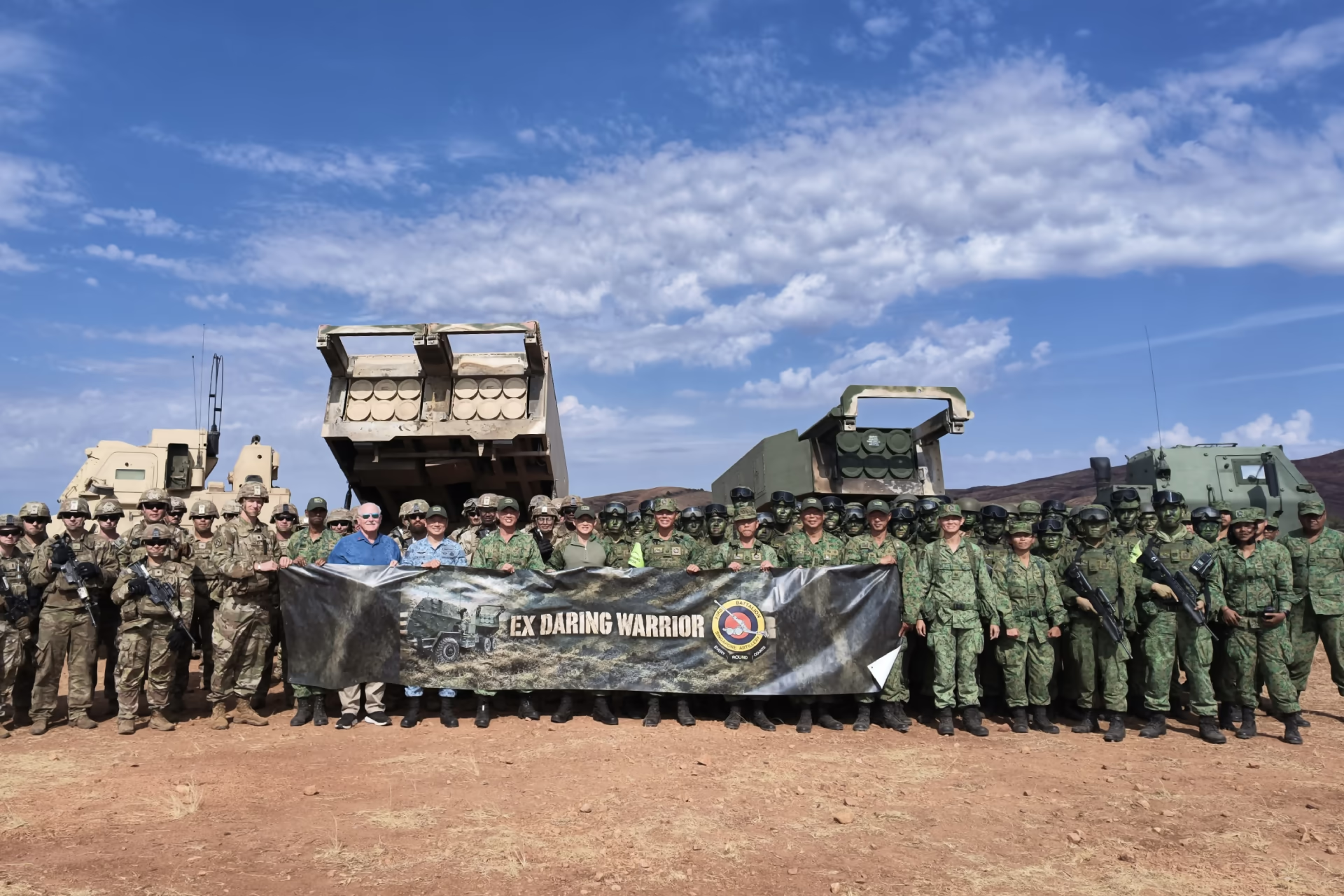
Exercise Daring Warrior 2026 brings about 110 Singapore Armed Forces personnel and 50 US Army personnel together from 29 August to 28 September, pairing Singapore’s 23rd Battalion, Singapore Artillery, with the US Army’s 75th Field Artillery Brigade.
Singapore’s M142 High Mobility Artillery Rocket System, or HIMARS, fired alongside the American M270 family Multiple Launch Rocket System, or MLRS, giving both forces an opportunity to practise coordinated fire missions using related weapons under controlled range conditions.
The distinction matters because a precision strike depends on more than a launcher and rocket: crews must process target coordinates, clear safety requirements, transmit firing instructions and execute a mission before changing circumstances reduce the target’s military value.
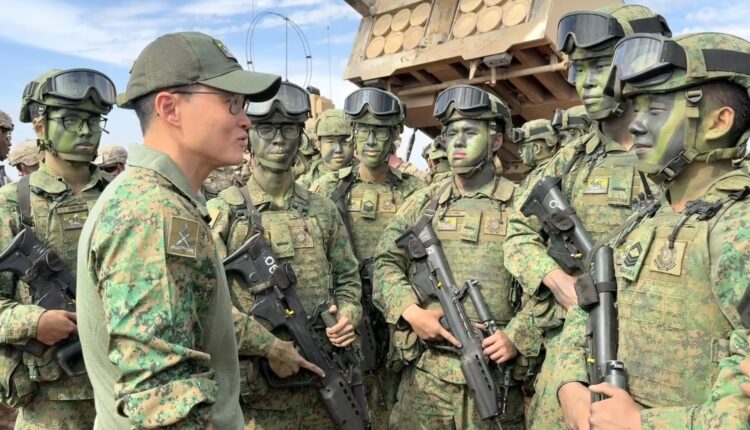
Minister of State for Defence Desmond Choo watched the firing and described Daring Warrior as “an extremely important exercise for the SAF,” linking the range access to realistic training conditions that land constrained Singapore cannot provide its artillery crews.
Choo also said training with US counterparts improves professional skills, while connecting the exercise to the approaching 60th anniversary of National Service, a reminder that Singapore must repeatedly qualify new cohorts to sustain an effective reserve based force.
The 2026 edition is the exercise’s eleventh, continuing a programme launched in 2010 to meet Singapore’s HIMARS live firing and training evaluation requirements after the army introduced an American rocket system whose reach exceeded available domestic training space.
Its immediate military value lies in crew qualification and shared procedures; its broader strategic value lies in maintaining a dependable overseas training site, American technical familiarity and a defence relationship that supports Singapore’s precision strike capability.
The combined firing used reduced range practice rockets without explosive warheads, according to the information available for the 22 September serial, so the event demonstrates a complete launch sequence without establishing the performance of an operational guided strike.
That limitation makes the exercise’s procedural evidence more significant than any claim about destructive effect: Singaporean and American personnel still had to coordinate a mission, operate their respective launchers and observe impacts within Fort Sill’s controlled training environment.
No published account establishes how many launchers fired, whether guided live rockets were used during other serials, or which battalion supplied the American firing crews, leaving the scale of this edition’s tactical evaluation partly unclear.
Even with those gaps, Daring Warrior illustrates a consequential feature of Indo-Pacific force posture: a country can own long range precision weapons yet depend on access to foreign ranges, logistics and partner expertise to keep those weapons operationally credible.
(CLICK): Singapore Splits F-35 Fleet: 12 F-35Bs in US, Eight F-35As at Tengah
Why Singapore’s HIMARS Crews Train at Fort Sill
Singapore’s dense urban geography makes rocket artillery training unusually difficult because a live firing area requires space for launch positions, rocket flight, impact zones and airspace controls, requirements that cannot be separated from civilian safety or surrounding maritime traffic.
A HIMARS unit can rehearse fire direction, communications and launcher procedures in Singapore, but simulations cannot reproduce every demand of an actual launch, including range clearance, weapon handling, crew coordination and observation of a rocket reaching its designated impact area.
Fort Sill provides a standing American artillery training environment for those tasks, making overseas access part of Singapore’s force generation system rather than an occasional opportunity to display a weapon already held in its inventory.
The location also houses the US Army Fires Center of Excellence, placing Singaporean crews near the doctrine, instruction and range management expertise associated with the same rocket artillery family that underpins their battalion’s principal strike role.
Singapore’s first HIMARS battery qualified at Fort Sill during the inaugural Daring Warrior in 2010, and the recurring exercise preserves an evaluation route through which successive crews can demonstrate skills developed during training at home.
That cycle creates a logistical obligation: personnel, launch arrangements, training support and host range access must converge at the right time, while the battalion maintains competence between overseas firing opportunities through drills and other available exercises.
For national servicemen, the exercise can become a decisive practical test within a limited period of full time service, making its scheduling consequential for both individual qualifications and the continuity of trained crews across successive cohorts.
Singapore has also fired HIMARS during larger training activities in Australia, but Fort Sill remains the established setting for Daring Warrior’s bilateral rocket artillery evaluation, with American users and training infrastructure concentrated around the same weapon family.
Dependence on an overseas range does not establish a deficiency in Singapore’s launcher capability; it identifies a constraint in the training footprint that must be managed if the army intends to preserve reliable long range fires.
The strategic consequence is straightforward: continuity of access to suitable foreign ranges helps determine how regularly Singapore can expose its rocket artillery crews to live firing conditions, even as the launchers themselves remain under Singaporean control.
(CLICK): Singapore Boosts Apache Strike Power With US$22.3 Million Hellfire Missile Deal Amid Rising Indo-Pacific Tensions
One Fire Mission, Two Rocket Artillery Systems
Singapore’s HIMARS is a wheeled launcher carrying one rocket pod, while the tracked M270 family MLRS typically carries two, allowing crews using different platforms to practise related firing procedures during the same bilateral exercise.
The systems’ common rocket artillery heritage gives Daring Warrior a practical basis for cooperation, although shared hardware does not automatically mean that national targeting approvals, communications practices or tactical procedures are identical.
During a fire mission, personnel must validate target information and safety data before transmitting instructions to launchers, making the command process as important to effective fires as the mechanical act of sending rockets downrange.
A combined mission therefore tests whether Singaporean and American crews can move information across their respective organisations accurately and in time, a narrower and more measurable form of interoperability than simply placing allied launchers on the same range.
The 22 September practice rounds permitted both sides to work through that sequence and observe impacts, while their lack of explosive warheads limits conclusions about operational effects against defended or moving targets.
American battalion commander Lieutenant Colonel Shaun M. Bailey characterised the activity as a way for partners to apply shared tactics to the same problem, highlighting the value of learning how another force handles a familiar artillery mission.
That exchange can reveal procedural friction before it matters in an operational setting, although the available account does not establish whether the exercise tested a single shared command network, separate national networks or specific digital targeting interfaces.
Nor does a range firing show how either force would locate a target under hostile electronic warfare, protect its launchers from counterfire or sustain rocket supplies across a contested maritime theatre.
Those distinctions matter for readers assessing precision strike capability, because reliable long range fires require reconnaissance, targeting, communications, ammunition and survivable movement as well as crews capable of launching accurately under controlled conditions.
Daring Warrior validates parts of that wider chain through live training and partner coordination, but its publicly described events support no claim that Singapore and the United States rehearsed an integrated wartime strike campaign.
(CLICK): Singapore’s HIMARS Force Just Became Far More Dangerous: US Approves US$83 Million Precision Rocket Deal With Major Indo-Pacific Implications
The Logistics Behind Singapore’s Precision Strike Posture
Singapore’s HIMARS capability rests on a sustained support system that connects domestic crew preparation with overseas ranges, American weapon expertise and the recurring movement of personnel needed to complete live training evaluations.
The original American notification of a possible Singapore sale in 2007 covered 18 HIMARS launchers alongside rockets, practice munitions, vehicles, radios and technical assistance, showing that fielding the system required an ecosystem beyond the firing vehicles.
Singapore began training personnel on HIMARS in 2009, conducted an early live firing at Fort Sill that year and took delivery of its own launchers in 2010, before commissioning its first battery in 2011.
That sequence helps explain why the exercise began as a qualification event: Singapore needed a way to convert a newly acquired American precision fires system into a trained, evaluated army unit despite limited domestic firing space.
For the 2026 edition, the information provided does not establish whether Singapore transported launchers from home or used equipment already available in the United States, a significant gap when assessing deployment speed and transport burden.
A reported earlier plan to keep six Singaporean HIMARS launchers at Fort Sill indicates how seriously the army considered a standing training presence, but the material provided does not establish whether that precise arrangement continues today.
The question matters operationally because moving launchers, support vehicles, personnel and rockets across the Pacific imposes different costs and preparation demands from maintaining equipment near an established training site.
Recent American approvals for possible sales of Alternative Warhead guided rocket pods and Common Fire Control System upgrade kits also indicate a wider modernisation pathway, although approval alone does not confirm delivery, installation or employment during Daring Warrior 2026.
Changes to ammunition or fire control can affect how crews train, yet the available account identifies only practice rockets in the observed combined firing and gives no basis for connecting that serial to newly approved equipment.
Singapore’s rocket artillery posture therefore depends on two linked forms of readiness: maintaining a serviceable precision strike fleet and repeatedly assembling the people, range access and support needed to evaluate its crews.
What the Smaller 2026 Exercise Signals
With about 160 participants, Daring Warrior 2026 is a focused rocket artillery event compared with the substantially larger 2016 edition, which included additional surveillance and attack helicopter elements in an integrated air and land firing.
The smaller footprint should shape expectations: the available description identifies Singaporean HIMARS, American MLRS and a combined firing, but does not identify Apache helicopters, artillery locating radar or a larger combined arms command structure.
Comparisons with 2024 suggest a modest shift in the personnel mix, with fewer Singaporean participants and more American personnel reported for 2026, although headcounts alone cannot show whether training was less demanding or more effective.
Its military purpose remains substantial because launcher crews must preserve proficiency through repeated training cycles, and a focused exercise can expose weaknesses in fire mission processing that a larger event might not measure as directly.
The public visit by Choo added political visibility to that technical work, signalling continued government support for overseas training and for the national servicemen and regular personnel responsible for operating Singapore’s rocket artillery.
A separate meeting between Singaporean Brigadier General Pang Lead Shuan and Fort Sill commander Brigadier General Patrick Costello reflected the installation level relationship that makes recurring access and practical support possible.
Those engagements have a force posture consequence: a regular host site lets Singapore plan training around an established relationship instead of treating every live firing requirement as an isolated negotiation over land, safety and support.
At the same time, a ministerial visit and senior officer meeting should not be mistaken for evidence of a new military commitment, since the provided account announces no revised basing agreement or expanded operational mission.
The exercise was scheduled to continue until 28 September, so the observed firing represents one documented event within the wider programme rather than a complete public record of every evaluation conducted this year.
Its strategic signal is continuity: Singapore and the United States are keeping a specialised artillery training relationship active while Singapore prepares new crews and considers upgrades to a long serving precision fires capability.
The Wider Stakes for Singapore–US Defence Cooperation
Daring Warrior sits within broader Singapore–US defence ties, but its clearest measurable contribution is specific: it allows Singaporean rocket artillery personnel to train on a suitable range with American forces familiar with related launchers and procedures.
That practical arrangement benefits Singapore’s readiness while giving the US Army another opportunity to practise cooperation with an Indo-Pacific partner, without requiring either side to present the firing as a commitment to a particular regional contingency.
The strategic relevance of HIMARS across the Indo-Pacific comes from its ability to move and deliver guided fires from land, but the exercise account does not establish Singaporean deployment plans, target sets or any change in national employment policy.
Likewise, the 2026 event should not be read as proof of new range or lethality: the observed practice rockets demonstrate crew procedures, while separate acquisition approvals leave unanswered when new ammunition or software might enter Singaporean service.
For planners, the enduring question is whether training access, experienced crews, targeting processes and logistics can be sustained together, because an interruption in any one element could reduce the practical value of otherwise capable launchers.
Fort Sill addresses the live firing portion of that problem and offers contact with American artillery expertise, while domestic training and other overseas exercises remain necessary to build skills the combined range event cannot test alone.
The available account also leaves important operational questions open, including how many launchers participated, what reload or night serials occurred, and whether any guided operational rockets were fired before or after the ministerial visit.
Those uncertainties limit conclusions about the depth of this year’s evaluation, yet they do not obscure its central purpose: keeping Singapore’s HIMARS crews qualified through live experience unavailable on their own island.
Sixteen years after the first Daring Warrior, the recurring requirement shows how a defence procurement decision can create lasting dependencies on training geography, partner support and the ability to move a unit through a credible qualification cycle.
For Singapore and the United States, the 2026 firing is consequently more than a ceremonial display: it is a bounded test of rocket artillery procedures and a visible measure of the infrastructure sustaining their bilateral defence relationship.
