
Trump Pressures Canada to Drop GlobalEye for E-7 Wedgetail
Washington’s attempt to link tariff relief with Boeing’s E-7 Wedgetail has turned Canada’s GlobalEye procurement into a strategic battle over NORAD, Golden Dome and defence sovereignty.

(DEFENCE SECURITY ASIA) — Washington’s attempt to connect Canadian tariff relief with Ottawa’s airborne early-warning procurement has transformed a radar-aircraft competition into a consequential test of alliance leverage, industrial sovereignty, and continental defence integration.
During intensive negotiations in mid-August 2026, American officials pressed Canada to reconsider Saab’s GlobalEye and purchase Boeing’s E-7 Wedgetail within a wider package encompassing tariffs, F-35 fighters, and Golden Dome participation.
The proposal was not a written trade clause, but its appearance among informal American phase-two security demands demonstrated how Washington could exploit an unsigned defence programme while negotiating immediate economic concessions.
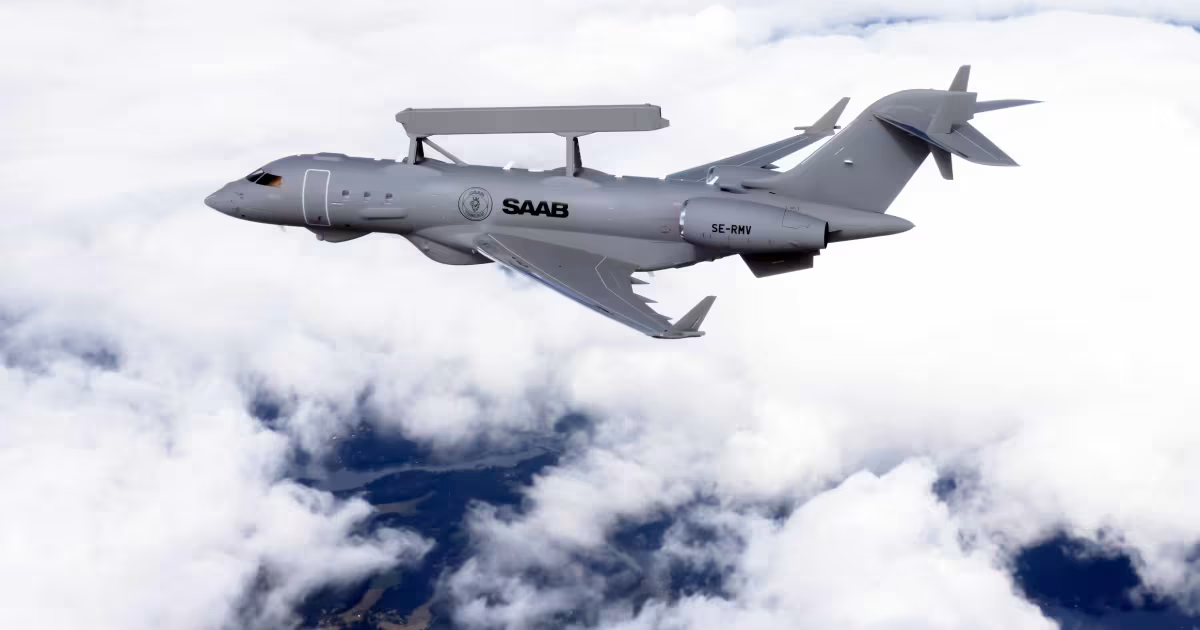
Canada selected Saab as preferred supplier on May 27, 2026, beginning negotiations for five or six GlobalEye aircraft valued above US$3.6 billion, although Ottawa has not signed a binding contract.
That distinction left the programme strategically exposed because Washington could present the E-7 as an interoperability requirement while Ottawa weighed tariff exposure, aerospace employment, technology transfer, and defence-supply diversification priorities.
The contest reaches beyond two aircraft: it concerns who controls Canada’s airborne battle-management architecture, how NORAD detects northern threats, and whether economic pressure can redirect a sovereign allied procurement decision.
GlobalEye combines Saab’s Erieye Extended Range radar and multi-domain sensors with the Canadian-built Bombardier Global 6500, linking Arctic surveillance requirements to a potentially substantial domestic production and support ecosystem at home.
The E-7 Wedgetail instead couples Northrop Grumman’s MESA radar with Boeing’s larger 737 airframe, offering 360-degree surveillance, additional battle-management stations, aerial refuelling, and established operational service among several American allies.
Washington framed American radar aircraft as important for integration with NORAD, F-35s, ground sensors, interceptors, and President Donald Trump’s proposed Golden Dome missile-defence architecture across the wider North American battlespace.
Ottawa, however, sees GlobalEye’s Canadian airframe, promised technology transfer, export production, and reduced dependence on American-controlled systems as valuable strategic insurance following a significant deterioration in increasingly strained bilateral relations.
Defence Procurement Secretary Stephen Fuhr said Canada remained in Saab negotiations “despite a lobbying campaign in favour of Boeing’s E-7 Wedgetail,” signalling continuity without converting preferred-supplier status into contractual certainty.
The unresolved decision therefore concentrates three competing imperatives—continental interoperability, Canadian industrial autonomy, and economic vulnerability—inside one airborne early-warning programme whose outcome could reshape future alliance procurement far beyond Canada itself.
(CLICK HERE): Secret Middle East Buyer Orders Saab GlobalEye in US$1.04 Billion Deal, Reshaping Gulf Air Defence and Regional Power Balance
Tariff Leverage Turns Defence Procurement Into Strategic Statecraft
The pressure emerged before an August 19 deadline, when Trump threatened 50-percent Section 338 tariffs covering roughly US$20 billion in additional Canadian exports unless negotiators secured a broader package of concessions.
Washington offered reduced existing tariffs on Canadian steel, aluminium, automobiles, and forest products, while pausing new measures, in exchange for movement on dairy quotas, alcohol distribution, procurement preferences, and retaliatory duties.
Although defence formally belonged to a later negotiating phase, American representatives indicated that Canadian flexibility on F-35 purchases or airborne radar aircraft could influence tariff terms offered during the immediate phase.
This sequencing provided Washington plausible separation between trade and security while preserving leverage, because Ottawa could signal future defence alignment without either government recording an explicit aircraft-for-tariffs transaction in formal text.
American demands reportedly included completing Canada’s 88-aircraft F-35 purchase, acquiring American radar planes for Golden Dome, granting critical-mineral preferences, and providing assurances concerning future Canadian energy supplies to the United States.
Canadian officials considered presenting critical minerals and defence cooperation as a closing offer, illustrating how military procurement, resource security, and market access were increasingly treated as components of one strategic negotiation.
The talks collapsed on August 21–22 after Ottawa said Washington introduced last-minute changes, allowing new tariffs to take effect and prompting Canada to prepare countermeasures without accepting a Wedgetail commitment.
The failed negotiation neither cancelled GlobalEye nor secured the E-7, but it exposed how unfinished procurement programmes can become bargaining assets when commercial dependence and security integration overlap increasingly asymmetrically.
For allies buying American systems, the episode raises a wider question: whether interoperability remains a military advantage freely selected by partners or becomes economic leverage when national procurement preferences diverge.
For Washington, linking trade concessions with defence alignment could consolidate continental architecture, yet repeated pressure may accelerate Canadian diversification toward European suppliers and weaken the industrial influence the approach seeks to preserve.

GlobalEye Anchors Canada’s Arctic Surveillance and Aerospace Strategy
Canada’s preferred platform places Erieye ER above a Global 6500 business jet, creating a comparatively fast, high-altitude aircraft with long unrefuelled endurance suited to monitoring immense and infrastructure-scarce Arctic approaches.
Its smaller airframe could reduce operating and deployment burdens compared with a 737-derived platform, an important consideration when northern missions require persistent coverage across dispersed bases and demanding environmental conditions.
Erieye ER provides long-range airborne surveillance and multi-domain sensing, but reported fore-and-aft coverage limitations mean mission planning, aircraft orientation, supporting sensors, and networked operations remain central to achieving continuous situational awareness.
GlobalEye also carries fewer onboard battle-management consoles than Wedgetail, potentially constraining the number of operators directing complex engagements even as distributed command networks could move some processing and coordination ashore.
Saab’s proposal connects operational capability with Canadian industrial policy by using Bombardier’s domestically built aircraft and promising technology transfer, mission-system work, sustainment capacity, and thousands of specialised aerospace-sector jobs nationwide.
The industrial concept could allocate Canada a significant share of future GlobalEye airframes, potentially involving approximately 40 aircraft over 15 years for domestic and export customers if projected demand materialises.
Bombardier has discussed a Canadian defence-modification facility, while Saab envisages a production and support hub serving Canada and NATO, which is separately negotiating for as many as ten GlobalEye aircraft.
Those prospects remain conditional rather than guaranteed, because Canada has signed no acquisition contract, export orders may change, and proposed workshare depends upon final negotiations, schedules, customers, and certification arrangements.
Nevertheless, Ottawa can treat domestic missionisation and sustainment as force-readiness assets, reducing exposure to foreign bottlenecks while building technical expertise required to modify sensors throughout the fleet’s operational service life.
GlobalEye therefore represents more than an aircraft purchase: it offers Canada a possible sovereign surveillance ecosystem linking Arctic operations, high-value aerospace employment, allied exports, technological control, and diversified defence-industrial relationships.
E-7 Wedgetail Offers Battle Management and NORAD Integration
Boeing’s E-7 combines the 737 airframe with Northrop Grumman’s MESA radar, delivering full 360-degree coverage and a larger mission crew able to manage a denser, faster-moving continental air battle effectively.
Additional consoles matter because airborne early-warning aircraft do not merely detect targets; their operators classify tracks, allocate fighters, coordinate interceptors, manage communications, and sustain essential command continuity during contested operations.
Air-to-air refuelling enables Wedgetail to extend station time beyond its baseline endurance, supporting prolonged NORAD missions when tanker availability, crew limitations, maintenance cycles, and adversary activity permit continued airborne operations.
The platform’s service with Australia, Britain, and other operators provides an established multinational user base, although common aircraft type alone does not automatically resolve sovereign software, data-sharing, configuration, or sustainment requirements.
Washington argues that E-7 would integrate more readily with American F-35s, ground radars, interceptors, and Golden Dome, creating a common battle-management layer for detecting and engaging threats approaching North America.
That case becomes stronger if Golden Dome requires highly protected American data paths, rapid sensor-to-shooter exchanges, and common mission systems linking airborne surveillance with space, terrestrial, and interceptor networks simultaneously.
However, the United States Air Force’s on-again, off-again relationship with E-7 introduces programme uncertainty, requiring Canada to assess American acquisition decisions separately from the aircraft’s demonstrated operational attributes in allied service.
A larger 737-based platform also creates a different logistics footprint, demanding compatible runways, maintenance skills, spares, support equipment, and personnel structures that could raise lifecycle burdens relative to GlobalEye’s business-jet architecture.
Conversely, selecting E-7 could simplify some coalition training, tactics development, software coordination, and mission-data exchange, especially if NORAD standardises Wedgetail as its principal airborne command-and-control platform for integrated continental defence.
Ottawa must therefore determine whether superior onboard capacity and potentially easier American integration outweigh industrial concentration, platform operating demands, procurement politics, and the strategic costs of reversing its preferred-supplier decision.
Datalinks and ITAR Define the Hidden Integration Contest
The decisive comparison may lie less in radar range than in network access, because an AEW&C aircraft creates operational value by distributing trusted tracks and engagement-quality data across a joint force.
GlobalEye’s compatibility with NORAD remains technically unresolved in public, particularly regarding American-controlled datalinks such as the F-35’s Multifunction Advanced Data Link, whose access may require export approvals, gateways, or additional integration.
ITAR restrictions could shape which components Canada can modify, what mission data it can inspect, how quickly software changes occur, and whether third-country support arrangements remain operationally and politically feasible.
Washington can consequently frame E-7 as the lower-risk integration choice, not simply an American product, because common security standards and protected interfaces may shorten certification across NORAD and Golden Dome networks.
Yet interoperability is not binary: GlobalEye could exchange information through approved tactical links, gateways, command centres, or federated networks, although latency, classification barriers, cyber assurance, and track fidelity require rigorous testing.
Without published integration results, claims that either aircraft is uniquely compatible remain partly assumptive, and policymakers should distinguish verified sensor performance from projected access to still-evolving Golden Dome architecture and networks.
Canada must also evaluate resilience under electronic attack, including radar jamming, datalink disruption, cyber intrusion, satellite degradation, and attacks against forward bases supporting airborne early-warning sorties over vulnerable northern approaches.
A smaller GlobalEye fleet of five or six aircraft would impose demanding availability mathematics, as training, deep maintenance, upgrades, crew rest, and unexpected failures reduce the number immediately deployable for continuous coverage.
Platform choice consequently affects basing, tanker demand, spare-aircraft margins, operator pipelines, mission-system laboratories, and hardened communications—critical elements that determine actual operational force posture more reliably than published catalogue specifications alone.
The winning proposal will therefore be the architecture Canada can sustain, secure, upgrade, and connect during crisis, rather than whichever radar or airframe appears strongest when assessed as an isolated platform.
(CLICK HERE): NATO SHOCK EXIT: Multi-Billion Euro Wedgetail AWACS Deal Collapses as Allies Abandon Boeing E-7—Europe Turns to GlobalEye
Ottawa’s Choice Will Signal the Future of Allied Procurement
As of September 1, 2026, Canada had not reversed its GlobalEye preference, and continuing Saab negotiations suggested that failed tariff talks strengthened rather than weakened Ottawa’s political case for supplier diversification.
Fuhr warned that sole-source awards to American companies would be politically difficult after the tariffs, saying, “I think people would not be happy about that,” while avoiding a definitive procurement commitment.
He argued Canada must stop putting “all our eggs in one basket,” framing cooperation with European, Asian, and Oceanian partners as a structural response to ITAR exposure and changing relations.
That policy could influence programmes beyond airborne surveillance, including the unresolved F-35 review, possible Saab Gripen interest, and politically sensitive American-linked acquisitions such as a potential Black Hawk purchase for special forces.
Canada holds a firm order for 16 F-35s and is funding long-lead items for 14 more, but the remaining aircraft within the original 88-fighter acquisition plan remain publicly unresolved today.
Choosing GlobalEye while retaining F-35s could produce a deliberately diversified force, spreading industrial dependence across suppliers while accepting additional integration work to preserve NORAD effectiveness and broader coalition combat credibility.
Selecting E-7 could signal that continental defence requirements override diversification, reinforcing American control over critical mission systems while potentially improving commonality across emerging Golden Dome sensor and interceptor networks in wartime.
Either decision carries alliance consequences because NATO partners will study whether Washington tolerates compatible non-American systems, and whether Canadian industrial benefits survive when economic negotiations collide with American security preferences.
Ottawa must preserve factual discipline: Saab remains preferred but uncontracted, E-7 pressure produced no signed commitment, integration questions remain open, and projected employment or export volumes are not guaranteed outcomes.
The lasting strategic issue is whether Canada can reconcile sovereign procurement, Arctic surveillance, industrial resilience, and NORAD interoperability without allowing either tariff retaliation or domestic politics to substitute for operational analysis.
