
USAF Fighter Fleet Hits 27.4-Year Average Age as F-35, F-15EX and F-47 Race Accelerates
A September 4, 2026 Congressional Research Service assessment highlights a heavily used USAF fighter fleet averaging 27.4 years old as Washington confronts aircraft shortages, readiness pressures and an increasingly demanding Indo-Pacific combat environment.
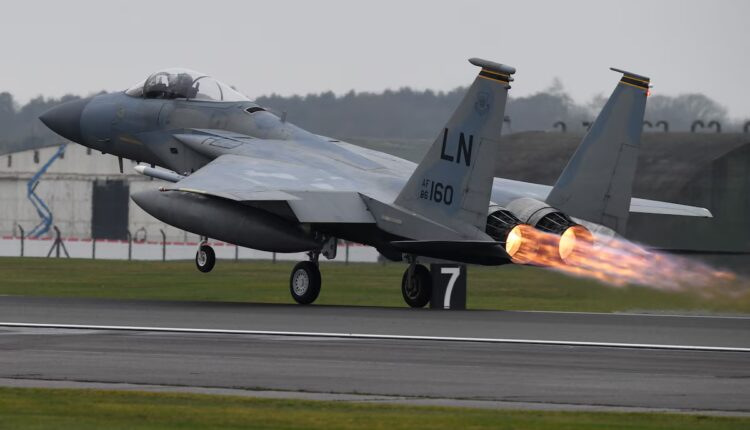
(DEFENCE SECURITY ASIA) — The United States Air Force enters its next-generation fighter transition carrying a strategically consequential liability: a heavily used combat fleet averaging 27.4 years old, creating mounting tension between immediate global commitments, aircraft availability, modernization requirements and future high-intensity warfare.
That aging profile matters because potential Pacific operations would demand long-range fighter sorties against sophisticated integrated air-defence systems, electronic warfare networks and contested logistics environments where aircraft reliability, sortie generation and maintenance resilience become fundamental components of combat power.
The problem extends beyond age because the Air Force acknowledged it would not satisfy its FY2026 statutory fighter requirement, while Secretary Troy Meink notified Congress on May 5, 2026 that the service possessed 1,098 fighters against the 1,145 requirement.
The resulting force-structure challenge places Washington between two competing military imperatives: retiring increasingly expensive legacy aircraft before sustainment burdens become prohibitive while retaining enough combat capacity to deter simultaneous contingencies across the Indo-Pacific, Europe and American homeland defence missions.
This tension arrives while Washington intends to accelerate F-35A and F-15EX acquisition, preserve selected F-16s, develop the sixth-generation F-47 and introduce Collaborative Combat Aircraft, effectively rebuilding American tactical aviation while substantial elements of the existing force remain operationally indispensable.

The Air Force consequently seeks an eventual force of 1,558 crewed fighters by 2035, an inventory objective derived from service analysis, wargaming and risk methodology intended to provide greater strategic depth against combatant-command requirements during potentially overlapping military crises.
Yet 1,558 aircraft represent an objective rather than a funded procurement programme, making industrial capacity, congressional appropriations, workforce availability and production rates decisive variables determining whether American airpower actually emerges from its approaching fighter-capacity trough during the early 2030s.
The transition therefore creates a dangerous timing problem because older A-10s, F-15C/Ds, selected F-15Es and early F-16s face retirement while replacement aircraft must simultaneously expand faster enough to restore numerical depth without degrading readiness through unsustainable maintenance requirements.
Readiness indicators deepen that concern, with overall aircraft availability reported around 54 percent during 2024 and the fighter mission-capable rate at 67.15 percent, demonstrating why nominal inventory alone cannot accurately measure deployable combat power during sustained high-tempo operations.
Human capacity compounds the aircraft problem because the service faced an approximately 1,900-pilot shortage during FY2024 and reported more than 9,700 missing maintainers, constraining the manpower ecosystem required to generate sorties from increasingly sophisticated and maintenance-intensive combat aircraft.
These pressures transform fighter modernization from a conventional procurement question into a geopolitical race between American recapitalization timelines and evolving threats, particularly across the Pacific where distance, sophisticated air defences and electronic warfare could magnify every shortfall in available aircraft.
Washington is therefore confronting more than an aging-fighter problem: it must simultaneously replace legacy capacity, expand combat mass, strengthen sustainment, train personnel and field sixth-generation technologies without creating a vulnerability window that competitors could potentially exploit before modernization reaches operational scale.
(CLICK HERE): USAF to Retire 250 Fighter Aircraft, Including 5th Generation F-22 Raptor
27.4-Year Average Exposes the Hidden Cost of America’s Aging Fighter Fleet
An average fighter age of 27.4 years represents the accumulated consequence of decades in which increasingly capable aircraft allowed smaller inventories, but that historical trade-off now encounters a security environment demanding both technological sophistication and considerably greater operational mass.
Older fighters remain militarily valuable because upgraded F-15s and F-16s can employ modern sensors, electronic warfare systems and precision weapons, yet structural fatigue, component obsolescence and maintenance intensity progressively influence how efficiently those aircraft can generate combat-ready sorties.
The strategic measurement is therefore not simply how many fighters appear on an inventory sheet, but how many aircraft can repeatedly launch, recover, undergo maintenance, regenerate weapons and return to combat during prolonged operations against a sophisticated peer adversary.
This distinction becomes especially important in the Indo-Pacific, where dispersed basing and enormous operational distances could increase flying hours while simultaneously complicating spare-parts distribution, depot support and maintenance manpower across geographically separated forward operating locations.
Aging aircraft consequently impose a logistics footprint that directly influences force posture because maintaining older platforms requires parts, technicians, inspection cycles and sustainment funding that compete against resources needed to purchase and operate replacement fighters and develop future systems.
Sustainment costs have reportedly increased approximately $950 million since FY2019, while per-aircraft costs rose more than 18 percent and an approximately $400 million annual weapon-system sustainment shortfall demonstrates the financial pressure accompanying continued operation of legacy fleets.
The FY2027 request for $4.4 billion in spare parts across Air Force aircraft further illustrates how combat effectiveness depends upon industrial throughput extending far beyond fighter assembly lines into engines, components, avionics, consumables and maintenance infrastructure.
Retiring aging aircraft could reduce those burdens, but accelerated divestment creates another strategic danger by removing operational squadrons faster than F-35A and F-15EX production can replace their numerical contribution, potentially worsening force availability during the modernization transition.
That trade-off explains congressional restrictions affecting F-22 and F-15E retirements and previous intervention surrounding A-10 divestment, reflecting concern that capability modernization cannot be separated from the number of aircraft available for geographically distributed combat requirements.
America’s 27.4-year fighter average therefore represents more than an aging statistic; it exposes the central modernization dilemma facing the USAF—how to exchange increasingly expensive legacy capacity for advanced combat power without surrendering operational mass during the transition.

Fighter Numbers Fall Before Recovery, Creating a Dangerous 2030 Capacity Trough
The force-structure problem becomes strategically sharper because fighter numbers are projected to continue declining until approximately 2030 before recovering, producing a transition period when retirement decisions, production delays or readiness deterioration could have disproportionate consequences for American force availability.
The Air Force proposes replacing the existing statutory Primary Mission Aircraft Inventory framework with Combat Coded Total Aircraft Inventory, arguing that PMAI excludes backup aircraft and attrition reserves representing approximately 15 percent of aircraft associated with combat-coded units.
Under that broader methodology, approximately 1,369 crewed fighters represent an interim 2030 force associated with acceptable risk, while the 1,558-aircraft objective for 2035 is intended to provide greater capacity, strategic depth and confidence in meeting operational objectives.
Numbers below those thresholds correspond with increasing operational risk because commanders could receive forces on a “just-in-time” basis or encounter insufficient readiness, reducing Washington’s flexibility when multiple theatres simultaneously demand fighter squadrons, air defence and strike capacity.
The significance becomes clearer when compared with the Cold War, when total-force combat-coded fighter numbers stood around 3,300, versus roughly 1,180–1,200 today, although modern aircraft possess dramatically greater sensors, weapons, networking and survivability.
Technology partially compensates for numerical contraction but cannot eliminate geography because one advanced fighter cannot simultaneously occupy multiple operating locations, escort bombers, defend bases, suppress air defences and maintain combat air patrols across separate theatres.
A June 2026 multi-theatre wargame characterized the force as “hollow,” concluding that capacity becomes indispensable when Europe, the Pacific and homeland defence generate concurrent demands, highlighting the operational limitations of relying exclusively upon superior individual-platform performance.
The Pacific magnifies that calculation because long transit distances consume fuel and mission time, requiring tanker support and sufficient aircraft numbers to maintain persistent combat presence while other fighters undergo maintenance, rearming, crew rotation or battle-damage repair.
Collaborative Combat Aircraft could eventually expand available combat mass by pairing uncrewed systems with crewed fighters, but current planning explicitly treats CCAs as force multipliers rather than replacements and excludes them from the proposed statutory crewed-fighter inventory.
The approaching 2030 trough therefore represents the critical bridge between America’s aging force and its intended future fleet, making production stability, retirement sequencing and readiness preservation central to maintaining deterrence before sixth-generation airpower becomes available in meaningful numbers.
F-35A and F-15EX Production Becomes a Strategic Race Against Fleet Aging
The F-35A is intended to remain the foundation of the future fighter force, with the Air Force seeking production approaching 100 aircraft annually by 2030, a rate that would significantly accelerate recapitalization if budgets and industrial capacity support sustained output.
Near-term procurement remains substantially below that ambition, however, with FY2027 planning discussed around 24 discretionary and 14 mandatory F-35As, illustrating the substantial distance separating current acquisition quantities from the production tempo envisioned for later modernization.
The programme of record remains 1,763 F-35As, giving the stealth fighter extraordinary importance because its sensors, electronic warfare architecture, networking and low-observable characteristics provide capabilities increasingly necessary against advanced integrated air-defence systems encountered in peer warfare.
The F-15EX performs a complementary role by replacing F-15C/D aircraft while potentially helping recapitalize the F-15E fleet, with production targeted at 24 aircraft annually by 2027 and discussions considering approximately 36 annually by 2030.
That combination creates a high-low operational architecture in which stealthy F-35As penetrate contested environments while heavily armed F-15EX aircraft contribute payload, range and weapons capacity, preserving force mass without requiring every tactical fighter to possess identical characteristics.
Industrial constraints nevertheless threaten both trajectories because F-15EX production shares manufacturing capacity with foreign customers, while F-35 output must satisfy the Air Force, Navy, Marine Corps and international partners competing within the same multinational supply ecosystem.
Supplier performance, aerospace workforce availability and spare-parts production consequently become geopolitical variables because insufficient American manufacturing capacity could force choices between domestic recapitalization requirements and allied deliveries supporting broader coalition deterrence and interoperability.
The difficulty is magnified by simultaneous sustainment requirements because factories and suppliers must support existing fighters while producing replacements, meaning industrial capacity must sustain yesterday’s aircraft and manufacture tomorrow’s fleet throughout the same strategically sensitive transition.
Accelerated procurement also requires substantial funding, with analysis indicating that purchasing 74 F-35As annually could require approximately $3.7 billion more each year than recent acquisition rates, before considering parallel F-15EX, F-47 and CCA investments.
Consequently, America’s fighter crisis cannot be solved by procurement announcements alone because the decisive measurement will be whether production lines, suppliers, workforce pipelines and appropriations collectively deliver aircraft faster than aging fleets lose affordable and operationally credible capacity.
F-47 and Collaborative Combat Aircraft Redefine the Future Pacific Battlespace
The sixth-generation F-47 sits at the centre of the 2035 force concept because the aircraft is expected to provide the survivability, range and connectivity necessary for penetrating increasingly sophisticated threat environments while supporting the planned 1,558-fighter inventory.
Public planning has discussed more than 185 F-47 aircraft, while the programme’s claimed combat radius exceeding 1,000 nautical miles directly addresses Pacific geography, where tactical aviation must project combat power across distances substantially greater than traditional European operating environments.
Greater range reduces—but does not eliminate—dependence upon vulnerable aerial refuelling because fighters operating deeper into contested airspace still require resilient tanker networks, distributed bases and logistics infrastructure capable of surviving missile, cyber and electronic attacks.
The F-47 therefore matters beyond its individual performance because sixth-generation air warfare increasingly depends upon networked formations combining crewed fighters, uncrewed aircraft, offboard sensors and distributed weapons into an interconnected combat architecture rather than isolated tactical platforms.
Collaborative Combat Aircraft are intended to augment those crewed fighters through affordable uncrewed mass, potentially extending sensor coverage, carrying weapons, complicating enemy targeting and allowing commanders to accept operational risks that would be politically unacceptable for crewed aircraft.
Their exclusion from statutory crewed-fighter totals remains significant because it preserves recognition that autonomous or semi-autonomous aircraft cannot automatically substitute for human-controlled fighters across every air-superiority, strike, command-and-control and rules-of-engagement requirement.
The Air Force consequently faces two modernization challenges simultaneously: producing sufficient crewed aircraft to restore numerical depth while developing enough affordable CCAs to create distributed combat mass without allowing technological ambition to overwhelm procurement budgets or sustainment systems.
Schedule risk remains strategically important because delays affecting the F-47 would extend reliance upon F-22, F-35, F-15EX and modernized F-16 fleets, potentially forcing Washington to preserve older aircraft longer than originally intended to maintain required force structure.
The transition also changes adversary calculations because a successfully fielded F-47-and-CCA architecture could distribute sensors and weapons across numerous nodes, complicating attempts to destroy American combat power through concentrated attacks against comparatively small numbers of premium crewed fighters.
Yet until those systems reach operational scale, the existing 27.4-year-old fleet remains the bridge carrying American airpower toward sixth-generation warfare, making present-day readiness and sustainment inseparable from the credibility of Washington’s future Pacific force posture.
(CLICK HERE): [VIDEO] “Leaked Over Area 51?” — Suspected Boeing F-47 NGAD Sixth-Generation Fighter Captured in Thermal Footage Near Groom Lake
Pilots, Maintainers and Industrial Capacity Could Decide Whether 1,558 Fighters Remain Aspirational
Aircraft procurement cannot independently restore American fighter power because the service requires pilots, maintainers, weapons, spare parts, training ranges, depot capacity and resilient operating bases capable of converting inventory into sustainable combat sorties during prolonged high-intensity operations.
The approximately 1,900-pilot shortfall reported for FY2024 demonstrates this constraint, while a production target around 1,500 pilots annually was not being achieved and active-duty fighter aviator manning was projected at only 67.2 percent during FY2027.
Maintenance manpower creates an equally consequential bottleneck, with the Air Force reporting a shortage exceeding 9,700 maintainers, approximately ten percent of requirements, directly affecting aircraft availability and the capacity to absorb additional technologically sophisticated fighters entering operational squadrons.
Training creates another resource competition because flying hours required to maintain combat proficiency draw upon the same broader funding environment supporting modernization, meaning procurement growth without adequate operating expenditure could produce more aircraft without proportionately increasing deployable combat power.
Air National Guard modernization further complicates force planning because all 24 Guard fighter squadrons are considered necessary for achieving the approximately 1,369-fighter acceptable-risk structure, yet 13 reportedly lack recapitalization pathways considered commensurate with strategic requirements.
Guard leaders have advocated multiyear procurement of at least 48 F-35As and 24 F-15EXs annually, eventually seeking 72 and 36 respectively, demonstrating how reserve-component modernization intersects with national force capacity, industrial stability and congressional politics.
Congress is consequently considering legislation establishing at least 1,369 combat-coded fighters by December 2030 and potentially 1,558 by December 2035, while extending inventory protections and enabling multiyear procurement intended to provide manufacturers with stronger demand predictability.
Even statutory requirements cannot manufacture combat power automatically because the classified unconstrained production pathway reportedly exceeds what existing budgets and industry can presently deliver, leaving the 1,558 objective dependent upon sustained investment extending across multiple administrations and congressional cycles.
The decisive strategic question is therefore whether Washington can synchronize retirement schedules, F-35A and F-15EX production, F-47 development, CCA integration, workforce regeneration and sustainment investment before declining legacy capacity produces an operationally consequential gap.
America’s aging 27.4-year fighter fleet ultimately represents a race against time: the United States possesses an ambitious pathway toward greater sixth-generation combat power, but deterrence will depend upon whether logistics, manpower and industrial capacity can carry today’s force safely across that transition.
