
US Marines Renew Philippines Rotation, Strengthening South China Sea Defence Links
The sixth MRF-SEA rotation strengthens command continuity and maritime surveillance coordination as Washington and Manila deepen coastal defence cooperation amid sustained Chinese pressure.
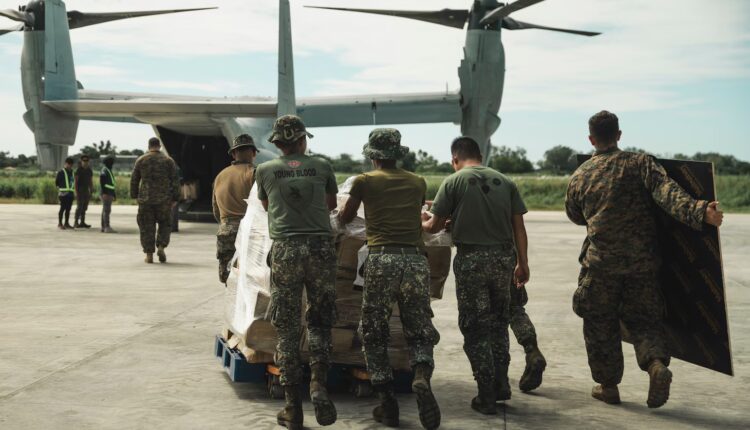
(DEFENCE SECURITY ASIA) — The latest US Marine rotation to the Philippines puts operational continuity at the centre of an evolving alliance posture, as Washington and Manila seek to connect dispersed forces, maritime surveillance and coastal defence across an archipelago facing sustained Chinese pressure.
The sixth iteration of Marine Rotational Force-Southeast Asia, or MRF-SEA, is the second consecutive rotation focused primarily on the Philippines, signalling that repeated deployments are becoming a mechanism for maintaining knowledge rather than demonstrating temporary presence.
A command turnover recently at Clark Air Base transferred responsibility from Colonel Robert Bunn to Colonel Coby Moran, with the incoming contingent drawn from I Marine Expeditionary Force at Camp Pendleton, California, to continue integration.
The central development is therefore a renewed forward command element rather than an announced expansion of combat formations, with the rotation intended to coordinate Marine training, improve combined planning and strengthen the foundations of US-Philippines military interoperability.
Outgoing MRF-SEA commander Colonel Robert Bunn captured that distinction with the statement, “Presence has to have purpose,” linking the deployment’s value to whether exercises and planning produce forces capable of communicating, responding and operating together under demanding conditions.

Incoming commander Colonel Coby Moran said personnel were “inheriting momentum,” a formulation that places the strategic emphasis on preserving relationships and accumulated lessons as rotations attempt to turn episodic engagement into a more coherent operational presence across Philippine territory.
That approach supports Manila’s Comprehensive Archipelagic Defense Concept, which prioritises external defence and maritime protection, while giving Washington a framework for integrating forces across dispersed locations without converting the rotation into a permanent American garrison.
Its significance extends beyond troop movements because command arrangements, communications procedures and sustainment networks determine whether surveillance aircraft, coastal defence weapons and visiting formations can contribute to a shared response when maritime confrontations create compressed timelines for allied commanders.
Recent confrontations around Second Thomas Shoal and Scarborough Shoal provide the security backdrop, although Philippine allegations of Chinese obstruction and unsafe manoeuvres remain contested by Beijing, which presents its activities as enforcement within waters and airspace it claims.
The deployment consequently carries two simultaneous messages: Manila retains an invited American military presence supporting its defence priorities, while Beijing faces an alliance working to make that presence operationally useful through repeated training rather than relying exclusively on diplomatic commitments.
However, the available details do not establish the incoming contingent’s exact strength, a new missile deployment or combat readiness across the archipelago, making any conclusion that this turnover alone transforms the regional military balance premature and unsupported by disclosed information.
DSA’s assessment is that the consequential shift lies in operational persistence: a rotating command element can help connect existing capabilities, but its deterrent value will depend on resilient logistics, communications and Philippine decisions governing how those capabilities are employed.
(READ) US Marines Test G/ATOR Radar in Philippines as First Island Chain Defences Harden
Marine Rotation Builds Philippine Command Continuity
MRF-SEA functions as I Marine Expeditionary Force’s forward command element in the Philippines, providing command and control for Marine forces training across the country while helping align activities with the Armed Forces of the Philippines and Philippine Marine Corps.
This role matters because an archipelagic operating environment divides personnel, equipment and information among separated locations, making coordination a recurring requirement rather than an administrative task that can be completed once before an exercise or deployment begins.
The force’s flexible composition allows capabilities to adjust to missions, but that flexibility also means the label MRF-SEA cannot be treated as evidence of a fixed combat formation, an established weapons inventory or a predetermined wartime force package.
Task Force-Philippines provides a broader joint coordination framework, whereas the Marine rotation concentrates on operational integration, creating complementary functions whose effectiveness depends on clear responsibilities, shared planning processes and arrangements that prevent competing headquarters from slowing decisions during emergencies.
The previous rotation participated in Balikatan 26 and KAMANDAG 10, providing a practical inheritance for the incoming contingent through experience in command and control, sensing, aviation, communications, unmanned systems and the coordination of fires across distributed Philippine operating areas.
Bunn’s emphasis on becoming “more interoperable, responsive and capable together” identifies the intended outcome, although that language represents a command objective rather than independently demonstrated proof that combined formations can sustain equivalent performance under disruption or military pressure.
The incoming rotation’s task is to preserve useful procedures while identifying remaining friction, since personnel turnover can weaken relationships and institutional memory unless planning records, liaison arrangements and lessons transfer effectively between outgoing and incoming American and Philippine teams.
That continuity can shorten the time required to integrate additional I Marine Expeditionary Force personnel during a crisis, although faster reinforcement would still require transport availability, access permissions, receiving capacity and functioning support arrangements at locations selected for operations.
The rotation’s concentration on the Philippines also marks a geographic narrowing from earlier engagement across Brunei, Indonesia, Malaysia, Singapore and Thailand, concentrating training effort where South China Sea confrontations have made alliance responsiveness a visible strategic issue for both governments.
For regional observers, the important force posture question is therefore whether repeated rotations generate durable operational competence, because a headquarters that coordinates dispersed capabilities effectively can deliver greater value than a more conspicuous presence lacking comparable integration and sustainment.
(READ) US Deploys F-22 Raptor to Philippines—But Pacific War Reality Exposes Critical Gaps Against China’s Chengdu J-20

Logistics and EDCA Access Determine Operational Reach
The logistics footprint underpinning this posture centres on nine Philippine-owned Enhanced Defense Cooperation Agreement locations, where American rotational access supports training, equipment prepositioning and disaster response while ownership and control remain with the Armed Forces of the Philippines under existing agreements.
Those locations include Antonio Bautista Air Base, Basa Air Base, Fort Magsaysay, Mactan-Benito Ebuen Air Base and Lumbia Airport, providing an access framework that stretches across different parts of the archipelago rather than concentrating the posture around one installation.
Naval Base Camilo Osias, Lal-lo Airport, Camp Melchor Dela Cruz and Balabac Island complete that network, linking northern and western access points to a broader defence geography whose utility depends on the functions and readiness of each location.
Infrastructure and storage improvements matter because access agreements alone cannot move fuel, repair equipment or maintain aircraft, while the available information identifies continuing work at existing sites rather than an announcement of additional locations for an enlarged basing network.
Dispersal can complicate an opponent’s operational planning by distributing activity among multiple locations, but it also increases the burden of moving supplies, maintaining communications and supporting small detachments whose requirements must be met across maritime and air transport routes.
A distributed force therefore faces a sustainment tradeoff: spreading assets may reduce dependence on one installation, while insufficient transport, maintenance or replenishment capacity could leave individual detachments isolated and prevent commanders from concentrating useful capabilities during a local crisis.
Long-range expeditionary communications and movement training address parts of that problem, yet successful exercises would demonstrate selected procedures under particular conditions rather than establish that the entire support network could withstand disruption, damaged infrastructure or contested access during conflict.
Antonio Bautista Air Base in Palawan has particular relevance because the reported MQ-9A Reaper detachment operates closer to South China Sea flashpoints, connecting surveillance reach directly to airfield support, maintenance demands and dependable communications with operational headquarters.
The distinction between rotational access and permanent basing remains strategically important for Manila, since the posture depends on Philippine consent and existing agreements, while the practical depth of cooperation grows through infrastructure, prepositioning and repeated use of shared operating procedures.
DSA assesses that logistics will provide the clearest test of this model, because a distributed defence network becomes credible only when its locations can receive forces, sustain equipment and exchange information reliably beyond the conditions of scheduled training.
Sensors, Missiles and Maritime Awareness Need Shared Control
The broader American posture includes capabilities with different military functions, from MQ-9A intelligence, surveillance and reconnaissance to the Army’s Typhon missile system, making integration a question of connecting distinct operational requirements rather than counting platforms as interchangeable additions to deterrence.
The reported Marine Reaper presence provides a surveillance component nearer the Spratlys and Second Thomas Shoal area, but collecting imagery or tracking vessels does not automatically provide the identification, authorisation and communications required to support a engagement decision safely.
Maritime domain awareness consequently has value before any weapons employment, helping commanders build a shared picture of activity, distinguish incidents and coordinate responses, provided information can be processed and distributed quickly enough to remain relevant as ships and aircraft manoeuvre.
Typhon, described in the material as capable of launching SM-6 and Tomahawk missiles, represents a separate Army capability within the broader posture, and its presence should not be presented as equipment newly delivered by the incoming Marine rotation to Philippine territory.
Likewise, HIMARS rocket artillery and the Navy-Marine Expeditionary Ship Interdiction System have featured in exercises, but participation in training does not establish their permanent deployment, continuous availability or assignment to MRF-SEA under a defined operational command relationship.
These distinctions prevent an inflated picture of force structure, because missile launchers, surveillance aircraft and command personnel may contribute to complementary missions while remaining subject to different service authorities, deployment schedules, maintenance cycles and arrangements for cooperation with Philippine forces.
The Archipelagic Coastal Defense Continuum addresses the connective layer through recurring work on sensing, fires integration, aviation and communications, allowing bilateral teams to revisit procedures between major exercises instead of assuming that occasional demonstrations produce lasting operational proficiency across the alliance.
For coastal defence, the military mechanism is the reliable movement of information between observers, planners and potential response forces, although the disclosed material does not establish a fully operational combined targeting network or publish its performance under operational disruption.
Countermeasures must therefore be considered as analytical constraints rather than documented features of this rotation, since interference with communications or loss of access to a supporting location could degrade the operational relationship between surveillance, command decisions and the forces tasked to respond.
The strategic consequence is conditional but significant: improved integration could make existing assets more useful across the First Island Chain, while unresolved communications, sustainment or command arrangements could leave an apparently posture delivering less coordinated military effect than platform inventories suggest.
South China Sea Confrontations Raise the Stakes of Persistent Presence
Second Thomas Shoal remains a particularly sensitive operational problem because Philippine personnel aboard BRP Sierra Madre depend on access for support, making resupply and medical evacuation missions potential pressure points where maritime obstruction can create immediate humanitarian and alliance management consequences.
Philippine reports describe Chinese interference with a late September resupply mission and an early October medical evacuation, including alleged obstruction and water-cannon use, but the available material does not provide verification sufficient to settle every disputed detail.
President Ferdinand Marcos described the obstruction as signalling a potential “new phase” of escalation, reflecting Manila’s assessment, while the military relevance lies in whether repeated interference changes the difficulty, timing and protection requirements of maintaining the isolated Philippine outpost.
Around Scarborough Shoal, the reported close approaches by a Chinese J-16 fighter to an unarmed Philippine C-208 patrol aircraft illustrate a different escalation pathway, where competing descriptions of airspace and aircraft conduct can turn surveillance activity into a rapid crisis.
Manila characterised that encounter as unsafe, whereas Beijing accused the Philippine aircraft of intrusion, requiring careful separation between the occurrence described in the material, the opposing legal and political narratives, and any assessment of intent or responsibility for possible escalation.
Chinese combat-readiness patrols around Scarborough Shoal in late October added military signalling to the confrontation, with Beijing describing its activity as a response to Philippine provocation and Manila rejecting Chinese conduct it considers coercive and inconsistent with its maritime rights.
Reported increases in Chinese naval and coast guard activity reinforce the relevance of persistent surveillance, although vessel counts from different monitoring periods cannot establish a continuous force level or demonstrate that every observed ship was assigned to the same mission.
For the Marine rotation, these encounters favour training that improves common situational awareness and crisis coordination, since maritime pressure below sustained armed conflict can require timely decisions even when the employment of military force would carry disproportionate strategic and political consequences.
The alliance’s treaty framework adds deterrent weight, but the publicly described American assurances should not be interpreted as an automatic operational script for every collision, obstruction or aircraft encounter, because circumstances and national decisions would shape any concrete military response.
DSA’s assessment is that persistent rotational forces can support more organised responses without eliminating escalation risk, especially when improved surveillance reveals more incidents while opposing patrols, close manoeuvres and conflicting claims continue to compress the time for political judgement.
Balikatan 27 Will Test Whether Presence Becomes Usable Capability
The incoming rotation is expected to continue the Archipelagic Coastal Defense Continuum and participate in Balikatan 27 in spring 2027, giving both allies a structured opportunity to test whether inherited procedures remain effective as personnel and operational requirements change over rotations.
However, detailed scenarios, participating formations and the exercise’s final scope remain undisclosed in the material, preventing firm conclusions about specific missile deployments, combat rehearsals or the scale of reinforcement that the incoming Marine contingent will coordinate during the training cycle.
A meaningful measure of progress would be whether successive events improve the movement, communication and sustainment of dispersed forces, since these functions determine whether commanders can exploit geography or instead find their options constrained by the archipelago’s separation of operating locations.
Bilateral humanitarian assistance and disaster response training also contributes practical value by exercising coordination and support processes, although competence during a natural disaster cannot alone establish readiness for the additional disruption, opposition and political constraints associated with an armed regional crisis.
Earlier rotations’ assistance with typhoon relief offers a relevant operational precedent, demonstrating why relationships and coordination procedures matter outside scheduled exercises while providing no basis for assuming that emergency relief performance translates directly into contested military sustainment across the same geography.
The reported late October agreement between Pete Hegseth and Philippine Defense Secretary Gilberto Teodoro on an “alliance command and control modernization sprint” reinforces the emphasis on integration, but the material does not disclose the programme’s technical architecture or measurable implementation milestones.
Additional security cooperation funding and infrastructure progress may support that effort, yet no specific amount is established here, making the more useful analytical question whether investment removes identifiable operational bottlenecks in communications, storage, training and the support of Philippine defence modernisation.
Strategic signalling will remain tied to visible continuity, because successive American rotations reassure Manila that cooperation persists between major exercises, while also giving Beijing grounds to portray the expanding network as evidence of a more entrenched US military posture near disputed waters.
Neither interpretation resolves the central military uncertainty, which is whether the alliance can preserve access, coordinate decisions and sustain distributed capabilities during a prolonged confrontation, rather than simply demonstrate that personnel and equipment can assemble for a bilateral exercise.
The latest Marine rotation therefore matters as another step toward a more connected Philippine defence posture, with its ultimate strategic effect resting on operational performance, resilient logistics and political consent rather than the symbolism of another turnover at Clark Air Base.
