
US, Japan Agree AMRAAM Assembly Facility to Strengthen Indo-Pacific Missile Supply
Washington and Tokyo’s AMRAAM assembly agreement and SM-3 Block IIA production cooperation could strengthen regional replenishment, supporting fighter operations and Aegis ballistic missile defense.

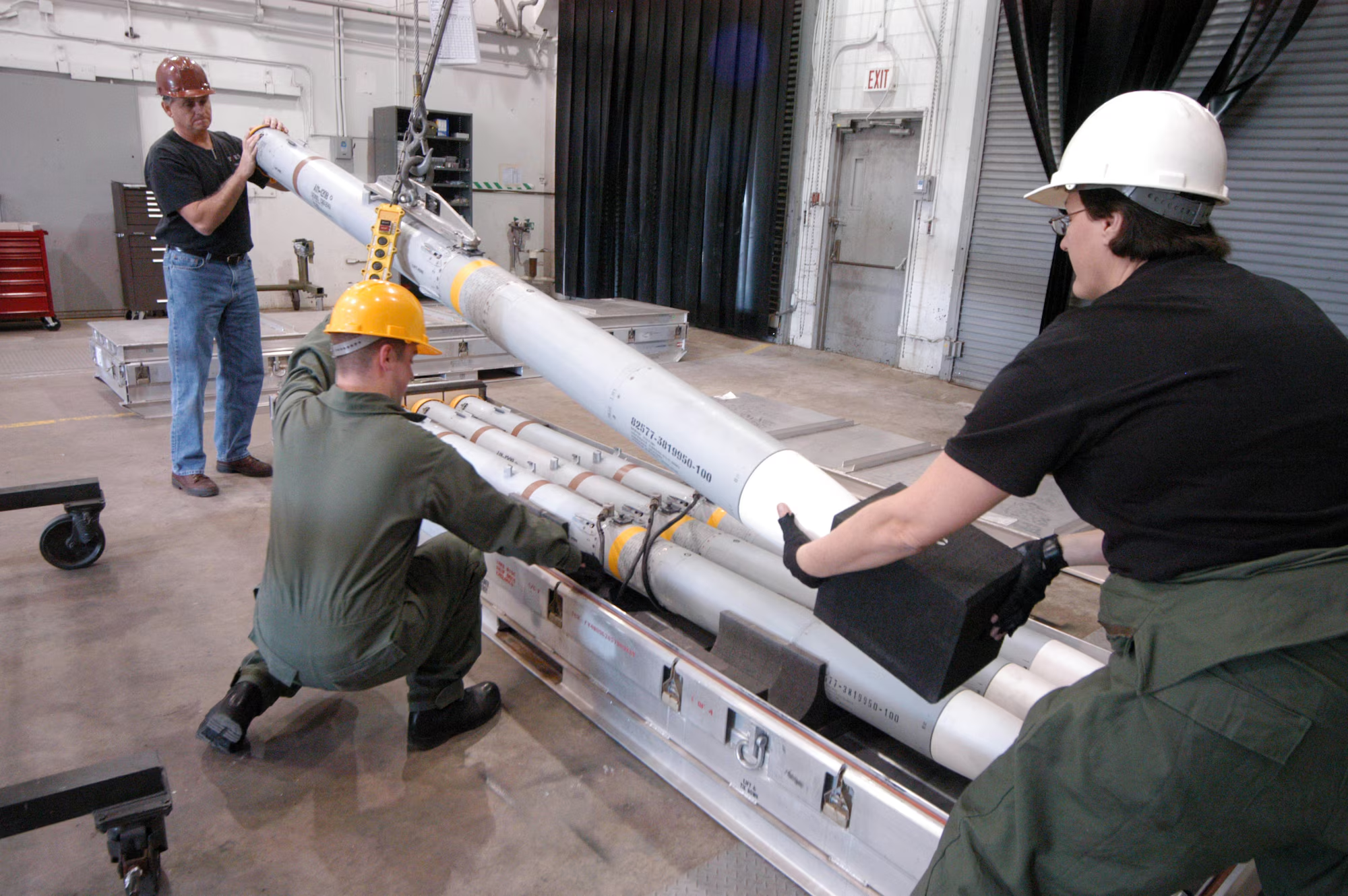
(DEFENCE SECURITY ASIA) — The United States and Japan have agreed to establish an AIM-120 AMRAAM final assembly facility in Japan, advancing an industrial partnership that could strengthen Indo-Pacific missile replenishment while exposing how heavily allied combat endurance depends on manufacturing capacity.
Japanese Defense Minister Shinjiro Koizumi and US Secretary of Defense Pete Hegseth reached the agreement in Cebu, Philippines, alongside a separate commitment to share technical information intended to accelerate SM-3 Block IIA interceptor production.
Together, the decisions connect beyond-visual-range air combat and ballistic missile defense to a common strategic requirement: producing sufficient weapons to sustain operations when competing demands, lengthy industrial lead times and trans-Pacific logistics constrain the availability of replacement rounds.
Koizumi described the AMRAAM arrangement as a “groundbreaking agreement,” linking equipment availability for both countries with a stronger Japanese defense industrial base and support for their F-35 fleets, although the proposed facility’s operational timetable remains undisclosed at present.
The agreement advances earlier feasibility discussions into a political commitment, but it does not establish that Japan can immediately assemble missiles, independently manufacture critical components or deliver additional weapons to operational squadrons within any publicly specified period of time.
For military planners, the potential significance lies in changing the regional logistics footprint, because assembly closer to Indo-Pacific forces could reduce some transportation requirements while introducing another industrial node into a supply chain still dependent on imported components.
For Tokyo, participation also carries strategic signalling value, presenting Japan as a contributor to sustained allied munitions availability rather than solely a purchaser, while leaving the scale of its eventual manufacturing responsibilities subject to implementation and technology safeguards.
The parallel SM-3 decision addresses a different mission, supporting Aegis ballistic missile defense through technical cooperation, but its operational value likewise depends on whether industrial expansion produces deliverable interceptors faster than competing requirements absorb the additional supply available.
Neither agreement discloses enough information to calculate a measurable improvement in wartime endurance, since facility output, missile allocation, stockpile depth and delivery schedules remain unspecified, preventing a reliable assessment of how quickly regional force posture might actually change.
The announcements fall under Operation Supercharge, Japan’s initiative to accelerate defense equipment and technology cooperation, and build on the Defense Industrial Cooperation, Acquisition, and Sustainment framework, which has examined missile coproduction, industrial constraints and wider supply-chain resilience issues.
DSA’s assessment is that the immediate development concerns industrial positioning and alliance commitment, while any subsequent shift in deterrence will depend on executable contracts, qualified production processes, reliable component flows and the actual delivery of operationally usable missile stocks.
That distinction matters across the First Island Chain, where the ability to maintain air-combat and missile-defense activity rests on both deployed platforms and replenishment capacity, making the announced industrial architecture strategically consequential even before additional missiles reach operational units.
(READ) U.S. Approves Record-Breaking $41.6 Billion AMRAAM Missile Deal Covering 30 Allied Nations
AMRAAM Assembly Reshapes Regional Missile Logistics
A final assembly and checkout facility integrates manufactured components into completed missiles, conducts testing and prepares weapons for delivery, creating a regional production function without necessarily transferring responsibility for rocket motors, guidance sections, warheads or every other critical subsystem.
That distinction defines the proposed AMRAAM facility’s strategic limits, because local assembly can diversify the final stages of production while leaving upstream dependencies intact, particularly if essential components continue arriving primarily from Raytheon’s existing manufacturing network in the United States.
A shorter route between final assembly and regional users could improve replenishment efficiency, but the actual benefit will depend on component routing, inspection requirements, storage arrangements and allocation rules, none of which have been publicly detailed for this facility.
From a force-posture perspective, the attraction is sustained availability for compatible aircraft, including the F-35 fleets highlighted by Koizumi, rather than an announced change to fighter numbers, forward basing arrangements or the weapons configurations carried on individual operational missions.
AMRAAM availability supports beyond-visual-range engagements, but assembling additional rounds does not by itself improve target detection, communications or tactical coordination, meaning industrial expansion strengthens one element of an air-combat system whose operational effectiveness depends on several interconnected capabilities.
The supplied program details do not identify which AIM-120 variants the Japanese facility will assemble, preventing a defensible comparison of its eventual output with particular missile configurations or a precise assessment of the combat capabilities those deliveries would support.
Similarly, the agreement does not establish whether completed weapons will prioritize Japanese requirements, US forces or other approved customers, leaving a central question unresolved about whose readiness would improve first when production begins and demand exceeds immediately available supply.
Distributed assembly could reduce dependence on a single final integration location, but the resilience gained would be smaller if both countries still rely on the same constrained component suppliers, transport routes or specialized equipment to complete their respective missile deliveries.
Establishing the facility therefore represents the beginning of an implementation challenge involving industrial qualification, secure technology handling and predictable procurement demand, rather than evidence that the alliance has already removed the production bottlenecks limiting its regional missile replenishment capacity.
The most meaningful future indicator will be accepted missiles entering inventories, because announced infrastructure only changes operational endurance once tested rounds become available for issue, training and deployment under arrangements that translate manufacturing activity into usable regional military capacity.
(READ) U.S. to Sell 1,200 AIM-120 (D-3/C-8) AMRAAM Missiles to Japan in $3.64 Billion Deal

Mitsubishi Electric’s Role and Technology Limits
Japan’s identified AMRAAM contribution centers on circuit card assemblies, establishing an electronics workshare that could support wider participation while keeping the distinction between component manufacturing, final integration and complete domestic missile production essential to understanding the agreement’s industrial significance.
Mitsubishi Electric emerged as the principal Japanese industry partner, with its April 28, 2026, announcement advancing discussions with Raytheon on coproduction and identifying circuit card manufacturing alongside an ambition to participate in final assembly and checkout activities in Japan.
The company’s experience developing and manufacturing air-to-air missiles for Japan provides relevant industrial context, but experience with domestic programs does not automatically establish that every AMRAAM manufacturing process, quality requirement or classified subsystem can transfer directly into Japanese production.
Earlier Japanese defense study contracts in 2024 and 2025 examined domestic AMRAAM production and the establishment of a manufacturing base, showing that October’s announcement follows preparatory industrial work rather than an entirely new initiative emerging from the Cebu meeting.
April’s DICAS 2.0 discussions identified circuit card assembly as Japan’s workshare and considered a local final assembly facility, creating a progression from feasibility assessment to ministerial commitment while leaving important production responsibilities and implementation milestones open to further negotiation.
Electronics participation can broaden the supplier base, yet its contribution to finished missile output depends on whether circuit card availability constrains production, because expanding one component’s supply cannot compensate for shortages affecting other indispensable parts of the same weapon.
Technology safeguards and intellectual-property arrangements remain consequential because AMRAAM cooperation involves sensitive military capabilities, making the scope of authorized information exchange an operational variable that can influence troubleshooting, production flexibility and the speed of resolving manufacturing problems across national boundaries.
The final assembly model consequently offers a bounded form of industrial integration, allowing greater Japanese participation without demonstrating complete manufacturing autonomy, a distinction that matters when assessing how independently the facility could operate during a disruption to external component deliveries.
Japan’s defense-equipment transfer policies also shape the commercial and strategic framework, but the supplied information does not disclose the facility’s eventual export permissions or contractual distribution terms, preventing assumptions that Japanese assembly will automatically support unrestricted international missile deliveries.
For the alliance, the central industrial test is whether agreed workshare creates additional dependable throughput, because technology cooperation delivers its strongest readiness benefit when new capacity complements existing production instead of merely redistributing assembly tasks between already constrained manufacturing organizations.
SM-3 Block IIA Expansion Targets Aegis Readiness
The SM-3 Block IIA agreement concerns sharing technical information to enable higher production, distinguishing it from the AMRAAM facility announcement and underscoring that the two initiatives pursue improved munitions availability through different industrial mechanisms rather than identical manufacturing arrangements.
Designed for Aegis ballistic missile defense, SM-3 Block IIA uses a kinetic interception approach against ballistic missiles during midcourse flight, placing it in a different operational category from AMRAAM and preventing either weapon from substituting directly for the other.
Its larger rocket motors and enhanced kinetic warhead distinguish it from earlier SM-3 variants, but the supplied information does not provide sufficient engagement data to define precise defended areas or calculate interception performance against particular regional missile trajectories and countermeasures.
The interceptor’s joint development by American and Japanese organizations provides an established cooperation framework, including Raytheon and Mitsubishi Heavy Industries, although existing technical participation does not eliminate the need for additional arrangements when governments seek substantially higher rates of production.
The program reached full-rate production in October 2024, an industrial milestone that supports expansion planning but does not imply unlimited capacity, since completed interceptor deliveries still depend on component supply, integration facilities, testing schedules and the funding sustaining contracted manufacturing.
A July 2024 award valued at approximately $1.9 billion to $2 billion covered complete SM-3 Block IIA rounds for American and Japanese requirements, with work extending toward February 2031, illustrating how missile procurement commitments can span lengthy industrial delivery periods.
A further $745.39 million award in summer 2026 supported additional American and Japanese requirements, with roughly $277.7 million in Japanese funding alongside approximately $275.6 million in US funding within the immediate obligation, demonstrating substantial shared financial participation in production.
A March 2026 bilateral commitment envisaged a fourfold increase in SM-3 Block IIA production in Japan, but the undisclosed baseline and implementation schedule prevent translating that multiplier into a reliable annual quantity or a specific improvement in deployed interceptor availability.
Technical information sharing can enable manufacturing improvements, yet October’s agreement does not itself establish a new delivery schedule, meaning the distinction between political production ambitions and contractually executable output remains central to assessing future Aegis missile-defense readiness across both fleets.
For Aegis-equipped forces, additional interceptors could support sustained defensive operations, but greater manufacturing capacity cannot alone determine interception outcomes, which also depend on engagement conditions, available sensors and the characteristics of incoming threats not quantified within the supplied program information.
Missile Production Shapes Indo-Pacific Force Posture
The AMRAAM and SM-3 initiatives address complementary readiness demands, supporting fighter operations and ballistic missile defense respectively, while demonstrating that an effective regional force posture requires a continuing supply of specialized weapons alongside aircraft, ships and their supporting infrastructure.
Regional assembly could place part of the replenishment process closer to Indo-Pacific users, but proximity provides only conditional resilience because dispersed manufacturing still requires functioning transport networks, secure facilities and predictable upstream deliveries throughout the period in which demand rises.
The existing American AMRAAM expansion targets annual output of at least 1,900 missiles, providing a broader industrial context for Japanese participation, although the supplied material does not establish how much additional capacity the proposed Japanese facility would contribute beyond that target.
A multiyear AMRAAM contract announced in September 2026 carries a potential value of up to $20.7 billion, but a contract ceiling does not establish spending already incurred, missiles already delivered or the distribution of future production among competing national requirements.
Japan’s January 2025 potential purchase of up to 1,200 AIM-120D-3 and AIM-120C-8 missiles, estimated at $3.64 billion, demonstrates substantial prospective demand, while approval of that package should remain distinct from confirmed deliveries or the eventual configuration of Japanese assembly.
The broader industrial effort responds to concerns about interceptor consumption and competing requirements across theaters, but the supplied information does not provide verified stockpile totals, making any claim that these agreements resolve a quantified regional missile shortage premature at present.
Japan’s evolving deterrence-by-denial approach places combat sustainability alongside long-range missiles, drones and industrial strength, creating a strategic rationale for coproduction while leaving the actual balance between acquisition, deployment and replenishment dependent on subsequent policy decisions and funded implementation measures.
Tokyo’s characterization of China, North Korea and Russia reflects Japan’s stated threat assessment, rather than an independently demonstrated intention behind every regional military development, and should be distinguished from DSA’s narrower assessment of the agreements’ effects on industrial resilience.
The strategic signal is nevertheless clear: Washington and Tokyo intend to connect Japanese industrial capacity more closely with alliance readiness, potentially complicating an adversary’s planning by demonstrating attention to replenishment rather than relying exclusively on the initial presence of advanced platforms.
That signal remains conditional because governments can announce cooperation faster than companies can qualify production, meaning its deterrent credibility will strengthen only as observable industrial milestones establish that additional capacity is funded, functioning and capable of sustaining required missile deliveries.
Missile Deliveries Will Determine Deterrence Impact
The decisive next developments will be disclosure of the AMRAAM facility’s location, construction schedule, operational start date and planned output, because those details would allow analysts to distinguish an emerging replenishment capability from a political commitment awaiting substantive industrial implementation.
Allocation arrangements will be equally important, since a facility supporting both countries could face competing priorities during simultaneous demand surges, making distribution rules a direct influence on which deployed forces receive replacement missiles and how quickly their inventories recover afterward.
For SM-3 Block IIA, meaningful progress would require evidence that technical cooperation translates into higher accepted output, because information exchange is an enabling measure whose operational consequences remain dependent on procurement, supplier capacity and the successful integration of completed interceptors.
A published production multiplier would become more informative when paired with a disclosed baseline, delivery period and customer allocation, allowing assessment of whether expansion materially increases available defensive capacity or primarily offsets existing obligations and previously accumulated demand for additional rounds.
The alliance must also reconcile industrial efficiency with resilience, since concentrating specialized tasks can reduce duplication while preserving shared vulnerabilities, whereas additional production nodes offer greater redundancy only when essential inputs and supporting logistics can remain available during significant external disruption.
Against missile saturation, expanded interceptor supply could improve endurance, but the supplied information does not establish engagement ratios or attack volumes, preventing any credible calculation of how many defensive actions the proposed production increases would support during an actual regional contingency.
Similarly, more AMRAAM rounds could strengthen sustained air operations without establishing air superiority, because missile inventories cannot independently resolve the operational challenges of detecting opponents, coordinating engagements and maintaining aircraft availability across an extended period of contested regional combat activity.
These limitations do not erase the agreements’ significance; they identify the mechanisms through which industrial cooperation must become military utility, ensuring that assessments of deterrence reflect the relationship between manufacturing, logistics and operational requirements rather than treating announced capacity as deployed capability.
DSA assesses that Japan’s proposed AMRAAM assembly role and expanded SM-3 cooperation could deepen alliance interdependence, with mutual reliance on industrial performance becoming more visible as both governments connect their strategic signalling to the sustained availability of precision weapons in theater.
The October 28 agreements therefore mark a consequential industrial commitment whose ultimate effect on Indo-Pacific deterrence will be measured through delivered missiles, dependable replenishment and sustained force readiness, with the unresolved implementation details defining the distance between announced ambition and operational impact.
