
Ankara Denies Airspace to Apache Helicopters Bound for India, Escalating Defence Tensions in Asia
Turkey’s denial of airspace to an AN-124 transporting India’s AH-64E Apache attack helicopters has ignited a high-stakes geopolitical confrontation, exposing fragile defence supply chains and escalating tensions across the Indo-Pacific and West Asia.

(DEFENCE SECURITY ASIA) — In a move that underscores the fragile and increasingly volatile state of international relations across the Indo-Pacific and West Asian theatres, Turkey has denied airspace clearance to a cargo aircraft transporting three AH-64E Apache attack helicopters destined for the Indian Army.
This unprecedented denial in early November 2025 has not only delayed the shipment of critical military assets but also illuminated the deepening rift between New Delhi and Ankara as both nations navigate competing alliances and rapidly shifting geopolitical rivalries.
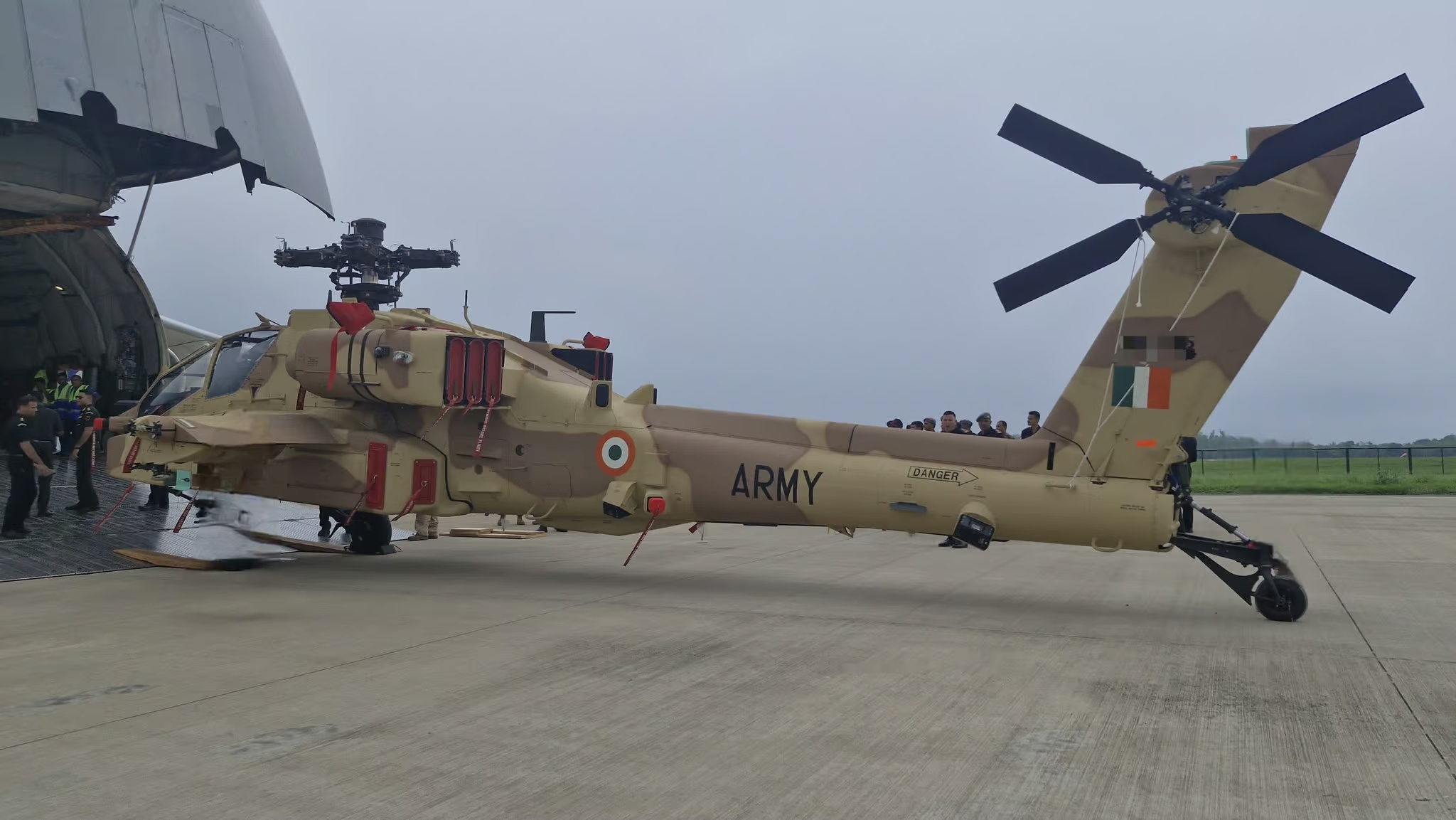
The incident has raised immediate questions about the reliability of global defence supply chains and the vulnerability of high-value military shipments to geopolitical coercion, especially as India seeks to strengthen its posture along volatile frontiers.
The Apache helicopters, built by Boeing in the United States, represent a major enhancement to India’s strike capabilities along contested borders, and their delay creates operational complications at a time when the regional security environment remains tense.
Turkey’s refusal to grant overflight permission forced the transport aircraft to abandon its route and return to its point of origin, thrusting India’s procurement timeline into uncertainty and prompting an urgent search for alternative delivery options.
This development spotlights the fragility of international logistics in high-stakes weapon transfers, especially when transit routes cross the territories of politically sensitive states with competing security agendas.
India’s Apache Procurement: A Multi-Billion-Dollar Game-Changer for High-Intensity Conflict
India’s acquisition of the AH-64E Apache Guardian is a core component of a long-term military modernization plan designed to bolster offensive airpower, particularly for high-altitude operations and contested border environments.
The AH-64E, often described as the “world’s most advanced multi-role combat helicopter,” carries a suite of advanced avionics, sensor fusion technologies, AGM-114 Hellfire missiles, Hydra-70 rockets, Stinger air-to-air missiles, and a 30-mm M230 chain gun, making it a lethal platform for anti-armor, close air support, deep strike, and reconnaissance missions.
India’s Apache journey began in September 2015 when New Delhi signed a government-to-government agreement with Washington to acquire 22 AH-64E helicopters for the Indian Air Force under a deal worth approximately USD 2.1 billion (RM 9.92 billion).
Deliveries commenced in 2019 and were completed by March 2020, enabling the Indian Air Force to deploy Apache units within the Western Air Command to reinforce deterrence along the Line of Actual Control (LAC) with China and the Line of Control (LoC) with Pakistan.
Strengthening the Apache fleet further, in February 2020 the Indian Ministry of Defence approved the procurement of an additional six AH-64E helicopters specifically for the Indian Army Aviation Corps under a deal valued at ₹4,168 crore, or approximately USD 556 million (RM 2.63 billion).
These six Army Apaches were intended to form India’s first dedicated attack helicopter squadron under the Army Aviation Corps, providing independent close air support for strike, mechanized, and armored formations under the Western Command.
The first batch of three Army Apaches arrived in July 2025 aboard an Antonov AN-124 aircraft that previously passed through Turkish airspace without any restrictions, highlighting the stark contrast with the November blockade.
The remaining three helicopters, which now form the focus of this controversy, were scheduled for delivery by late 2025 to complete the squadron based in Jodhpur, Rajasthan.
The procurement aligns indirectly with India’s “Make in India” programme even though the helicopters are fully imported, as New Delhi sees foreign high-end platforms like the Apache as technological benchmarks for future local development.
India-specific modifications to the AH-64E include enhancements for extreme high-altitude operations in the Himalayas where India faces ongoing tensions with China across the LAC and with Pakistan along the Siachen-Kargil axis.
Simulated exercises conducted by Indian forces demonstrate that Apache units dramatically improve India’s ability to destroy armored columns, conduct hunter-killer operations, suppress enemy air defences, and gather real-time tactical intelligence across a contested battlespace.
However, the delay caused by Turkey’s action risks disrupting pilot conversion timelines, weapons integration schedules, and coordination training with India’s indigenous Light Combat Helicopter (LCH) Prachand.

The Airspace Denial: A High-Stakes Logistical Disruption with Strategic Overtones
The airspace denial incident began on October 30, 2025, when the Antonov AN-124 Ruslan (serial UR-82008), one of the world’s largest heavy-lift cargo aircraft, departed Leipzig, Germany before flying to Mesa Gateway Airport in Arizona to load the three AH-64E Apaches destined for India.
The aircraft then took off on November 1 for East Midlands Airport in England for refueling, but the mission quickly ran into complications when Turkey refused to grant the required overflight clearance.
The aircraft was then stuck on the ground in the United Kingdom for eight days as operators sought diplomatic and logistical remedies to bypass Turkish airspace.
With no alternative corridor able to support the heavy-lift flight path and inability to reroute through long southern corridors due to fuel constraints and airspace restrictions, the mission was aborted.
The AN-124 returned to Mesa Gateway Airport on November 8, and upon arrival the helicopters were unloaded and transported via F-250 trucks into secure storage.
A statement described the disruption as arising from “logistical issues caused by external factors,” signalling clear diplomatic complications without naming Turkey directly.
With air transport blocked, India and Boeing began exploring sea transport options from U.S. ports to India, a move that could add several weeks or even months to the delivery timeline and significantly increase shipping and insurance costs due to the value of the military hardware.
Shipping three advanced combat helicopters by sea requires specialized roll-on/roll-off military-grade vessels and high-security maritime escort planning, especially across piracy-prone shipping lanes in the Arabian Sea.
This bottleneck highlights the vulnerability of India’s current dependence on foreign airlift capacity, especially heavy cargo aircraft like the AN-124, which are rare and increasingly trapped in geopolitical crosswinds.
Why Turkey Blocked the Apache Flight: Strategic Signalling in a Polarised Security Landscape
Turkey’s denial cannot be seen as a technical or administrative decision, but rather as a deliberate geopolitical signal amid rapidly deteriorating India-Turkey relations.
Ankara has positioned itself as a strong political supporter of Pakistan, especially on the sensitive Kashmir dispute, with repeated statements calling Kashmir a “threat to peace” and urging resolutions under United Nations mandates.
These statements have angered New Delhi, which views Kashmir as an internal matter and rejects foreign commentary categorically.
Tensions escalated sharply during Operation Sindoor in May 2025 when India launched retaliatory strikes in Pakistan following a major terrorist attack in Pahalgam, prompting condemnation from Turkey.
Turkey’s material support to Pakistan during the conflict, including the transfer of Bayraktar TB2 unmanned aerial vehicles and other battlefield systems, further deepened mistrust between Ankara and New Delhi.
India responded with domestic campaigns promoting a “Boycott Turkey” movement, which contributed to declining imports of Turkish goods and a visible freeze in bilateral diplomatic engagements.
By October 2025, Indian officials deliberately skipped Turkish National Day celebrations in New Delhi, signalling the extent of diplomatic estrangement between the two states.
Turkey, meanwhile, has strengthened defence and political ties with Pakistan and Bangladesh, forming an informal alignment that counters India’s traditional regional influence.
Ankara’s rivalry with Israel—one of India’s most important defence partners—adds a further layer of strategic antagonism.
Against this backdrop, blocking airspace for Apache deliveries serves as a low-cost but high-visibility diplomatic message.
Ankara is signalling that it will leverage its geography at the crossroads of Europe and Asia to impose costs on India, particularly for actions it views as enhancing India’s military edge over Pakistan.
The timing of the denial, especially since Turkey previously allowed the first Apache delivery earlier in 2025, indicates that the move was political rather than procedural.
The fact that Turkey remains a NATO member does complicate the scenario, but current frictions between Ankara and Washington over issues such as the S-400 missile system and Mediterranean disputes have limited U.S. leverage over Turkish decisions.
Implications for India’s Military Posture, Defence Logistics, and Strategic Autonomy
The blocked delivery creates immediate complications for the Indian Army, which expected full operational capability of the Apache squadron by late 2025 to reinforce strike formations along the western frontier.
Delays will disrupt pilot training cycles, weapons trials, and Apache-LCH interoperability development, weakening India’s preparedness in a region where border skirmishes with Pakistan and China remain frequent.
From a logistical perspective, the incident exposes India’s dependence on foreign airlift for transporting critical military equipment, revealing significant vulnerabilities in India’s global supply chains.
India may need to consider future reliance on indigenous heavy-lift options or deepen cooperation with friendly states capable of granting guaranteed overflight permissions for sensitive cargo.
The crisis also strengthens arguments for accelerated indigenisation of attack helicopter capabilities, including further scaling of the LCH Prachand, advanced variants under development, and investments in next-generation rotary-wing combat systems.
Broader strategic implications include reinforcing the need for India to diversify global supply chains and reduce exposure to the political whims of transit states.
The episode also serves as a cautionary example for other Indo-Pacific states that rely on complex transcontinental defence supply routes vulnerable to geopolitical disruptions.
A New Era of Strategic Disruption in Defence Supply Chains
Turkey’s denial of airspace to the Apache-carrying Antonov is far more than a logistical setback; it is a powerful indicator of how geopolitical rivalries, strategic alignments, and regional conflicts can directly interfere with modern defence procurement.
The incident illustrates that in an era of intensifying strategic competition across the Indo-Pacific and West Asia, the movement of military hardware is increasingly subject to political blockades, coercive diplomacy, and great-power signalling.
For India, the episode reinforces the importance of resilient supply chains, diversified logistics pathways, and long-term self-reliance in critical defence technologies.
As border tensions persist, naval competition intensifies, and regional alliances evolve, the Apache airspace blockade may serve as a pivotal moment that accelerates India’s drive toward strategic autonomy and a more robust defence ecosystem capable of withstanding geopolitical turbulence.
In this new era of contested airspace and polarized alignments, the uninterrupted flow of strategic assets is no longer guaranteed by contracts or diplomacy alone but depends on a state’s ability to anticipate, mitigate, and counter geopolitical headwinds. — DEFENCE SECURITY ASIA
